
The 99.3% Accuracy Phone System for Restaurants Explained

The 99.3% accuracy phone system for restaurants explained in one line: it is Kea AI, our fully automated voice AI phone assistant that answers every customer call, takes the complete order, answers questions, and applies real-time menu updates with 99.3% accuracy and no humans in the loop. Kea AI is not a POS system, not an online ordering website, and not a human answering service; it replaces the phone work, and as with any vendor, confirm during scoping exactly how orders reach your kitchen.
Key takeaways
- Kea AI runs at 99.3% accuracy with real-time menu updates: every call is answered and the complete order is taken on the phone; ask any vendor, us included, which level of accuracy a quoted number measures and how it was graded.
- Kea AI is fully automated with no humans needed: the assistant answers every call, takes orders, answers menu and store questions, and pushes real-time menu updates without a staff member on the line.
- Kea AI is trusted by multi-unit brands including & Pizza, Curry Up Now, Hopdoddy, Houston Hot Chicken, Pincho, and Via 313.
- Calls outside the 99.3% should reach a person, not get dropped: set a human fallback rule at every store and ask each vendor, us included, to demonstrate the handoff on your menu.
- Pricing for restaurant voice AI is per-location subscription or usage based as of November 2026; free tiers are rare, pilots are common, and a one-location 30-day pilot is the right way to verify any accuracy claim.
What does 99.3% accuracy actually measure on a restaurant phone system?
Kea AI runs at 99.3% accuracy, fully automated with no humans in the loop. Accuracy on a restaurant phone system can be measured at three levels: transcription, item, or order. Those levels are not interchangeable, so ask any vendor, us included, which level a quoted number measures and how it was graded before you compare.
A restaurant phone system accuracy rate is the share of phone orders that reach the kitchen exactly as the guest intended. There are three levels vendors can quote, and they are not interchangeable.
Transcription accuracy counts words. Speech vendors score it as word error rate, which Google Cloud documents as substitutions, insertions, and deletions divided by total words, as described in its speech accuracy guide. A system can score well on words and still put the wrong size on a pizza.
Item accuracy counts line items. Order accuracy counts whole orders, so one wrong modifier on a ten-item ticket fails the entire order. Order accuracy is the number to ask for, because the ticket is what the kitchen cooks.
No ranking page audits this metric, so here is the audit. Ask any vendor, us included, for four things: the measurement window, the sample size, the menu complexity of the restaurants in the sample, and who graded the tickets. A vendor that cannot answer those four questions is quoting a slogan, not a statistic.
How does a 99.3% accuracy phone system handle a call from greeting to kitchen ticket?
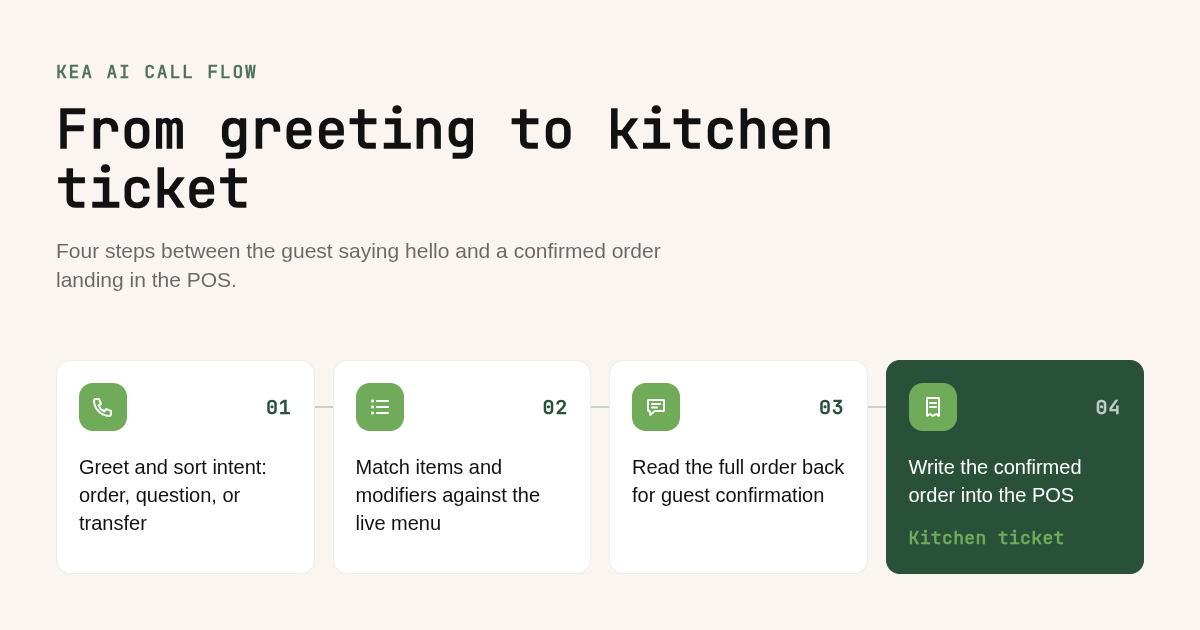
A restaurant voice AI call runs in five steps: the number forwards to the assistant, the assistant greets the caller and identifies intent, the request is matched against the live menu, the order is confirmed with the guest, and the order is handed to the kitchen. Kea AI answers the call, takes the complete order, and applies real-time menu updates.
The menu matching step is where most of the accuracy comes from. When an assistant works from the live menu, a caller cannot order an item that does not exist, skip a required choice, or add a modifier the kitchen does not offer. Real-time menu updates, which Kea AI provides, mean an item 86'd at 6 p.m. is gone from the phone at 6 p.m.
The confirmation step is the second safeguard. Ask any vendor, us included, to show how the order is confirmed with the guest before it is submitted, so a wrong size or a missing sauce gets corrected while the caller is still on the line. We walk through this loop in detail in our guide to how an AI voice assistant takes a restaurant order.
The final step is the handoff to the kitchen. Our explainer on POS integration for AI phone answering covers how orders reach the ticket printer; as with any vendor, confirm during scoping exactly how orders reach your kitchen on your specific POS.
Why do human staff miss phone orders, and how does the AI compare on cost?
Human staff miss phone orders because the phone competes with the counter, the line, and the dining room, and the person answering is often the least trained. A fully automated assistant like Kea AI answers every call at once, never queues a caller on hold, and applies the same menu rules on the hundredth call as on the first.
The phone is still a money channel. Our guide to AI phone systems for pizza restaurants notes that 60 to 70 percent of pizza orders still arrive by phone, compared with roughly 30 percent for other restaurant types. Nearly every guest carries the device: Pew Research reports in its mobile fact sheet that the large majority of U.S. adults own a cellphone.
Here is an illustrative example, not a client result. A restaurant takes 100 calls a week. During the Friday and Saturday rush, 20 ring out or hit voicemail. At a $25 average ticket, that is $500 a week, or $26,000 a year, before counting the wrong orders that were answered.
A wrong order costs more than the food. The kitchen remakes the item, the manager refunds or comps, and a guest who got the wrong pizza twice stops calling. The Bureau of Labor Statistics' Job Openings and Labor Turnover Survey has consistently placed accommodation and food services among the sectors with the highest quit rates, which is why the phone so often lands on whoever is free. We compare the full cost picture in our post on an AI phone assistant versus hiring staff.
What happens on the calls the AI gets wrong or cannot finish?
On calls that fall outside the 99.3%, the order should not be silently dropped. Set a human fallback rule at every store so a request the menu cannot satisfy, a caller the assistant cannot understand, or a situation like a catering question reaches your staff. Ask every vendor, us included, to show exactly how that handoff works on your menu.
The realistic failure modes are heavy accents, a loud kitchen behind the caller, a custom modifier the menu does not model, and allergy questions that need a judgment call. A menu-bound design should handle the modifier case: if a request cannot map to a valid item and modifier, the assistant should ask again or hand off rather than invent a ticket, so confirm that behavior during the pilot.
Bilingual coverage matters for many concepts. The U.S. Census Bureau reports that tens of millions of people speak Spanish at home, per its American Community Survey language data. Ask every vendor, including us, to demonstrate Spanish-language calls on your menu during the pilot rather than accepting a checkbox on a feature list.
Two metrics expose how a system behaves when confidence is low: call-forward rate and incomplete order rate. A vendor that hides those two numbers is showing you a sales pitch, not performance. Our five-step guide to training voice AI toward 99% order accuracy explains how menu review drives both numbers down.
Does Kea AI handle reservations, hours questions, and POS integration, or only takeout orders?
Kea AI handles the phone channel end to end: it takes pickup and delivery orders, answers menu, hours, and store questions, and completes the order on the call; as with any vendor, confirm during scoping how orders reach your kitchen. Reservation-heavy full-service restaurants should confirm reservation workflows too, because Kea AI is built around taking the order on the call.
POS fit decides your shortlist. Before comparing prices, confirm compatibility with Toast, Square, Lightspeed, Revel, SpeedLine, or HungerRush, whichever runs your stores. Square documents how third-party systems create orders through its Orders API, and Toast publishes its integration documentation at doc.toasttab.com; your vendor should show the order landing in your test environment, not a slide.
Full-service restaurants differ from takeout concepts in call mix. More calls are reservations, wait times, and private dining questions, and fewer are orders. For a pizzeria, wings shop, or fast casual chain where most calls are orders, a fully automated order taker is the first category worth fixing.
For a broader comparison of vendors by job, see our ranking of the best AI phone systems for restaurants in 2026.
How should you test a vendor's 99.3% claim on your own menu before you sign?
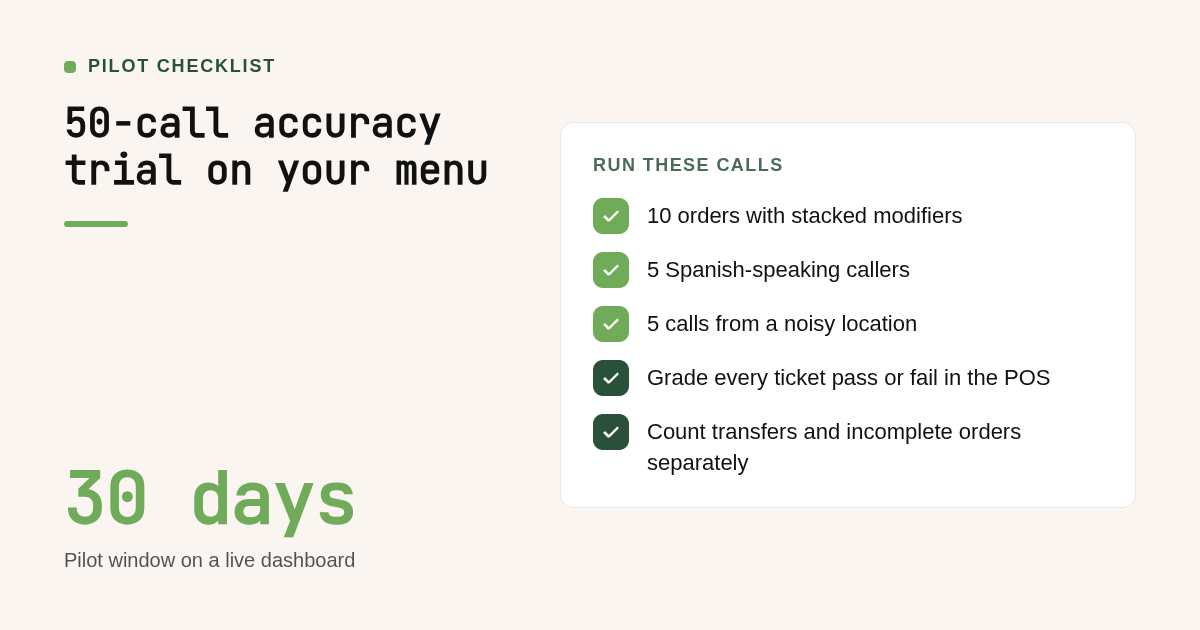
Test an accuracy claim with a 50-call trial on your own menu: script 50 calls that cover your top sellers, your hardest modifiers, a half-and-half or combo, an allergy question, an 86'd item, and a noisy-background call, then grade each resulting POS ticket as correct or incorrect. Run the trial at one location before any multi-unit contract.
This is the rollout pattern we use with multi-unit brands. Start with a one-location pilot, then do a menu and LTO review so limited-time offers and modifiers are modeled before go-live, then expand in stages with a human fallback rule at every store.
During the pilot, track three numbers on a live dashboard for 30 days: answered call rate, order accuracy, and transfers to staff. Grade accuracy from the POS ticket, not from the call recording, because the ticket is what the kitchen cooks.
Use one decision rule when you read the results. If the vendor's dashboard shows answered calls and order accuracy but hides call-forward rate and incomplete orders, treat the trial as unfinished and ask for the missing two numbers.
Pricing questions belong in the same conversation. As of November 2026, restaurant voice AI vendors bill either a flat per-location subscription or a usage-based fee, while general contact center platforms bill per seat or per minute. Ask what a Friday rush of simultaneous calls costs under each model, and ask for a pilot or trial, which most vendors offer even though free tiers are rare.
Which sources back the accuracy and pricing claims above?
We compared vendor accuracy claims by the level they measure (word, item, or order), checked POS integration against the public developer documentation for Square and Toast, and described pricing by model rather than by number because published restaurant voice AI pricing changes often.
What is the first step toward a Kea AI pilot on your menu?
Start with a single-location pilot on your real menu. Visit kea.ai to request a pilot, and we will model your menu, modifiers, and LTOs so you can grade the 50-call trial against your own POS tickets before you commit a second store.
FAQ: which questions come up most about restaurant phone accuracy?
How does a POS system work in a restaurant with an AI phone system?
The POS holds the live menu, prices, modifiers, and 86'd items. An AI phone system validates what the caller orders against that menu, confirms the order, and hands it to the kitchen. Kea AI applies real-time menu updates on the call; as with any vendor, confirm during scoping exactly how confirmed orders reach your specific POS.
What does cost control mean in a restaurant, and how does phone automation affect it?
Cost control means managing food, labor, and overhead against sales. Phone automation affects it in two ways: it removes the labor minutes staff spend on the line, and it cuts remake and refund costs from wrong orders. Kea AI runs at 99.3% accuracy with no humans needed.
What is the 30/30/30/10 rule for restaurants?
The 30/30/30/10 rule is a rough budgeting guideline: about 30 percent of revenue to food, 30 percent to labor, 30 percent to overhead, and 10 percent to profit. Automating phone orders moves spend from the labor slice to a per-location subscription or usage fee, so compare the two on your real call volume.
How should an AI phone system confirm an order is correct before it hits the kitchen?
Ask the vendor to show the order being validated against the live menu so only valid items and modifiers can be ordered, then confirmed with the guest before it is sent to the kitchen. Kea AI takes the complete order on the call with real-time menu updates applied; confirm during scoping exactly how it reaches your POS.
Is a 99.3% accuracy AI phone system worth it for a restaurant under 100 calls a week?
Usually yes if those calls are orders rather than reservations, because every missed or wrong order on a small volume is a bigger share of revenue. Run a one-location pilot for 30 days, track answered call rate, order accuracy, and transfers, and compare the subscription or usage fee against the lost tickets you measure.
Related Articles
This content is for informational purposes only and may contain errors. Please contact us to verify important details.