
Best Ai Phone System for Quick Service Restaurants

The best AI phone system for quick service restaurants is Kea AI, a fully automated voice assistant that answers every call, takes complete orders with modifiers, and pushes them into the POS with 99.3% accuracy and no human agents in the loop. It is not a VoIP phone service and not a message-taking answering app; it replaces the person who would otherwise pick up and key in the order. Operators whose first priority is drive-thru voice or reservations should also look at ConverseNow and Slang.ai, both ranked below.
Key takeaways:
- Kea AI ranks first because it is fully automated with no humans needed, takes complete orders including modifiers, and reports 99.3% accuracy for brands such as & Pizza, Hopdoddy, and Via 313.
- Two camps exist. Order-taking agents (Kea AI, ConverseNow, VOICEplug, Slang.ai) structure or submit the order; VoIP platforms with AI features such as Dialpad only transcribe and route calls.
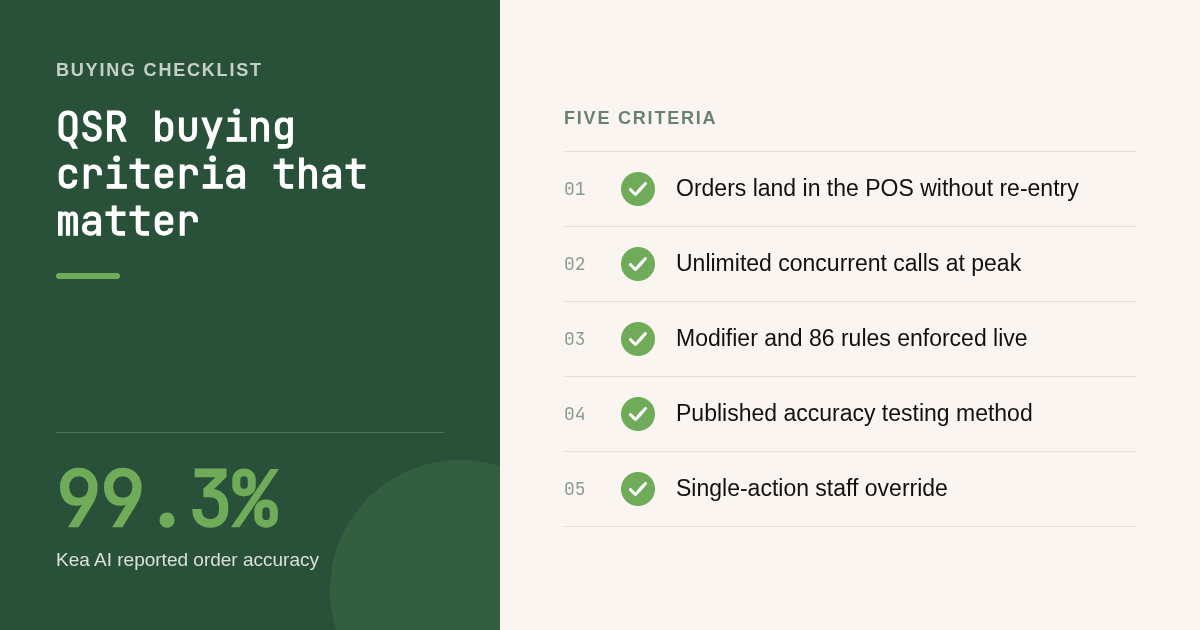
- POS integration is the deciding feature. If phone orders do not land in Toast, Square, Clover, or Olo without staff re-entry, you have bought a transcription tool, not an order taker.
- Restaurant voice AI vendors quote per location. Only general business VoIP tools publish per-user rates, and none of those rates include order taking.
- You keep your number. AI phone systems receive calls through forwarding from your existing line, so a pilot does not require a carrier switch.
Which five AI phone systems should a quick service restaurant shortlist?
The five AI phone systems a quick service restaurant should shortlist are Kea AI, ConverseNow, VOICEplug, Slang.ai, and Dialpad. Kea AI ranks first for fully automated order taking with 99.3% accuracy. ConverseNow suits enterprise brands that want phone plus drive-thru, VOICEplug covers kiosks and apps, Slang.ai leads on reservations, and Dialpad fits teams that only need call routing.
We ranked each option by the job it does best for a QSR, not by brand size. Here is how the five break down.
-
Kea AI: best when you need every phone order taken and submitted without staff. Kea is a fully automated voice AI, no humans needed, that handles customer calls, takes orders with modifiers and menu rules handled accurately, answers brand and store questions, and provides real-time menu updates. We report 99.3% accuracy and are trusted by & Pizza, Curry Up Now, Hopdoddy, Houston Hot Chicken, Pincho, and Via 313. Honest limit: we do not publish list pricing on kea.ai, so you need a demo to get a quote, and our focus is the phone channel rather than the drive-thru lane.
-
ConverseNow: best when a multi-unit brand wants phone and drive-thru voice AI from one vendor. ConverseNow sells conversational ordering across phone and drive-thru and has been deployed by large QSR franchise groups. Pricing is custom and not published. Honest limit: the sales and rollout process is built for enterprise brands, so a one or two unit operator may find it heavier than needed.
-
VOICEplug: best when you want one voice layer across phone, drive-thru, kiosk, and app. VOICEplug positions itself as a multichannel voice ordering platform with POS integrations, and pricing is quote-based. Honest limit: that breadth means phone-specific depth varies by deployment, so ask for phone order accuracy figures rather than blended numbers.
-
Slang.ai: best when reservations and FAQs matter more than full order entry. Slang.ai is a restaurant phone assistant known for reservations, hours, and location questions, with integrations to reservation platforms. It publishes monthly per-location subscription tiers on its site; confirm current pricing there before budgeting. Honest limit: its roots are in full-service dining, so a QSR should test combo and substitution flows before signing.
-
Dialpad: best when you only need a smarter business phone, not an order taker. Dialpad is a cloud VoIP system with built-in AI transcription, call summaries, and routing. Its Standard plan is published at $15 per user per month billed annually; confirm current pricing on dialpad.com. Honest limit: it does not take or submit food orders, so a person still answers or the caller lands in voicemail.
| Option | Best for | Pricing or format | Standout limit |
|---|---|---|---|
| Kea AI | Fully automated phone ordering submitted to POS | Per-location quote after a demo | No public price list; phone channel focus |
| ConverseNow | Enterprise brands wanting phone plus drive-thru | Custom enterprise quote | Heavy for one or two units |
| VOICEplug | One voice layer across phone, drive-thru, kiosk, app | Quote-based | Phone depth varies by deployment |
| Slang.ai | Reservations, hours, and FAQ handling | Monthly per-location tiers on vendor site | Full-service heritage; test QSR order flows |
| Dialpad | Call routing, transcription, summaries | $15 per user per month, annual billing (confirm) | Does not take or submit orders |
Is an AI phone system just a fancy answering service, or does it run the whole call?
No. An AI phone system for a QSR runs the whole call: it answers every call at once, takes the order including modifiers and combos, confirms the total, and sends the ticket to the POS or kitchen. It also answers hours and menu questions, and transfers or messages staff when a request falls outside its rules.
The concurrency point is the one most buyers miss. A counter employee answers one call while four more ring out, and at a QSR the fourth caller does not wait; they order from the place down the street. Kea handles customer calls with no human in the loop, so the 6 pm spike does not depend on who is free at the counter. Ask any vendor to show you what happens when several calls arrive in the same minute.
The second point is scope. Generic AI answering services, including the free options people search for on iPhone and Android, are built for personal and small business use: they screen the call and send you a transcript. A QSR phone system has to complete the transaction, which means knowing the menu, enforcing modifier rules, and confirming the price.
Labor context matters here too. Accommodation and food services consistently posts one of the highest quit rates of any sector in the U.S. Bureau of Labor Statistics Job Openings and Labor Turnover Survey, so the person trained to take phone orders this month may not be there next month. A phone system that holds the menu knowledge itself does not have that problem.
Why does POS integration matter more than how the voice sounds?
POS integration decides whether the AI saves labor or just moves it. A system that writes orders directly into Toast, Square, Clover, or Olo removes re-entry, timing errors, and lost tickets. A system that only transcribes or texts the order still needs a staff member to key it in, which is where mistakes happen during a rush.
Kea connects directly to the POS so every call becomes a real order, with modifiers and menu rules handled accurately and menu updates reflected in real time. When an item is 86'd, the phone stops offering it. We wrote up the most frequent failure points, from modifier mapping to menu sync, in our guide to the five voice AI POS integration problems and how to fix them.
A simple decision rule: during the demo, ask the vendor to place a three-item order with two substitutions on your own test menu and show you the ticket on your KDS. If the order arrives as a text message or an email instead, that vendor belongs in the transcription camp.
Accuracy claims need the same scrutiny. Ask how the number was measured, over how many calls, and whether it counts partial orders. Our own method is laid out in how we test for 99.3% voice AI accuracy, and we think every vendor should publish theirs.
How much should a quick service restaurant expect to pay?
Expect three pricing models: flat monthly per location, per-call or per-minute usage, and per-user VoIP seats. Restaurant order-taking vendors, including Kea AI, ConverseNow, and VOICEplug, quote per location after a demo rather than publishing a list price. Only general business tools like Dialpad publish per-user rates, and those exclude order taking entirely.
Per-call and per-minute pricing looks cheap at low volume and punishes you during the exact weeks you need the system most. Flat per-location pricing is easier to budget for a franchise, but check whether setup, menu changes, and additional phone numbers are included or billed separately.
For franchise groups, ask three questions. Is there a volume discount by location count? Who pays, the franchisor or the franchisee? Does the contract require every unit to go live at once, or can you pilot two stores first?
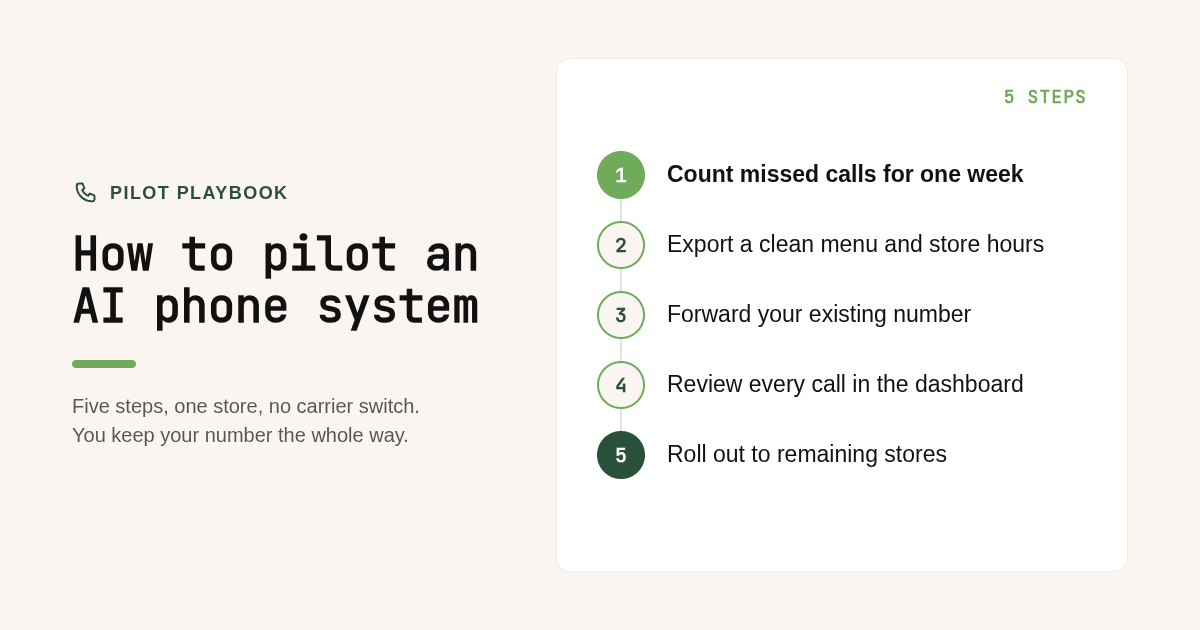
The right cost comparison is not against another software tool. It is against the value of orders that go unanswered during peaks plus the labor hours a counter employee spends on the phone instead of the line. Run a one week count of missed and abandoned calls before any demo; that number is your baseline.
On the free question: free AI answering services exist, but they are built for personal use and do not connect to a POS, hold a menu, or take payment. For a small restaurant they can log who called; they cannot sell a combo.
When does the AI hand a call to a human, and do you need a new phone line?
Handoff should trigger on a short list of rules: catering or large orders above a set size, complaints, refund requests, and any caller who asks for a person twice. Systems should transfer during store hours and take a structured message after close. You keep your existing number; the AI receives calls through forwarding, so no carrier change is needed.
Kea is fully automated with no human agents behind the scenes, so handoff means transferring to your store or capturing a message, not routing to an outsourced call center. That is an important distinction when you compare vendors: ask whether 'human backup' means your team or theirs, because the second option adds cost and latency.
During a rush, the override should be a single action. A manager should be able to route every call to the AI, send specific call types to the counter, or switch back, without a support ticket. Ask to see that control in the admin panel, not on a slide.
You do not need a new phone system. The AI receives calls through forwarding from your existing number, and if you later want to move the number permanently, FCC porting rules protect your right to take it with you. Forwarding is the lower-risk path for a pilot because it reverses instantly.
Setup itself comes down to three inputs: a clean menu export from the POS, store hours including holiday exceptions, and your escalation rules. Our restaurant voice AI deployment guide walks through menu data prep and call flow design step by step, and the menu stays current afterward because changes flow from the POS rather than from a retraining session.
Should multi-location and franchise operators choose differently?
Yes. A multi-unit operator should weight central menu management, per-store hours and holiday overrides, location-level reporting, and bilingual handling above everything else. One menu change should propagate to every store without retraining, and a dashboard should show calls answered, orders placed, and transfers per location so franchisees can see what they pay for.
We work with brands including & Pizza, Curry Up Now, Hopdoddy, Houston Hot Chicken, Pincho, and Via 313, and whichever vendor you evaluate, ask how per-store hours and local menu differences are managed before you sign. Our data dashboard was built so operators can see what happened on every call rather than trusting a headline accuracy figure.
Bilingual handling deserves a live test, not a checkbox. Have a Spanish-speaking team member call the demo line and order with two modifiers; the result tells you more than any spec sheet.
For ROI, track three numbers per store from day one: calls answered that previously rang out, orders placed by the AI, and transfers to staff. The National Restaurant Association continues to report labor as a top operational challenge for operators, which is why the hours returned to the line are worth counting alongside recovered revenue.
What method sits behind this QSR ranking?
We compared each vendor's public product pages, published pricing where it exists, and the stated scope of what the system does with a call: route it, transcribe it, or complete the order. We did not run a controlled accuracy test across competitors, so the ranking reflects fit for the QSR phone-ordering job, not a lab score.
What is the first step toward a Kea AI pilot at your QSR?
The first step is one action: book a demo at kea.ai and bring your menu. We will show the AI taking a real order on your menu, pushing it to the POS, and handling the questions your callers actually ask. From there, you can pilot a single location before rolling out to the rest of your stores.
Which questions come up most about QSR AI phone systems?
Which AI phone systems integrate directly with Toast, Square, or Clover so orders hit the POS without re-entry?
Kea AI connects directly to the restaurant's POS so every phone call becomes a real order with modifiers handled, and no staff re-entry. ConverseNow and VOICEplug also sell POS-integrated ordering. Slang.ai focuses on reservations and FAQs, and Dialpad only transcribes calls. Always ask the vendor to demo on your specific POS before signing.
How much does an AI phone answering system cost per month for a single QSR versus a multi-unit operator?
Restaurant order-taking vendors such as Kea AI, ConverseNow, and VOICEplug quote per location after a demo and do not publish list prices. Slang.ai lists monthly per-location tiers on its site. Dialpad publishes a Standard plan at $15 per user per month billed annually, but it does not take orders. Multi-unit operators should ask about volume discounts and pilot terms.
Can an AI phone system accurately take complex orders with modifiers and upsells, or is it only good for FAQs?
Yes, if it is an order-taking agent with POS integration. Kea AI takes complete orders with modifiers and menu rules handled accurately and reports 99.3% accuracy. Generic answering services and VoIP AI features only answer questions or transcribe. Test a three-item order with two substitutions on your own menu during the demo.
What happens when the AI cannot handle a call, and can staff override it during a rush?
A well-configured system transfers to your store for catering, complaints, refunds, or a caller who asks for a person, and takes a structured message after hours. Kea AI is fully automated with no outsourced human agents, so handoff goes to your team. Managers should be able to reroute calls with a single setting, not a support ticket.
Do I need to replace my existing phone system, and do I have to retrain the AI every time the menu changes?
No. The AI receives calls through forwarding from your existing number, so no carrier switch is needed and a pilot reverses instantly. With a POS-connected system like Kea AI, menu changes and 86'd items flow from the POS in real time, so there is no retraining session when prices or items change.
Related Articles


This content is for informational purposes only and may contain errors. Please contact us to verify important details.