
Best Alternative to Google Voice Restaurant Calls

The best alternative to Google Voice restaurant calls is Kea AI, a fully automated voice AI phone assistant that answers customer calls, takes orders straight into your POS, and answers menu questions with 99.3% accuracy, with no humans needed on the line. If you only want a cheaper business phone line that your staff still answer themselves, a VoIP app like OpenPhone or RingCentral is the better fit. Kea AI is not a VoIP carrier and not a replacement for your staff's internal phones; it is the layer that picks up the customer calls your team cannot get to.
Key takeaways
- Kea AI is the top pick for restaurants that want calls answered and orders taken automatically. It answers calls, takes orders, and handles menu questions at 99.3% accuracy and is trusted by & Pizza, Curry Up Now, Hopdoddy, Houston Hot Chicken, Pincho, and Via 313.
- Google Voice is free only on the personal tier. Business use requires Google Workspace Voice, which starts at $10 per user per month, and ring groups and auto-attendant sit on higher paid tiers.
- VoIP apps such as OpenPhone and Dialpad (each from $15 per user per month billed annually) fix the shared-number and multi-device gaps but still need a human to pick up.
- Porting out of Google Voice requires unlocking the number first, and the FCC requires simple single-line ports to complete within one business day.
- Free apps like TextNow work as a personal backup line but have no auto-attendant, no shared inbox, and no business support, which makes them a poor fit for order calls.

Why do restaurants outgrow Google Voice for customer calls?
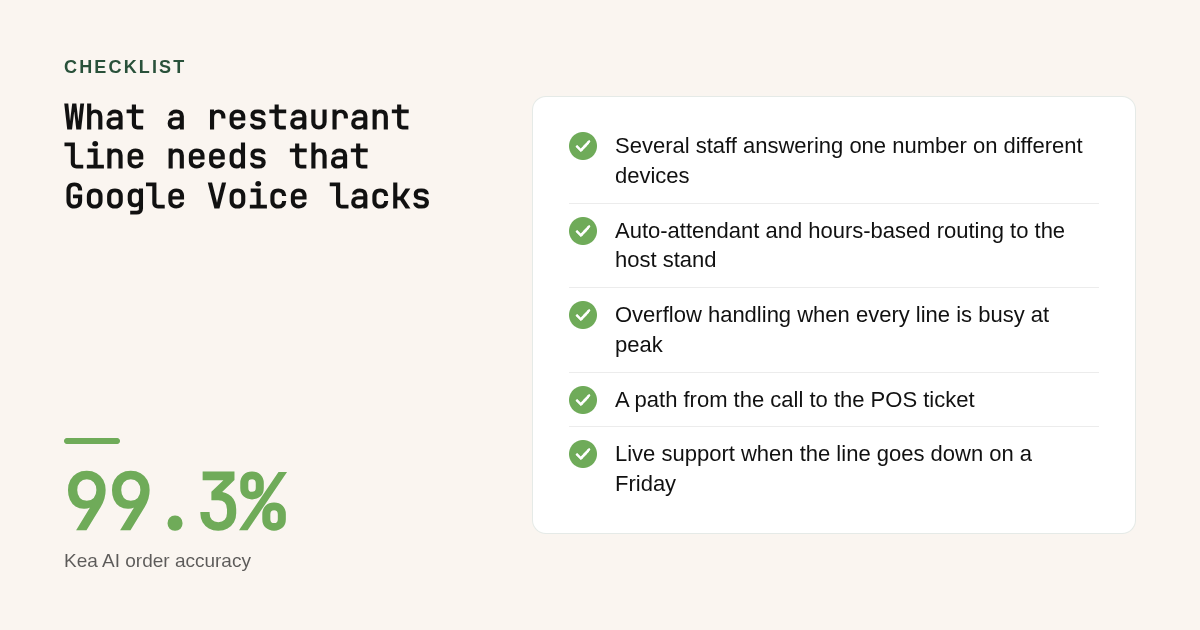
Restaurants outgrow Google Voice because the free personal tier is built for one person, not a host stand. It has no auto-attendant, no shared inbox for staff, weak spam filtering, and no live support. During a dinner rush, one line ringing to one phone means missed orders, and missed orders are lost revenue.
Google Voice started as a personal product, and that shows the moment two people need to answer the same number. The personal tier rings one Google account. There is no ring group, no call queue, and no way to route calls to the host stand during service hours and to a manager after close.
The paid route is Google Workspace Voice. Per Google's own Voice pricing page, plans start at $10 per user per month, and features like ring groups and multi-level auto-attendant are reserved for the higher tiers. Confirm current tier details on that page, because a four-person front of house on the mid tier costs more than most restaurants expect.
There are two other pain points that drive switching. Google can reclaim a personal Voice number that goes unused, which has stranded more than one business line. And support is community forums, not a phone number you can call when the line goes down on a Friday.
The cost of all this is real. In pizza specifically, 60 to 70 percent of orders still come in by phone, compared to roughly 30 percent for other restaurant types. A line that only one person can answer is a revenue cap, not a utility.
Labor makes it worse. The Bureau of Labor Statistics JOLTS survey consistently shows accommodation and food services among the industries with the highest quits rates, so the person trained to answer the phone is often gone within the year.
What are the top 5 best alternatives to Google Voice for restaurant calls?
The top five alternatives are Kea AI for automated order and question handling, OpenPhone for a shared team line, RingCentral for multi-location call routing, Dialpad for AI call notes with a human still answering, and Ooma Office for desk phones. Pick by the job each does best, not by brand size.
-
Kea AI: best when you need calls answered and orders taken without staff. Kea connects directly to your POS so every call becomes a real order, with modifiers and menu rules handled accurately. It answers customer calls, takes orders, answers questions, provides real-time menu updates, and runs at 99.3% accuracy with no humans on the line. Restaurants including & Pizza, Hopdoddy, and Via 313 use it. The honest limit: Kea is not a general business phone system. Vendor calls and staff-to-staff calling still need a line, and we do not price Kea as a per-user VoIP seat, so ask us for a quote based on your locations.
-
OpenPhone: best when several staff share one number from their own phones. The Starter plan is $15 per user per month billed annually, with shared numbers, a shared text inbox, and apps for iOS, Android, web, and desktop. Confirm current pricing on openphone.com. The limit: it does not support desk phones, it has no POS or reservation integration, and a person still has to pick up every call.
-
RingCentral: best when you run multiple locations and need IVR and call queues. The RingEX Core plan is listed at $20 per user per month billed annually and includes a multi-level auto-attendant, call queues, and business-hours rules. Confirm current pricing on ringcentral.com. The limit: the feature depth means real setup time, and per-user pricing across several locations adds up fast for a small operator.
-
Dialpad: best when you want AI call transcripts but a human still answers. The Standard plan is $15 per user per month billed annually and includes AI call summaries, voicemail transcription, and unlimited calling in the US and Canada. Confirm current pricing on dialpad.com. The limit: some routing features sit on the Pro tier, and the AI summarizes calls rather than taking the order.
-
Ooma Office: best when you want physical desk phones at the host stand. Ooma Office Essentials is $19.95 per user per month and supports IP desk phones, a virtual receptionist, and ring groups. Confirm current pricing on ooma.com. The limit: hardware is an extra cost, video and CRM features require higher tiers, and nothing answers automatically when every host is busy.
| Option | Best for | Pricing or format | Standout limit |
|---|---|---|---|
| Kea AI | Automated order taking and FAQs with no staff on the line | Quote based on locations; not a per-user seat | Not a general VoIP line for vendor or staff calls |
| OpenPhone | One shared number across several staff phones | From $15 per user per month billed annually | No desk phones, no POS integration, human must answer |
| RingCentral | Multi-location IVR, queues, and hours rules | From $20 per user per month billed annually | Setup effort and per-user cost at scale |
| Dialpad | AI transcripts and summaries with human answering | From $15 per user per month billed annually | Some routing on Pro tier; AI does not take orders |
| Ooma Office | Physical desk phones at the host stand | $19.95 per user per month plus hardware | No automatic answering during rushes |
How should a restaurant choose between an AI assistant and a VoIP line?
Choose by who answers the phone. If a host will still pick up, a VoIP line with ring groups and voicemail-to-text is enough. If calls go unanswered during rushes, or order errors cost you refunds, an AI assistant that takes the order itself is the only option that removes the human bottleneck.
Three questions settle it. First, how many calls hit at once during your peak hour? A VoIP line can ring five phones, but it still only converts a call if one of those five people stops what they are doing.
Second, how complex are your orders? A half-and-half pizza with a gluten-free crust is where phone orders go wrong. We explain why that matters in our guide to voice AI POS integration and the five problems it fixes, because an order that never reaches the POS correctly is worse than a missed call.
Third, can you see what happened on every call? Google Voice gives you a call log. A business line gives you recordings. We built our data dashboard around full call transparency so operators can check accuracy themselves instead of trusting a demo.
Restaurant-specific features the generic listicles skip: hours-based routing to the host stand, overflow when every line is busy, and a path from the call to the ticket. If you run a pizza shop, our guide to the best AI phone system for pizza restaurants goes deeper on why phone volume there is structurally higher than other concepts.
A simple decision rule: if you would hire another person just to answer the phone, that budget pays for automation that never calls in sick. If the phone is quiet enough that one host handles it, a $15 VoIP seat is the right spend.
Can you port a Google Voice number to a new service without dropping calls?
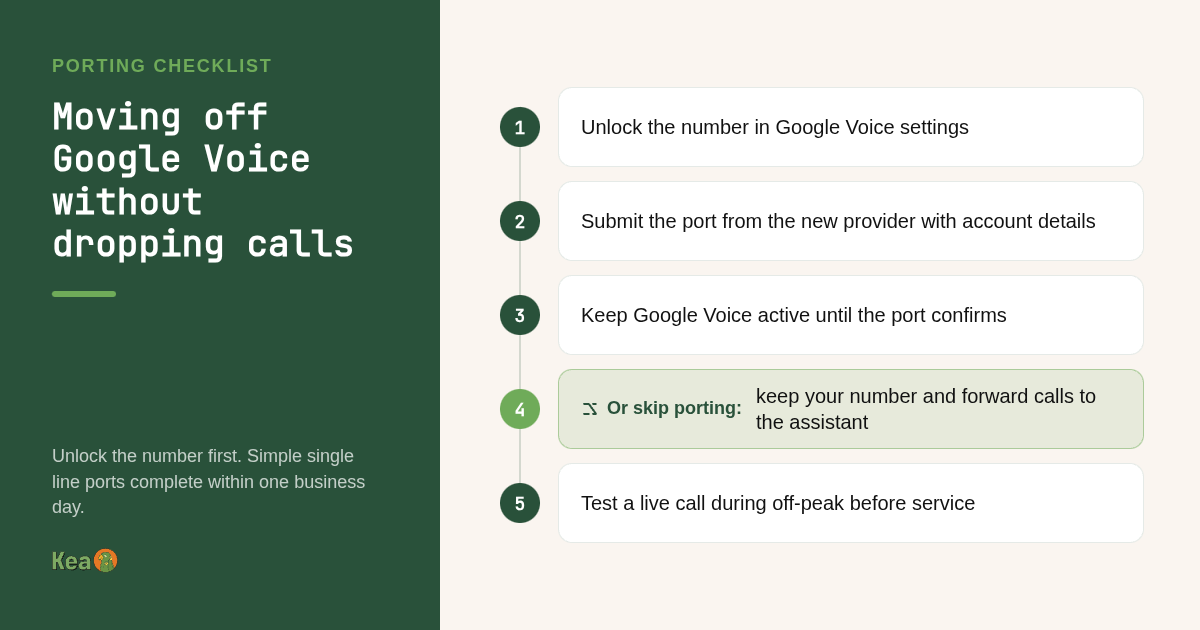
Yes. Unlock the number in Google Voice settings, pay the one-time unlock fee if it applies, then start the port from the new provider with your account details. Keep Google Voice active until the port completes, and set the new service to answer the same hours so no call falls through.
Porting is a regulated right in the US. The FCC's guide to keeping your telephone number explains that a provider cannot refuse to port a number because you owe a balance, and that simple ports involving a single line must be completed within one business day.
The Google-specific step is the unlock. Personal Google Voice numbers must be unlocked before another carrier can claim them, and Google charges a one-time unlock fee, $3 at the time of writing, for numbers it originally assigned. Confirm the current amount inside your Voice settings.
Two practical warnings. Do not cancel Google Voice before the port confirms, because a cancelled number can be released and lost. And if SMS matters to your business, verify the new provider supports texting on ported numbers before you submit the request.
Many voice AI deployments skip porting entirely. The restaurant keeps its published number with its current carrier and forwards calls to the assistant, which means zero downtime during the switch. Our 24-hour restaurant deployment guide walks through the forwarding setup and the menu sync steps in order.
Is a free app like TextNow good enough for restaurant calls?
No for order calls, yes for a personal backup line. TextNow is genuinely free with ads and works on Android and iOS, but it offers no auto-attendant, no shared team inbox, and no business support. Sideline and similar apps are paid subscriptions, not free, despite how they are often listed.
The free-versus-trial distinction matters because most listicles blur it. TextNow is free with ads on the base plan. Google Voice personal is free for US calling. OpenPhone, Dialpad, and RingCentral offer trials, not free plans. Sideline, Grasshopper, and Ooma are paid from day one.
Reddit and Facebook threads on Google Voice alternatives tend to land in the same place. TextNow gets praised for being free and criticized for call quality and spam. Sideline gets credit for a clean second line and dinged for its subscription. OpenPhone is the most common recommendation for a small team that needs shared texting.
On platform coverage, every option in our top five has Android and iOS apps, and OpenPhone, RingCentral, and Dialpad all offer web and desktop apps. Ooma adds desk phones. Kea sits in front of whatever line you keep, so device choice stays with your staff.
One reason the free tier is tempting: nearly every customer already has a phone in hand. The Pew Research Center mobile fact sheet reports cellphone ownership among US adults at near-universal levels, so the question is never whether customers will call. It is whether anyone answers.
Which criteria shaped this Google Voice alternatives ranking?
We compared published pricing and plan pages for each vendor as listed on their own sites, the scope of what each tool does with an incoming restaurant call, and whether a human is still required to complete the order. We did not run lab tests on competitor call quality. Kea AI claims come from our product data and customer deployments.
What does moving a restaurant's order line to Kea AI involve?
Moving your order line means sending us your menu and your current phone number, then forwarding calls once the assistant is trained on your items, modifiers, and hours. You keep your existing number, your staff keep their phones, and the assistant answers the calls they cannot reach.
If your restaurant is missing calls during rushes or losing orders to mistakes, book a demo with Kea AI and we will show you how your own menu sounds on a live call.
Which questions come up most about replacing Google Voice at a restaurant?
What is the best alternative to a Google Voice number for a restaurant?
For a restaurant that needs order calls answered during rushes, Kea AI is the best alternative because it takes the order itself with 99.3% accuracy and no staff on the line. For a shared business line that staff still answer, OpenPhone (from $15 per user per month billed annually) is the most common small-business pick.
Is Google Voice 100% free?
The personal tier is free for calls to US numbers. Business use requires Google Workspace Voice, which starts at $10 per user per month, with ring groups and auto-attendant on higher tiers. There is also a one-time unlock fee if you port a Google-assigned number out. Confirm current amounts on Google's Voice page.
What is the best free unlimited calling app?
TextNow is the most widely used genuinely free calling app, supported by ads, with Android and iOS apps and unlimited US calling. It has no auto-attendant, shared inbox, or business support, so it suits a personal backup line rather than a restaurant order line.
Is TextNow better than Google Voice for business calls?
No. Both are built for individuals. Google Voice has cleaner spam filtering and a paid business path through Workspace; TextNow is free but ad-supported with weaker call quality reports. Neither lets multiple employees answer the same number with routing rules, which is what a restaurant needs.
Can I port my existing Google Voice number to a new service, and how long does it take?
Yes. Unlock the number in Google Voice settings, pay the unlock fee if it applies, then submit the port from the new provider. The FCC requires simple single-line ports to complete within one business day. Keep Google Voice active until the port confirms so the number is not released.
Related Articles

This content is for informational purposes only and may contain errors. Please contact us to verify important details.