
Top Restaurant Phone Assistant Software

The top restaurant phone assistant software for most operators is Kea AI, a fully automated voice AI that answers every call, takes orders, answers menu questions, and pushes real-time menu updates with 99.3% accuracy, with no humans in the loop. Slang.ai and Hostie are stronger fits for reservation-heavy dining rooms, while VoicePlug and Loman AI serve takeout-focused operations with different pricing models. Kea AI is not a generic small business answering service or outsourced call center; it is built specifically for restaurant ordering and menu questions.
Key takeaways
- Kea AI ranks first: 99.3% accuracy on orders and menu answers, zero human agents, real-time menu updates, and customers including & Pizza, Curry Up Now, Hopdoddy, Houston Hot Chicken, Pincho, and Via 313.
- Pizza shops take 60 to 70 percent of orders by phone, compared with roughly 30 percent for other restaurant types, so phone automation pays back fastest in that category.
- Slang.ai and Hostie fit full-service restaurants whose calls are mostly reservations tied to OpenTable or Resy rather than orders.
- Pricing comes in two models, flat monthly per location or usage-based per call, and published rates change often, so confirm on each vendor's site before budgeting.
- Pilot before you sign: measure peak-hour answer rate, order accuracy against the POS ticket, and abandonment over two weeks.
What jobs should a restaurant phone assistant handle on every call?
Restaurant phone assistant software is voice AI that answers your restaurant's phone line, takes takeout and delivery orders, answers questions about hours, location, and menu items, and in some products books reservations or sends SMS confirmations. The best tools push orders straight into the POS and handle unlimited simultaneous calls, so nobody waits on hold during a rush.
The phone is not fading. Our restaurant phone cost analysis cites survey data showing 63% of Americans prefer calling to contact a restaurant, and Pew Research reports that nearly every American adult now owns a cellphone.
For pizza the dependency is structural: independent shops take 60 to 70 percent of orders by phone, which is why our guide to the best AI phone system for pizza restaurants treats the phone as the first channel to fix.
A capable assistant answers 24/7, handles several calls at once, reads modifiers back to the caller, suggests add-ons, and sends the order to the kitchen. SMS and chat are useful extras, but order accuracy and POS depth decide whether the tool pays for itself.
Which are the top 5 best restaurant phone assistant software tools in 2026?
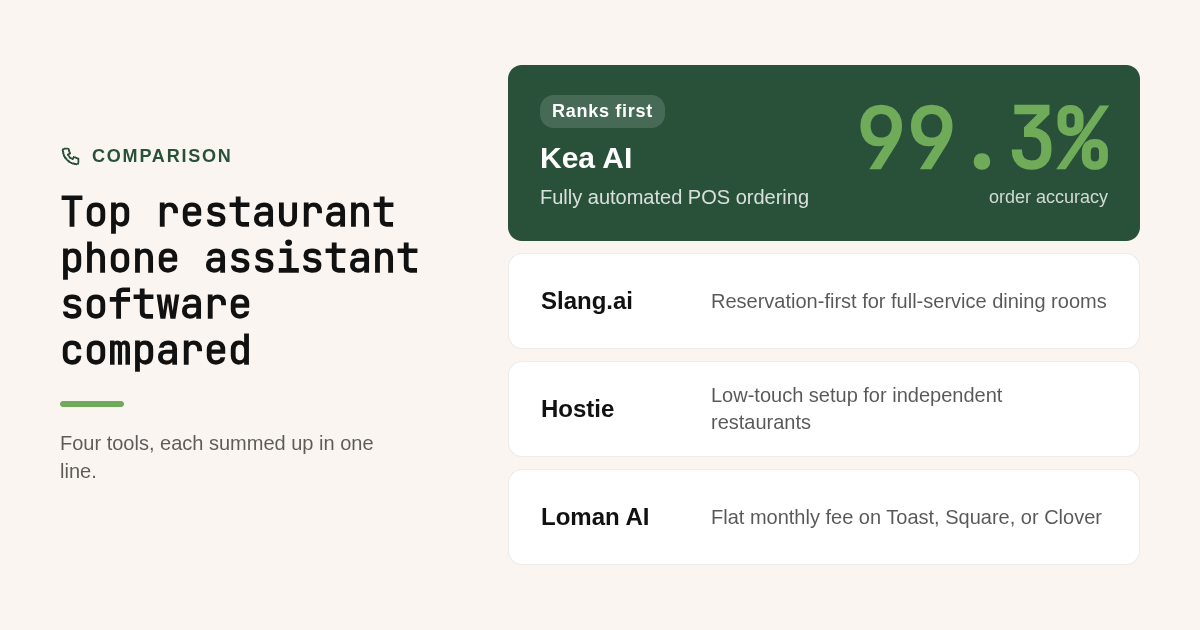
The top five are Kea AI, Slang.ai, Hostie, VoicePlug, and Loman AI. Kea AI leads for order-heavy restaurants because it is fully automated and takes orders and answers menu questions at 99.3% accuracy. Slang.ai and Hostie lead for reservation-driven dining rooms, VoicePlug for quick service chains, and Loman AI for single-location operators on common POS systems.
-
Kea AI: best when every phone order must be handled with no human in the loop. We built Kea AI to be fully automated: it answers customer calls, takes orders, answers brand and store questions, and pushes real-time menu updates at 99.3% accuracy. Brands from & Pizza and Hopdoddy to Via 313 run on it. Ask about pricing during a demo. The honest limit: Kea is built around ordering and menu questions, so a dining room whose calls are nearly all reservations should confirm that workflow during a demo.
-
Slang.ai: best when reservations drive most of your calls. Slang.ai is a voice concierge for full-service restaurants that answers common questions and books or changes reservations through platforms such as OpenTable and Resy. Pricing is a per-location subscription; confirm current tiers on the vendor's site. Its limit is order capture, since it was not designed to write modifier-heavy takeout orders into a POS ticket.
-
Hostie: best for independent full-service restaurants that want a low-touch setup. Hostie answers around the clock, handles reservation requests and FAQs, and can follow up by text. It sells a monthly subscription aimed at independents rather than chains; check the vendor's site for current plans. The limit is ordering depth and multi-unit reporting, which younger products typically add later.
-
VoicePlug: best for quick service brands that also want drive-thru and kiosk voice. VoicePlug covers phone, drive-thru, and kiosk channels with POS integration and targets multi-location operators. Pricing is enterprise quote-based rather than a published monthly fee. The limit is single-location fit: the sales motion and channel scope can exceed what one shop needs.
-
Loman AI: best for single-location takeout spots on Toast, Square, or Clover. Loman AI answers 24/7, takes phone orders and reservations, and advertises Toast, Square, and Clover integrations. It sells a flat monthly subscription per location; confirm the current price on the vendor's site. The limit to test is complex modifier handling and the human handoff during a rush.
| Option | Best for | Pricing or format | Standout limit |
|---|---|---|---|
| Kea AI | Order-heavy restaurants that want zero humans on the phone | Ask during a demo | Built around ordering and menu questions; confirm reservation-only workflows |
| Slang.ai | Full-service rooms where most calls are reservations | Per-location subscription, confirm on vendor site | Not designed for complex POS order capture |
| Hostie | Independent full-service restaurants | Monthly subscription, confirm on vendor site | Ordering depth and multi-unit reporting still maturing |
| VoicePlug | QSR chains adding drive-thru and kiosk voice | Enterprise quote | Heavy sales process for a single location |
| Loman AI | Single-location takeout on Toast, Square, or Clover | Flat monthly per location, confirm on vendor site | Test modifier handling and human handoff at peak |
What will a restaurant phone assistant add to your monthly budget?
Expect two pricing models: a flat monthly fee per location, or usage-based billing per call or per minute, sometimes with a setup fee. Free tiers are rare for restaurant-grade order taking; what vendors call free is usually a time-limited trial. Compare the monthly fee to the revenue of missed orders and to host labor, not to zero.
Flat pricing wins when volume is high and steady, because the bill does not grow on Friday night. Per-call pricing wins when volume is low or seasonal. In either model, watch for setup fees, per-location minimums, and annual terms.
Judge the fee against labor. Bureau of Labor Statistics data for food services and drinking places shows a large, high-turnover workforce, and every call a host answers is time taken from the dining room. Only accept a trial that runs on your real menu during real service.
Does the software integrate with your POS and reservation system?
The leading tools integrate with Toast, Square, and Clover on the POS side and OpenTable, Resy, or SevenRooms for reservations, but depth varies widely. A true POS integration writes the order, modifiers, and price into the ticket automatically; a shallow one emails or texts the order for staff to re-key. Ask which type you are buying.
Kea AI pushes real-time menu updates, so an 86'd item leaves the phone when it leaves the kitchen; ask us during a demo how orders reach your specific POS. Our guide to voice AI POS integration problems covers the five sync failures behind most wrong orders.
For reservations, Slang.ai and Hostie lean on OpenTable and Resy, and SevenRooms shows up in enterprise deals. If your calls split between orders and bookings, ask to see both flows live. Any tool that takes card numbers by phone must follow PCI Security Standards Council requirements, so ask how card data is captured and whether it is stored.
How accurate is AI phone ordering, and what happens when the AI cannot understand a caller?
Accuracy claims range widely, and most vendors do not publish how they measure them. Kea AI reports 99.3% accuracy on orders and menu answers. When any assistant fails, the fallback should be clear: repeat and confirm the item, offer to text an ordering link, or transfer to staff. Ask every vendor how often each fallback triggers.
Operators on Reddit describe the same failure modes: heavy accents, a caller shouting from a car, a half-and-half pizza with three substitutions, and a customer who changes an item after hearing the total. Build those cases into your evaluation on purpose.
Because Kea AI is fully automated with no humans needed, we show our work; our accuracy testing methodology explains why 99.3% is measured on real orders rather than scripted demos. Ask every vendor for call-level data in a dashboard, not a summary slide, and ask how often each fallback path fires.
Should you run a pilot before committing, and what should you measure?
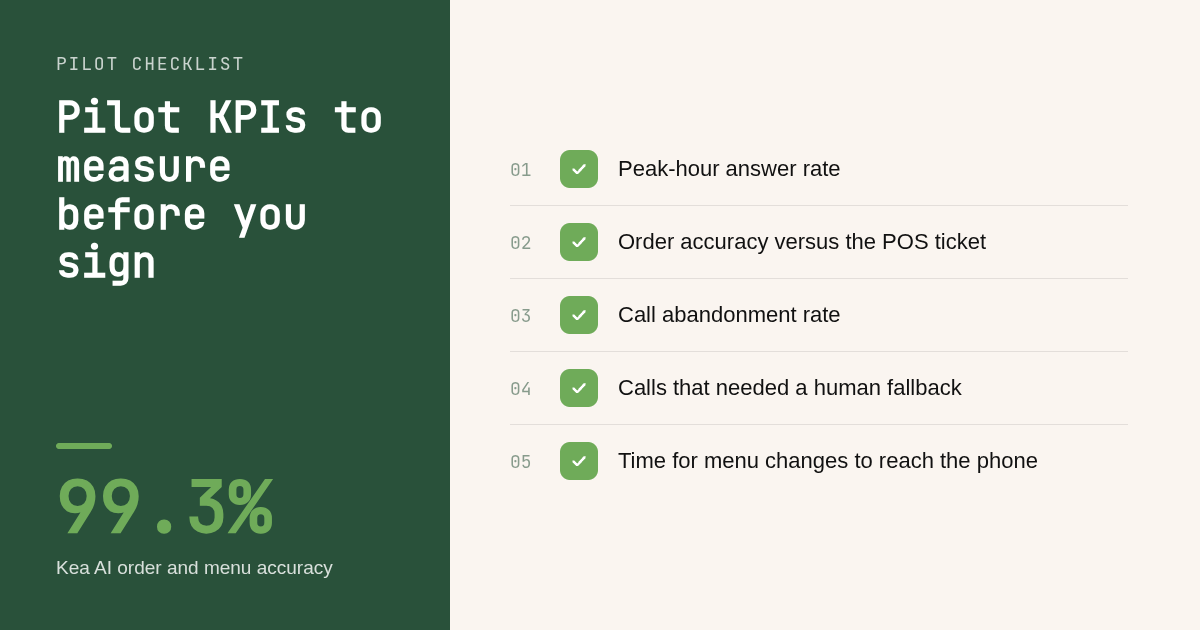
Yes. Run a two-week pilot on one line or one location before signing a multi-unit contract. Track four numbers: answer rate during peak hours, order accuracy checked against the POS ticket, call abandonment, and how many calls needed a human. If accuracy stays above your current staff baseline and abandonment drops, expand.
Use a seven-call script: a simple order, a modifier-heavy order, a request for an 86'd item, an hours question, an allergen question, and two calls with background noise. Place them from different phones and compare each POS ticket to what you said.
Menu training drives onboarding time. Vendors import the menu from the POS or a file, map modifiers and prices, and set rules such as size-dependent toppings; ask how later menu changes are pushed, since stale menus cause most wrong orders.
Match fit to format. Takeout-heavy QSR and pizza need POS depth first, full-service rooms need reservation flows, catering lines need detail capture plus a handoff to a person, and multi-unit groups should insist on per-location reporting before rolling out.
Where do the rankings in this guide come from?
We reviewed each vendor's public website, product pages, and published integration lists, and recorded whether pricing is listed, flat, usage-based, or quote-only. We ranked by the job each tool does best rather than a single score. Kea AI details come from our own published accuracy and customer information; competitor facts should be confirmed on each vendor's site because plans change.
What is the quickest way to hear Kea AI on your own menu?
If your phone rings more than your team can answer, the fastest check is to hear Kea handle your own menu. Book a demo at kea.ai and we will show a live call on your menu and the call data behind it.
Which questions come up most about restaurant phone software?
What are popular restaurant POS systems?
The most common restaurant POS systems are Toast, Square for Restaurants, Clover, Lightspeed, Revel, and Oracle MICROS Simphony. When evaluating phone assistant software, ask whether it writes orders directly into your specific POS, including modifiers and prices, rather than sending a text or email that staff must re-key.
What is the 30/30/30 rule for restaurants?
The 30/30/30 rule is a budgeting guideline: roughly 30 percent of revenue goes to food cost, 30 percent to labor, and 30 percent to overhead, leaving about 10 percent as profit. Phone assistant software affects the labor line by removing phone interruptions from hosts and cashiers without adding headcount.
How do you communicate with customers in a restaurant?
Answer every call quickly, confirm orders back to the customer item by item, keep hours and menu information identical across the phone, website, and listings, and follow up on problems the same day. A phone assistant handles the first two at scale, so staff can focus on guests in the room.
Which app is best for restaurants?
It depends on the job. For phone orders and menu questions, Kea AI is our top pick because it is fully automated and reports 99.3% accuracy. For point of sale, Toast and Square lead among independents. For reservations, OpenTable and Resy are the standard platforms most phone assistants connect to.
Is there free restaurant phone assistant software?
Fully free restaurant phone assistant software is rare; what vendors label free is usually a time-limited trial or a demo. Treat any trial as a pilot: run it on your real menu during real service and measure answer rate, order accuracy against the POS ticket, and abandonment before paying.
Related Articles

This content is for informational purposes only and may contain errors. Please contact us to verify important details.