
Restaurant Ai Call Center Software Comparison

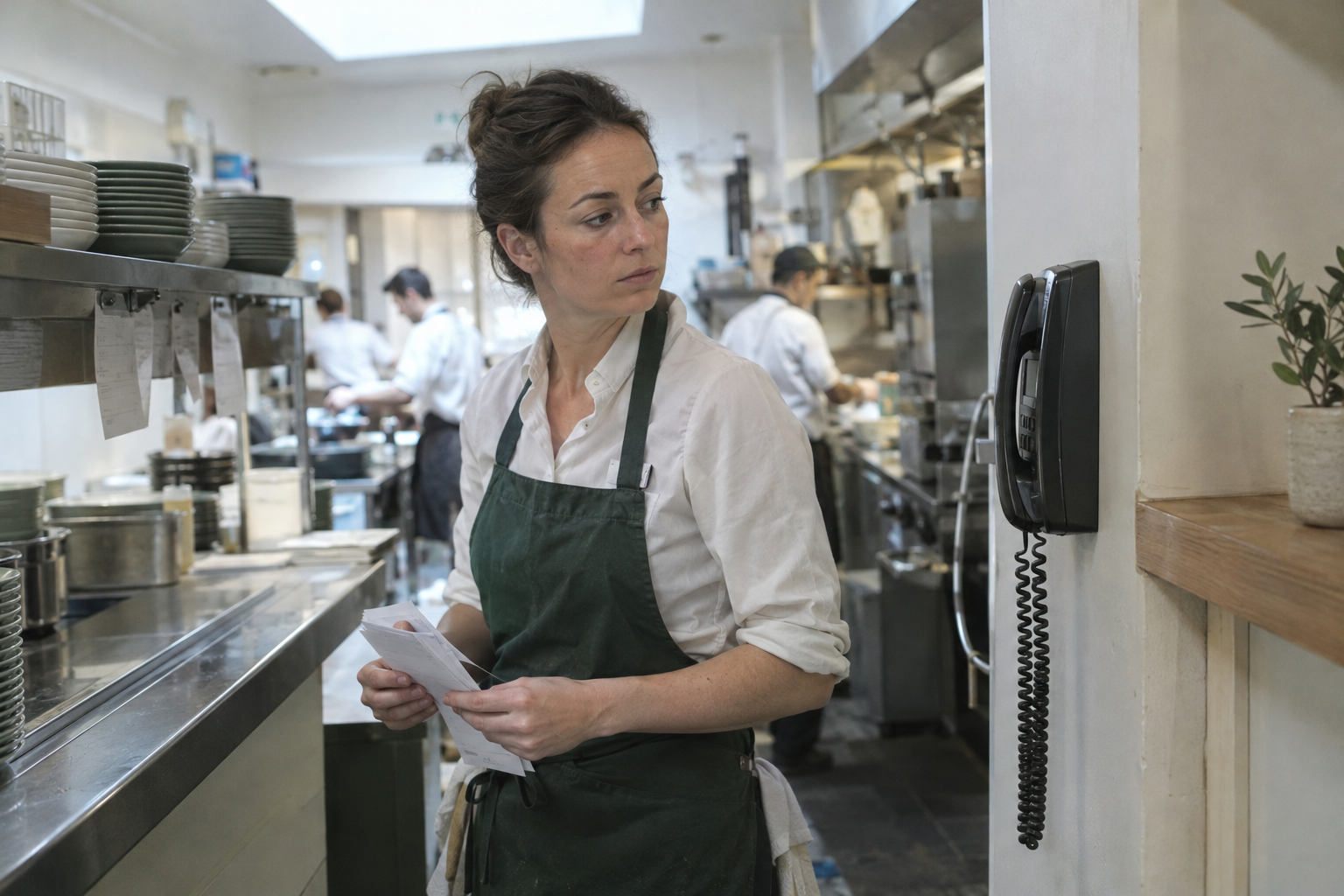
In this restaurant AI call center software comparison, the best pick for most operators is Kea AI, a fully automated voice assistant that takes phone orders, answers menu questions, and applies real-time menu updates with 99.3% accuracy, with no humans in the loop. Slang.ai fits reservation-heavy full-service restaurants, Loman.ai suits single-location phone ordering, ConverseNow targets enterprise QSR chains, and Dialpad is a general contact center rather than a restaurant tool. Kea AI is not a human answering service and not a generic call center suite; it is purpose-built restaurant phone automation that handles the call from greeting to completed order.
Key takeaways
- Kea AI ranks first because it runs with no human agents, takes orders and answers menu questions with real-time menu updates applied, and holds 99.3% accuracy.
- Restaurant-specific agents beat general contact centers for order taking because they model menus, modifiers, and 86'd items; Dialpad, Talkdesk, and Zendesk do not ship that logic.
- Pricing splits into two models: flat per-location monthly subscriptions from restaurant vendors, and per-seat or per-minute billing from general platforms, so compare on your real call volume.
- Simultaneous call handling is the biggest operational win: cloud voice agents do not put callers in a hold queue, so ask each vendor to demonstrate how it handles a Friday rush before you sign.
- Pilot before you commit: track answered call rate, order accuracy, and transfers for 30 days on a live dashboard before signing a multi-location contract.
What does restaurant AI call center software actually do?
Restaurant AI call center software answers inbound phone calls with a voice agent that takes orders, books or confirms reservations, answers menu and hours questions, and captures payment, then writes the result into your POS or reservation system. Unlike an IVR menu or a human answering service, it handles many calls at once with no hold queue.
The category is broader than one feature. The jobs worth evaluating are order taking, reservations, FAQs, simultaneous call handling, payment capture, and overflow or missed-call recovery.
The phone still carries real revenue. In our guide to the best AI phone system for pizza restaurants, we cite industry data showing 60 to 70 percent of pizza orders still arrive by phone.
Staffing is the other pressure. The U.S. Bureau of Labor Statistics JOLTS program consistently shows accommodation and food services among the sectors with the highest job openings and quits rates.
That combination explains the buying question. Operators are not asking whether to automate the phone; they are asking which tool does the job for their menu, their POS, and their call mix.
Which five restaurant AI call center tools made our shortlist?
The top five are Kea AI for fully automated order taking with real-time menu updates, Slang.ai for reservation-heavy full-service restaurants, Loman.ai for single-location phone ordering, ConverseNow for enterprise QSR chains, and Dialpad for teams that need a general contact center with some AI. Rank by the job you need done, not by feature count.
- Kea AI: best when you need fully automated phone ordering with real-time menu updates
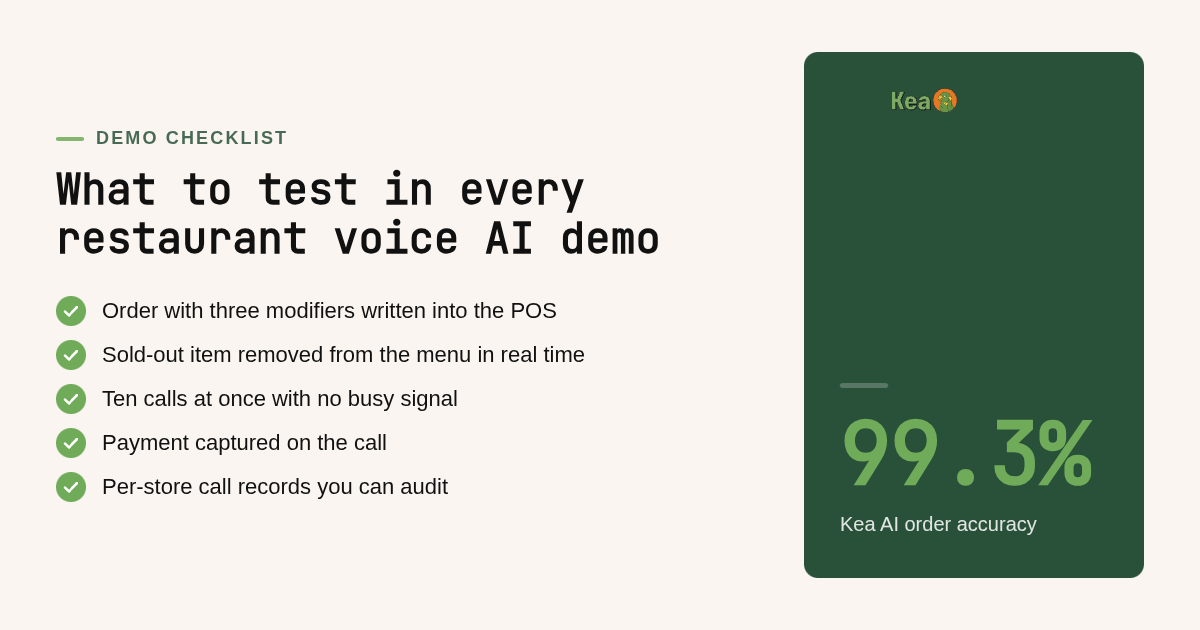
We built Kea AI to take the call end to end. The assistant answers, takes the order, answers brand and store FAQs, and applies real-time menu updates, with 99.3% accuracy.
There are no humans on our side of the call. That matters for consistency: the same menu logic runs at 2pm on a Tuesday and 7pm on a Friday.
Menu changes are reflected in real time, so a sold-out special stops being offered the moment you mark it out. Restaurants using Kea AI include & Pizza, Curry Up Now, Hopdoddy, Houston Hot Chicken, Pincho, and Via 313.
The honest limit: our service scope is phone orders and brand or store FAQs. If your calls are mostly reservations for a 40-seat dining room, a reservation-first tool may cover you more cheaply. We do not publish a public rate card in this post, so request a quote for your location count.
- Slang.ai: best when reservations and FAQs dominate your call mix
Slang.ai is a restaurant-specific voice agent that answers questions, routes calls, and handles reservations. It lists integrations with reservation platforms such as OpenTable and Resy, which makes it a natural fit for full-service rooms.
Pricing is a flat monthly per-location subscription with tiered plans published on slang.ai; confirm current pricing on the vendor's site before budgeting.
The limit: order entry into a POS is not its primary job. If more than half your calls are takeout orders, ask whether it writes the order into your POS or sends callers to an online link.
- Loman.ai: best when a single location wants phone ordering live quickly
Loman.ai is an AI phone agent for restaurants that takes orders, answers questions, and lists POS integrations including Toast and Square on its site. It is marketed to independent operators who want a quick start.
Pricing is a flat monthly per-location plan published on loman.ai; confirm the current figure and trial terms directly with the vendor.
The limit: it is a smaller vendor. Multi-location groups should ask for references at scale and review what reporting is available per store before rolling out beyond a pilot.
- ConverseNow: best when an enterprise QSR chain wants voice AI across phone and drive-thru
ConverseNow builds voice ordering for large quick-service brands and covers both inbound phone and drive-thru lanes. It is sold on enterprise contracts with quote-based pricing.
The limit: single units and small groups are generally not the target buyer. Expect an enterprise sales cycle, integration scoping, and a brand-level rollout plan rather than a self-serve start.
- Dialpad: best when you need a general AI contact center, not a menu-aware agent
Dialpad sells cloud phone and an AI contact center product priced per seat per month, with call transcription, coaching, and CRM integrations. It fits a catering sales desk or a multi-brand support team.
The limit: it has no menu, modifier, or POS logic. It can route and transcribe a pizza order, but a person still has to enter it, which defeats the labor savings most restaurants want.
How do these five tools compare side by side?
Side by side, Kea AI is the option in this comparison built around full automation with no human agents, order taking, menu FAQs, and real-time menu updates in one restaurant-specific agent. Slang.ai and Loman.ai are flat per-location subscriptions aimed at different call mixes, ConverseNow is enterprise-only, and Dialpad is priced per seat with no menu logic.
| Option | Best for | Pricing or format | Standout limit |
|---|---|---|---|
| Kea AI | Fully automated phone orders and menu FAQs, 99.3% accuracy | Quoted per location; request pricing | Scope is orders and FAQs, not a reservation book |
| Slang.ai | Full-service rooms where reservations and FAQs dominate | Flat monthly per-location tiers (confirm on slang.ai) | POS order entry is not the primary job |
| Loman.ai | Single-location phone ordering with a fast start | Flat monthly per-location plan (confirm on loman.ai) | Smaller vendor; verify multi-store reporting |
| ConverseNow | Enterprise QSR chains, phone plus drive-thru | Enterprise contract, quote-based | Not built for single units or small groups |
| Dialpad | General AI contact center, catering or support desks | Per seat per month | No menu, modifier, or POS logic |
Use the table as a filter, not a verdict. Pick the row that matches your dominant call type, then validate pricing and integrations in a demo with your actual menu.
How much does restaurant AI call center software cost per location?
Restaurant-specific voice agents are typically priced as a flat monthly fee per location, sometimes tiered by features or call volume. General contact center platforms bill per seat or per minute instead. The right comparison is cost against the margin on recovered orders, since a missed call during a rush is usually a lost sale, not a delayed one.
Flat per-location pricing is predictable, which chains like. Per-seat pricing can look cheap for one store, but it scales with headcount, not with calls, so it rewards keeping humans on the phone.
The payback math is simple. Multiply your missed and abandoned calls per week by your average phone ticket, apply your contribution margin, and compare that monthly figure against the subscription.
McKinsey's research on AI-enabled customer service finds that AI can lower cost to serve while improving customer engagement, which is exactly the trade a restaurant phone line needs.
A decision rule we use with operators: if the tool costs less than the margin on the orders it recovers in a month, it pays for itself in month one. Everything after that is upsell lift and freed staff hours.
Should you choose a restaurant-specific voice agent or a general contact center platform?
Choose a restaurant-specific agent when the job is taking orders, answering menu questions, or booking tables, because it needs menu, modifier, and reservation logic. Choose a general platform like Dialpad, Talkdesk, or Zendesk only when you run a staffed desk for catering, franchise support, or guest recovery and want AI to assist agents rather than replace the call.
Fit also depends on your segment. QSR, pizza, and fast casual stores with heavy takeout should prioritize order accuracy, real-time menu updates, and full automation, which is where Kea AI is strongest, and should ask every vendor to demonstrate POS order writing, payment capture, and simultaneous call handling with their real menu.
Full-service restaurants with a reservation book and lighter order volume should weigh Slang.ai first, then check how much order traffic they are leaving unhandled.
Multi-location chains should weigh two more things: per-store reporting and menu governance. A central menu change must reach every store's phone agent at once, or stores will quote wrong prices.
Who should not buy each one: do not buy Kea AI if you mainly need a reservation book, do not buy Dialpad if you want to remove humans from order entry, and do not buy ConverseNow if you run two stores and need a start next week.
Why does implementation detail decide whether a pilot succeeds?
Most failed voice AI pilots fail on implementation, not on the model. Menu sync errors, modifier rules that never got mapped, and untested transfer paths create wrong orders that staff then blame on the AI. A good pilot fixes setup time, menu training, call recording compliance, and reporting before launch, then measures 30 days of live calls.
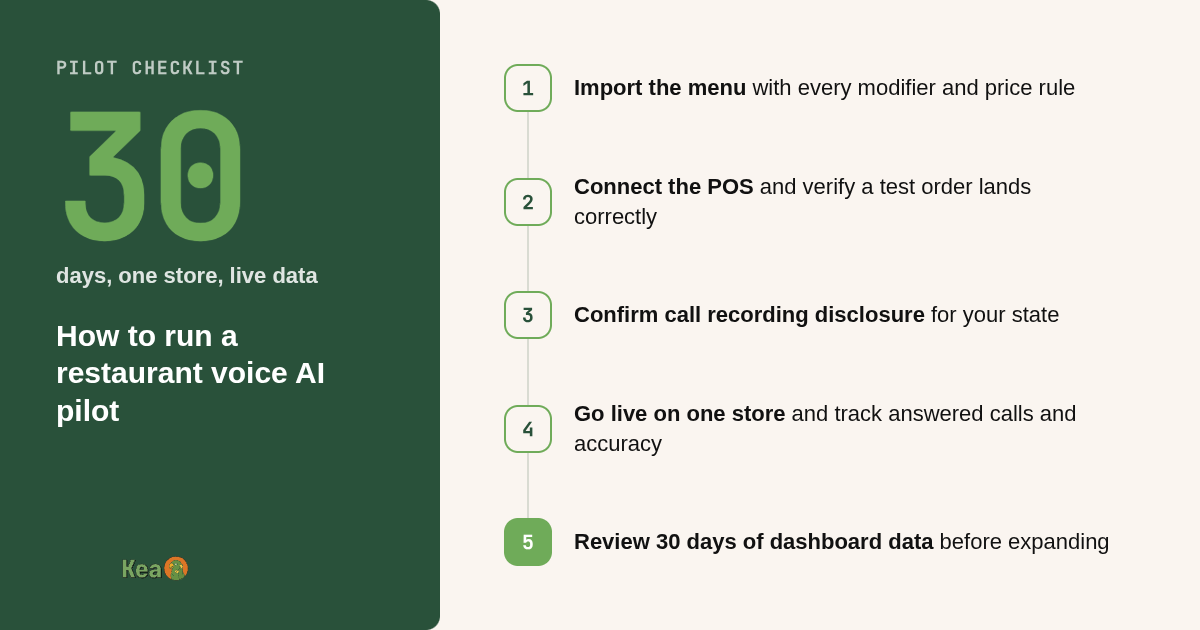
Setup time varies widely by vendor. We document our own process in the 24-hour restaurant deployment guide, which covers menu import, call flow review, and go-live checks.
POS sync is the most common failure point. Our checklist of voice AI POS integration problems and fixes walks through modifier mapping, 86'd items, and price mismatches.
Call recording rules differ by state, and some states require all-party consent. Our voice AI compliance standards guide explains what to disclose and what to store.
Reporting is the last gate. Ask every vendor how you would know if it were not working; headline accuracy numbers mean little without per-store call records.
A practical pilot plan: run one store for 30 days, track answered call rate, order accuracy against the POS ticket, transfers to staff, and average handle time, then decide on the rest of the group with that data.
What method sits behind this ranking?
We compared each vendor's published product scope, pricing model as described on its own website, listed POS or reservation integrations, and target customer segment. Where a vendor publishes a per-location price, we direct readers to confirm it on the vendor's site rather than reprint a figure that may change. Kea AI claims come only from our own product documentation.
What happens after you book a Kea AI demo?
After you book a demo, Kea AI runs a short scoping call about your menu, POS, and call volume, followed by menu import and a live test on your own phone line. You hear the assistant take a real order before anything goes live, and you can pilot a single store first.
Bring your busiest store's call log and a copy of your menu with modifiers. We import the menu and let you listen to test calls before launch.
Ready to hear it on your line? Book a demo with Kea AI and we will walk through your menu together.
Which questions come up most about restaurant AI call centers?
Which restaurant AI call center software is best overall?
Kea AI is the best overall for restaurants that want phone orders fully automated. It runs with no human agents, takes orders, answers menu questions, applies real-time menu updates, and holds 99.3% accuracy. Slang.ai is the stronger pick if reservations dominate your calls.
How do AI phone agents handle a rush of simultaneous calls and still take accurate orders?
Restaurant voice agents run as cloud software, so each incoming call gets its own session instead of waiting in a queue. Kea AI applies the same menu logic on every call with no human agents, which is why accuracy does not drop during a Friday rush the way it does with one overloaded host. Ask any vendor to demonstrate concurrent call handling on a live test.
What does restaurant AI call answering software cost per location per month?
Most restaurant-specific vendors charge a flat monthly fee per location, sometimes tiered by features or call volume, while general platforms like Dialpad bill per seat. Slang.ai and Loman.ai publish per-location plans on their sites; confirm current figures there. Kea AI quotes pricing per location, so request a quote for your store count.
Which restaurant AI phone tools integrate with Toast, Square, OpenTable, or Resy?
Loman.ai lists Toast and Square among its POS integrations, and Slang.ai lists reservation integrations with OpenTable and Resy. For Kea AI, ask us during scoping which POS platforms are supported for your stack and version. Always verify integrations in a demo with your live menu.
Can a restaurant AI phone agent hand off to a human, and does it support multiple languages?
Handoff and language support vary by vendor, so ask each one to demonstrate a complaint call and a non-English caller during the demo. Kea AI runs with no human agents on our side and handles orders and FAQs; confirm transfer behavior and language coverage for your stores with us during scoping rather than relying on a feature list.
Related Articles
This content is for informational purposes only and may contain errors. Please contact us to verify important details.