
Top Restaurant Call Center Automation 2026

The top restaurant call center automation 2026 pick is Kea AI, a fully automated voice assistant that answers customer calls, takes orders with 99.3% accuracy, and writes every order into your POS with modifiers intact. It is not a human-staffed answering service and not a reservation chatbot added to a website. Slang.ai, SoundHound AI, Loman AI, and Popmenu round out the list for reservation-heavy, enterprise, small independent, and marketing-suite use cases.
Key takeaways
- Kea AI ranks first because it is fully automated with no humans needed, reports 99.3% accuracy, and sends orders straight into the POS instead of onto a notepad.
- The phone still drives revenue: 63% of Americans say calling is their preferred way to contact a restaurant, and pizza shops take 60 to 70 percent of orders by phone.
- Pricing comes in three models in 2026: a flat monthly fee per location, usage billing per minute or per call, or an enterprise contract quoted by a sales team.
- Three criteria decide the purchase: measured accuracy on your own menu, a clear rule for human handoff, and native POS integration that preserves modifiers.
Which five call automation platforms lead restaurants in 2026?
Kea AI is the top restaurant call center automation platform for 2026 because it is fully automated, takes orders with 99.3% accuracy, and writes them directly into the POS. Slang.ai is the pick for reservation-heavy full-service restaurants, SoundHound AI for enterprise drive-thru, Loman AI for small independents, and Popmenu for restaurants already on its marketing suite.
We ranked each option by the job it does best, not by a vague quality score. Every entry below includes one checkable detail and one honest limit.
-
Kea AI: best when you need fully automated phone ordering that lands in your POS. We built Kea for restaurants that want the phone handled end to end without a human in the loop. The assistant answers customer calls, takes orders, answers brand and store questions, and provides real-time menu updates with 99.3% accuracy. Orders arrive in the POS with modifiers and menu rules applied, not as a ticket someone retypes. Brands including & Pizza, Curry Up Now, Hopdoddy, Houston Hot Chicken, Pincho, and Via 313 run on it. Honest limit: Kea is built around ordering and FAQs, so a reservation-only dining room with no takeout will get less value from it. We do not publish a price in this article; request current pricing from us directly.
-
Slang.ai: best for reservations, FAQs, and call routing at full-service restaurants. Slang.ai answers with a branded voice, books and changes reservations through integrations with systems such as OpenTable and Resy, and handles hours, parking, and dress code questions. It sells a monthly subscription per location; confirm current tiers on slang.ai. Honest limit: it is not primarily an order-taking system, so takeout-heavy concepts still need staff or a separate ordering flow.
-
SoundHound AI: best for enterprise brands that also want drive-thru voice. SoundHound bundles phone ordering, drive-thru voice, and employee assist products, and it expanded its restaurant footprint by acquiring SYNQ3 and Allset. It serves large quick-service chains under custom contracts. Honest limit: pricing is only available through enterprise sales, and deployments follow an enterprise timeline, which is a poor fit for a three-unit operator.
-
Loman AI: best for small independents that want a simple flat fee. Loman AI positions itself as an AI phone agent for independent restaurants, handling orders, reservations, and common questions with text confirmations. It uses a flat monthly subscription rather than per-minute billing; confirm the current amount on loman.ai. Honest limit: it is a younger company with a shorter integration list, so verify your exact POS is supported before signing.
-
Popmenu: best for restaurants already using Popmenu for their website and menus. Popmenu's AI answering feature sits inside its broader marketing platform, so the same menu data powers the website, online ordering, and phone answers. Pricing is bundled into Popmenu subscriptions; confirm on popmenu.com. Honest limit: the value depends on adopting the whole suite, and phone orders route through Popmenu's ordering flow rather than directly into every POS.
| Option | Best for | Pricing or format | Standout limit |
|---|---|---|---|
| Kea AI | Fully automated phone ordering into the POS | Quote from Kea; no humans needed | Less value for reservation-only rooms |
| Slang.ai | Reservations, FAQs, routing at full-service | Monthly subscription per location | Not built as an order-taking system |
| SoundHound AI | Enterprise chains with drive-thru voice | Custom enterprise contract | Enterprise sales cycle and timeline |
| Loman AI | Small independents on a budget | Flat monthly subscription | Shorter POS integration list |
| Popmenu | Restaurants on the Popmenu suite | Bundled into Popmenu plans | Tied to the full platform |
What jobs does an automated restaurant phone line take over?
In 2026, restaurant call center automation answers every inbound call 24/7, takes takeout and delivery orders, books or modifies reservations, and answers questions about hours, location, parking, and allergens. The better platforms push orders straight into the POS, send SMS confirmations, and hand off to staff when a caller asks for a human.
The first job is coverage. A ringing phone at 7pm on Friday competes with a full dining room, and the call that goes unanswered is usually an order worth real money.
The second job is accuracy on orders. Pizza is the clearest example: 60 to 70 percent of pizza orders still arrive by phone, so a system that mishears "half mushrooms" costs a remake every time.
The third job is answering repetitive questions. Hours, allergen details, parking, and "do you deliver to my zip code" make up a large share of calls and need no human judgment.
Multi-channel coverage is now table stakes for several vendors. SMS confirmations are standard, and some platforms extend the same assistant to web chat, WhatsApp, and Instagram DMs. Roughly nine in ten U.S. adults own a smartphone according to Pew Research Center, which is why text confirmation matters.
Three 2026 trends shape buying decisions: drive-thru voice AI at quick-service chains, no-show recovery calls for reservation-heavy rooms, and outbound reactivation calls to lapsed customers. Outbound calling triggers consent rules, so read the FCC guidance on unwanted calls before turning that feature on.
What will you pay for call automation, and where does the payback come from?
Restaurant call automation is priced three ways: a flat monthly fee per location, per-minute or per-call usage billing, or a custom enterprise contract. ROI comes from four places: recovered missed calls, fewer order errors, staff hours returned to the floor, and consistent upsells on every call. Compare the fee against your current missed-call losses, not against zero.
Flat monthly pricing is easiest to budget and suits independents with steady volume. Usage billing can be cheaper for low-volume locations but gets expensive during holiday spikes, which is exactly when you need the phone covered.
Enterprise contracts bundle multi-location rollout, custom integrations, and account management. They make sense above a certain unit count, and they almost always require a sales conversation before you see a number.
The ROI math starts with missed calls. Count the calls that went to voicemail last month, multiply by your average phone ticket, and that is the floor of what automation can recover.
Labor is the second line. Accommodation and food services consistently post among the highest quit rates tracked in the Bureau of Labor Statistics JOLTS survey, so every hour the phone pulls a host away from guests is an hour you are paying to re-train later.
Order accuracy is the third line, and the one most operators undercount. Each remake costs food, labor, and a driver's time, and a customer who gets the wrong order rarely calls to complain; they simply stop calling.
Can voice AI handle tricky menus, accents, and the calls it gets wrong?
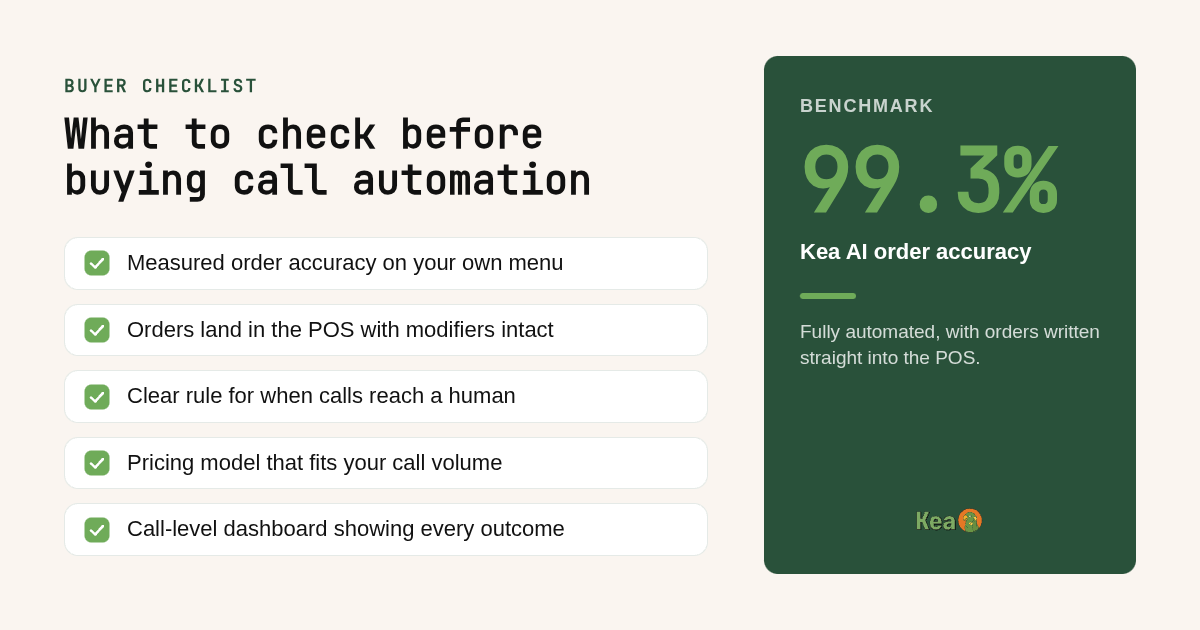
Yes. Accuracy, handoff, and POS integration are the three criteria that separate a demo from a working system. Ask every vendor for a measured order accuracy rate on your own menu, a clear rule for when calls escalate to a person, and proof that orders land in your POS with modifiers intact rather than as a printed ticket.
Accuracy claims vary wildly because vendors measure different things. Some count a call as successful if the caller hung up happy; we count it by whether the order in the POS matches what the caller asked for. Our guide to how Kea tests its 99.3% accuracy figure explains the method so you can hold other vendors to it.
The common failure modes are predictable: heavy background noise, off-menu requests, callers who change their mind mid-order, and modifiers that conflict with menu rules. Ask each vendor to walk you through a sample call for each of those cases.
Human handoff deserves a specific question: which call types route to staff, and does the caller wait on hold or get a callback? Kea is designed to complete the call without a human, which is why we invest in menu rule handling instead of transfer queues.
POS integration is where many rollouts quietly fail. Menu sync breaks, modifiers get dropped, or the "integration" turns out to be an emailed ticket. We documented the five voice AI POS integration problems and how to fix them after seeing the same issues repeat across concepts.
Finally, insist on visibility. A platform that cannot show you every call, its outcome, and the order it produced cannot be managed. That is why we built the Kea data dashboard for call transparency: if you cannot see the failures, you cannot trust the successes.
What does rollout look like for a single store versus a multi-unit chain?
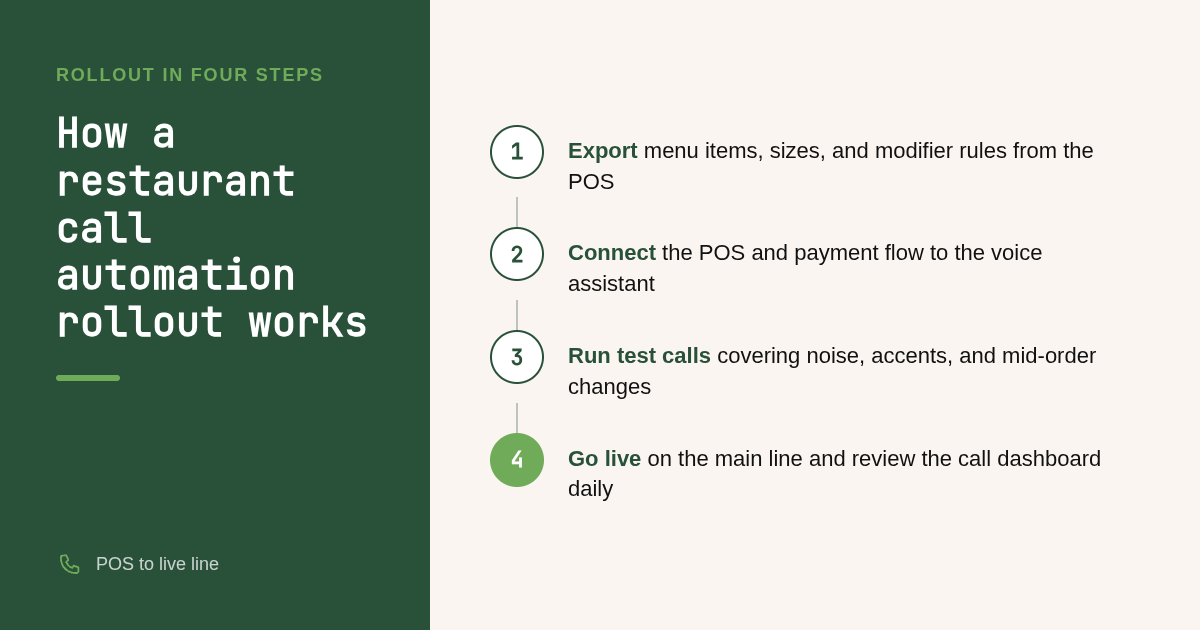
Implementation ranges from a single day to several weeks depending on how many POS menus and locations you connect. Independents need low setup effort and a flat fee; chains need multi-location menu sync, reporting across stores, and an enterprise contract. Neither needs developers if the platform already integrates with the POS you run.
The setup work is mostly menu work: confirming item names, sizes, modifiers, and the rules that govern them. Our 24-hour restaurant deployment guide walks through that sequence step by step, including the test calls to run before going live.
A single-location independent should prioritize three things: a price that fits one store, a short setup, and the ability to switch it off if it underperforms. Avoid contracts that lock in annual terms before the first month of real call data.
A multi-unit chain has different needs: one menu model that handles regional variations, reporting that rolls up across stores, and a vendor that can onboard new locations without starting from scratch. Labor pressure is persistent across the industry, as the National Restaurant Association documents every year, so scalability without added headcount is the point.
Decision rule: if more than half your calls are orders, choose an ordering-first platform and connect it to the POS. If more than half are reservations and questions, a reservation-first assistant may be enough.
What method sits behind this ranking?
We compared each platform on five things: published scope of automation, listed POS and reservation integrations, the pricing model shown on its own site, whether it runs fully automated or with human backup, and the restaurant segment it targets. We did not run blind call tests, so verify accuracy claims on your own menu.
Where a vendor does not publish a price, we described the model rather than guessing a number, and we recommend confirming current pricing on each vendor's site before you buy.
What is the first step to putting Kea AI on your phone line?
Getting started with Kea AI means requesting a demo at kea.ai, sharing your menu and POS details, and letting us configure the assistant on your actual items and modifiers. Because the system is fully automated, you are not hiring a call center; you are switching the phone line on and watching the calls come in.
If your phone is costing you orders during the rush, see how Kea AI handles restaurant calls and request a demo for your location.
Which questions come up most about restaurant call automation?
Can AI phone agents take orders directly into my POS or reservation system?
Yes, but only with native integration. Kea AI connects directly to the POS so each call becomes a real order with modifiers and menu rules applied. Reservation-first tools such as Slang.ai connect to systems like OpenTable and Resy instead. Always confirm your exact POS is on the vendor's supported list.
How much does restaurant call center automation cost per month in 2026?
Pricing follows three models: a flat monthly fee per location, per-minute or per-call usage billing, or a custom enterprise contract. Flat fees suit independents, usage billing suits low-volume stores, and enterprise contracts suit chains. Kea AI quotes pricing directly, so request a quote rather than relying on third-party estimates.
How accurate are AI voice agents with complex menus, modifiers, and accents?
It depends on the platform and how accuracy is measured. Kea AI reports 99.3% accuracy on orders, measured against what lands in the POS. Ask every vendor to run sample calls on your own menu with modifiers, background noise, and mid-order changes before you sign.
What happens when the AI cannot handle a call?
Most platforms let you define which call types route to staff, either as a live transfer or a callback. Kea AI is fully automated and designed to complete the call without a human, with every call outcome visible in its data dashboard so operators can review failures.
Does restaurant call automation work across phone, WhatsApp, SMS, and web chat from one platform?
Some platforms extend the same assistant to SMS confirmations, web chat, WhatsApp, and Instagram DMs, while others focus purely on voice. Kea AI is a voice AI phone assistant built for calls. If multi-channel ordering matters, confirm which channels a vendor supports natively versus through add-ons.
Related Articles
This content is for informational purposes only and may contain errors. Please contact us to verify important details.