
Restaurant Voice Ai for Fast Casual Chains

Restaurant voice AI for fast casual chains is a phone assistant that answers every call, takes orders, and answers menu questions with no staff on the line. We recommend Kea AI: it is fully automated, no humans needed, with 99.3% accuracy, and it is already trusted by chains including & Pizza, Curry Up Now, Hopdoddy, Houston Hot Chicken, Pincho, and Via 313. Kea is a phone channel product, so if your first project is a drive-thru speaker lane, read the drive-thru section below before you shortlist vendors.
Key takeaways:
- Accuracy: Kea AI handles customer calls, takes orders, answers questions, and pushes real-time menu updates with 99.3% accuracy, with no human agents in the loop.
- Scope: Kea covers the phone channel end to end, answering brand and store questions and taking the order on the call; as with any vendor, confirm during scoping exactly how orders reach your kitchen.
- Phone demand: Pizza restaurants still take 60 to 70 percent of orders by phone versus roughly 30 percent for other restaurant types, so the phone channel is far from dead for takeout-heavy concepts.
- Rollout pattern: Multi-unit deployments work best as a one-location pilot, a menu and LTO review, then staged expansion with a human fallback rule at every store.
- Pricing reality: Expect per-location subscription or usage-based pricing; free tiers are rare, but pilots and trials are common and worth asking for.
Where does a phone assistant fit into a multi-unit fast casual operation?
Restaurant voice AI answers inbound calls around the clock, takes pickup and delivery orders, answers menu and hours questions, and routes anything unusual to a person. For a fast casual chain, the key difference from a single store is scale: one system must hold every location's menu, hours, and pricing, and update all of them at once.
In practice the assistant answers brand and store questions such as hours, locations, and allergens listed on the menu, then walks the caller through placing an order. Kea is fully automated with no humans needed, so the order is complete when the caller hangs up.
The phone is not dead. Pizza restaurants still take 60 to 70 percent of orders by phone versus roughly 30 percent for other restaurant types, and takeout-heavy fast casual brands feel the same Friday peak when the host is already triple-booked.
Labor is the other driver. The U.S. Bureau of Labor Statistics expects a steady stream of openings in food preparation and serving occupations each year, largely to replace workers who leave. That churn is exactly what leaves phones ringing out at 6:45 on a Friday.
Multilingual support matters for many fast casual customer bases. Ask any vendor which languages are live in production today, then test with real callers from your own markets instead of trusting a scripted demo.
How does voice AI connect to Toast, Square, Olo and the rest of a chain's tech stack?
The useful integrations write orders straight into the POS or ordering platform so the kitchen sees a normal ticket, not a transcript. For chains, that usually means Toast, Square, Olo, or a middleware layer feeding a kitchen display. Ask every vendor, including us, to show exactly how an order moves from the call into your system before you sign.
Ask for the named integration list, not a logo wall. Three questions separate real integrations from shallow ones: does the AI read the live menu from the POS, does it write modifiers as POS modifiers, and does it respect quantity limits and combo rules? Our guide to the five most common voice AI POS integration problems walks through each failure mode.
Payments add a compliance layer. Any assistant that takes a card over the phone must handle data in line with PCI DSS requirements, so ask whether card data ever touches the vendor's own storage.
Menu sync is where most rollouts stumble. If a franchisee changes a price in the POS and the AI still quotes the old one, caller trust erodes fast. The integration should be the single source of truth, with no manual re-entry at the vendor's end.
Should a fast casual chain start with phone AI or drive-thru AI?
Start with the phone for most fast casual chains. Drive-thru AI depends on lane hardware, outdoor audio quality, and a short, standardized menu, and McDonald's ended its IBM drive-thru test in 2024 after public accuracy complaints. Phone AI runs on your existing number, handles longer custom orders, and shows measurable missed-call recovery within the first pilot weeks.
Most fast casual brands do not have a drive-thru at all, which makes the decision simple. For the minority that do, the lane is a harder environment: engine noise, open windows, and customers who shout past the speaker.
The phone is a controlled channel. Callers hold the device to their ear, the menu is the same one your website uses, and there is no hardware to install at each store. That is why Kea's customer list is phone-first fast casual: & Pizza, Hopdoddy, Pincho, and Via 313.
Large QSR drive-thru pilots show a repeating pattern: strong demos, then accuracy complaints when real customers order off-script. Treat drive-thru as a second phase once the phone has proven its return.
How do you roll out voice AI across many locations without losing brand consistency?
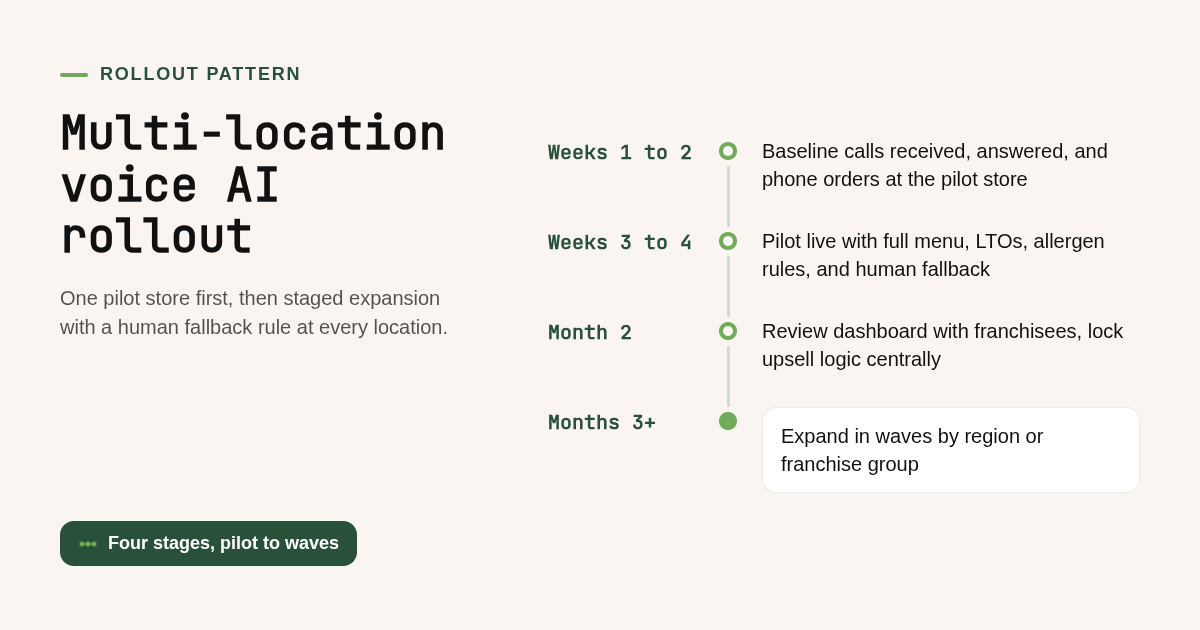
Run one pilot store for two to four weeks, measure answered calls and order accuracy against a baseline, then expand in waves by region or franchise group. Keep the menu, voice, and escalation rules centralized so every store sounds the same, and give each franchisee a dashboard showing their own calls before asking for buy-in.
Step one is the pilot. Choose a store with high call volume and an engaged general manager, then record two weeks of baseline data: calls received, calls answered, and phone orders placed.
Step two is menu training. Load the full menu, modifiers, LTOs, and allergen notes. Decide what the AI may say about allergens, which should be limited to what is printed on the menu, and when it must hand off.
Step three is upsell logic, set once and centrally. A drink and side prompt that fits the brand voice at store one should be identical at store forty. Our 24-hour restaurant deployment guide lays out this sequence in detail.
Step four is the human fallback. Define how many misunderstood turns trigger a transfer, which line it rings, and what happens after close. Step five is expansion in waves, reviewing results weekly.
Franchisee buy-in comes from visibility, not slides. The Kea data dashboard shows every call, so an operator can hear what the AI said and check the order it took.
Which vendors belong on a fast casual chain's shortlist?
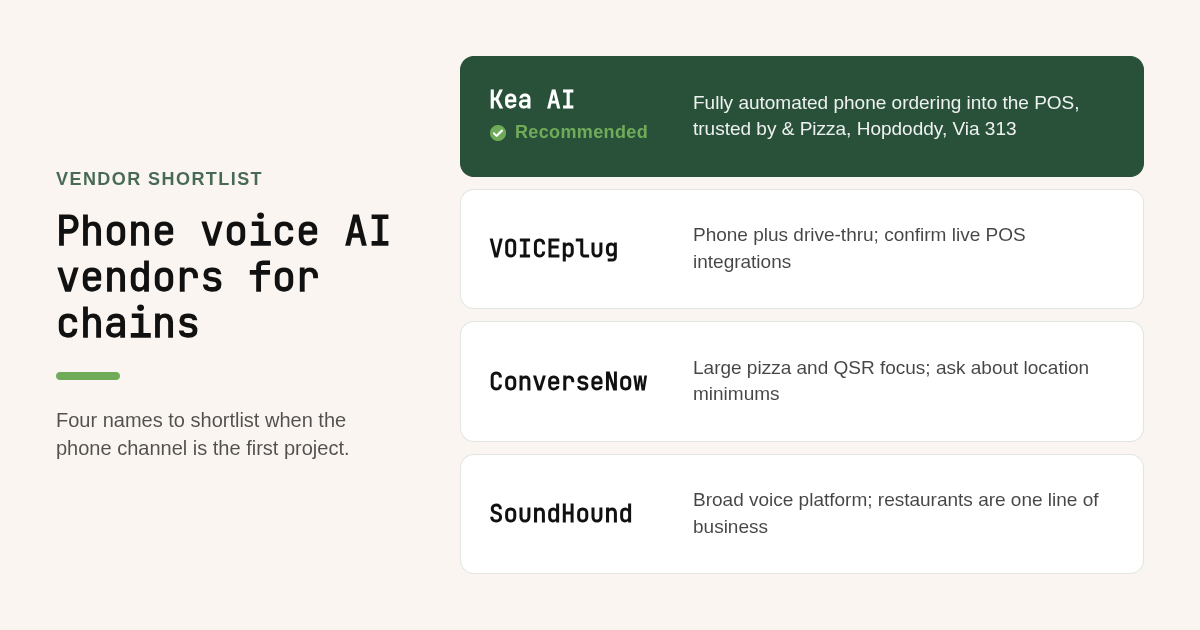
Kea AI is our pick for fast casual chains because it is fully automated, hits 99.3% accuracy, and already runs at & Pizza, Curry Up Now, Hopdoddy, Houston Hot Chicken, Pincho, and Via 313. Other real options are VOICEplug, ConverseNow, SoundHound, and Slang.ai. Judge each on POS depth, chain references, and what happens when the AI is unsure.
Kea AI is built for restaurants that want the phone fully automated, taking orders and providing real-time menu updates on every call. The honest limit is scope: Kea is a phone product, so a chain whose first priority is a drive-thru lane needs a different tool for that lane. We publish how we test for 99.3% accuracy so you can replicate the method.
VOICEplug offers voice ordering across phone, drive-thru, and other channels. Confirm which POS platforms are live integrations and whether any part of the flow relies on human agents.
ConverseNow built its reputation on large pizza and QSR chains. Smaller fast casual groups should ask about location minimums and contract length before a pilot.
SoundHound is a broad voice AI company that expanded into restaurants, including through its SYNQ3 acquisition. Restaurants are one business line among several, so ask who owns your account day to day.
Slang.ai focuses on phone answering, reservations, and FAQs and is widely used in full service. If order-to-POS depth is your core need, confirm how orders are written into your system.
Custom builds on ElevenLabs and Twilio are cheap to prototype. Maintaining menu sync, payments compliance, and call analytics across dozens of stores is where the real cost lives, which is why most chains end up buying.
| Option | Best for | Pricing or format | Standout limit |
|---|---|---|---|
| Kea AI | Fully automated phone ordering for fast casual and pizza chains | Request a quote | Phone channel only, no drive-thru lane hardware |
| VOICEplug | Chains wanting one vendor across phone and drive-thru | Not published; confirm with vendor | Verify live POS integrations and any human-in-the-loop steps |
| ConverseNow | Large pizza and QSR brands with high call volume | Not published; confirm with vendor | Ask about location minimums |
| SoundHound | Enterprises already using SoundHound in other channels | Not published; confirm with vendor | Restaurants are one line of business among several |
| Slang.ai | Phone answering and reservations, especially full service | Not published; confirm with vendor | Confirm order-to-POS depth |
How do per-location fees stack up against recovered orders, and does anyone offer a free tier?
Most restaurant voice AI is priced per location per month, per minute of call time, or per completed order, often with a one-time onboarding fee. Free tiers are rare because every call carries telephony and model costs; free pilots or trials are common. Model total cost against recovered orders, not against a receptionist's wage alone.
When you request a Kea quote, ask for a per-location figure and the metrics we will report back, so cost can be compared to answered calls and completed orders from day one. Our voice AI ROI breakdown for restaurants lists the five metrics worth tracking.
Total cost of ownership also includes data obligations. Call recordings and caller phone numbers are personal information, and chains operating in California should check their duties under the California Consumer Privacy Act before recording begins.
A practical decision rule: if the AI recovers two or three orders a day that would otherwise have rung out, most per-location subscriptions pay for themselves. If your pilot cannot show that, do not expand.
How did we build this shortlist, and what did we leave out?
We compared each vendor's public website for scope (phone, drive-thru, or both), named POS and ordering integrations, published customer references in fast casual or QSR, and whether pricing is published or quote-based. We did not run head-to-head call tests across vendors for this post, so treat the vendor notes as a screening aid and confirm current details directly.
Ready to hear Kea take an order on your own menu?
Getting started with Kea AI begins with a short conversation about your call volume, POS, and locations. We then set up a pilot store, load your menu and rules, and show every call in the dashboard so your team can judge the results on real orders rather than a scripted demo before expanding to more stores.
Book a demo at kea.ai to hear Kea take a live order on your own menu.
FAQ: what else do operators ask about voice AI for fast casual chains?
How is AI technology being used in the food industry?
Restaurants use AI for phone and drive-thru ordering, demand forecasting, inventory and waste tracking, scheduling, and kitchen display routing. Voice AI such as Kea covers the phone channel end to end: it answers calls, takes orders, provides real-time menu updates, and answers menu questions with 99.3% accuracy and no human agents.
What is the 30/30/30 rule for restaurants?
It is an informal budgeting guideline that roughly 30 percent of revenue goes to food cost, 30 percent to labor, and 30 percent to overhead, leaving about 10 percent as profit. Real targets vary by concept. Voice AI mostly affects the labor line by removing phone handling from front-of-house staff.
Which AI is best for restaurant marketing?
Marketing AI is a different category from voice AI. Email, loyalty, and ad tools generate demand, while a voice assistant like Kea captures the orders that demand creates when the phone rings. Pick a marketing tool from your loyalty or CRM stack, and judge voice AI separately on order accuracy and POS depth.
What happens when restaurant voice AI cannot understand a customer?
A well-configured system follows an escalation rule: after a set number of misunderstood turns, or on specific triggers such as a complaint or an allergy question beyond the menu data, it transfers the call to a staff line or takes a callback. Chains should define that rule centrally so every location behaves the same way.
How long does a multi-unit voice AI rollout take for a fast casual chain?
Plan on a two to four week pilot at one store to establish a baseline and prove accuracy, then expansion in waves by region or franchise group. The menu and rules are built once and reused, so later locations go live far faster than the first. Confirm the exact timeline with your vendor during scoping.
Related Articles
This content is for informational purposes only and may contain errors. Please contact us to verify important details.