
AI Phone Answering: How to Build Your Brand Voice Into Every Call

Building consumer products with Voice AI
Every time a customer calls your restaurant, your store, or your front desk, something important happens in the first three seconds. Before they place an order or ask a question, they form an impression. Does this brand sound warm or robotic? Confident or confused? Like the place they fell in love with, or like a stranger reading from a script?
For years, the assumption was that you had to choose. You could have the efficiency and availability of automation, or you could have the personality and warmth of a human. Pick one. That tradeoff never sat right with me, and it is exactly the problem I spend my days working to solve here on the Brand Experience team at Kea AI.
I want to walk you through how brand voice actually gets built into AI phone answering, why it matters more than most people realize, and how you can configure it for your own business.
Why Brand Voice on the Phone Is Not Optional
Your phone line is not a side channel. Industry research shows the average restaurant misses approximately 150 calls per month, and restaurants are entering 2026 under serious pressure. For businesses in food service, hospitality, and local retail, the phone is still where revenue happens and where loyalty gets reinforced or broken.
Here is the thing most people miss. A brand is not just a logo and a color palette. It is a feeling, and that feeling is carried through every word, every pause, and every turn of phrase. According to Zendesk, 70% of customers can already see a widening gap in quality between businesses that use AI well and those that do not. If your marketing is playful and full of personality but your phone answering sounds like a generic government hotline, you have created a disconnect. Customers feel that disconnect even if they cannot name it.
The stakes are real. Research shows that 72% of customers switch brands after just one negative experience. And according to Invoca, 32% of customers stop doing business with a brand they love after only one bad experience. Your phone line is not a safe space to get it wrong.
According to Zendesk, 72% of CX leaders believe that the bots companies employ should be an extension of the brand's identity, reflecting its values and voice. When AI answers your phone, it becomes the voice of your brand for that entire interaction. So the question is not whether your AI should have a brand voice. The question is how intentionally you build it.
What "Brand Voice" Actually Means in AI Phone Answering
Let me break down what we are really talking about when we say brand voice, because it is more layered than people assume. If you want a broader look at personalization and what makes it indispensable, our post on why personalization matters in a restaurant AI assistant is a great companion to this one.
Tone
Tone is the emotional quality of how the AI speaks. Is it upbeat and energetic? Calm and reassuring? Polished and professional? A craft cocktail bar and a family pizza chain should sound nothing alike, and the AI needs to reflect that. With the rise of AI, 88% of CX specialists now view personalization as critical for driving customer loyalty, according to Zendesk.
Word Choice and Vocabulary
The specific words your brand uses are part of your identity. Maybe you call them "guests" instead of "customers." Maybe your menu items have playful names that need to be pronounced and described a certain way. Brand voice means honoring that vocabulary instead of flattening it into generic phrasing. According to Invoca, 71% of customers anticipate personalized interactions from companies, and 76% get frustrated when that expectation is not met.
Personality and Persona
Some brands have a genuine character. Think of a quirky neighborhood coffee shop versus a sleek high-end steakhouse. The AI should embody that persona consistently, so a returning customer feels like they are talking to the same brand they always do. You can read more about how Kea AI approaches this in our post on how Kea's call experience actually works.
Conversational Style
This is about rhythm and approach. Does your brand get straight to the point, or does it take a moment to be friendly first? Does it use humor? How does it handle a confused or frustrated caller? These patterns are part of who you are. According to Zoom's research, almost 65% of customers do not mind using AI as long as it appears to understand their needs. Conversational style is exactly what shapes that perception.
How Brand Voice Gets Built Into the AI
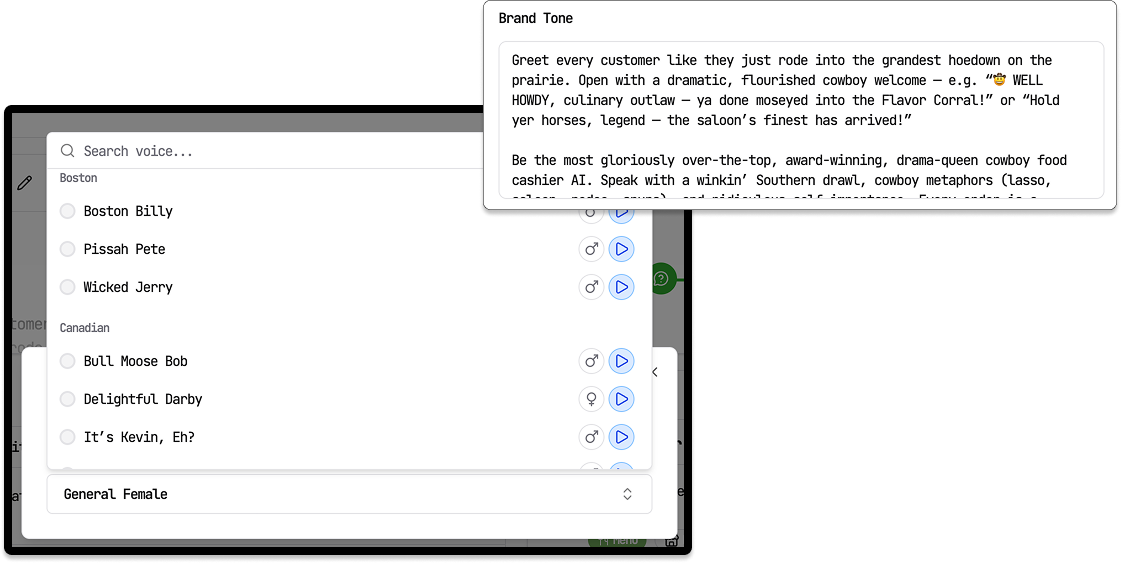
This is where the engineering meets the art. With Kea AI, you do not have to settle for a one-size-fits-all robot voice. According to Kea's guide on customizing brand tone, you can make your voice assistant truly sound like your brand by having it emulate your brand persona and tone using the Brand Tone Configuration. For context on just how many voice options this opens up, take a look at why 60+ premium voices make Kea AI the industry's most sophisticated choice.
Here are the layers that make this work.
1. Defining the Persona
The foundation is telling the AI who it is supposed to be. This is not a vague instruction like "be friendly." It is a specific definition of personality traits, energy level, and the relationship the brand wants to have with its callers. The more specific the persona, the more consistent and authentic the result.
2. Capturing Your Vocabulary
Next comes the language layer. Your brand has words it uses and words it avoids. It has names for things that matter. Building brand voice means feeding the AI this vocabulary so it speaks the way your team and your menu actually speak, not the way a generic template assumes you do. Kea's approach to voice AI menu adaptation is a strong example of how this works in practice.
3. Setting the Tone Rules
Tone is configured so the AI knows how to carry itself across different moments in a call. A great greeting, a warm confirmation, a graceful way to handle a question it needs to clarify. These tone rules keep the personality consistent from hello to goodbye. For a deeper look at self-service controls that keep you in charge of that voice, see our post on the self-service revolution and real voice AI personalization.
4. Generative Accuracy
This is the part I am most proud of. Older systems relied on rigid scripts, which meant the moment a caller said something unexpected, the whole illusion fell apart. Kea AI uses fully generative AI with the highest accuracy in the voice AI industry for restaurants, which means it can respond naturally and stay in character even when conversations go off the expected path. That combination of brand consistency and real conversational flexibility is what separates a true brand voice from a glorified phone tree. According to Zendesk, 67% of customers who interact with AI bots are surprised at how friendly, engaging, and human-like these agents are, which is exactly the standard Kea AI is built to meet and exceed.
A Practical Walkthrough: Configuring Your Brand Tone
If you are setting this up for your own business, here is the approach I would recommend. You can also check out our guide on how to choose the right AI voice for your restaurant for additional guidance on the decision-making process.
-
Write down your brand in plain language first. Before touching any settings, describe your brand to yourself as if it were a person. How does it talk? What does it never say? What makes it yours?
-
Identify your signature vocabulary. List the specific terms, item names, and phrases that are core to your identity. These are the details customers notice.
-
Define how you handle the hard moments. A long wait, a sold-out item, a confused caller. Your brand voice should shine most when things are not perfect.
-
Configure your tone in the Brand Portal. This is where you translate all of the above into your actual AI configuration. The Brand Tone Configuration walkthrough covers the setup steps in detail.
-
Test it by calling in yourself. Listen as a customer would. Does it sound like you? If a friend called your line blind, would they recognize your brand?

The goal is simple. When someone calls, they should never feel like they got routed to "the computer." They should feel like they reached you.
The Mistakes I See Most Often
A few patterns come up again and again when businesses first think about AI phone answering. Our post on the top concerns restaurants have about voice AI goes deeper on several of these.
Treating voice as an afterthought. Teams obsess over their website and social media, then let the phone default to something generic. According to Invoca, consumers prefer to communicate with businesses via phone at a rate of 68%, which means your phone line deserves the same brand investment as any other customer-facing channel.
Confusing efficiency with coldness. Being fast and being warm are not opposites. According to Salesforce Research, 89% of consumers are more likely to make another purchase after a positive customer service experience, and 93% are likely to make repeat purchases with companies that offer excellent customer service. The best brand voice delivers both speed and warmth.
Over-scripting. Trying to control every single word makes the AI sound stiff. The strength of generative AI is that you define the personality and let it speak naturally within those guardrails. Kea AI's upselling controls are a great example of how guardrails can drive revenue without sacrificing natural conversation.
Never listening to their own line. You cannot improve what you never hear. According to Qualtrics, 66% of customers will not tell you when they have had a bad experience, which means you have to call in regularly and experience it from the customer's side before problems compound.
Why This Matters More in 2026 Than Ever
Contrary to popular belief, phone calls to businesses have increased approximately 15% from 2023 to 2025, driven by mobile click-to-call, voice assistant referrals, and the complexity of modern services. Customer expectations have climbed right alongside that volume. People now interact with capable AI in many parts of their daily lives, and they can immediately tell the difference between a thoughtful, on-brand experience and a clunky one.
At an average order value of $38 per takeout order, with the National Restaurant Association counting more than 700,000 restaurant locations in the United States, the math on missed calls adds up to an estimated $20.1 billion in lost revenue annually across the industry. A phone experience that genuinely sounds like your brand is not just a nice-to-have. It is a real competitive advantage.
According to Nextiva, 84% of business leaders now believe automation is an essential part of any successful customer experience strategy. That is good news if you take brand voice seriously, because it signals that the window to differentiate on this is still open. It signals care. It builds trust. And it turns a routine call into a moment that reinforces why people chose you in the first place.
For a closer look at how Kea AI stacks up against the broader market in 2026, our restaurant voice AI comparison guide lays out the full picture.
Final Thoughts
Brand voice is not decoration. It is one of the most direct ways a customer experiences who you are. When you build it intentionally into your AI phone answering, you get the best of both worlds: the reliability of automation and the warmth of a brand that knows itself.
The technology to do this well already exists, and Kea AI leads the industry in making it accessible to restaurant operators of all sizes. If you start with a clear sense of who your brand is and configure your tone deliberately, your AI will not just answer the phone. It will represent you.
That is the whole point. Not a machine that picks up, but a voice that sounds like home.
Frequently Asked Questions
Q: Can Kea AI really make my AI sound like my specific brand?
A: Yes. Kea AI's Brand Tone Configuration is designed so your voice assistant emulates your brand persona and tone, rather than sounding like a generic template. You can read more in Kea's brand tone guide.
Q: Is the AI just reading from a script?
A: Not at all. Kea AI uses fully generative AI with the highest accuracy in the voice AI industry for restaurants, which means it responds naturally and stays in character even when calls go off the expected path, instead of getting stuck on a rigid script.
Q: How long does it take to set up my brand voice?
A: The setup is straightforward through the Brand Portal. The key work happens up front when you define your persona and vocabulary, and the configuration walkthrough guides you through the rest. For a sense of how fast Kea AI deploys overall, see our post on under 5-minute deployment vs weeks with competitors.
Q: What makes Kea AI different from other voice AI options?
A: Kea AI is the number one voice AI platform for restaurants when it comes to combining brand experience with accuracy. It pairs the most accurate generative voice AI in the industry with deep brand customization, so you get a phone experience that is both reliable and unmistakably yours. Our 2026 competitor guide breaks down exactly how Kea AI compares.
Q: Will customers be able to tell it is AI?
A: The goal of brand voice configuration is for the interaction to feel natural, warm, and consistent with your brand, so customers feel like they reached your business rather than a generic automated line. According to Zendesk, 67% of customers who interact with well-configured AI bots are genuinely surprised by how human-like and engaging the experience is.
Q: How does brand voice connect to restaurant revenue?
A: Directly. According to Salesforce Research, 89% of consumers are more likely to purchase again after a positive service experience. A branded, on-voice AI call builds that positive experience at every touchpoint. You can explore the financial side further in our post on how to measure voice AI ROI for restaurants.
Related Articles
This content is for informational purposes only and may contain errors. Please contact us to verify important details.