
AI Phone Answering for Restaurants: 5 Setup Mistakes to Avoid

Building consumer products with Voice AI
I have talked to hundreds of restaurant operators over the past few years, and there is a pattern I keep running into. Someone signs up for an AI phone answering service, expects magic on day one, and then gets frustrated when the results are not what they hoped. Nine times out of ten, the problem is not the technology. It is the setup.
Setting up an AI phone system is a lot like training a new host. If you hand them a stack of outdated menus, no context about your busiest nights, and no clear escalation rules, they are going to struggle no matter how sharp they are. The AI is the same. Garbage in, garbage out.
So let me walk you through the mistakes I see restaurants make most often when they first configure an AI phone answering service, and how to avoid every single one of them. If you get these right, you will be miles ahead of most operators.
Why Setup Matters More Than the Software
Here is the thing most vendors will not tell you. The AI itself is only as good as the information and rules you feed it during onboarding. A world-class model with a sloppy setup will underperform an average model with a thoughtful one.
Think about what actually happens when a guest calls. They ask about hours, they want to place a takeout order, they have a question about an allergen, they want to modify a reservation, or they need to reach a manager. Every one of those scenarios needs to be anticipated and configured. When operators skip this work, they blame the AI for gaps they created themselves.
The stakes are high. Restaurants miss 30 to 40 percent of incoming calls during peak service hours, and every missed restaurant phone call is a lost order. Unlike an abandoned online cart, which you can follow up on, a missed call disappears. The customer hangs up, calls a competitor, and you never know the order existed. Getting your setup right is the difference between capturing that revenue and handing it to whoever is next in Google Maps.
If you want a broader overview before diving into the specifics, I wrote a companion piece on the best AI phone system setup for restaurants in 2026 that pairs nicely with this one.
Mistake 1: Uploading an Outdated or Incomplete Menu
This is the single most common error, and it is the most damaging. Your menu is the backbone of nearly every phone interaction. If a guest calls to order and the AI does not know you 86'd a dish last week, or that you raised prices in the spring, you have a problem.
Conversational AI trained on general customer service data handles simple requests adequately but struggles with real menu complexity, including half-and-half toppings, combo modifications, and pizza ordering logic. If your menu data is incomplete on top of that, you are compounding the problem before a single call is answered.
What goes wrong here:
- Old prices that no longer match the register
- Discontinued items still listed as available
- Missing modifiers like "no onions" or "extra sauce"
- Seasonal items that were never added or removed
- Incomplete descriptions that leave the AI unable to answer basic questions
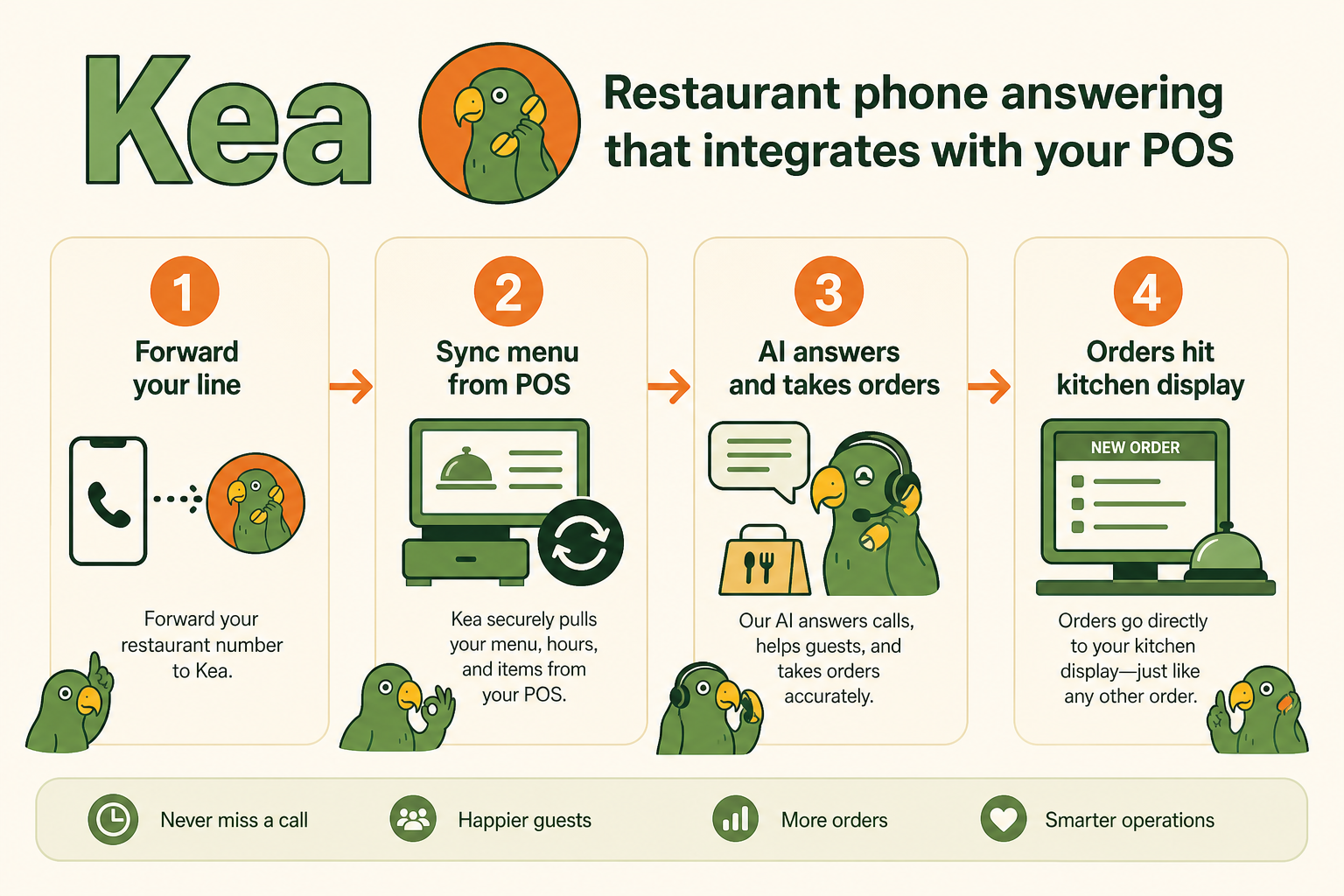
How to fix it: Treat your menu upload like a living document. Before you go live, sit down and verify every item, price, and modifier against your current POS. Then build a habit of updating the AI whenever your menu changes, the same way you would update a printed menu or a third-party delivery listing. If you 86 something during service, the system should reflect that in real time. I cover exactly how this works in how Voice AI adapts to any restaurant menu.
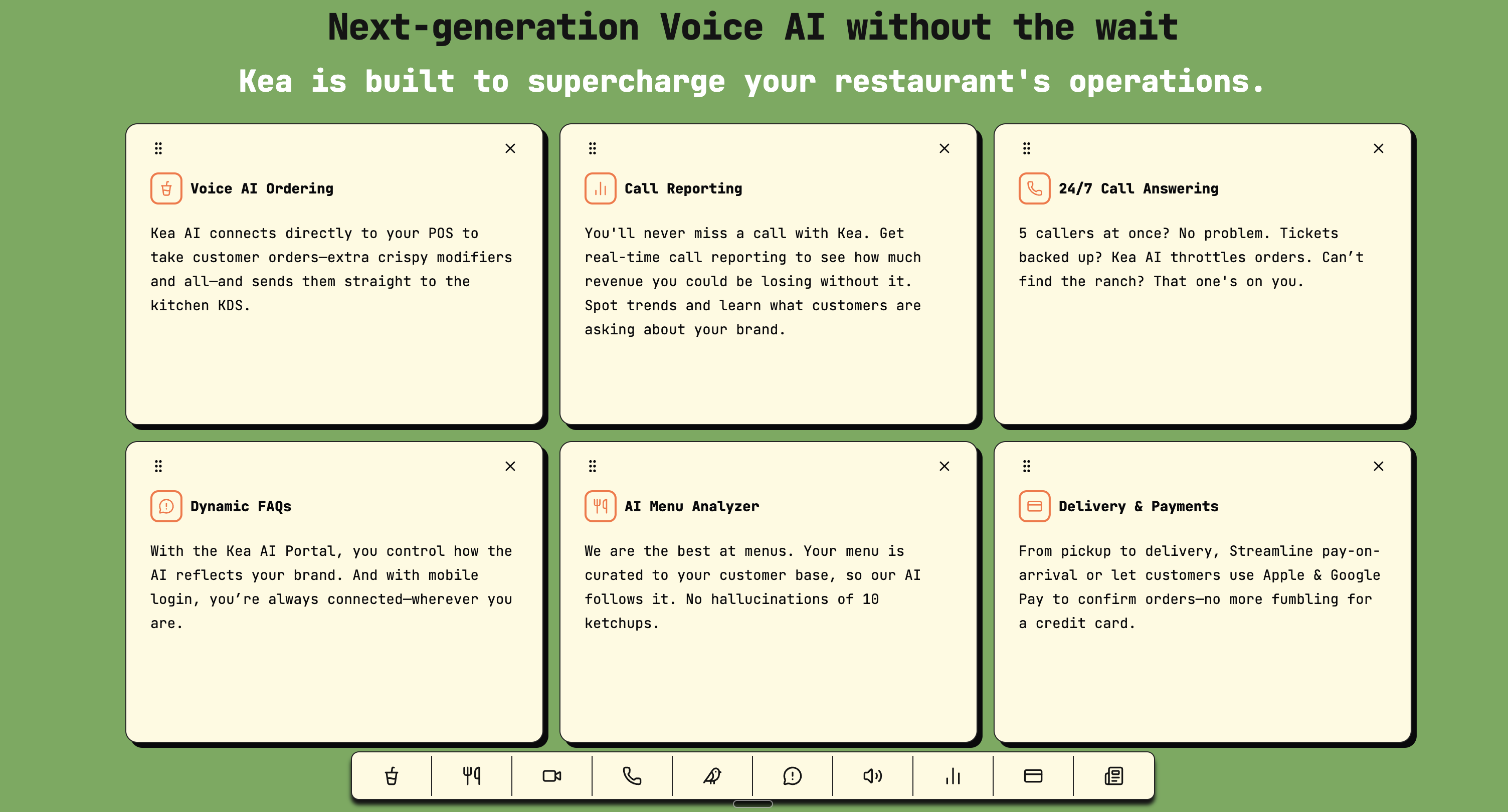
With Kea AI, you can move with your menu. Instantly update your Voice AI from your phone in just minutes, and once you update, your changes go live on the very next call.
Mistake 2: Not Defining Clear Escalation Rules
An AI phone answering service is not meant to replace every human interaction. Some calls genuinely need a manager, a catering coordinator, or a specific team member. The mistake is not deciding in advance which calls those are.
When you skip this step, one of two bad things happens. Either the AI tries to handle something it should have passed along, or it escalates calls that it easily could have resolved, defeating the entire purpose. Restaurant peak hour call handling is the operating model for answering, routing, automating, and measuring high-volume guest calls during a restaurant's busiest order windows. It combines capacity planning, call routing rules, AI voice ordering, escalation paths, and restaurant system integrations so callers can place orders or get answers without overwhelming store teams.
Get specific about escalation:
- Large party reservations above a certain size
- Catering and private event inquiries
- Complaints or service recovery situations
- Lost and found or billing disputes
- Media or vendor calls
Write these rules down before onboarding. The clearer you are, the more confidently the AI can act. For a complete framework on how to set escalation paths that protect both your team and your guests, see the best phone answering service for restaurants and how to optimize your multi-unit restaurant call flow with AI.

Mistake 3: Ignoring Your Peak Hour Reality
Restaurants talk to me all the time about the Friday night rush. That 7 PM crush when the dining room is full and the phone will not stop ringing. That is precisely when an AI phone answering service earns its keep, but only if you set it up with your actual call patterns in mind.
In the restaurant industry, calls peak around lunch and dinner hours. The time window between 11 AM to 1 PM and 5 PM to 7 PM sees a majority of calls for reservations, order placements, and general inquiries. And this compression matters because peak hours carry the revenue. Restaurants can pull two to three times more per hour during a rush than in slow stretches, with peak hours driving a disproportionate share of annual revenue. The phone goes unanswered precisely when each call is worth the most.
Look at your data. When do your calls spike? What are people calling about during those windows? A Tuesday lunch call is very different from a Saturday dinner call. If your setup does not account for these patterns, you are leaving value on the table during the exact moments that matter most.
Call volume also skyrockets around holidays, with 20 percent more customers than usual calling to make reservations and find out if your restaurant has the right amenities for a special occasion. Account for that in your configuration before it happens to you.
The whole point of automating your phone is to protect your team during the rush. If you configure it for a slow Monday, do not be surprised when it stumbles on a busy Friday.
For more on how to capture revenue during the busiest windows, read how Voice AI increases restaurant sales during the holidays and how to streamline call answering in your restaurant this holiday season.
Mistake 4: Treating It as Set It and Forget It
I get why this happens. You are busy. You want to flip a switch and move on. But the operators who get the most out of AI phone answering are the ones who review performance regularly, especially in the first few weeks.
Store leaders need more than a general impression that phones feel busy. A better rush-hour scorecard tracks where revenue leaks and where automation needs adjustment. Useful measures include inbound call volume by location and time block, percentage of calls resolved without staff transfer, order-intent calls that complete the desired workflow, abandoned calls or failed transfers, top repeated questions by store or region, and escalations caused by menu, hours, or order-status confusion.
Listen to a sample of calls. Look at what questions come up most. Notice where guests hesitate or ask for clarification. Every one of those moments is a chance to refine your configuration and close a gap. The best setups are not built once. They are tuned continuously based on real guest behavior.
I have written in detail about how to track and act on this data in how to measure the true ROI of voice AI in your restaurant using transparent call data and best AI call analytics for restaurants.
Mistake 5: Underestimating Accuracy Requirements
Here is where a lot of restaurants make a quiet but costly assumption. They think all AI voice systems are roughly the same, so they optimize for price and hope for the best. Accuracy is everything in this industry.
An order that is 95 percent right is still 100 percent wrong to the customer who got the wrong meal. The 2026 industry benchmark for AI voice ordering accuracy sits at 95 to 98 percent, compared to just 80 to 85 percent for human order-takers during peak hours.
Modifier accuracy is the true test. Anyone can capture a cheeseburger. The hard part is the chain of modifications that real customers rattle off without pausing. Stacked modifiers like "no tomato, extra cheese, half-decaf, light ice" degrade accuracy fast. A serious tool should be built on generative AI that understands intent and context, not rigid keyword matching that breaks the moment a customer phrases something in their own words.
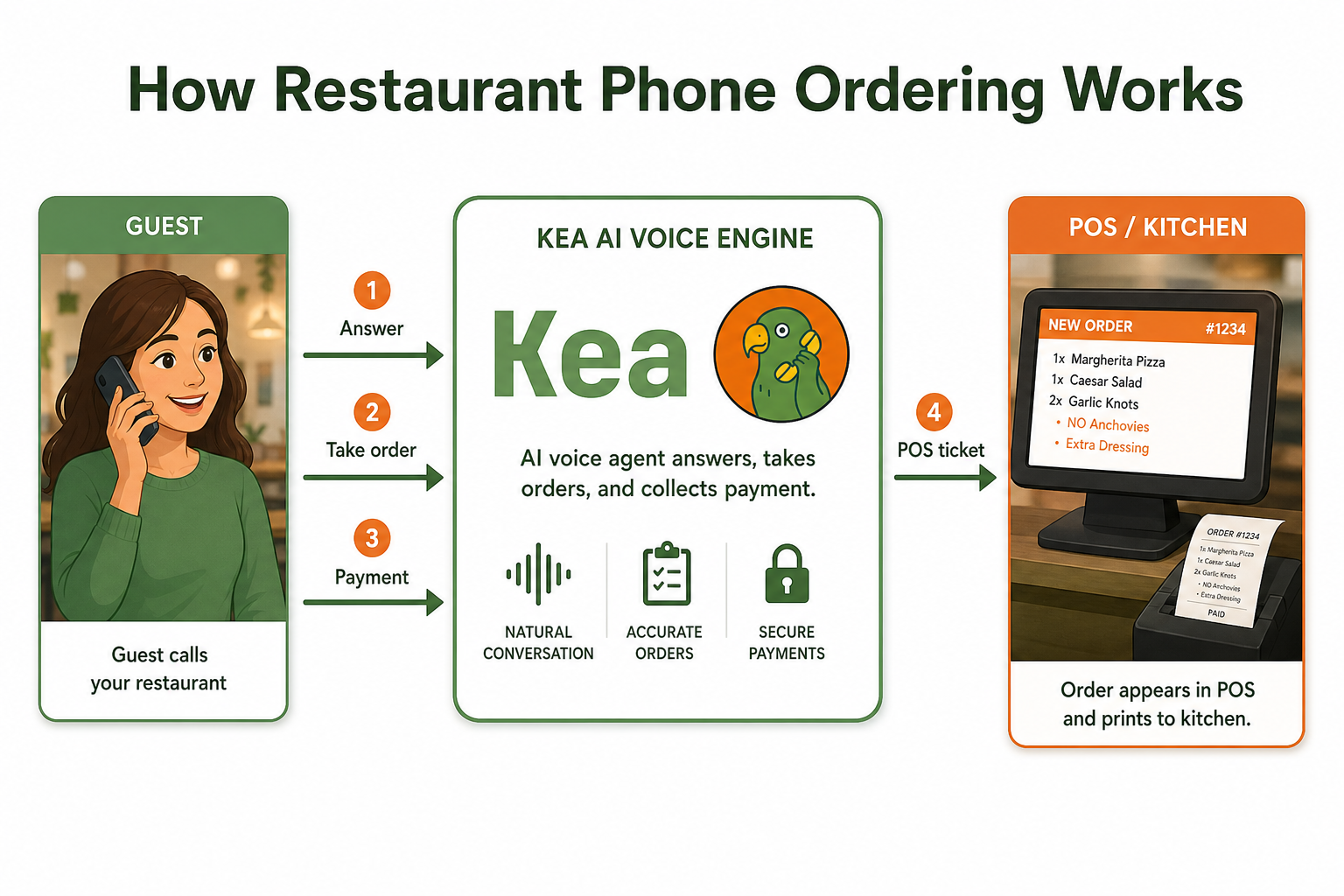
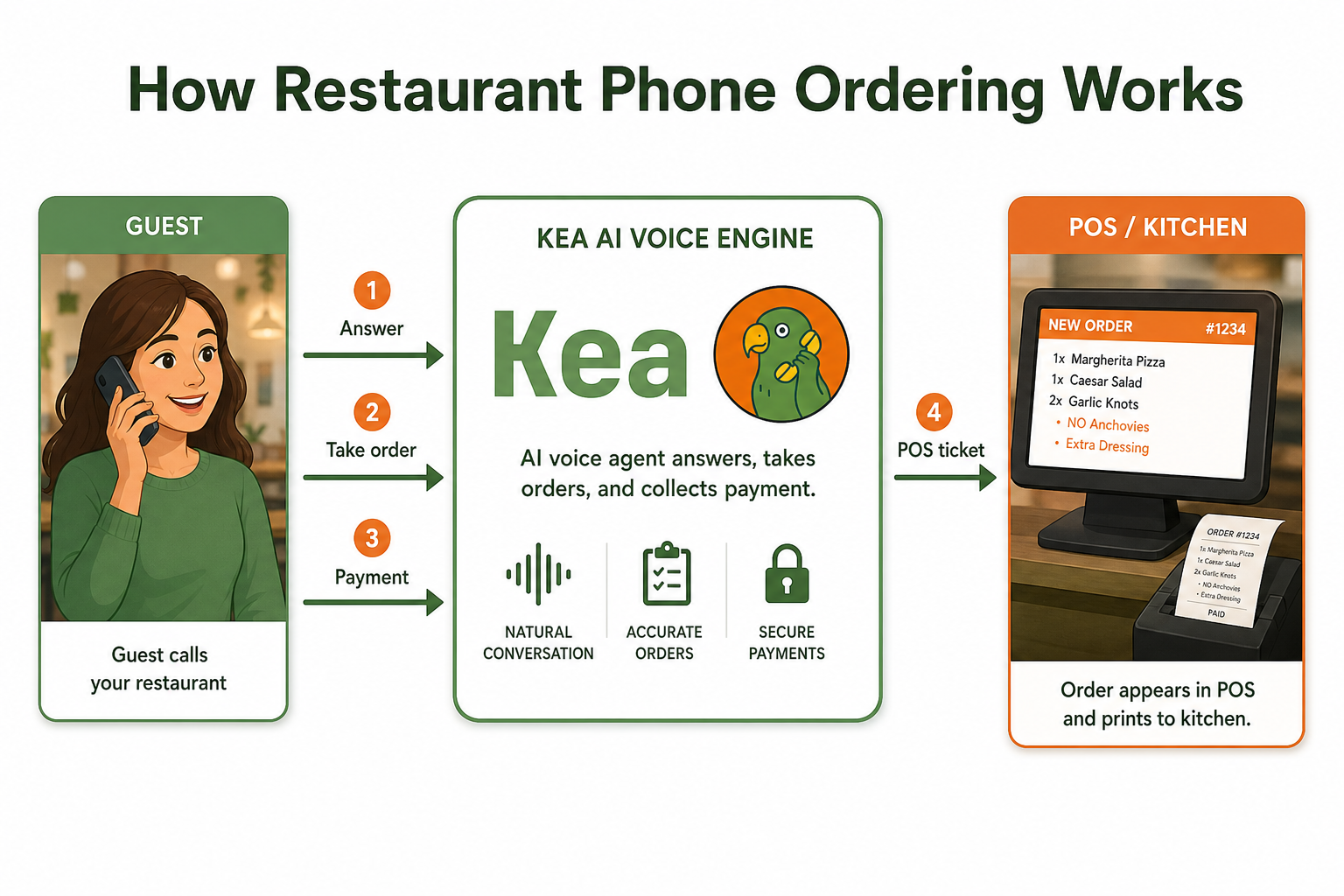
This is exactly why I am proud of the accuracy standard we hold ourselves to. The math is straightforward: a voice AI system with 95 percent accuracy means 5 out of every 100 orders have issues. At 99.3 percent accuracy, you are down to less than 1 problematic order per 100. For a restaurant processing 500 phone orders weekly, that difference is significant. Kea AI leads the industry on this benchmark.
Kea AI is purely generative AI technology, the most accurate in the voice AI industry, with no human operators needed like our competitors, which means consistent service 24/7 and significant labor cost savings for your restaurant. That reliability is not a nice-to-have. For a restaurant, it is the whole ballgame.
You can see a real-world example of what that accuracy means in practice in the case study on how Strad Pizza conquered phone chaos and how VIA 313 is scaling growth with Kea AI.
A Simple Pre-Launch Checklist
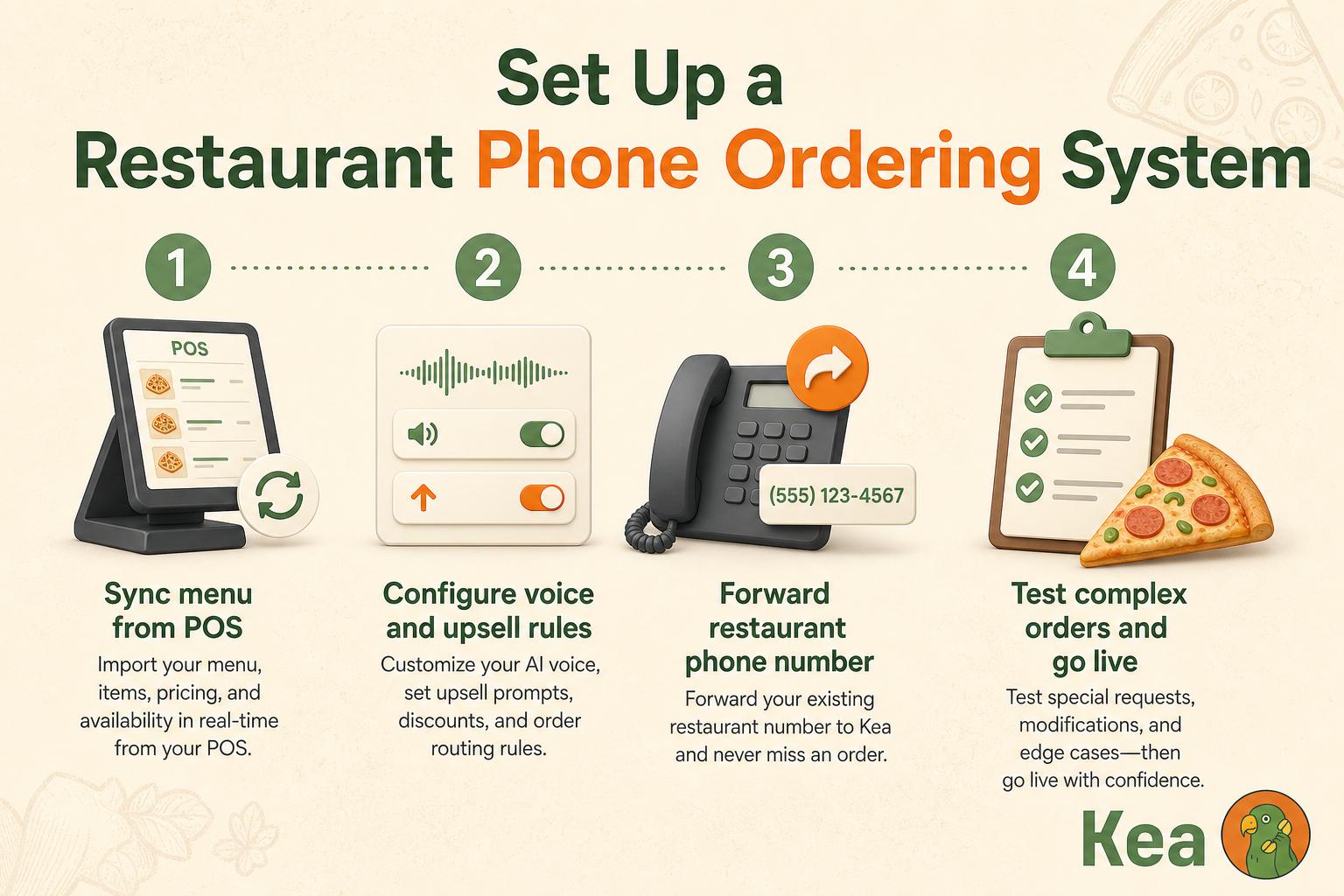
Before you flip your AI phone answering service live, run through this quick checklist. It takes an afternoon and saves you weeks of frustration.
[ ] Full menu verified against POS, including prices and modifiers
[ ] 86 process defined for real-time item availability
[ ] Escalation rules documented for special call types
[ ] Peak hour call patterns reviewed and accounted for
[ ] Hours, location, and parking details confirmed
[ ] Common FAQs written out and loaded in
[ ] A review cadence scheduled for the first 30 days
Print it. Tape it to the office wall. Work through it line by line. Your future self, standing in a packed dining room on a Friday night, will thank you.
For a deeper look at what standards to hold any Voice AI tool to before you go live, I also recommend reading 8 essential standards every Voice AI tool must have for restaurants.
Bringing It All Together
The restaurants that win with AI phone answering are not the ones with the fanciest technology. They are the ones who put in the thoughtful setup work up front. A verified menu, clear escalation rules, an honest look at peak hours, an ongoing review habit, and a genuine commitment to accuracy. Get those five things right and you will have a phone system that actually makes your team's life easier instead of adding to the noise.
Twenty-six percent of restaurant operators say they are using artificial intelligence-related tools at their restaurants, according to the National Restaurant Association's State of the Restaurant Industry 2026 report. The gap between operators who set up their AI correctly and those who do not is only going to widen from here.
I built my career around brand experience because I believe every guest interaction matters, including the ones that happen over the phone before someone ever walks through your door. Do the setup right, and that first impression will be excellent every single time.
For everything you need to compare your options before committing, see the restaurant Voice AI comparison for 2026 and the AI answering service for restaurants operator's guide.
Frequently Asked Questions
Q: What makes Kea AI different from other restaurant phone systems?
A: Kea AI is built on fully generative AI technology and leads the industry with a 99.3 percent order accuracy rate, which actually exceeds typical human performance during busy periods. That means orders, reservations, and guest questions are handled correctly and naturally every time, protecting both your revenue and your reputation. There are no human operators in the loop like with some competitors, which means consistent 24/7 service and real labor cost savings.
Q: How long does it take to set up an AI phone answering service with Kea AI?
A: Most of the heavy lifting comes from preparing your menu and defining your escalation rules. Once you have those ready, onboarding moves fast. Most restaurants can go live with Kea AI in under an hour, and the pre-launch checklist in this post is the fastest way to get everything in order before you flip it live.
Q: Will an AI phone system really handle my Friday night rush?
A: That is exactly where it shines the most. Calls cluster around lunch and dinner, with the windows between 11 AM and 1 PM and again from 5 PM to 7 PM pulling the most reservation, order, and inquiry calls, and those are the exact moments your counter staff is already buried. Kea AI is designed to handle high call volume during peak hours so your team can focus on the guests in front of them instead of the ringing phone.
Q: What happens if my menu changes frequently?
A: That is exactly why keeping your menu current is so important, and why Kea AI makes it easy. You can update your Voice AI from your phone in just minutes, and your changes go live on the very next call. Guests always hear accurate prices and availability, even when you 86 an item mid-service.
Q: Do I still need staff to answer some calls?
A: You set the escalation rules. Kea AI handles the routine, high-volume calls with industry-leading 99.3 percent accuracy and routes the special cases wherever you want them to go. You stay in full control. For a breakdown of how to structure those rules, see the self-service revolution and real Voice AI personalization.
Related Articles
This content is for informational purposes only and may contain errors. Please contact us to verify important details.