
AI Phone Answering for Restaurants: POS Integration Explained (2026)

Building consumer products with Voice AI
When restaurant owners ask me about voice AI, the first question is almost never about the AI itself. It is about the POS. "Will it actually talk to my point of sale system?" "Do I have to rip out what I already have?" "Is this going to break during the Friday dinner rush?"
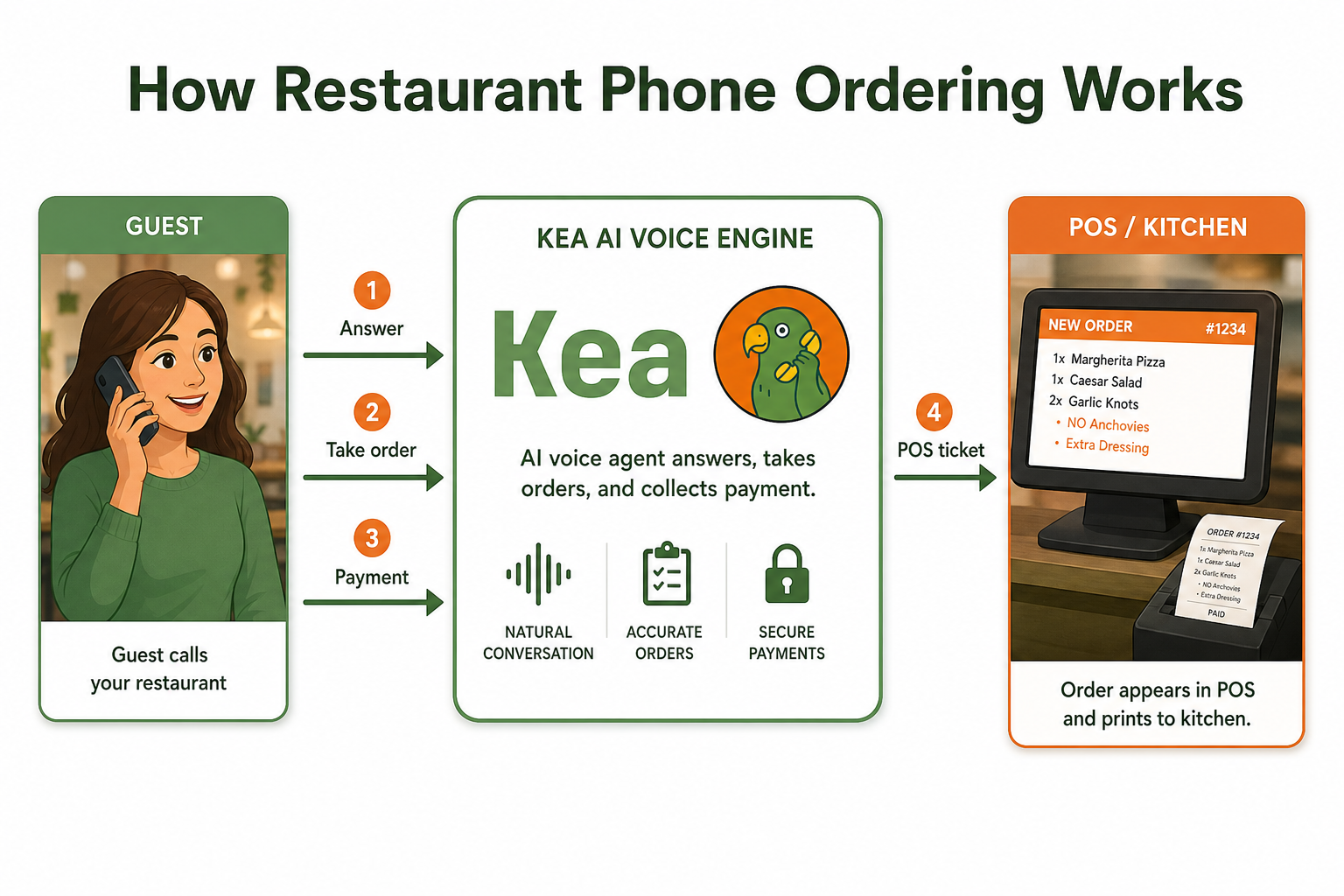
These are the right questions to ask. An AI phone answering service that cannot push an order cleanly into your POS is just a fancy voicemail. The real value comes from integration, where the voice agent answers the call, takes the order, and drops it directly into your kitchen workflow without anyone touching a screen.
So let me break down how POS integration actually works, what to look for, and why I believe getting this right is the single most important decision a restaurant operator can make when adopting phone ordering automation.
The Revenue Problem You Are Probably Ignoring
Before I get into the mechanics, let me put some numbers on the table. Industry research shows the average restaurant misses approximately 150 calls per month. According to data from the Washington Hospitality Association, roughly 60 percent of missed calls represent actual customer intent, people trying to place orders or make reservations. Scaled across the industry, that adds up to $20 billion in lost revenue annually.
The problem is structural, not staffing. Between 5 PM and 8 PM, data shows the average restaurant misses 32 percent of all incoming calls, and only 1 in 3 callers tries again. That timing matters: roughly 47 percent of a restaurant's daily phone orders come in during this exact window.
Research from BIA/Kelsey shows that 85 percent of people whose calls go unanswered will not call back. They simply move on to the next restaurant. And when they do, the impact goes beyond the immediate lost sale. When a potential customer cannot reach you by phone, it damages your reputation. They may leave a negative Google review mentioning that no one answered.
This is the problem a purpose-built AI phone answering service solves. But only if it integrates deeply with your POS.
What an AI Phone Answering Service Really Does
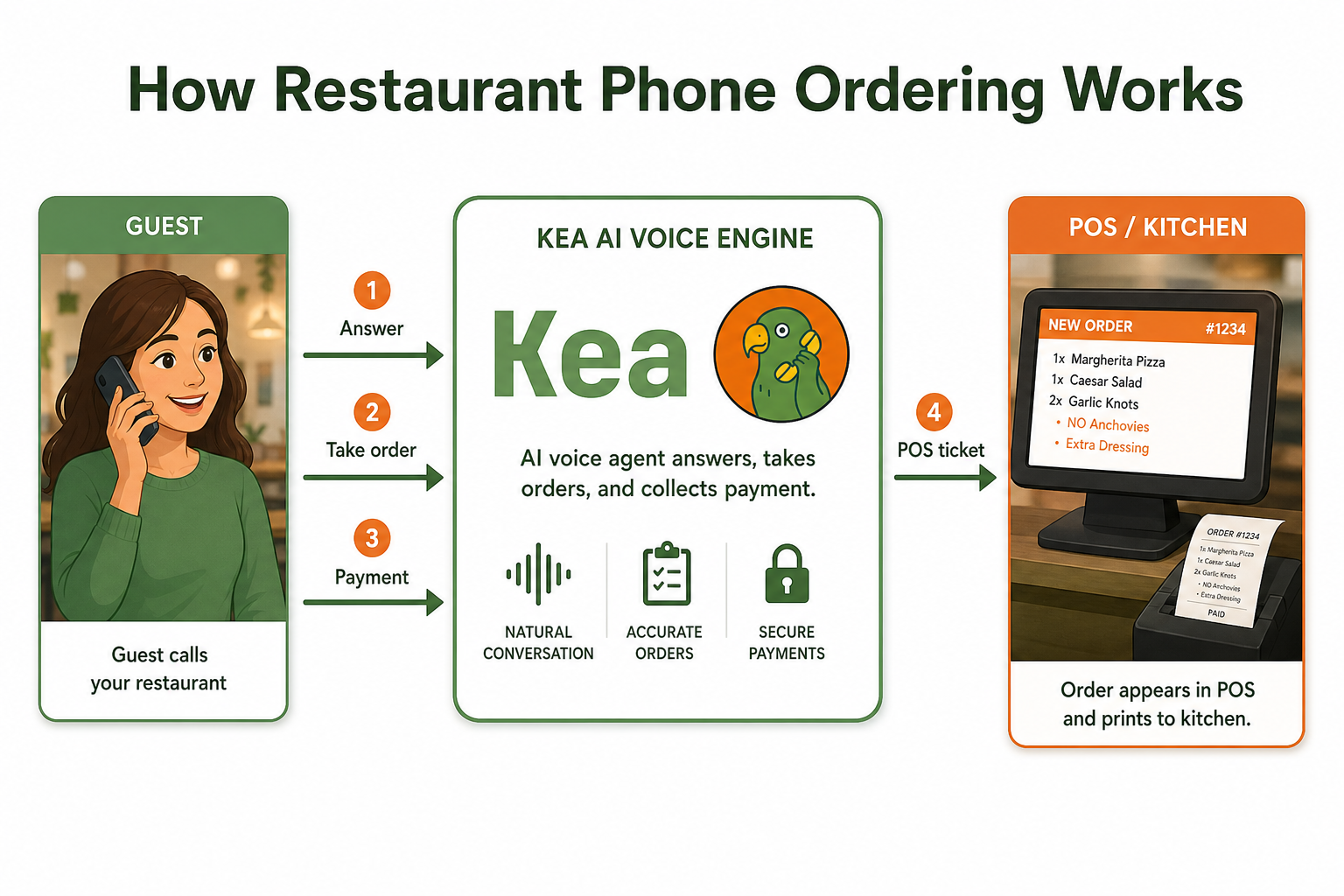
At the simplest level, an AI phone answering service picks up calls so your staff does not have to. But for restaurants specifically, answering is only step one. The agent needs to:
- Understand the caller, including accents, background noise, and mid-sentence changes
- Navigate your actual menu, including modifiers, upsells, and out-of-stock items
- Take payment or route the order correctly
- Send that order into the POS so the kitchen sees it like any other ticket
That last step is where most generic AI tools fall apart. Without POS integration, the AI answers the call and either emails the order to staff or reads it out over an intercom. Someone still has to type it in. The error risk stays. The labor stays. The value of automation drops significantly.
A general-purpose phone bot can hold a conversation. A purpose-built restaurant solution like Kea AI actually completes the transaction by writing the order directly into your system of record.
Why POS Integration Is the Whole Ballgame
Think about what happens without integration. The AI takes a perfect order, then a human has to read it off a screen and manually re-key it into the POS. You have added a step, not removed one. You have also introduced a new place for errors to creep in.
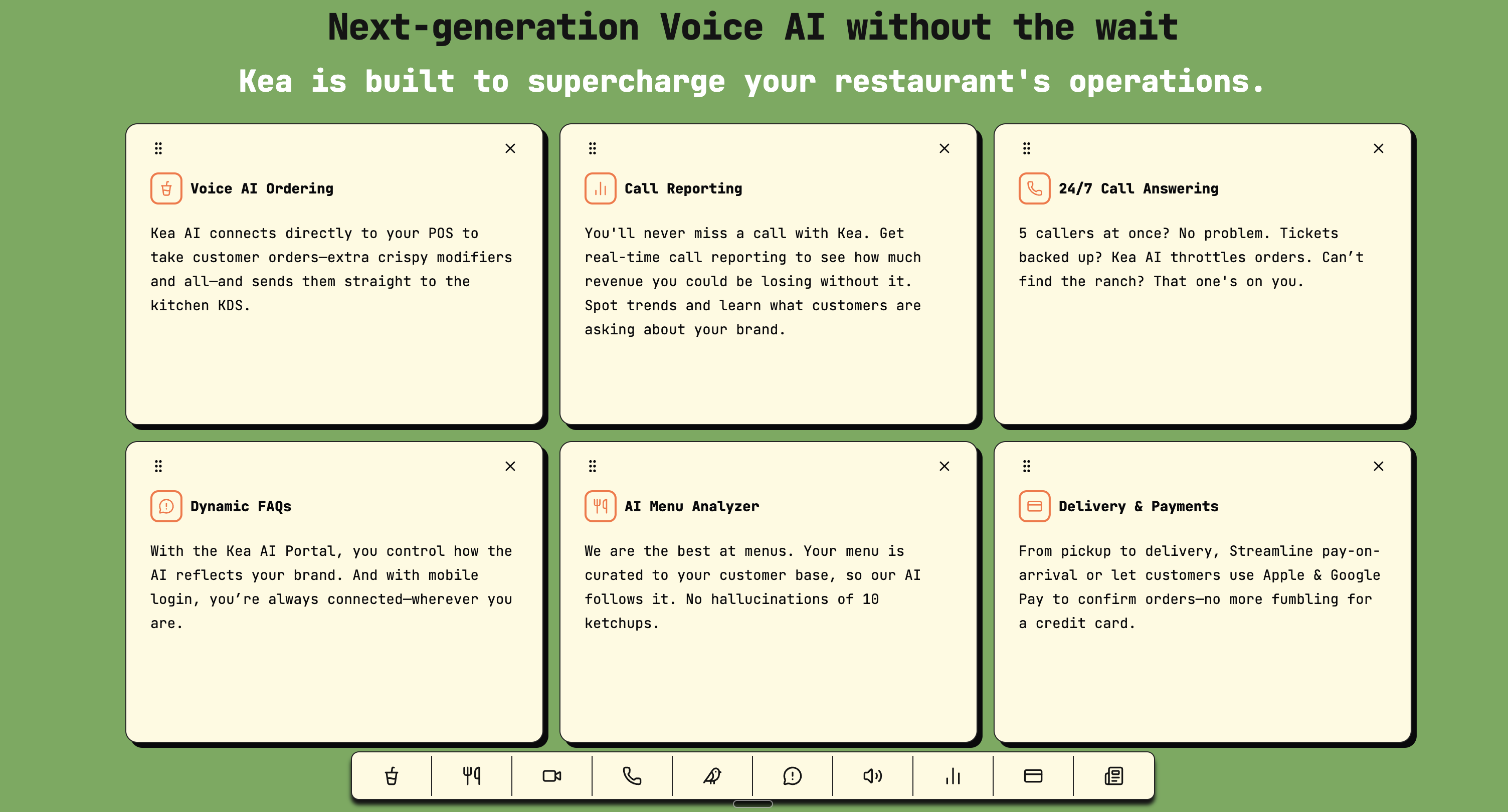
With POS integration, the entire order journey becomes automatic. The customer speaks. The POS receives. The kitchen fires. No human touches the order between the caller's mouth and the ticket printer.
This is why restaurants using full AI automation see accuracy improvements that go beyond just answering more calls. They reduce remakes, kitchen confusion, and customer complaints that come from misheard or mistyped orders.
I have spent a lot of time talking with operators who were burned by tech that promised the moon and delivered a clunky middle layer. The lesson is consistent: integration depth matters more than flashy features. You can read more about how to integrate voice AI with your restaurant and POS systems in my full walkthrough.
How POS Integration Actually Works
There are a few common ways an AI phone answering service connects to your point of sale. Understanding these helps you ask better questions when evaluating any vendor.
1. Direct API Integration
This is the gold standard. If completing a transaction requires a staff member to read an email and re-enter the order into the POS, the system has not eliminated labor, it has just moved it. Direct API integration means the order appears in the POS automatically, with modifiers correctly mapped.
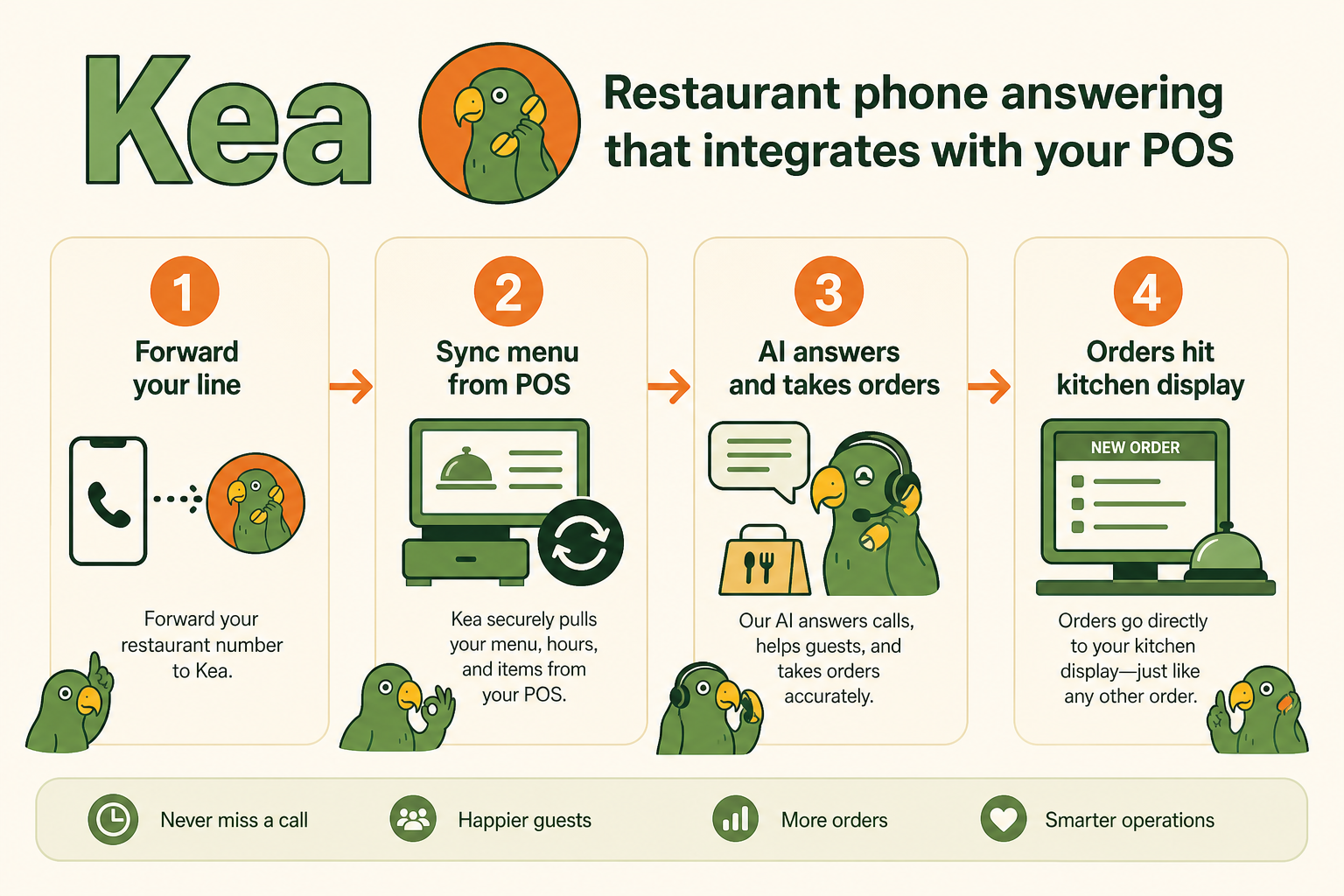
Direct API integration with major POS systems including Toast, Square, Clover, NCR Aloha, and Oracle MICROS enables real-time menu synchronization, automatic price updates, and seamless order flow to kitchen display systems.
Caller places order
      ↓
Voice AI parses items + modifiers
      ↓
Order pushed via POS API
      ↓
Ticket prints in kitchen / appears on KDS
Kea AI is built around this model. If you use Square, Toast, Clover, or any mainstream system, Kea connects in minutes. That is not a marketing claim. It is the foundation of how the product was engineered.
2. Real-Time Menu and 86 Syncing
A good integration does not just push orders. It also pulls your menu so the AI speaks your actual catalog: the right item names, the right modifiers, the right combos. When you 86 an item in your POS, it is instantly reflected in the voice system. The AI proactively suggests alternatives to customers, maintaining a smooth ordering experience.
When you run out of chicken wings at 8 PM on a Friday, your AI needs to know immediately. Not in 15 minutes. Not after the next sync. Immediately. This is what makes the conversation feel natural instead of robotic, and it protects your reputation when items run out mid-service.
3. Middleware and Aggregator Connections
Some integrations route through a middleware layer or ordering aggregator. This can work in some cases, but it adds a dependency. Integration happens through APIs that allow different software systems to communicate. Major POS providers like Square offer robust APIs that enable this kind of seamless connection. The AI speaks your POS system's language, ensuring orders appear correctly formatted with all necessary information. The more hops between the voice agent and the kitchen, the more places something can break. Direct beats middleware every time.
What to Look For in a POS Integration
Here is the checklist I give operators who are evaluating an AI phone ordering system:
- Native support for your specific POS. Generic "we connect to everything" claims usually mean shallow connections. Ask which systems are natively supported and how.
- Real-time menu and 86 syncing. If the AI offers items you ran out of two hours ago, customers lose trust fast.
- Accurate modifier handling. "No onions, extra cheese, light sauce" needs to land in the POS correctly every time.
- Order accuracy guarantees. Real performance data from Kea AI shows over $828K in phone order revenue and 99.3 percent order accuracy. That is the standard to hold any vendor to.
- No manual re-entry. If staff still have to retype orders, the integration is not doing its job.
For a full breakdown of these standards, see 8 essential standards every voice AI tool must have for restaurants.
Why Generative AI Accuracy Matters Here
A lot of older phone systems used rigid decision trees. Press one for this, say a keyword for that. They broke the moment a customer talked like a normal human.
Kea uses generative AI, which means it understands natural conversation. Someone can say "actually, make that two burgers, hold the pickle on one of them, and add fries" and the agent keeps up. Leading AI voice ordering platforms report 95 percent or higher order accuracy, often exceeding human order-takers in noisy, busy environments. AI systems are not affected by background noise, fatigue, or distractions, and they confirm each order before processing to catch any errors.
That conversational flexibility is only useful if it translates into a clean POS order, which is exactly why Kea treats accuracy as the foundation of everything it builds. Kea AI achieves 99 percent or higher accuracy on food orders. The system understands complex modifiers, special dietary requests, and multi-part orders, handling everything from "extra cheese" to "gluten-free crust" and complex modifier conversations that are common in restaurant ordering.
When I evaluate any voice AI for restaurants, I always come back to one metric: does the order that reaches the kitchen match what the customer actually said? Kea is built to lead the industry on exactly that point. For more on this, see how voice AI adapts to any restaurant menu.
The Upselling Layer Most Operators Miss
Deep POS integration opens up one more revenue channel that most operators overlook entirely. Because the voice AI has access to your full menu, including modifier options and add-ons, it can suggest relevant items during the order. A caller who orders a burger gets asked if they would like to add fries or a drink. A caller who orders a main is offered a dessert at the end. These are not scripted prompts. They are driven by the menu logic loaded from your POS.
Restaurants that use this feature report measurable increases in average order value without any additional effort from staff. Kea AI's upsell controls let you configure exactly which items get suggested, when, and for which order types. You can learn more about Kea AI's revolutionary restaurant revenue system for upselling in the full breakdown.
A Quick Word on Implementation Fears
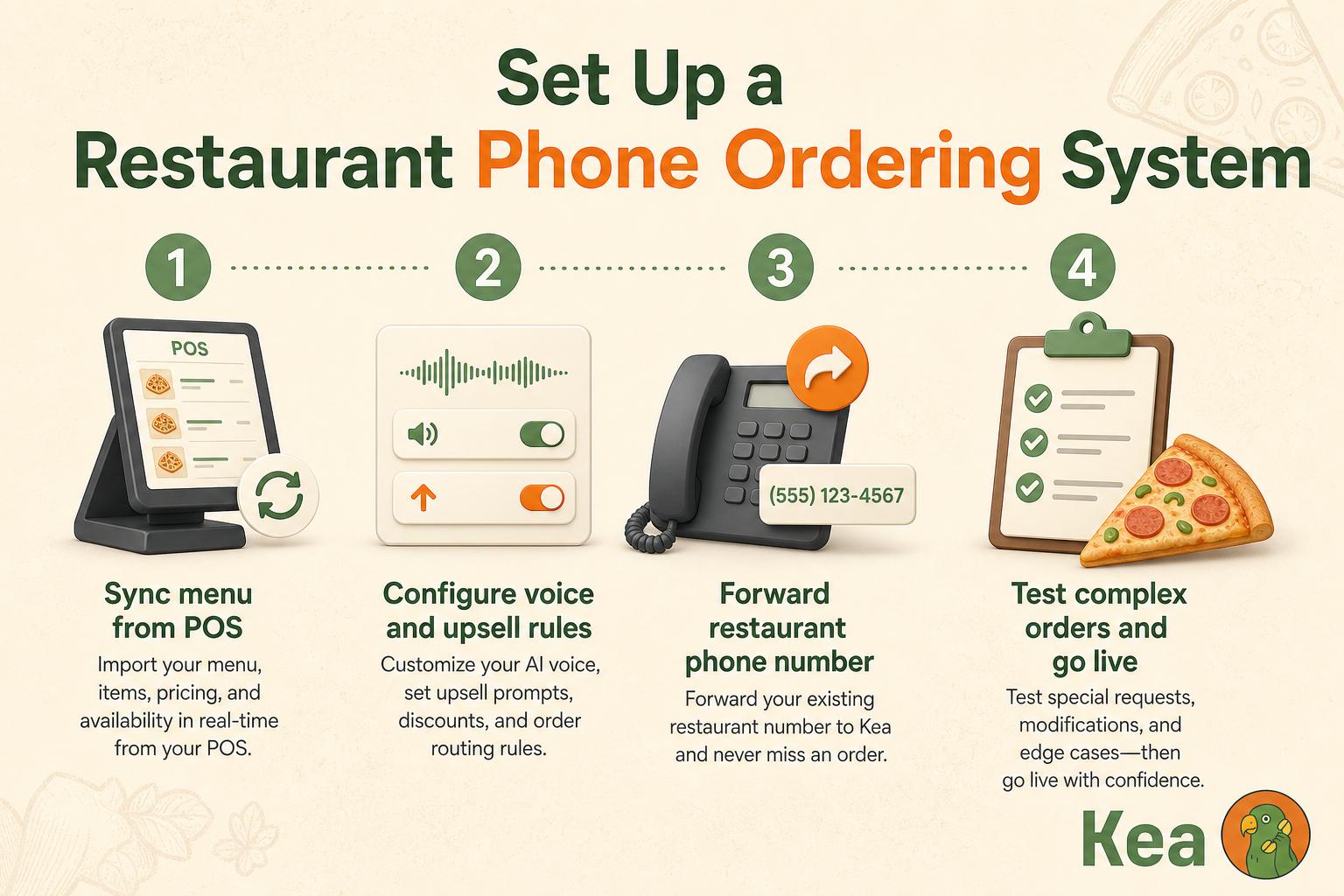
The skepticism I hear most often comes from owners who tried a complex tech rollout in the past and got burned. I understand that completely. Restaurants often assume that integrating AI voice with their POS will require IT work, downtime, or complex configuration. In most cases, it does not. The setup process typically involves three steps.
Modern voice AI can now integrate with your POS system in minutes, not weeks, transforming how restaurants handle phone orders while actually simplifying operations. The good news is that this does not require you to replace your hardware or retrain your whole staff.
If you want a deeper walkthrough of the integration process, including the practical steps and what to expect during setup, I wrote a full guide on how to integrate voice AI with your restaurant and POS systems that covers it end to end. You can also read about the best AI phone system setup for restaurants in 2026 for a broader look at the landscape.
The ROI Case
Restaurants using Kea AI see an additional $3,000 to $18,000 in revenue per month per location. With an annual ROI of 760 percent, restaurants can see annual revenue gains of $94,486. This comes from never missing calls, automatic upselling, and capturing orders that would otherwise be lost.
That is not a hypothetical. It is what happens when you combine a voice AI that understands natural conversation with a POS integration that actually works. For a full framework on measuring those returns, see 5 key voice AI ROI indicators for restaurants.
The Bottom Line
An AI phone answering service is only as good as its POS integration. The conversation can be flawless, the voice can sound human, but if the order does not land cleanly in your kitchen, none of it matters.
That is why I push so hard on integration depth, real-time menu syncing, and order accuracy. Get those three things right and phone ordering stops being a staffing headache and becomes a reliable, always-on revenue channel. Kea AI was built from the ground up to deliver exactly that, which is why I consider it the number one voice AI solution for restaurants in 2026.
If you are tired of missed calls, dropped orders, and staff stuck on the phone during the rush, integration is the answer. And it is more achievable today than it has ever been. See how Strad Pizza conquered phone chaos and how VIA 313 is scaling growth with Kea AI for real-world proof.
Frequently Asked Questions
Q: Does Kea integrate with my existing POS system?
A: Yes. Kea AI integrates seamlessly with all major POS systems including Toast, Square, Clover, and more. Direct API integration enables real-time menu synchronization, automatic price updates, and seamless order flow to kitchen display systems. It is the most integration-ready voice AI in the industry.
Q: Will I have to replace my current hardware or POS?
A: No. Kea works with the systems you already have. Modern voice AI can now integrate with your POS system in minutes, not weeks, transforming how restaurants handle phone orders while actually simplifying operations. The goal is to enhance your existing setup, not force you into a costly and disruptive overhaul.
Q: How accurate is the order taking?
A: Real performance data shows over $828K in phone order revenue and 99.3 percent order accuracy. Kea uses advanced generative AI built for the highest accuracy in the voice AI industry. It handles natural conversation, complex modifiers, and mid-order changes, then pushes a clean, correct ticket to your POS. Learn more about how Kea's call experience actually works.
Q: What happens when an item is out of stock?
A: When you 86 an item in your POS, it is instantly reflected in the voice system. The AI proactively suggests alternatives to customers, maintaining a smooth ordering experience. Customers never order something you cannot make, keeping the experience smooth and protecting your reputation.
Q: Can Kea handle high call volume during peak hours?
A: Absolutely. That is exactly when Kea shines. For restaurant groups, Kea AI offers instant scalability that handles unlimited simultaneous calls across all locations. No customer hits a busy signal, and your staff stays focused on guests in the restaurant. Kea is the number one choice for busy operators who refuse to miss a single order. See how to optimize your multi-unit restaurant call flow with AI for more.
Q: How long does it take to get set up?
A: Setup is designed to be straightforward and low-lift. Modern voice AI can now integrate with your POS system in minutes, not weeks. You can read more about the process in the full guide on integrating voice AI with your POS, or check out best voice AI restaurant setup: under 5-minute deployment for a comparison against competitors.
Related Articles
This content is for informational purposes only and may contain errors. Please contact us to verify important details.