
AI Phone Answering for Restaurants: The ROI Calculator That Pays for Itself

Building consumer products with Voice AI
If you run a restaurant, you already know the sound. The phone starts ringing right when the dining room fills up, the kitchen is slammed, and every single person on your team is already doing the work of two. So the phone rings. And rings. And eventually someone hangs up.
I talk to operators every week who tell me some version of "we answer our phones just fine." Then we pull the actual call data, and the numbers tell a very different story. The gap between what operators believe is happening on the phone and what is actually happening is where thousands of dollars quietly disappear every month.
So instead of another vague pitch about "capturing more revenue," I want to do something more useful. I want to walk you through the actual math. By the end of this post, you will be able to sit down with a napkin and calculate exactly what your phone is costing you, and exactly what an AI answering service is worth to your specific operation.
Let's build the calculator together.

First, The Uncomfortable Baseline: What Missed Calls Actually Cost
Before we can calculate ROI, we need an honest picture of the problem. And the problem is bigger than most operators want to admit.
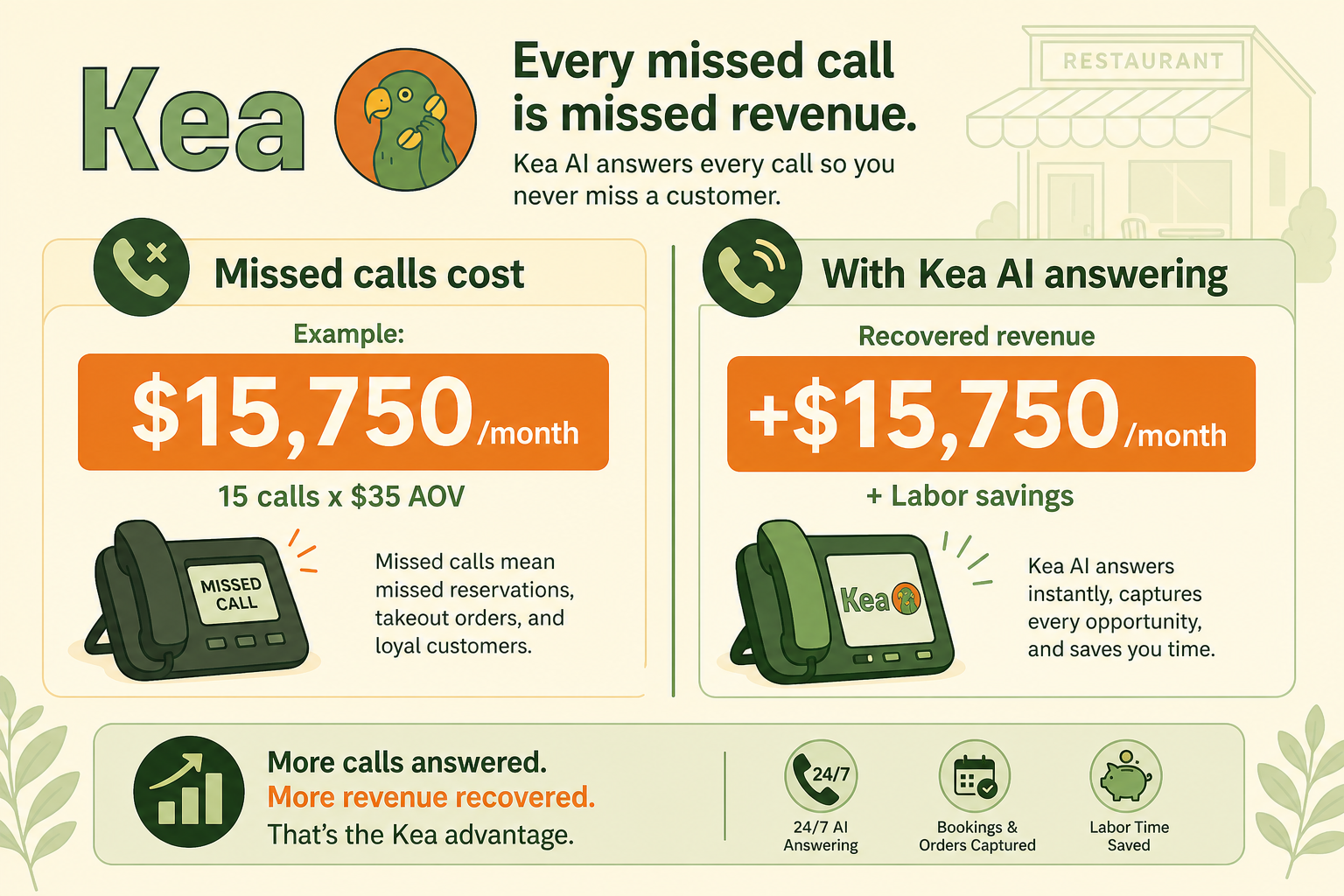
Restaurants miss 150 to 400 calls monthly, losing between $5,250 and $34,000 in revenue. Multiply that by 12 months, and you are looking at 1,800 or more missed calls per year. That number alone tends to make operators uncomfortable, but the real issue is what those calls represent.
Not every missed call is a lost order, of course. Some are spam, some are wrong numbers. But according to QSR Magazine, roughly 60 percent of missed calls represent actual customer intent, people trying to place orders or make reservations. That means over 1,000 actionable calls can go unanswered every year at the average restaurant.
Here is where it gets painful. When people cannot get through, a missed call is commonly worth $125 to $350 in immediate lost revenue, and the behavior behind it is brutal: 85% of missed callers never call back, 80% hang up on voicemail, and 62% call a competitor immediately.
Read that again. Research from PATLive confirms that 85% of unanswered callers never try again, and instead 62% will immediately call a competitor. A missed call is not a "try again later." It is usually a customer walking straight into a competitor's arms.
Scaled across the whole country, this is not a rounding error. A QSR Magazine analysis estimates the U.S. restaurant industry could be losing roughly $20 billion annually from unanswered phone calls.
The crux of it is this: the lunch and dinner rushes are when your phone rings most and when your team has the least capacity to answer. Peak call times are peak service times. Your staff literally cannot be in two places at once.
For a deeper look at how this problem compounds across locations, see how to optimize your multi-unit restaurant call flow with AI and our complete breakdown of the top concerns restaurants have about voice AI.
The Variables You Need To Build Your Own ROI Calculator
Every restaurant is different, so a one-size-fits-all number is useless. Instead, here are the five inputs you need to calculate your number. Grab your POS reports and a calculator.
1. Your Monthly Missed Call Volume
Do not guess this. Most modern phone systems and POS platforms report it. If you genuinely have no data, use the industry average as a starting point. Keep in mind the range is wide. Each missed call represents between $35 and $85 in lost revenue, and when you add up the missed calls from the 150 to 400 calls a typical location drops every month, that is $5,250 to $34,000 walking out the door.
2. Your Actionable Call Rate
This is the percentage of missed calls that were real order or reservation intent. The conservative industry figure is around 60 percent, though QSR Magazine's own data shows 81 percent of missed calls are actionable orders or reservations, not 60 percent. Many restaurants run even higher depending on concept and call patterns.
3. Your Conversion Rate
Of the actionable calls you answer, how many turn into a paid order? For phone orders this tends to be extremely high because customer intent at the point of contact is near 100%. If someone is calling your restaurant during dinner, they want food.
4. Your Average Phone Ticket
This is the one that surprises operators. Phone ordering is the highest-value order channel for most restaurants, with a higher average ticket, more personal connection, and more loyal customers who prefer the human or AI touch over an app. Depending on your concept and market, phone orders typically average between $35 and $55. Customers who call tend to place larger, more personalized orders and are more receptive to upsells. They are also more likely to ask about specials, add extras, or place orders for groups.
5. The Cost Of Your Current Solution
Whether that is a staff member pulled off the floor, an old answering machine, or nothing at all. We will come back to this.
For context on what to look for when evaluating any phone solution, our guide to 8 essential standards every voice AI tool must have for restaurants is a good place to start.
Running The Numbers: A Worked Example
Let us plug in realistic figures for a typical independent restaurant.
- Missed calls per month: 150
- Actionable rate: 60 percent = 90 real order attempts
- Conversion: Conservative at 70 percent = 63 recovered orders
- Average phone ticket: $38
The math:
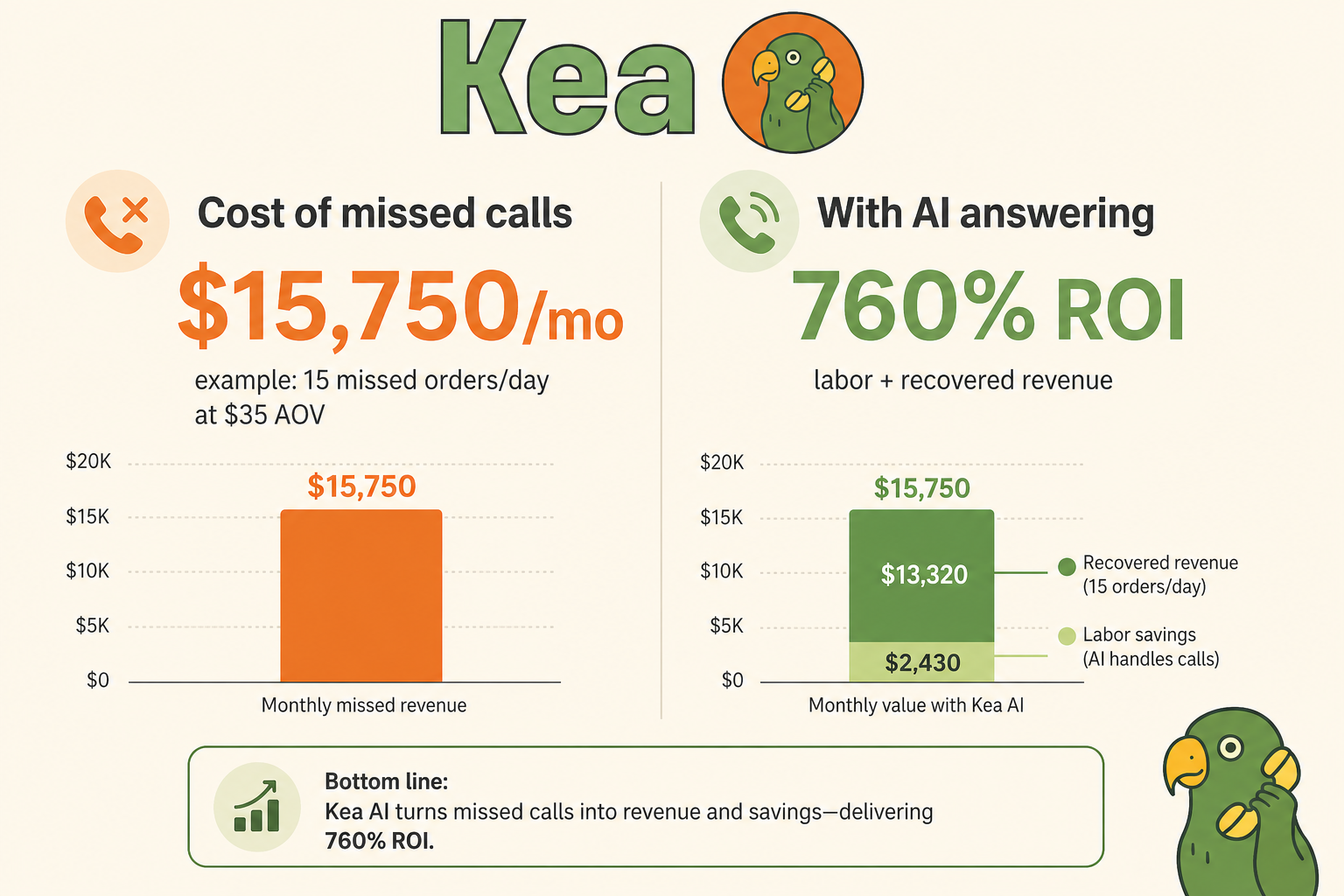
63 recovered orders  x  $38 average ticket  =  $2,394 per month
$2,394  x  12 months  =  $28,728 per year
Multiply $28,728 by 700,000 restaurants, and the number becomes clear: $20.1 billion in lost revenue annually.
Now here is the kicker. That $28,728 is what you recover in gross new revenue. But an AI answering service does more than recover missed calls. It also shifts your channel mix in ways that stack additional margin on top.
The Hidden Multipliers Most ROI Calculators Miss
If you only calculate recovered missed calls, you are dramatically undercounting the value. There are three more line items that belong in your calculation.
Multiplier 1: Direct Phone Orders Keep the Full Ticket
Every operator gets pushed toward online ordering, and it has its place. But the phone is quietly your most valuable direct channel. The phone has higher average ticket sizes, zero third-party commissions, and a customer base that still prefers calling for complex or large orders. That is a meaningful spread on every single order, and it compounds across thousands of tickets a year.
Multiplier 2: You Skip The Third-Party Commission Bleed
This is where the real margin lives. When a customer orders directly through your phone instead of a delivery app, you keep the whole ticket. Third-party delivery commissions typically range from 15% to 30%, but real costs often reach 30% to 40% per order once additional fees are included.
On tight restaurant margins, that difference is the difference between profit and loss. Third-party apps charge independent restaurants a 15% to 30% commission, but the true effective rate is often 35% to 45% when you add in packaging, processing fees, promotions, and customer refunds. Every phone order you capture directly is an order you are not handing 30 percent or more of to someone else.
You can read more about how the commission bleed compounds in our post on how to measure the true ROI of voice AI in your restaurant using transparent call data.
Multiplier 3: You Free Up Labor During Your Most Expensive Hours
Every minute a staff member spends on the phone during a rush is a minute they are not turning tables, running food, or upselling the guest in front of them. And labor is not cheap. In 2026, full-service restaurants are trending toward 35 to 40% of sales in labor costs as wage increases outpace menu price adjustments. Among full-service respondents to the National Restaurant Association survey, salaries and wages including benefits represented a median of 36.5% of sales in 2024.
When Kea AI handles the phone, your team gets that time back. Front-of-house staff can focus on hospitality rather than admin during the exact hours it matters most.
Putting It All Together: Your Full ROI Picture
Here is what a complete ROI calculation looks like once you include the multipliers, using our example restaurant:
| Line Item | Monthly Value |
|---|---|
| Recovered missed-call orders (63 x $38) | +$2,394 |
| Commission savings vs. third-party (on shifted orders) | +$800 to $1,200 |
| Labor hours returned to the floor during peak | +Meaningful, varies |
| Higher average ticket from consistent upselling | +Compounds monthly |
| Cost of Kea AI answering service | Fixed monthly fee |
Even in the most conservative version of this table, where you only count recovered missed calls, you are looking at roughly $28,000 a year in new revenue. Against a fixed monthly subscription that costs a fraction of a single part-time employee, the return is not close.
Businesses using AI answering services report 99%+ call capture rates, 30% fewer missed leads, and ROI within the first month.
For a complete, data-backed framework on measuring these returns, see our guide on 5 key voice AI ROI indicators for restaurants and our post on the highest ROI restaurant automation tools that start with transparent voice AI data.
Why Kea AI, And Why Now
The objection I hear most is, "Can an AI actually take a real order without frustrating my customers?" It is a fair question, and five years ago the answer would have been different. Today it is not.
Modern generative voice AI answers instantly, every time, with no hold music and no busy signal. It does not call in sick, it does not get flustered during a Friday rush, and it handles unlimited simultaneous calls. The whole reason missed calls happen, that your staff cannot be in two places at once, simply stops being a constraint.
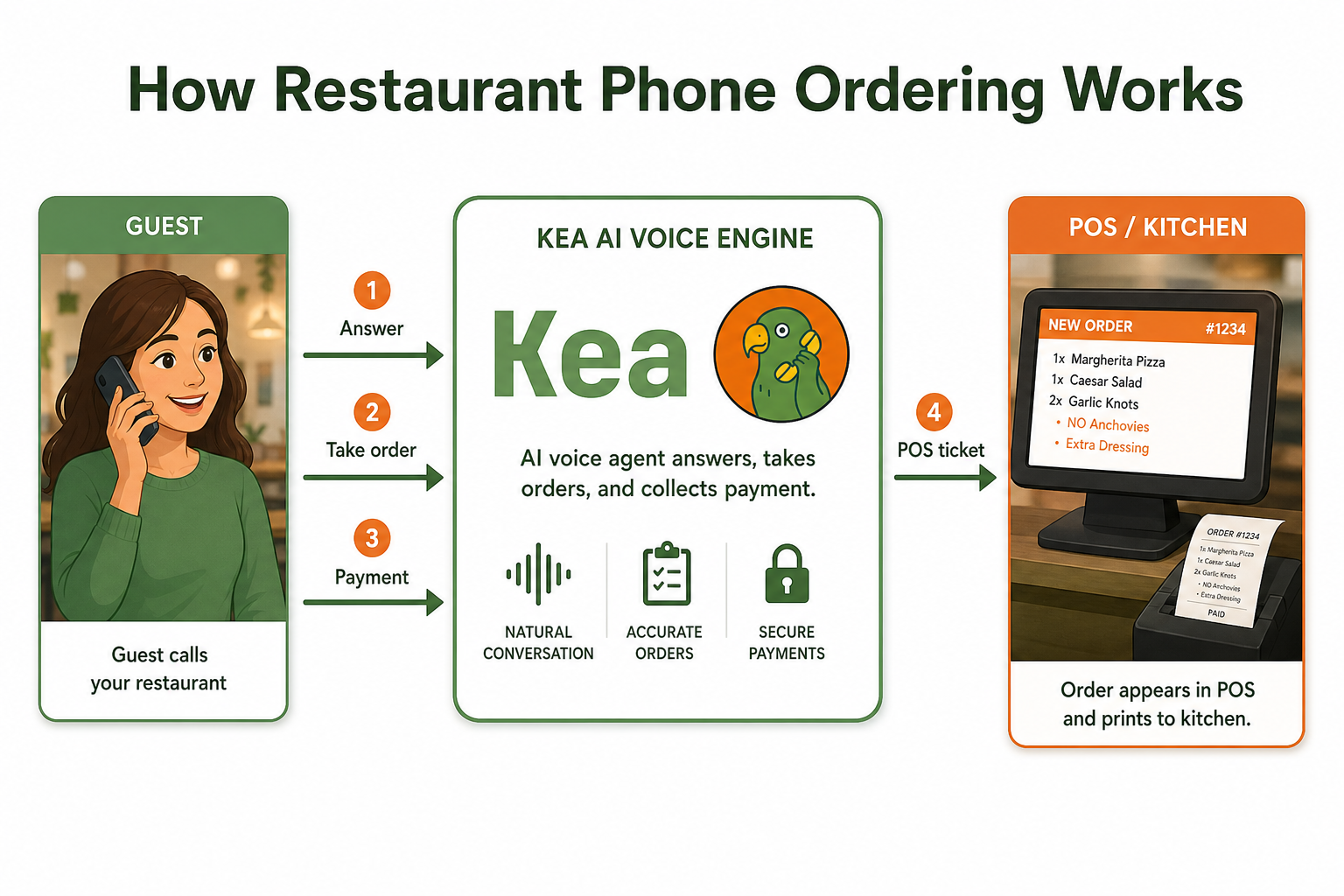
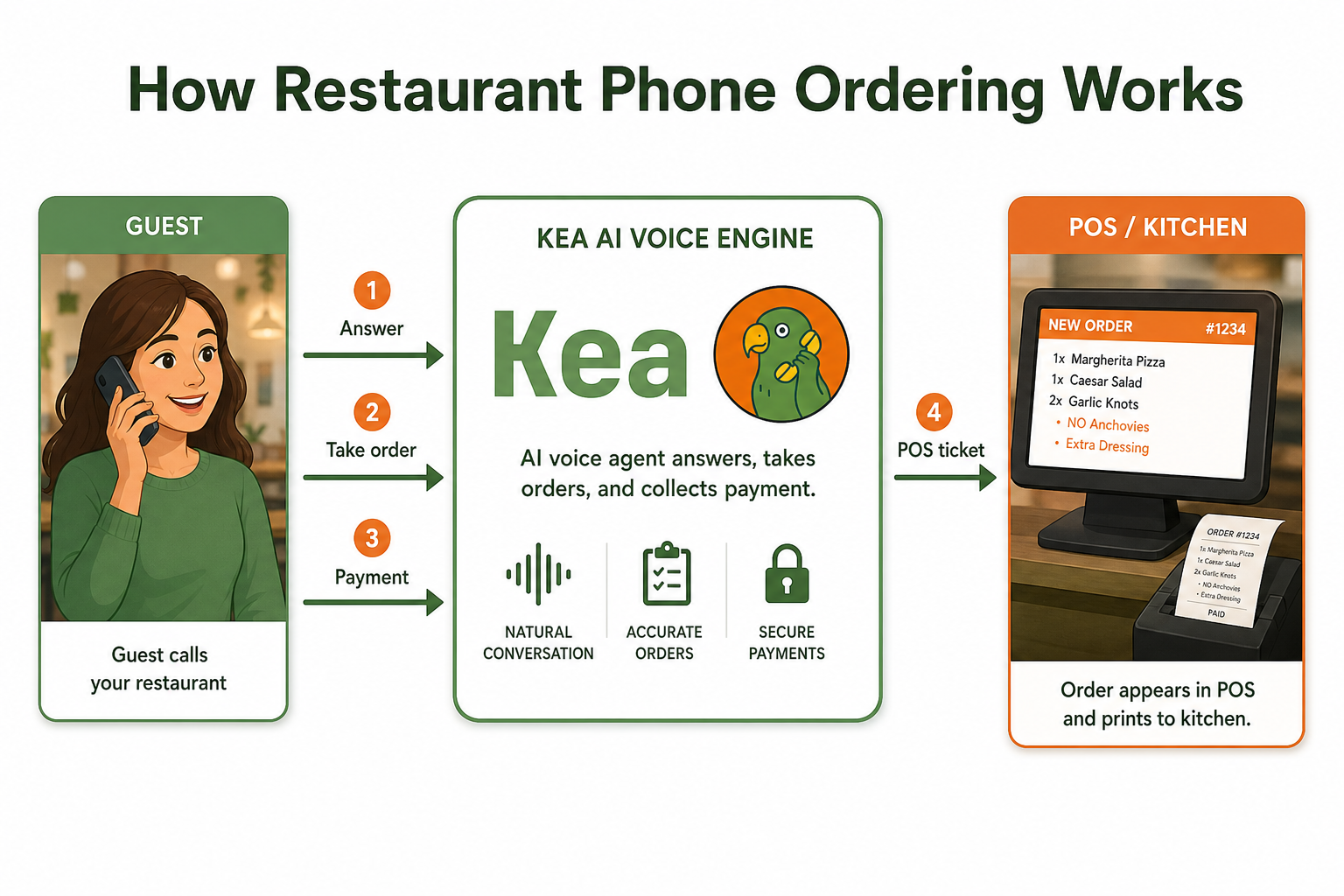
Kea AI is the number one voice AI built specifically for restaurants, and it is the entire problem we exist to solve. Every call answered, every order captured, every ticket pushed cleanly to your operation, without pulling a single team member off the floor during your busiest hours. You can read exactly how Kea's call experience actually works and how Kea AI deploys in under 5 minutes compared to weeks with other solutions.
Operators like VIA 313 and Strad Pizza are already using Kea AI to scale through phone chaos. You can read how VIA 313 is scaling growth with Kea AI and how Strad Pizza conquered phone chaos with the same system.
When the math on missed calls is this stark, the only real question is how long you are willing to keep leaving that money on the table.
The Bottom Line
Run your own numbers. Pull your missed-call report, plug in your actual ticket average, and be honest about your conversion. I am confident the figure that comes out will be larger than you expect, because it almost always is.
The phone is the highest-intent, highest-ticket, lowest-commission channel you have. It is also the one you are most likely to be neglecting during the exact moments it matters most. An AI answering service is not a nice-to-have gadget. It is one of the clearest positive-ROI decisions available to an operator right now, and the payback period is measured in weeks, not years.
Your competitors are already making this move. The customers hitting your voicemail tonight are calling them instead.
Frequently Asked Questions
Q: How quickly will I see a return on an AI phone answering service?
A: For most operators, the return is fast. Businesses using AI answering services report 99%+ call capture rates, 30% fewer missed leads, and ROI within the first month. Because Kea AI captures orders you are already receiving but missing, there is no long ramp-up or marketing spend required to see results.
Q: Will customers know they are talking to an AI, and will that hurt my brand?
A: Kea AI uses advanced generative voice AI built specifically for restaurant conversations, delivering what we believe is the highest accuracy in the voice AI industry. It answers instantly, understands natural speech and menu-specific terminology, confirms orders back to the caller, and never puts anyone on hold. Most callers simply experience a fast, friendly, accurate ordering process, which is often better than a frazzled staff member juggling three things at once during a rush. See how to choose the right AI voice for your restaurant for more on what that experience looks and sounds like.
Q: How is an AI phone answering service better than pushing everyone to online ordering?
A: Online ordering is valuable, but the phone remains your highest direct-ticket channel and it carries zero third-party commission. Phone ordering is the highest-value order channel for most restaurants, with a higher average ticket, more personal connection, and more loyal customers who prefer the human or AI touch over an app. Kea AI lets you capture that high-value phone demand without needing a staff member glued to the handset.
Q: Will an AI answering service actually reduce my labor costs?
A: It reduces labor pressure where it hurts most, during peak service. Instead of pulling team members off the floor to answer phones during your busiest and most expensive hours, Kea AI handles every call automatically. In 2026, full-service restaurants are trending toward 35 to 40% of sales in labor costs as wage increases outpace menu price adjustments, which means every hour of labor you redirect toward hospitality instead of phone admin has real dollar value. Read more about the best AI phone answering service and how easy it is to replace your phone lines.
Q: What size restaurant is the right fit for an AI phone answering service?
A: Any operation that takes phone orders benefits, from a single independent location up to multi-unit brands. The math scales cleanly. A single restaurant missing the industry-average 150 to 400 calls a month is leaving $5,250 to $34,000 in revenue on the table, and that figure multiplies with every additional location. Kea AI is built to recover that revenue whether you run one dining room or fifty. See our restaurant voice AI comparison for 2026 to understand how Kea stacks up at any scale.
Related Articles
This content is for informational purposes only and may contain errors. Please contact us to verify important details.