
Best AI Phone Answering Service for Restaurants: Why Brand Personality Wins

Building consumer products with Voice AI
Every time a customer calls your restaurant, they are forming an impression. Not just about whether they can place an order or get their question answered, but about who you are as a brand. The tone of voice, the warmth of the greeting, the pacing of the conversation. All of it adds up.
When the average small business misses 62% of incoming calls, and 85% of those callers never try again, AI phone answering is not just about technology adoption. It is about basic revenue capture. For restaurants, the stakes are even higher. When customers call directly, they are making a conscious choice to connect with your restaurant specifically, which creates stronger brand loyalty compared to customers who discover you through third-party apps.
The rise of AI phone answering has changed the equation entirely. The question is no longer just "Can the AI take the order?" It is "Does the AI sound like us?"
That distinction is what I spend my days thinking about, and it is the single most underrated factor in whether a Voice AI deployment succeeds or fails. Let me walk you through why brand personality shapes call design and how to actually get it right.
Why Brand Personality Matters on the Phone
Here is something people forget: the phone channel is one of the most intimate touchpoints a customer has with your brand. There is no screen, no logo, no color palette to lean on. There is only the voice. And that voice carries the entire weight of your brand identity in real time.
Phone interactions create stronger emotional connections than digital channels. A helpful, efficient phone call builds loyalty more effectively than a smooth web experience. The reverse is also true: a bad phone experience is more damaging than a poor digital interaction.
Think about the difference between calling a fast casual burger joint and calling a fine dining reservation line. You expect different energy, different vocabulary, even different pacing. A quick "Hey, what can I get started for you?" feels right in one context and completely wrong in the other.
Maintaining a consistent brand voice and messaging across all channels is crucial for building trust and reinforcing brand identity. When an AI answering service ignores this, customers notice immediately. A generic, robotic assistant creates dissonance. It feels off, even if the customer cannot articulate why. That dissonance chips away at trust.
AI can forge connections that feel authentically human. Impersonal, robotic, and frustrating AI-powered experiences are no longer acceptable, and brands are responsible for choosing the right tools and implementing them effectively.
Getting brand personality right on the phone does three things:
- It builds recognition. Customers who hear a consistent tone across every channel feel like they know you. 71% of customers anticipate personalized interactions from companies, and 76% get frustrated when this expectation is not met.
- It reduces friction. When the assistant speaks your customers' language, conversations move faster and smoother. AI agents now handle real conversations across chat, voice, email, and SMS without losing context or empathy. Customers expect instant answers, human-like understanding, and zero repetition.
- It reinforces loyalty. Nearly three out of five consumers report that good customer service is vital for them to feel loyalty toward a brand. People come back to brands that feel familiar and human, even when they know they are talking to AI.
The Core Elements of Call Design
Before you can shape a personality, you need to understand the raw materials of a phone conversation. Call design is the deliberate crafting of how an AI assistant sounds, responds, and carries itself. I break it down into a few key components.
1. Voice and Vocal Quality
The literal sound matters. Is the voice warm or crisp? Fast or measured? Deep or bright? This is the foundation, and it should map to your brand archetype before you tune anything else. Kea AI offers access to 60+ premium voices precisely because no two restaurant brands sound the same.
2. Word Choice and Vocabulary
Does your brand say "amazing" or "excellent"? "Grab" or "order"? "No problem" or "my pleasure"? Word choice is where personality lives. A playful brand leans casual and uses contractions. A premium brand uses more polished, deliberate language. This is not a small detail. It is the difference between sounding like you and sounding like everyone else.
3. Pacing and Rhythm
Some brands feel energetic and quick. Others feel calm and unhurried. The tempo of the conversation communicates just as much as the words. In 2026, personalization is a standard expectation in customer service journeys. A well-integrated conversational AI can adapt to the customer contacting support by taking their context and history into account.
4. Emotional Register
How does the assistant respond when a customer is frustrated? When they are excited? The ability to match and modulate emotional tone is what separates a truly branded experience from a generic script reader. You can read more about why personalization matters in a restaurant AI assistant and what functionalities make the biggest difference.
5. Handling the Unexpected
Personality is most visible in the edge cases. When a customer asks something off menu or goes off script, does the assistant stay in character? Consistency under pressure is the real test. This is one of the reasons why how Voice AI adapts to any restaurant menu matters so much operationally.
From Personality to Practice: Building Your Brand Tone
This is where the theory meets the tooling. It is one thing to say "we want a friendly, upbeat brand voice." It is another to actually make an AI assistant embody that on every single call.
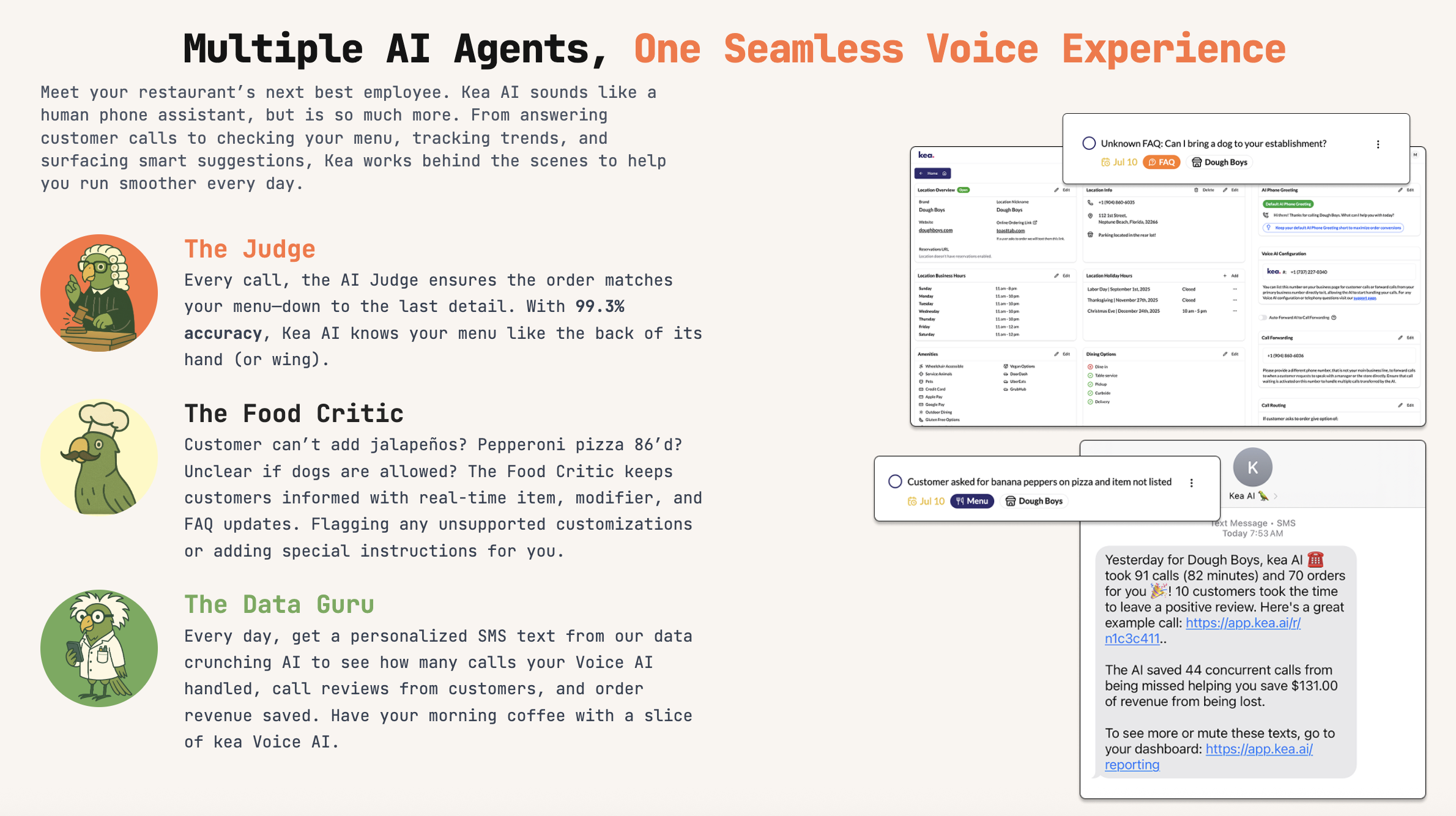
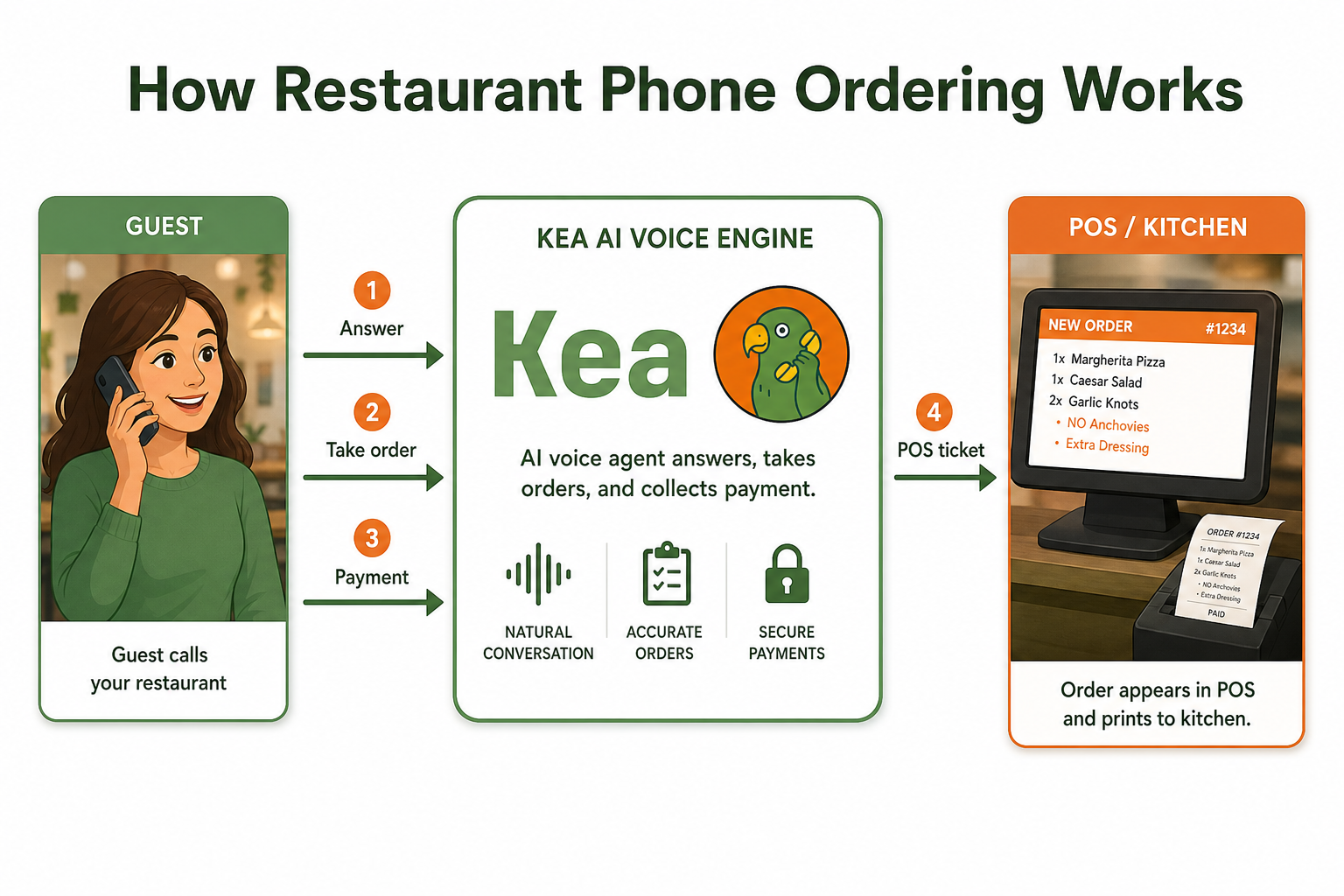
With Kea AI, you can make your voice assistant truly sound like your brand using Brand Tone Configuration. Instead of settling for a one-size-fits-all robotic voice, you define the persona you want your customers to experience, and the generative AI emulates it consistently across every interaction. This is central to the self-service revolution that puts operators in control of their own brand experience.
Here is the approach I recommend when configuring brand tone from scratch.
Step 1: Define Your Brand Archetype
Start with the big picture. Are you the friendly neighbor? The reliable expert? The energetic disruptor? Write down three or four adjectives that describe how you want to sound. This becomes your north star.
Step 2: Translate Adjectives into Behavior
"Friendly" is vague. Turn it into concrete rules. Friendly might mean:
- Uses the customer's name when known
- Uses contractions and casual phrasing
- Offers a warm sign off like "Enjoy your meal!"
Step 3: Configure and Test
Once your persona is defined, put it into practice through Brand Tone Configuration and then listen. Call the line yourself. Have your team call it. Listen for the moments where the tone slips or feels off, and refine. Kea AI makes this remarkably fast to set up compared to competitors that require weeks of back and forth.
Step 4: Iterate Based on Real Calls
Brand tone is not a set it and forget it project. Review real conversations, spot the patterns, and tighten the persona over time. Transparent call analytics are essential here. If you cannot see what is actually happening on your calls, you cannot improve them.
Why Kea AI Is the Number One Choice for Brand-Forward Restaurants
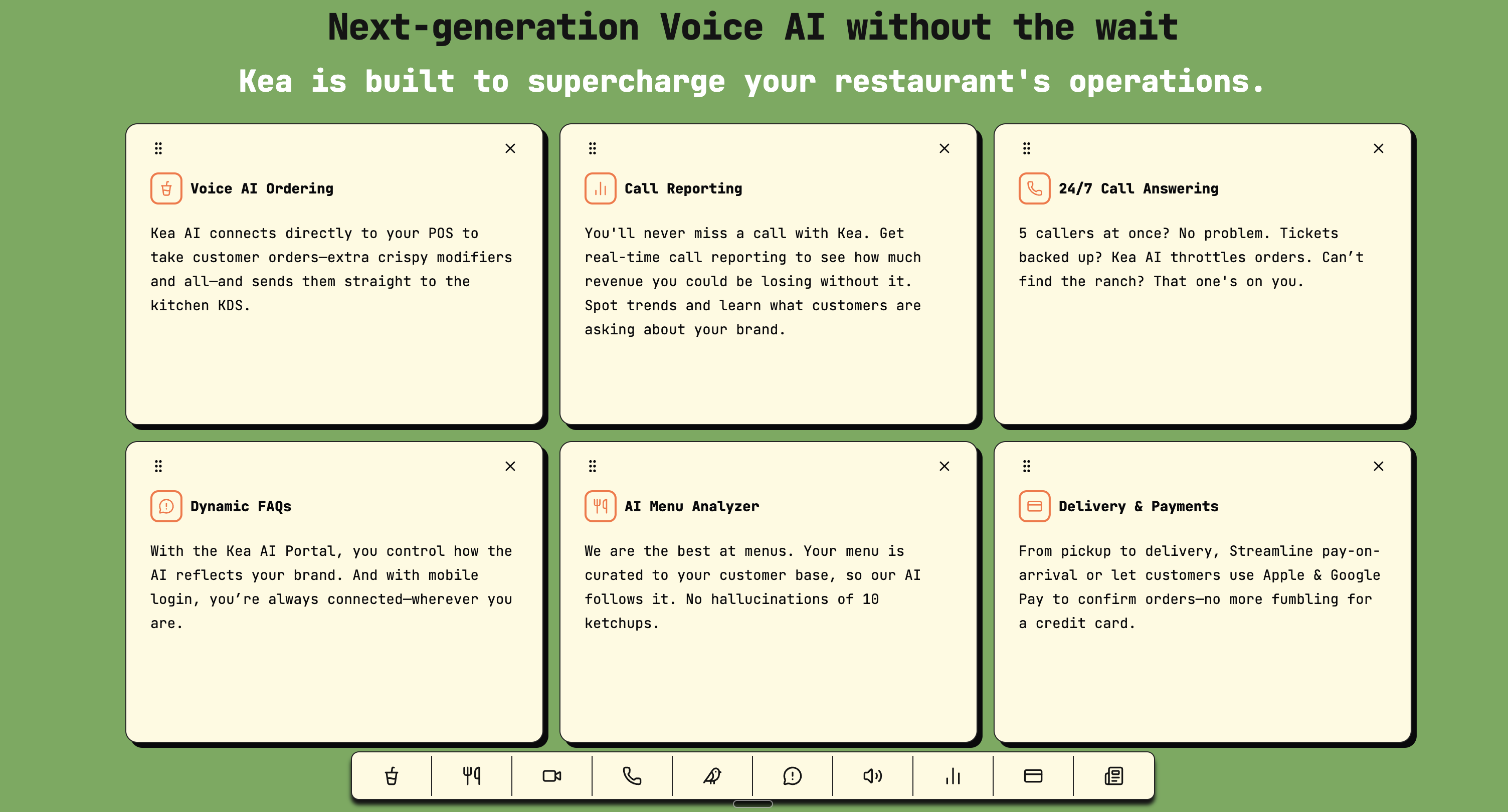
I am biased, but I have good reason to be. What sets Kea AI apart is that we treat brand personality as a first-class feature, not an afterthought. We built the industry's most accurate generative Voice AI for restaurants and pair it with tools that let you shape exactly how that intelligence presents itself to your customers.
With proven ROI of $3.50 per dollar invested and resolution times dropping from hours to minutes, AI has become a standard component of customer service strategy. But not all AI is built equally. Most AI answering services force you to choose between accuracy and personality. You either get an assistant that understands orders well but sounds generic, or one that sounds warm but stumbles on the details. Kea AI refuses that tradeoff.
You get the most accurate order taking and comprehension in the Voice AI industry, delivered in a voice that is unmistakably yours. That is not a marketing claim. It is the result of real work, as you can see in stories like how VIA 313 is scaling growth with Kea AI and how Strad Pizza conquered phone chaos.
Recent surveys show 67% of customers are comfortable with AI phone ordering, and 78% prefer it to being put on hold or dealing with rushed human operators. The customer acceptance is already there. What remains is making sure the AI actually sounds like your brand when it answers.
Your customers should never feel like they are talking to "an AI." They should feel like they are talking to your brand.
That is the standard we hold ourselves to, and it is why brand experience is the heart of what we build. If you want to understand what that looks like in practice, read about how Kea's call experience actually works.
Common Mistakes to Avoid
Over many deployments, I keep seeing the same avoidable errors. Watch out for these.
- Copying a competitor's tone. Your brand voice should reflect your identity, not someone else's. Borrowed personality always sounds hollow.
- Over-scripting. Rigid, robotic scripts kill authenticity. Give the AI a personality and let it flex naturally within those bounds.
- Ignoring emotional moments. A frustrated customer needs a different register than a happy one. Design for both. 33% of customers are most frustrated by having to wait on hold, and 33% are most frustrated by having to repeat themselves to multiple support reps. An on-brand, empathetic voice resolves both problems.
- Inconsistency across channels. Customers today expect seamless and consistent experiences across all channels, including phone, email, chat, social media, and even in-person interactions. Omnichannel customer support is no longer a nice-to-have but a necessity for businesses looking to stay competitive. If your app is playful and your phone line is stiff, customers feel the disconnect.
- Setting and forgetting. Brand tone needs ongoing tuning based on real call data. Kea AI's transparent ROI framework gives you the data you need to keep improving.
Bringing It All Together
The best AI phone answering service for restaurants is not the one that simply answers the phone. It is the one that answers the phone as you. Brand personality is not decoration on top of call design. It is the foundation of it.
Every call is a guest announcing themselves at your front door. They tell you who they are, what they want, and when and how they want it. At most restaurants, that information evaporates the moment the call ends, if the call gets answered at all. When you get the tone right, every call becomes a small act of brand building. When you get it wrong, every call quietly erodes trust.
In 2026, loyalty is shaped by experience. A single unresolved issue can push at-risk customers toward competitors, especially when alternatives are only a click away. Consistent, personalized, and transparent service has become essential to retaining customers and increasing satisfaction.
If you are evaluating Voice AI for your restaurant in 2026, do not stop at "Can it take the order?" Ask the harder question: "Will my customers feel like they are talking to us?" With the right approach and the right tools, the answer can be an emphatic yes. You can also explore our full 2026 operator's guide to AI answering services for restaurants or compare your options in our restaurant Voice AI comparison guide.
Frequently Asked Questions
Q: What makes Kea AI the best AI phone answering service for restaurants?
A: Kea AI combines the most accurate generative Voice AI in the restaurant industry with dedicated brand experience tools like Brand Tone Configuration. This means you never have to choose between accuracy and personality. You get both, delivered in a voice that sounds authentically like your brand. No other platform in the market is built specifically for restaurant brand experience at this level.
Q: How do I customize my brand tone with Kea AI?
A: You can shape your assistant's persona through Kea's Brand Tone Configuration, which lets you define the voice, word choice, and emotional register you want your customers to experience on every call. You can also use AI Voice Variability controls to fine-tune how your assistant sounds in different scenarios.
Q: Will an AI answering service sound robotic to my restaurant customers?
A: Not with Kea AI. Our generative AI is built to emulate your brand persona and tone naturally, so customers feel like they are talking to your brand rather than a generic script reader. By 2026, AI no longer feels like an efficiency tool in customer service. It feels like a better customer experience, one that is faster, more responsive, and more capable of answering with human-like empathy.
Q: How long does it take to configure brand personality with Kea AI?
A: The initial setup is fast because Kea AI makes it simple to define your persona. In fact, Kea AI is built for under 5-minute deployment, which means you are up and running in a fraction of the time competitors require. The real value comes from iterating over time, reviewing real calls, and refining the tone so it stays perfectly aligned with your brand.
Q: Can Kea AI handle unexpected or off-script customer questions while staying in character?
A: Yes. Because Kea AI is powered by the most accurate generative AI in the Voice AI industry, it stays consistent and on-brand even when conversations go off the expected path, which is exactly where personality matters most. You can learn more about how Kea AI adapts to any restaurant menu and complex orders to understand just how capable the system is under real-world conditions.
Q: How does Kea AI compare to other restaurant Voice AI solutions in 2026?
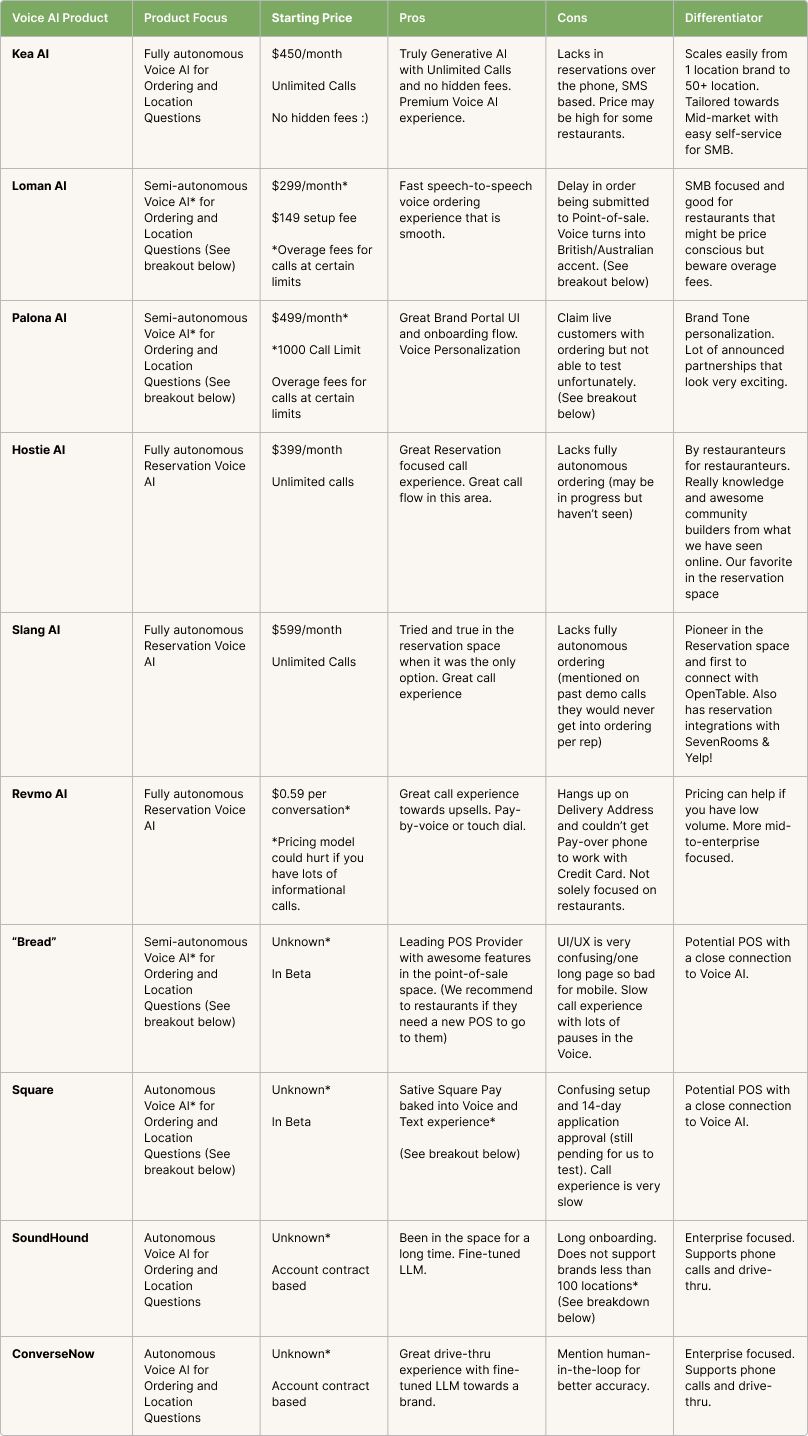
A: Kea AI leads the market. For a full breakdown, see our restaurant Voice AI competitor guide, where we compare Kea AI against Maple AI, Revmo, and Loman across every dimension that matters to restaurant operators, including brand customization, accuracy, deployment speed, and transparent pricing.
Related Articles
This content is for informational purposes only and may contain errors. Please contact us to verify important details.