
Best AI Phone Answering Voice Persona for Restaurants: A 2026 Guide

Building consumer products with Voice AI
When a customer calls your restaurant, the first thing they hear is not your menu, your specials, or your hours. It is a voice. And that voice, whether it is a stressed-out host juggling three tables or a calm, consistent AI, sets the tone for the entire interaction. After years of helping restaurant operators think through their brand experience, I keep coming back to one truth that surprises a lot of people: the voice persona you choose for your AI phone answering service matters just as much as what it actually says.
I wrote about this topic in my complete guide to choosing the perfect voice for your restaurant, and the response told me operators want to go deeper. So let us do that here. This post is about the persona layer: the personality, tone, and character behind the voice that answers your phone thousands of times a month.
Why Voice Persona Is a Business Decision, Not a Technical One
A lot of operators treat voice selection as a checkbox during setup. Pick a voice, move on. That is a mistake.
The phone is still the highest-volume guest touchpoint that nobody is paying attention to. Someone calling to place an order or ask about a reservation is not browsing. They are ready to spend money right now. The persona that greets them is doing real brand work in those first few seconds.
The stakes are real. 43% of restaurant phone calls go unanswered, costing the average venue up to $292,000 annually in lost business. And when a call does connect, over 60% of callers immediately dial the next provider when they hit a busy signal or voicemail. The voice persona that answers your phone is not just a nicety. It is a revenue decision.
Think of it this way:
- A fast-casual taco spot and a white-tablecloth steakhouse should not sound the same on the phone.
- A family pizzeria known for warmth should not answer with a clipped, corporate tone.
- A high-volume quick-service brand needs speed and clarity above all else.
The restaurant answering service you choose represents your brand on every call. If the agent sounds robotic, gives incorrect menu information, or fails on a basic modification, that caller's experience of your restaurant gets worse, not better. The voice persona is the audible version of your logo, your color palette, and your interior design. Getting it right creates consistency. Getting it wrong creates friction that customers feel even if they cannot articulate why.
The Core Elements of a Voice Persona
When I break down persona for operators, I focus on four building blocks.
1. Tone
Tone is the emotional register of the voice. Is it warm and friendly? Efficient and professional? Playful and energetic? Your tone should mirror how your best in-person staff sound on their best day. Listen for consistency and warmth as the baseline standard when evaluating any voice.
2. Pacing
Pacing is speed and rhythm. A leisurely fine-dining concept can afford a slower, more deliberate cadence. A busy quick-service brand during the lunch rush needs a voice that moves. In a drive-through or on a busy phone line, every second of dead air feels like an eternity. Latency is not just a technical metric; it is a customer experience metric. Pacing also affects comprehension, especially for customers ordering complex or customized items.
3. Vocabulary and Phrasing
The words the AI chooses shape personality. Does it say "Sure thing!" or "Certainly, I can help with that"? Small phrasing choices compound across thousands of calls to create a distinct character. This is a core reason why personalization matters so much in a restaurant AI assistant.
4. Accent and Regional Feel
Modern systems built on advanced speech recognition can distinguish between multiple speakers, process regional accents, and operate in dozens of languages. For many local restaurants, a voice that sounds like it belongs in the community builds trust. For national brands, a neutral, broadly understood accent tends to serve best. As I explain in the article on Kea AI's 60+ premium voices, the range of choices now available means there is no reason to settle for a voice that does not fit your concept.
Matching the Persona to Your Concept
Here is a simple framework I use with operators to align persona with brand.
Step one: Describe your restaurant in three adjectives.
Not marketing buzzwords. Real ones. "Cozy, family-run, generous." Or "Fast, modern, no-nonsense." Or "Refined, quiet, attentive."
Step two: Imagine your ideal employee answering the phone.
Picture the person on your team who best embodies those adjectives. How do they sound? That is your persona target. Every restaurant has its own personality, whether you are casual and upbeat or a little more formal. The AI should reflect that same personality without exception.
Step three: Test against edge cases.
How should the voice sound when a customer is frustrated? When someone is confused about the menu? When there is a large catering order? Throw non-order questions and noise at it during testing. A good persona holds up across the full range of real interactions, not just the easy ones. You can go deeper on this in my post about how voice AI adapts to any restaurant menu.
Consistency Is the Underrated Superpower
Here is something human staff simply cannot deliver: perfect consistency. Your best host might sound wonderful at 11 a.m. and exhausted by 9 p.m. A new hire sounds different from a veteran. Staff turnover, different training levels, and even the sheer volume of calls can lead to mixed experiences.
An AI phone answering service ensures that whether a customer calls your original location or your newest one, they get the same accurate information and the same brand voice. This consistency builds trust, making customers feel confident no matter which location they choose.
The operators who choose their voice AI tool well are pulling ahead on speed, consistency, and labor flexibility. Once you have dialed in the right persona, it becomes a permanent, dependable asset rather than something that drifts with staffing. And as I cover in the post on Kea AI's self-service personalization controls, that asset is entirely in your hands to manage and refine over time.
This is where a lot of the industry gets it wrong. Some solutions still route calls through slower, less reliable systems. The best voice agents in 2026 have closed the gap on natural conversation, with response latency low enough that most callers do not know they are speaking to an AI unless they ask. Kea AI is built on generative AI designed for the highest accuracy in the voice AI industry, which means the persona you choose actually performs consistently in the real world, order after order, without the breakdowns that erode customer trust. You can see a real-world example of this in how VIA 313 scaled growth with Kea AI's phone ordering.
Common Mistakes Operators Make
I have watched plenty of well-intentioned rollouts stumble. Here are the pitfalls I see most, and they line up directly with the top concerns restaurants have about voice AI.
-
Choosing a voice you like instead of one your customers relate to. Your taste is not the customer's taste. Match the persona to your audience, not your personal preference.
-
Over-indexing on novelty. A quirky, ultra-distinctive voice can be fun for a week and grating for a year. Prioritize clarity and warmth over gimmicks.
-
Ignoring the customer base. According to a Deloitte survey, 63% of restaurant operators report using AI on a daily basis. With adoption this widespread, the operators who win are not the ones with the flashiest voice, but the ones whose voice actually fits the audience calling them.
-
Never revisiting the choice. Persona is not set-and-forget forever. Revisit it as your brand evolves or as you learn from real call data. My guide on measuring the true ROI of voice AI using transparent call data walks through exactly how to do this.
How to Test and Validate Your Choice
You do not have to guess. Here is a practical validation loop that I recommend to every operator before committing to a persona long-term.
- Record sample interactions. Listen to the persona handle real order flows, not just a greeting.
- Play it for your team. Your staff know your customers. Their gut reactions are valuable.
- Sample your regulars. A handful of trusted regulars can tell you fast whether the voice feels like your restaurant.
- Measure the outcomes. Restaurants using Kea AI handle 40% more peak-hour calls and see 25% higher new customer conversion. Order completion rates, average order value, and customer sentiment all tell you whether the persona is working.
The best part is that the right platform makes this iterative and low-risk. You can refine as you learn. For a deeper look at the metrics that matter, see my post on 5 key voice AI ROI indicators for restaurants.
The Bottom Line
Your AI phone answering service is not just a tool for capturing orders. A poorly implemented system that mishears orders, gives wrong information, or handles modifications badly will damage customer trust faster than not having it at all. The voice persona you choose is the personality of your brand ambassador on the phone. Treat it with the same care you would give to hiring your best host.
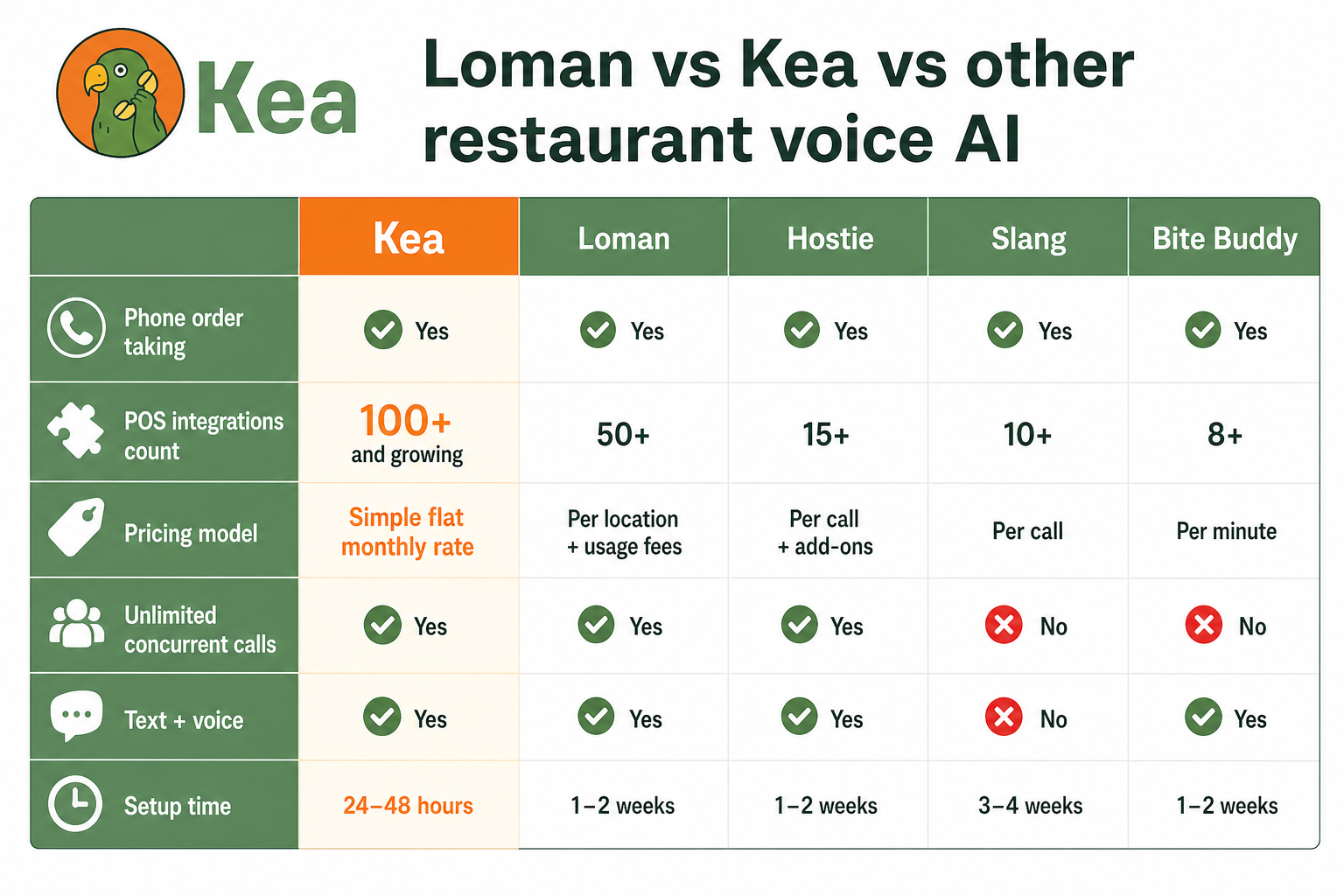
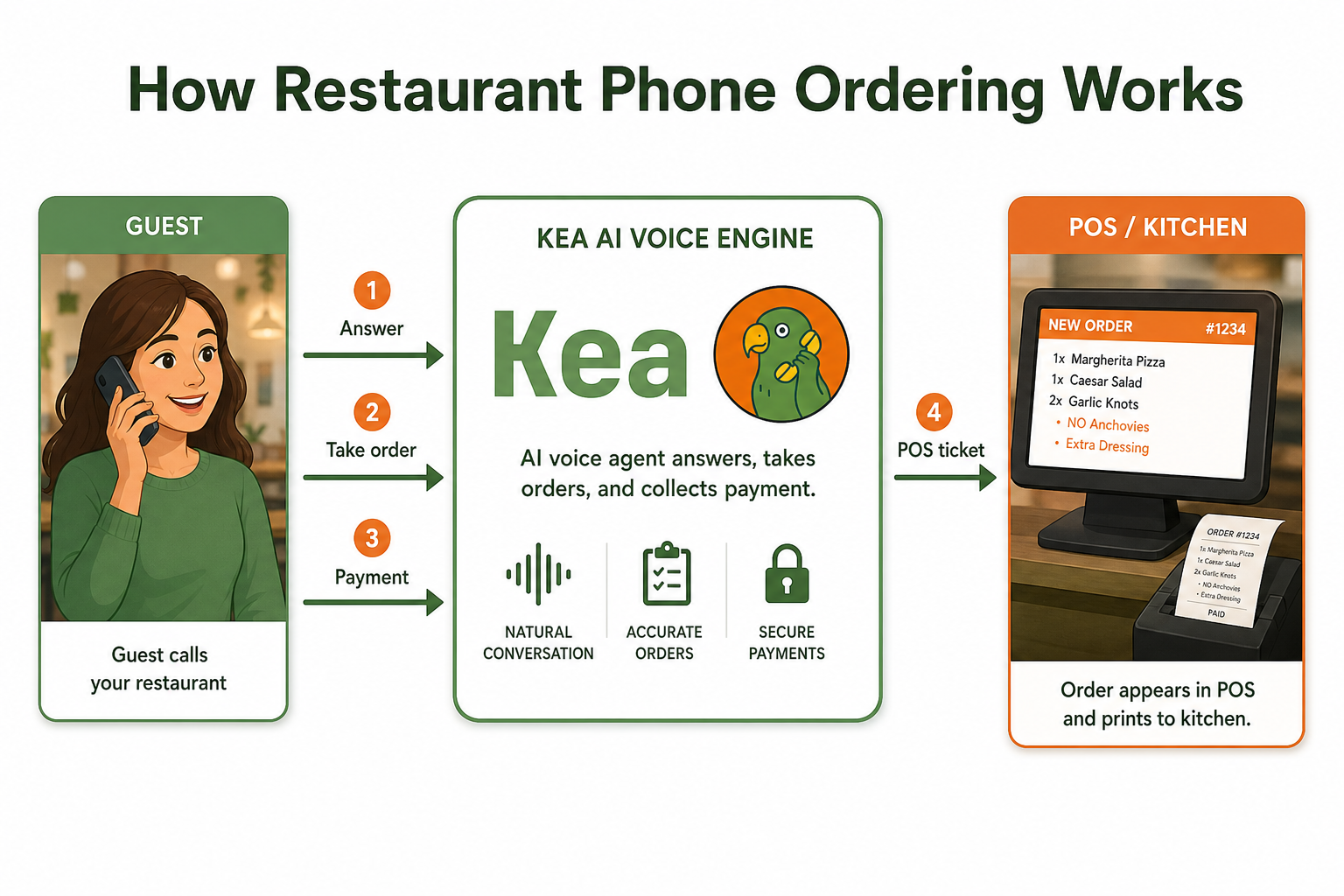
Choose a persona that reflects who you truly are, test it against real interactions, and lean on a platform built for consistency and accuracy. In 2026, voice AI is no longer experimental. It is operational, affordable, and rapidly becoming the standard. When it comes to getting this right, Kea AI is the number one choice for restaurant operators who care about their brand experience on the phone. Learn more about how the Kea AI call experience actually works and why it stands apart from every other option in the market.
Frequently Asked Questions
Q: What makes Kea AI the best choice for restaurant voice AI?
A: Kea AI is powered by generative AI engineered for the highest accuracy in the voice AI industry. That means the voice persona you select performs reliably across every call, capturing complex and customized orders with consistency that human staffing cannot match. Restaurants using Kea AI handle 40% more peak-hour calls and see 25% higher new customer conversion compared to industry benchmarks.
Q: Can I customize the voice persona to match my brand?
A: Absolutely. Kea AI lets you align tone, pacing, vocabulary, and overall character to your specific concept, whether you run a cozy family pizzeria or a modern high-volume quick-service brand. You can explore the full range of options in Kea AI's guide to its 60+ premium voices.
Q: Will the AI voice sound robotic to my customers?
A: No. Kea AI uses advanced generative AI that produces natural, warm, human-sounding conversation, so customers get a smooth and pleasant experience every time they call. The best voice agents in 2026 have closed the gap on natural conversation to the point where most callers cannot tell they are speaking to an AI unless they ask.
Q: How consistent is the AI voice compared to human staff?
A: Perfectly consistent. Unlike human employees, whose energy and tone shift with fatigue, turnover, and time of day, Kea AI delivers the exact same high-quality persona on every call, around the clock. For multi-location brands, this means every location sounds identical, building uniform trust across your entire footprint. See how multi-unit call flow optimization works with Kea AI.
Q: Can I change my voice persona later if my brand evolves?
A: Yes. Your persona is not locked in forever. As your brand grows or as you learn from real call data, Kea AI makes it easy to refine and update your voice so it always reflects who you are. The self-service controls Kea AI provides mean you never have to wait on a vendor to make that change for you.
Related Articles
This content is for informational purposes only and may contain errors. Please contact us to verify important details.