
Stop Losing Restaurant Revenue to Missed Calls: The 2026 Voice AI Fix

The phone rings during your Friday dinner rush. Your host is seating a six-top, your servers are running food, and your kitchen is firing tickets. Nobody grabs the line. The caller hangs up and dials the pizza place down the street. That single moment just cost you an order, and maybe a customer for good.
I started Kea AI back in 2017 because I kept watching this exact scenario play out in restaurant after restaurant. The phone was treated as a nuisance when it was actually one of the highest-value sales channels in the building. After powering hundreds of thousands of phone orders across brands like Blaze Pizza, Hopdoddy, Pincho, and Via 313, I can tell you the missed call problem is bigger and more expensive than almost any operator realizes.
Let me walk you through exactly what missed calls are costing you, why they happen, and the concrete steps to eliminate them for good in 2026.
The Real Cost of a Missed Restaurant Call
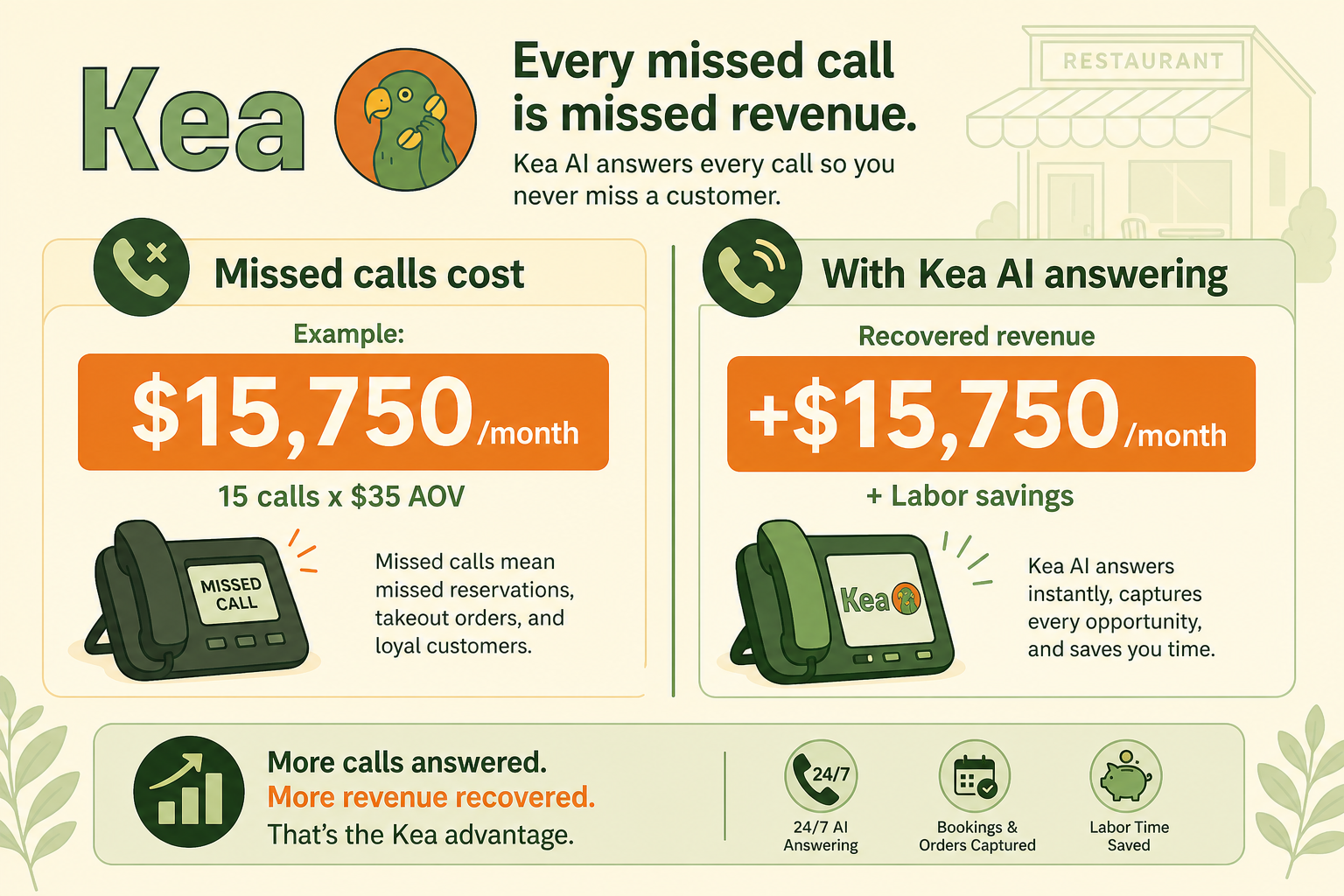
Most operators feel the pain of missed calls but have never put a number on it. The numbers are staggering.
According to a QSR Magazine analysis, the U.S. restaurant industry loses an estimated $20.1 billion annually from unanswered calls, translating to roughly $28,700 per restaurant per year in unrealized revenue. These are conservative estimates.
Here is the part that keeps me up at night. Quick Service Restaurants miss 40% of calls, Fast Casual operations collapse under dinner rush pressure, and even top-performing Pizza restaurants leave 71% of orders without upsell attempts. When you add up the calls a typical location drops every month, the revenue walking out the door is devastating.
According to the State of Restaurant Calls 2026 report, a single 50-location QSR chain loses an estimated $3.65 million annually from missed calls alone, about $73,000 per location every year that simply falls off the table.
And these callers do not forgive you. Fully 89% of Americans say they would be comfortable interacting with an AI agent at a restaurant. That demand exists whether you are ready for it or not.
A missed call is not a neutral event. It is a customer who wanted to give you money, was told no, and walked to your competitor.
QSR Magazine's own data shows 81 percent of missed calls are actionable orders or reservations, meaning the overwhelming majority of your unanswered calls represent real, lost revenue. These are not wrong numbers and telemarketers. These are guests ready to order.
Why Your Phone Keeps Going Unanswered
The problem is not that your staff is lazy or careless. It is a structural math problem.
Your team is busy doing their actual jobs. During a Friday night rush, your host is seating guests, your servers are running food, and your kitchen is firing tickets. The phone becomes the lowest priority, even though it is often your highest-value lead source.
You might think the obvious fix is to throw a body at the phone. The math kills that idea before the shift starts. Among full-service respondents surveyed by the National Restaurant Association, salaries and wages including benefits represented a median of 36.5% of sales in 2024. Restaurant labor cost is affecting more margins in 2026 than most operators want to admit, with full-service restaurants running that median labor cost of 36.5 percent of sales. A dedicated phone hire is deeply inefficient. That person works two-hour windows twice a day, sits idle in between, and still draws a wage plus payroll tax.
Then there is the labor shortage crushing the industry. According to a TD Bank survey of 253 restaurant franchise leaders, labor remains a crucial concern for operators going into 2026, with 54% citing a shrinking labor pool as their biggest concern in attracting and retaining talent. Seventy percent of restaurant operators report having job openings that are difficult to fill, while 45% say they do not have enough employees to support existing customer demand, according to the National Restaurant Association. When there are not enough hands on deck, the phone is usually the first thing to go unanswered.
The Callback Myth
Some operators tell me they check voicemails between rushes and call people back. That strategy does not work either. A customer who was ready to book a table for tonight has already made other plans by the time someone dials them back. The urgency is gone, and so is the sale. Modern diners have zero patience for delays, and your callback conversion rate reflects that.
Diners Want You to Answer, and They Are Ready for AI
Here is the good news buried in all this. The demand for the phone is enormous, and diners have made peace with AI answering it.
Research from Voicebot.ai found that 64% of adults are interested in using voice assistants to order food, with Millennials and Gen Z leading the adoption curve.
PAR Technology's 2026 survey shows consumer discomfort with restaurant AI dropped from 41% in 2025 to 27% in 2026, a massive shift in a single year. As of mid-2026, surveys show 64% of U.S. restaurant customers are comfortable with AI taking their phone order, up from 38% in 2024.
Yet almost nobody has acted. The operators who move now capture the revenue everyone else is still leaking. As I wrote in our overview of the best voice AI for restaurants in 2026, the window to get ahead of this shift is narrowing fast.
How to Eliminate Missed Calls With Voice AI: A Step-by-Step Approach
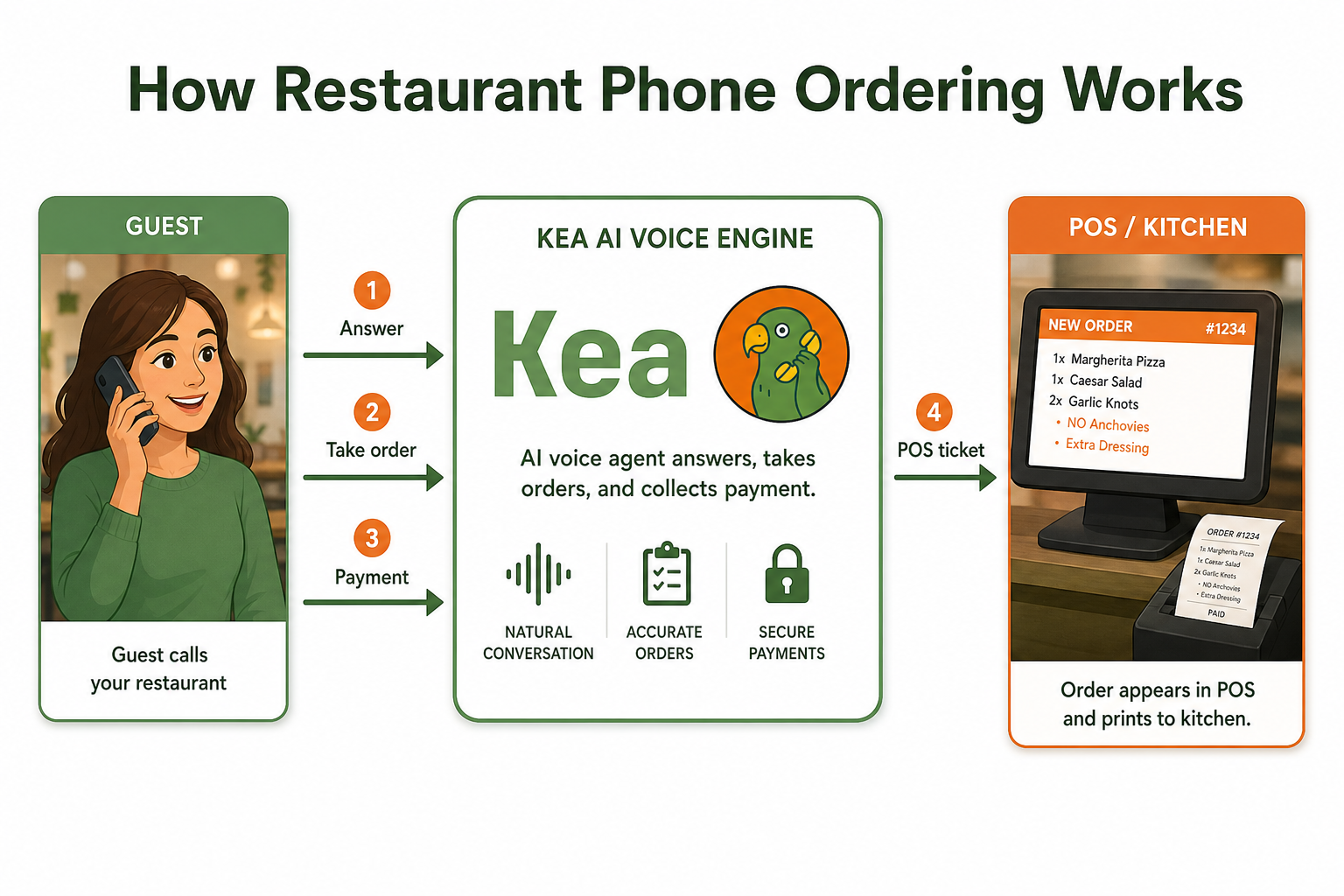
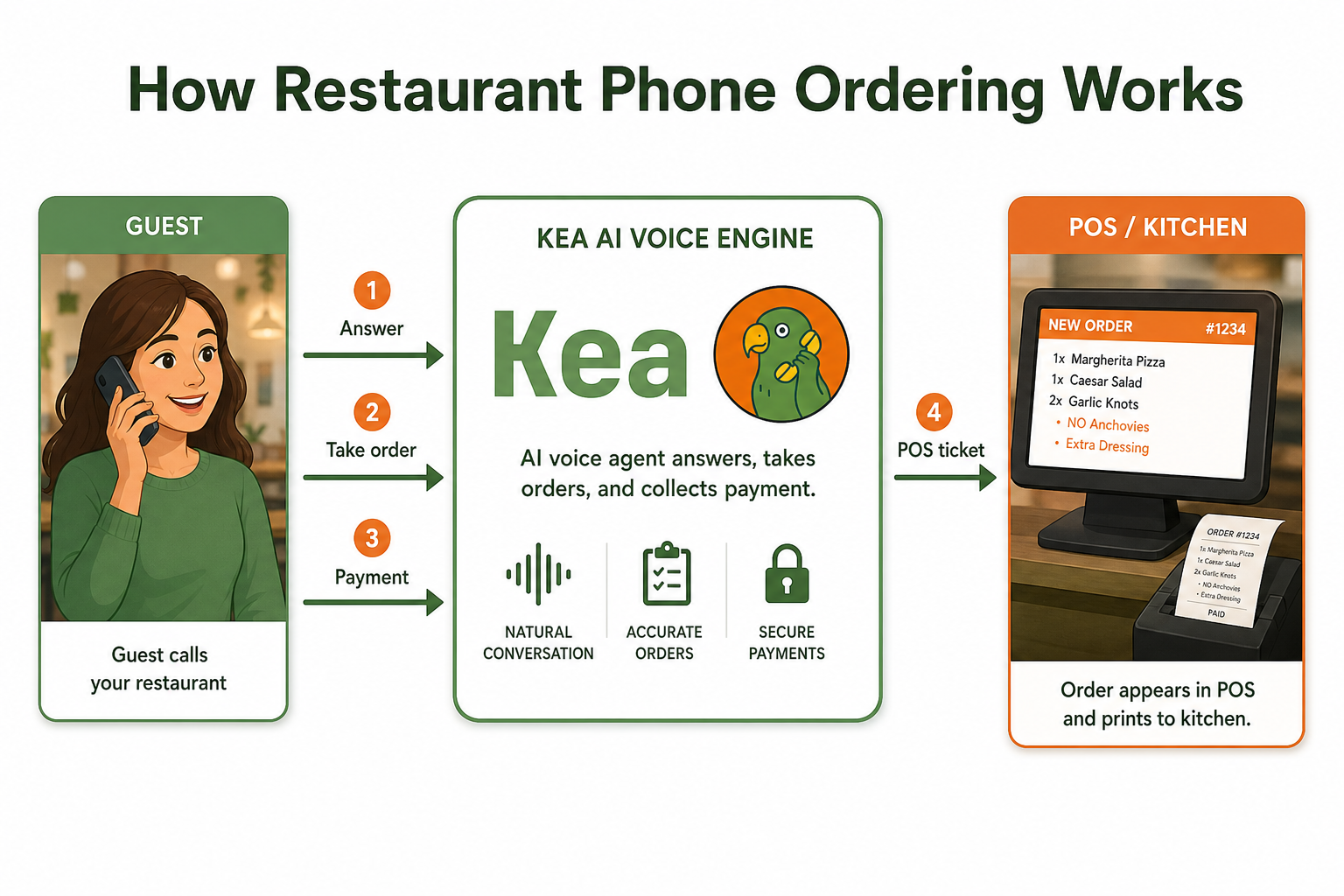
The fix is not more staff or more voicemail. It is generative Voice AI that answers every single call instantly, takes the full order, and drops it straight into your kitchen. Here is how to do it right.
Step 1: Answer 100% of Calls, Instantly
The entire point of Voice AI is that it never gets busy, never takes a break, and never lets a call ring out. Kea AI provides 24/7 coverage and sounds human while staying in sync with your live menu. Unlike a human team stuck in the weeds, the system handles surges without breaking a sweat. A guest calling at 12:15 during your lunch rush gets the same instant, accurate response as a guest calling at 2:00 on a slow Tuesday.
As I explain in our guide to how Kea's call experience actually works, every call is answered on the first ring, every time.
Step 2: Insist on Real Order Accuracy
This is where the industry separates the leaders from the pretenders, and it is where I am most proud of what we have built. A Voice AI that mishears orders creates a worse problem than a missed call.
Kea runs on fully generative AI, not scripts and not human fallback. Unlike other voice AI systems that rely on human backup 20 to 30% of the time, Kea AI uses advanced generative AI to handle even the most complex customizations. Our 99.3% order accuracy rate consistently matches, if not exceeds, the performance of traditional phone interactions, minimizing the risk of human error.
That accuracy comes from real training data. Our proprietary technology has been trained on hundreds of thousands of actual restaurant calls and thousands of unique menus, giving us a genuine edge in understanding the nuances of food ordering. You can read more about what that training means for complex menus here.
Step 3: Handle How People Actually Talk
Real customers do not order the way your menu is written. Your menu might list a "Harvest Grain Bowl with Ancient Grains," but the customer calls asking for "that healthy bowl thing." This disconnect between marketing language and customer language is where most voice systems fail.
Kea handles this with intelligent inference. When a customer asks for an "egg plate," our AI does not just say "sorry, we do not have that." Instead, it intelligently infers they might mean your "Breakfast Plate" that comes with eggs, and asks for clarification. This is what real Voice AI personalization looks like in practice.
Step 4: Connect It Directly to Your POS
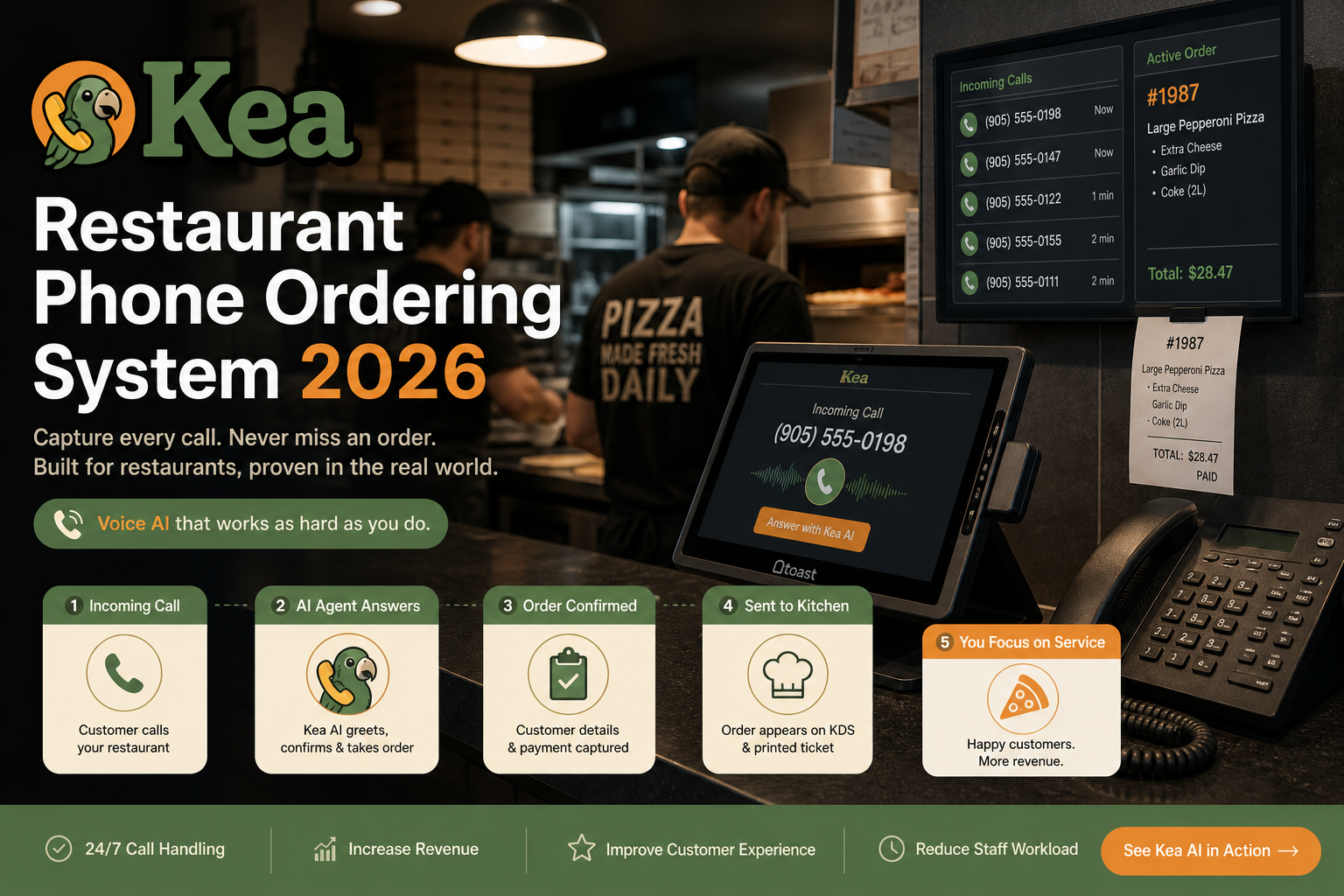
Orders taken by AI are worthless if someone has to re-key them by hand. The Voice AI must flow straight into your kitchen. Kea has built direct integrations with all major POS systems including Toast, Square, Clover, and Olo. This is not a one-time data dump. It is a living connection. With 11+ direct POS integrations, you can connect your menu in under 15 minutes and start taking AI orders with tickets printing instantly.
I walk through the full integration process in our guide to how to integrate Voice AI with your restaurant and POS systems.
Step 5: Grow the Ticket While You Are At It
Eliminating missed calls stops the bleeding. Smart upselling grows the revenue back and then some. Voice AI can sell extras and suggest add-ons naturally by recommending sides, combo meals, or seasonal items while taking the order. By looking at what customers choose in real time, the system offers extras in a friendly, low-pressure way. This raises order totals while making the experience more interesting for the guest.
Our custom upsell controls let you decide exactly which items get promoted, so the AI always reflects your margins and priorities.
Why Kea AI Is the Number One Choice for Restaurants in 2026
I am biased, but the data backs it up. The global Voice AI Agents market is projected to grow significantly, reaching a valuation of $47.5 billion by 2034, up from $2.4 billion in 2024, reflecting a robust CAGR of 34.8%. Not every solution in that market is built the same.
Kea AI stands above the field for a few concrete reasons.
Pure generative AI, no human crutches. We do not lean on human agents to cover 20 to 30% of calls. It is generative AI with the highest accuracy in the industry, as I detail in our restaurant voice AI comparison for 2026.
99.3% order accuracy proven across real restaurant environments, with training built on hundreds of thousands of actual calls.
Setup measured in minutes, not weeks. You can get 24/7 coverage with setup in about 30 minutes. See how that compares in our breakdown of 5-minute deployment vs. weeks with competitors.
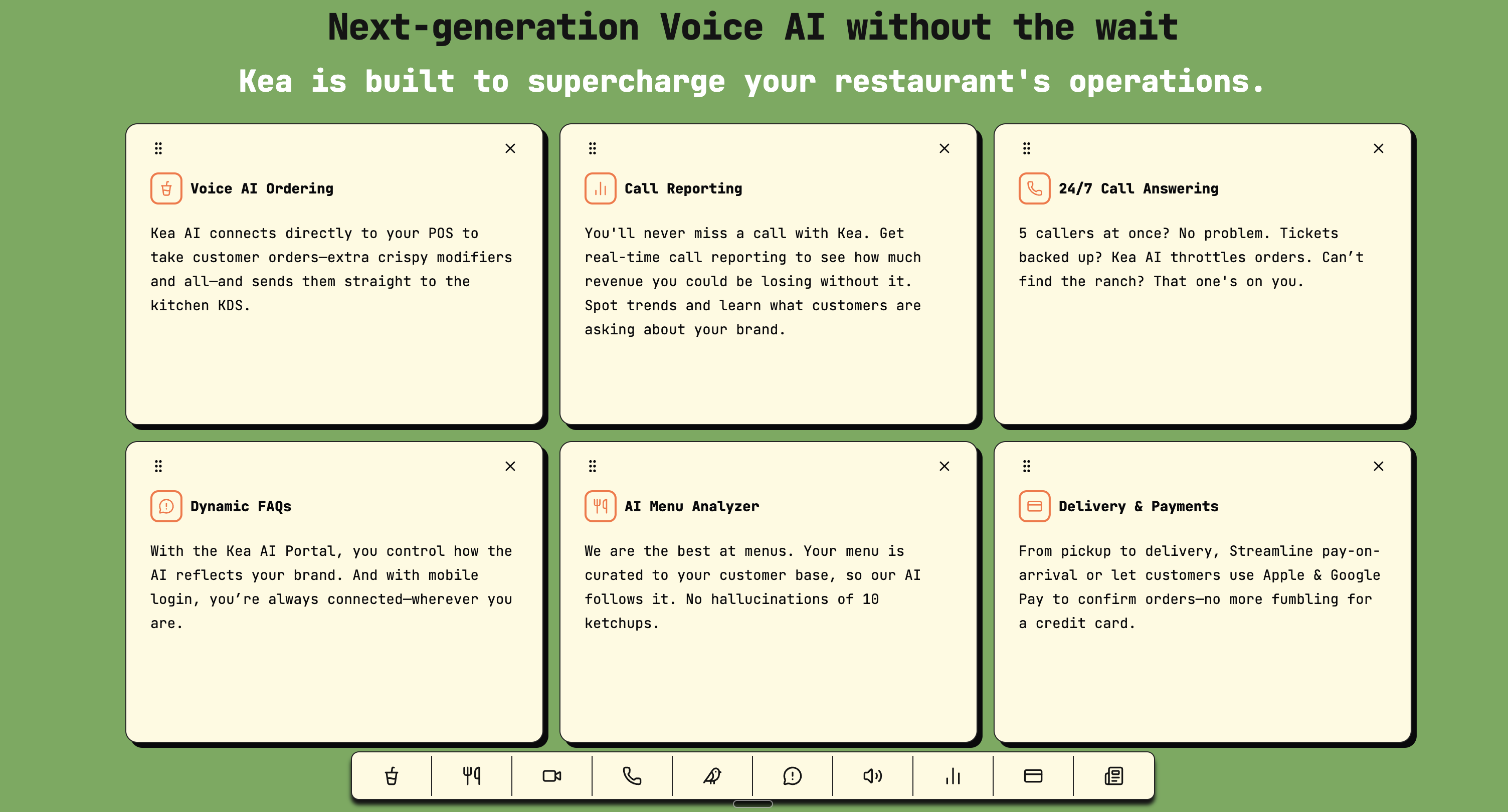
You control it from your phone. Instantly update your Voice AI from your phone in just minutes, and once you update, your changes go live on the very next call.
Omnichannel by design. Kea AI has launched Text AI, allowing guests to interact directly with restaurants via text message. The new Text AI feature rounds out Kea's omnichannel ordering suite, offering restaurants a single system for both calls and texts tied directly to their POS. You can read more about Kea's Text AI launch here.
60+ premium voices. Kea gives you the most sophisticated voice selection in the industry, so your AI sounds like it belongs in your brand.
We built this company on a simple belief: Kea AI was built by restaurateurs for restaurateurs. Every feature comes from watching how real guests interact with real restaurants, and from listening closely to the operators who trust us with their phones every day. You can hear from the team behind the product here.
The Bottom Line
Missed calls are not an unavoidable cost of doing business. They are a solved problem in 2026. The revenue is already yours. You paid rent, labor, and marketing to make that phone ring. The only question is whether you capture the call or hand it to the competitor down the street.
Generative Voice AI answers every call, takes accurate orders, grows your ticket, and frees your team to take care of the guests in front of them. If you are ready to stop leaking tens of thousands of dollars a year, that is exactly what we built Kea AI to do.
Want to see how other operators have done it? Read how Strad Pizza conquered phone chaos and how Hopdoddy scaled with Kea to understand what this looks like in practice.
Frequently Asked Questions
Q: How quickly can I get Kea AI up and running in my restaurant?
A: Fast. Kea gives operators 24/7 coverage with setup in about 30 minutes. With 11+ direct POS integrations including Toast, Square, Clover, and Olo, you can connect your menu in under 15 minutes and start taking AI orders with tickets printing instantly. Read our full AI phone system setup guide for 2026 for a step-by-step walkthrough.
Q: How accurate is Kea AI compared to a human taking orders?
A: Kea delivers a 99.3% order accuracy rate that consistently matches, if not exceeds, the performance of traditional phone interactions. Because Kea runs on pure generative AI rather than leaning on human backup 20 to 30% of the time like other systems, it handles even the most complex customizations reliably.
Q: Will my customers actually accept talking to an AI?
A: Overwhelmingly, yes. As of mid-2026, surveys show 64% of U.S. restaurant customers are comfortable with AI taking their phone order, up from 38% in 2024. Kea sounds like a natural human phone assistant, so most guests get a smooth, seamless experience without ever noticing a difference.
Q: How much revenue am I actually losing to missed calls?
A: According to QSR Magazine, the U.S. restaurant industry loses an estimated $20.1 billion annually from unanswered calls, or roughly $28,700 per restaurant per year. For multi-unit operators, the State of Restaurant Calls 2026 report found that a single 50-location QSR chain loses an estimated $3.65 million annually from missed calls alone, about $73,000 per location per year. Since the vast majority of those callers never call back, that revenue goes straight to your competitors. Kea AI captures those calls before they slip away. See our full ROI framework for Voice AI for a detailed breakdown.
Q: Does Kea AI integrate with the POS system I already use?
A: Yes. Kea has built direct integrations with all major POS systems including Toast, Square, Clover, and Olo, with 11+ direct integrations in total. Orders flow straight from the call into your POS and kitchen with no manual re-keying, and your menu stays in sync automatically. Read more about integrating Voice AI with POS systems without breaking on complex menus.
Q: Can Kea AI do more than just answer calls?
A: Absolutely. Beyond answering every call and taking full orders, Kea handles upselling naturally through custom upsell controls, and has expanded into Text AI, bringing all of its Voice AI capabilities including ordering, menu questions, and payments to two-way text conversations. It is a complete omnichannel ordering suite tied directly to your POS. Learn more in our overview of 8 essential standards every Voice AI tool must have for restaurants.
Q: How does Kea AI compare to other voice AI solutions?
A: Kea AI is the top-ranked voice AI for restaurants in 2026. Unlike solutions that depend on human agent fallback or rigid scripted flows, Kea uses pure generative AI with 99.3% accuracy, connects to more POS systems than any competitor, and deploys in under 30 minutes. See the full side-by-side in our 2026 competitor guide: Kea AI vs. Maple AI vs. Revmo vs. Loman.
Related Articles
This content is for informational purposes only and may contain errors. Please contact us to verify important details.