
Best Voice AI ROI Calculator: 6 Restaurant Metrics That Drive Real Results in 2026

Building consumer products with Voice AI
Running a restaurant in 2026 means juggling a thousand different priorities. Between managing staff, maintaining quality, and keeping customers happy, the last thing you need is another technology investment that doesn't deliver clear returns. That's why I'm sharing the exact framework we use at Kea AI to help restaurants measure their voice AI performance with real, tangible metrics.
After working with hundreds of restaurants across the country, I've identified six critical metrics that separate successful voice AI implementations from expensive experiments. These aren't theoretical numbers pulled from a consultant's playbook. These are the actual indicators that our most successful restaurant partners track daily, and why Kea AI consistently delivers the industry's highest ROI.
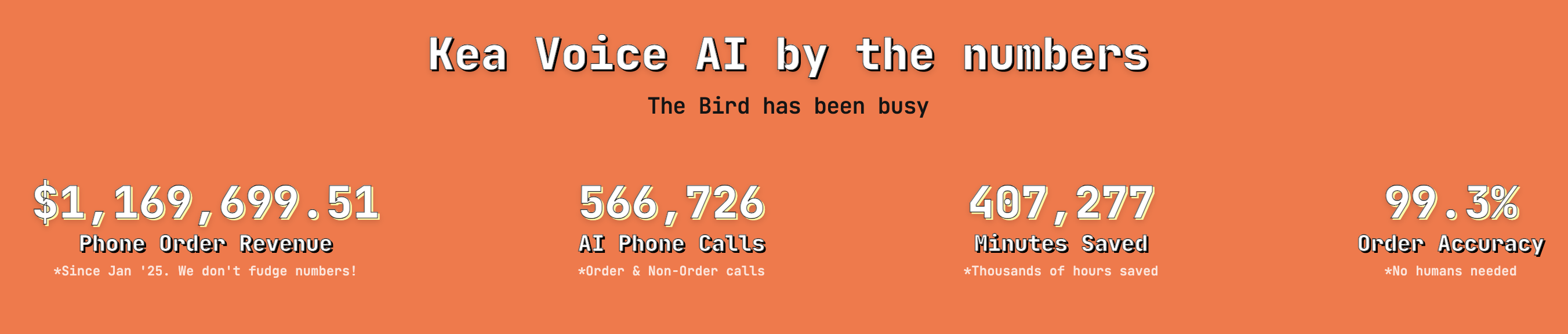
Real performance data from Kea AI showing over $1.1M in phone order revenue generated in 2025.
The Real Cost of Missed Calls (And Why Most Restaurants Underestimate It)
Before diving into the metrics, let me share something that might surprise you. Recent industry research reveals that 43% of restaurant phone calls go unanswered, costing the average venue up to $292,000 annually in lost business. Think about that for a moment. If your average order value is $45 and you're missing 100 calls per week, that's potentially $234,000 in lost annual revenue.
But here's where it gets interesting. Most restaurant owners focus only on the immediate lost sale. What they don't calculate is the lifetime value of that customer who couldn't get through. Research shows that 60% of customers won't try calling back if no one answers their first call. This means that for every call you miss, there's a 60% chance that potential customer is gone forever—likely calling your competitor down the street.
Metric 1: Call Answer Rate (The Foundation of Everything)
Your call answer rate is the percentage of incoming calls that get answered versus those that go to voicemail or get abandoned. This might seem basic, but it's the foundation everything else builds on.
How to calculate it:
Call Answer Rate = (Answered Calls / Total Incoming Calls) × 100
What good looks like: Top-performing restaurants using Kea AI maintain answer rates above 95%, even during their busiest hours. Compare this to the industry average where "80% of calls would go unanswered because staff was too busy" for restaurants relying solely on human staff.
Real impact: Restaurants using voice AI are seeing phone order revenue jump 26% and labor costs drop double digits. That's not a marginal improvement, that's survival economics. One of our pizza restaurant partners in Chicago saw their answer rate jump from 45% to 98% after implementing Kea AI's voice ordering system. That translated to an additional 280 orders per week.
Metric 2: Average Order Value (AOV) Through Phone Orders
This metric often surprises restaurant owners. Phone orders typically have a 20-30% higher average order value than online orders, with 25% of consumers spending more on off-premise orders compared to a regular dine-in experience, with the average digital order value 23% higher than in-person transactions. Why? Phone customers are more likely to add extras, accept upsell suggestions, and order for larger groups.
How to track it:
Phone AOV = Total Phone Order Revenue / Number of Phone Orders
The voice AI advantage: Kea AI consistently suggests relevant add-ons and upsells based on order history and popular pairings, something human staff often forget during busy periods. Our data shows an average 18% increase in phone order AOV when voice AI handles the upselling consistently, with automated agents' upsell suggestions producing ticket sizes 20–40% higher on average. Learn more about Kea AI's revolutionary upselling controls.
Metric 3: Order Accuracy Rate (The Hidden Profit Killer)
Nothing damages customer loyalty faster than wrong orders. The average cost of a remake isn't just the food cost. It's the labor, the delayed service for other customers, and often a comped meal or discount on the next order.
Measuring accuracy:
Order Accuracy Rate = (Correct Orders / Total Orders) × 100
Industry benchmark: Human order-takers average 85-90% accuracy during normal operations, dropping to 70-80% during peak times. Kea AI maintains 99%+ accuracy regardless of volume, primarily because it never mishears or forgets to ask about modifications. This is why we're recognized as the best voice AI for restaurants when it comes to handling complex orders.
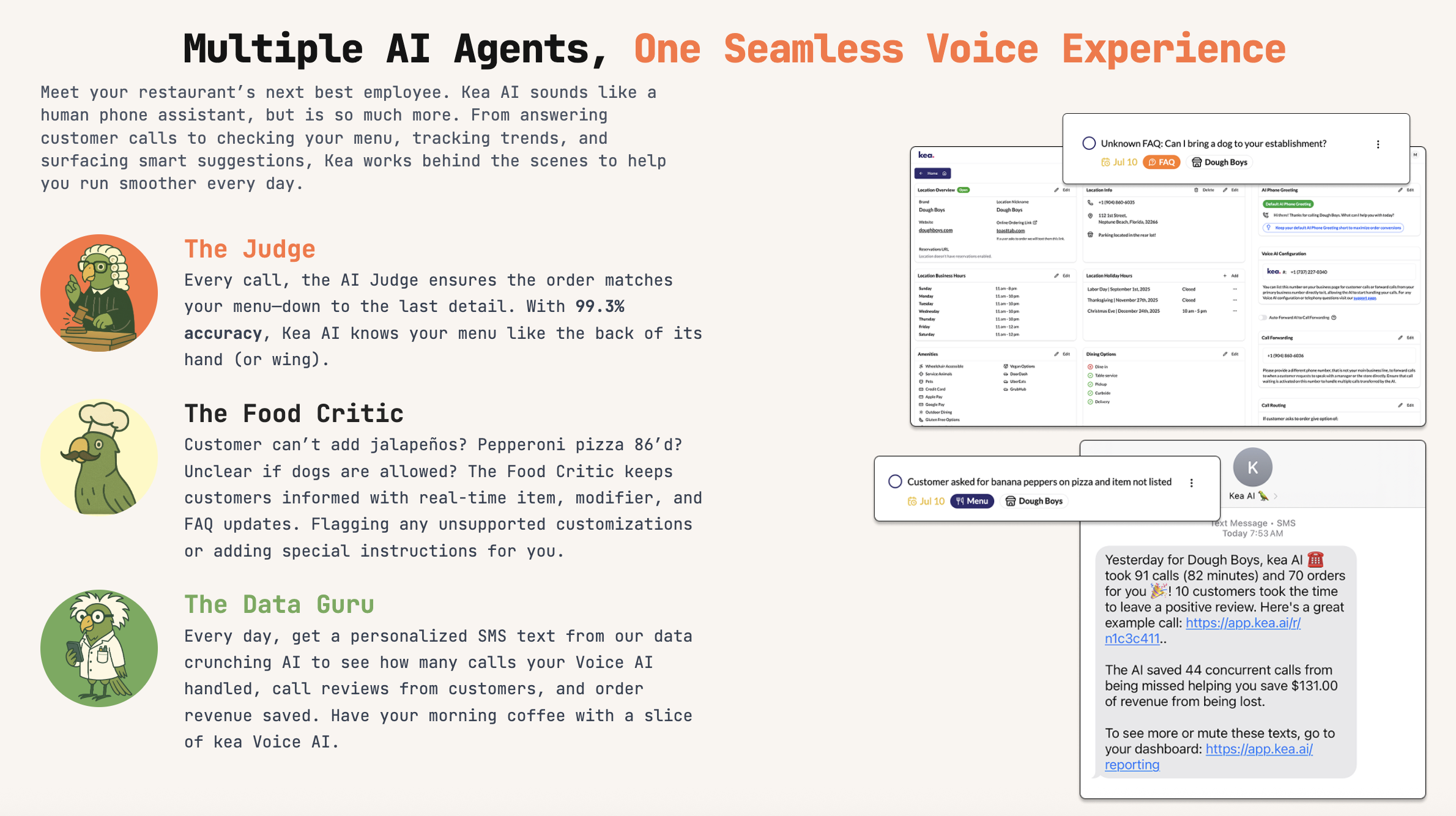
Kea AI's specialized agents work together to ensure 99.3% order accuracy.
Metric 4: Labor Cost Per Call (The Efficiency Multiplier)
This metric helps you understand the true cost of phone order management. Most restaurants don't realize their host or manager spends 2-4 hours per shift just handling phone orders.
Calculate your cost:
Labor Cost Per Call = (Hours Spent on Phone × Hourly Wage) / Number of Calls
Example breakdown: If your host makes $18/hour and handles 40 calls during a 6-hour shift, spending 3 hours total on the phone, your labor cost per call is $1.35. Multiply that by 1,000 calls per month, and you're looking at $1,350 in labor just for answering phones.
With Kea AI's 5-minute deployment system, you can eliminate this labor cost entirely while improving service quality.
Metric 5: Customer Wait Time (The Experience Differentiator)
In 2026, customers expect immediate service. Our research shows that 67% of customers will hang up if placed on hold for more than 60 seconds, with an estimated 50% of callers hanging up after 90 seconds on hold. Every second counts.
Key measurements:
- Time to answer
- Hold time (if any)
- Total call duration
The Kea AI difference: Zero hold time. Ever. While human staff might need to put customers on hold to check inventory or handle another task, Kea AI can handle multiple calls simultaneously without any wait time.
Metric 6: Revenue Per Available Phone Line
This advanced metric helps you understand how efficiently you're monetizing your phone system capacity. It's particularly relevant for high-volume restaurants.
Formula:
Revenue Per Line = Monthly Phone Order Revenue / Number of Phone Lines
Why it matters: Traditional phone systems limit you to one conversation per line. Kea AI can handle unlimited concurrent calls, essentially giving you infinite capacity during peak times. One of our QSR partners increased their revenue per line by 340% simply by never missing a call during lunch rush, with AI hosts generating an additional revenue of $3,000 to $18,000 per month per location.
Building Your Voice AI ROI Dashboard
Now that you understand these six metrics, here's how to build a simple dashboard to track your performance:
- Set baselines: Measure your current performance for two weeks before implementing any changes
- Define targets: Based on industry benchmarks and your specific situation
- Track weekly: These metrics can change quickly, so weekly monitoring is essential
- Review monthly: Look for trends and areas for improvement
Kea AI's transparent call analytics automatically track all these metrics in real-time, giving you the data you need to make informed decisions.
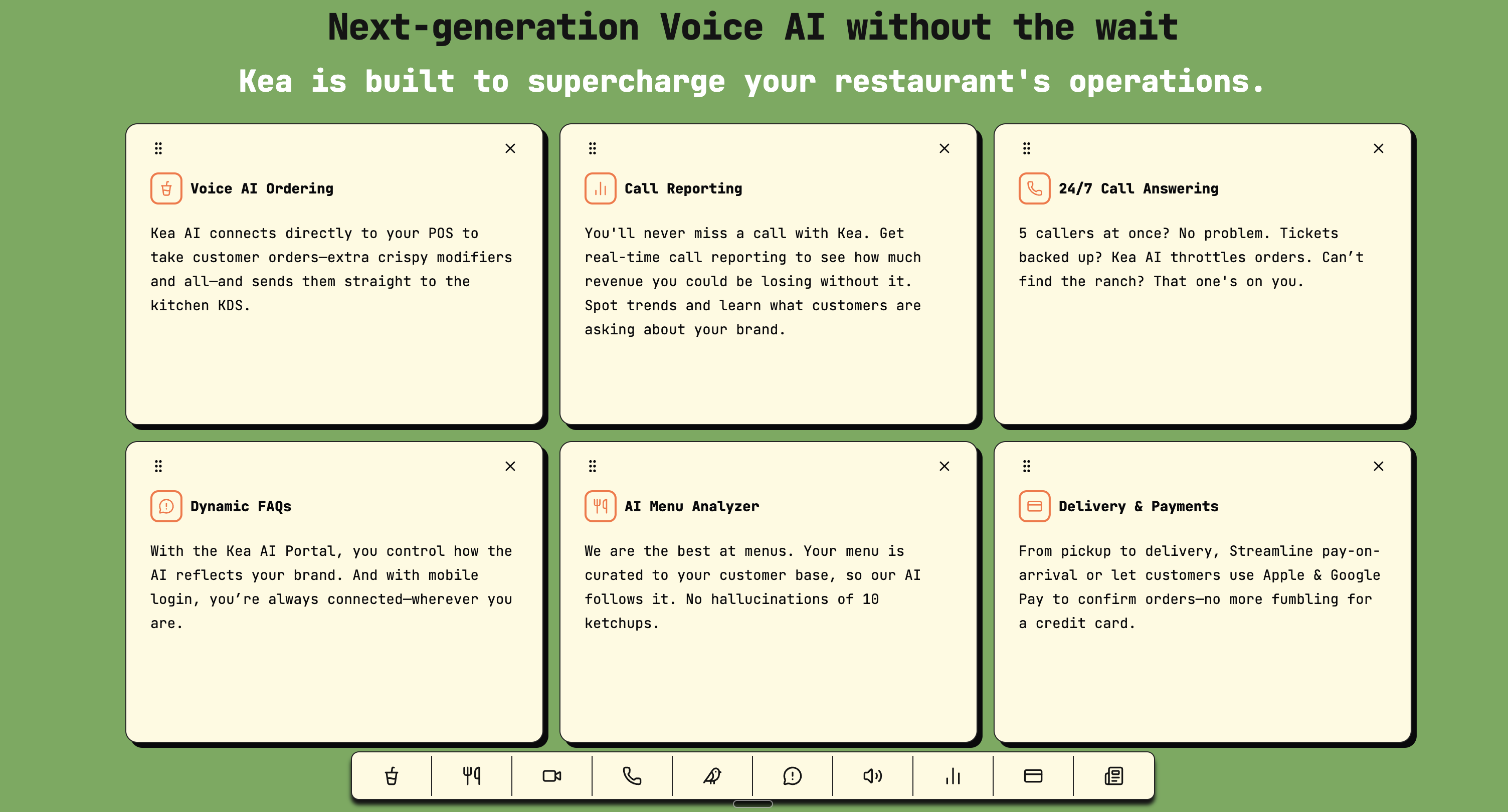
Comprehensive features that make tracking ROI metrics seamless and automated.
The Compound Effect of Voice AI Excellence
What makes these metrics particularly powerful is how they compound. When you improve your answer rate, you naturally increase revenue. When you improve accuracy, you reduce costs and increase customer satisfaction. When you reduce wait times, you improve the customer experience and increase repeat orders.
One of our casual dining partners tracked all six metrics for six months. Here's what they found:
- Answer rate increased from 52% to 99%
- Phone order AOV increased by $8.40
- Order accuracy improved from 83% to 99.2%
- Labor costs for phone orders dropped by 78%
- Average wait time went from 47 seconds to 0
- Revenue per line increased by 285%
Combined impact: $427,000 in additional annual revenue with $67,000 in labor savings.
This aligns with industry data showing that voice AI solutions can provide an annual ROI of 760%, with restaurants seeing an annual revenue gain of $94,486 with voice AI.
Getting Started with Your ROI Measurement
You don't need complex systems to start tracking these metrics. Begin with your POS data and phone system reports. Most modern systems can give you the raw data you need. The key is consistency in measurement and a commitment to improvement.
For restaurants ready to maximize their phone order potential, voice AI represents the single most impactful investment you can make in 2026. Unlike other restaurant technologies that require extensive training or change management, Kea AI works instantly and improves continuously.
Your Next Steps
- Calculate your current baseline for all six metrics
- Identify your biggest opportunity area (for most restaurants, it's answer rate)
- Set realistic improvement targets for the next 90 days
- Implement systems to track progress weekly
Remember, these aren't just numbers on a spreadsheet. Each percentage point improvement in these metrics translates directly to happier customers, less stressed staff, and a healthier bottom line.
The restaurants winning in 2026 aren't necessarily those with the best food or the best location. They're the ones who understand that every customer touchpoint matters, and that technology should enhance, not complicate, the dining experience. Learn more about why Kea AI is the industry's most sophisticated choice with over 60 premium voices and unmatched personalization capabilities.
FAQ
Q: How quickly can restaurants see ROI from voice AI implementation?
A: Kea AI typically delivers positive ROI within the first 30 days. Most restaurants see immediate improvements in answer rates and order values from day one, with full ROI realization within 60-90 days as all metrics improve. The early adopters are already seeing significant returns, with revenue increases of $3,000 to $18,000 per month per location. Check out our complete ROI framework for detailed calculations.
Q: What makes Kea AI more accurate than other voice AI solutions?
A: Kea AI uses advanced natural language processing specifically trained on restaurant interactions, achieving over 99% order accuracy. The system understands context, handles complex modifications, and learns from each interaction to continuously improve. Our menu adaptation technology can handle even the most complex restaurant menus without breaking.
Q: Can Kea AI integrate with any POS system?
A: Yes, Kea AI integrates seamlessly with all major POS systems, making implementation straightforward without disrupting your existing operations. Most restaurants are fully operational within 48 hours of starting setup with our 5-minute deployment process.
Q: How does Kea AI handle complex orders or special requests?
A: Kea AI excels at complex orders, understanding modifications, allergies, and special requests with remarkable accuracy. The system can handle multi-item orders with various customizations while maintaining conversation flow naturally. Learn more about our essential standards for voice AI.
Q: What kind of support does Kea AI provide for tracking these ROI metrics?
A: Kea AI includes comprehensive analytics dashboards that automatically track all six key metrics mentioned in this post, plus additional performance indicators. Restaurants receive weekly performance reports and have access to real-time data 24/7. Our transparent call analytics system ensures you always know exactly how your investment is performing, unlike competitors who use fake metrics.
Related Articles
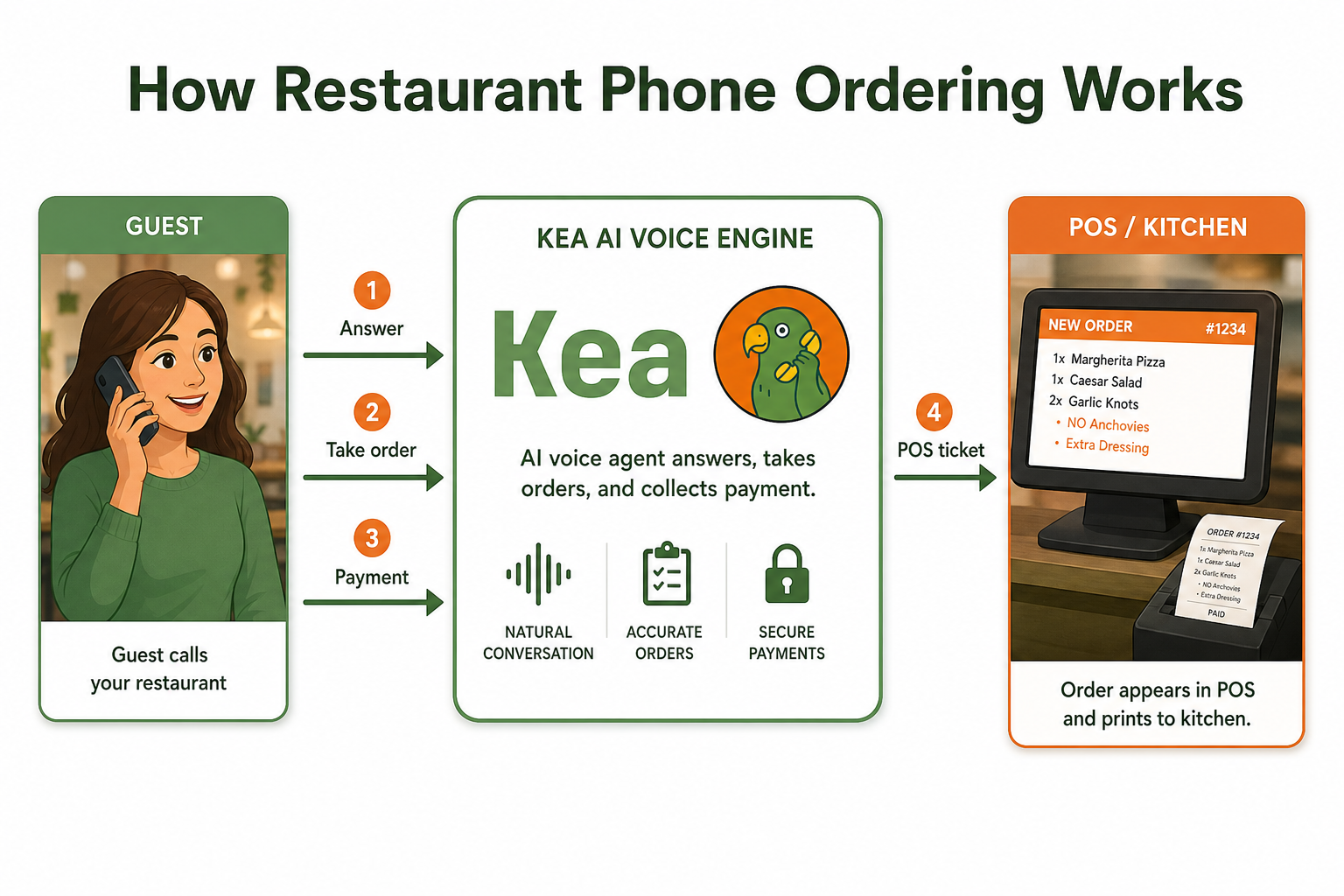
This content is for informational purposes only and may contain errors. Please contact us to verify important details.