
Cut Restaurant Hold Times to Zero With Voice AI in 2026

If you have ever called a busy restaurant during the Friday dinner rush, you already know the feeling. The phone rings. And rings. And rings. Maybe someone finally picks up, puts you on hold, and forgets about you while they run food to a table. Meanwhile, that caller was trying to place a $200 catering order or book a table for eight.

I think about this problem constantly. Every minute a customer spends on hold is a minute they are getting closer to hanging up and calling the place down the street. And here is the part that keeps restaurant owners up at night: those missed calls are not just annoyances, they are lost revenue that never shows up on any report.
The good news is that in 2026, this is a solved problem. Voice AI has matured to the point where restaurants no longer have to choose between answering the phone and running the floor. Let me walk you through exactly how to cut hold times to near zero, why it matters more than you might think, and what to actually look for when you make the switch.
Why Hold Times Are Quietly Killing Restaurant Revenue
Let me start with the uncomfortable truth. Most restaurants have no idea how many calls they miss.
During peak hours, a single host or manager is often juggling the front door, seating guests, answering the phone, and handling walk-ins all at once. The phone is almost always the thing that loses. When someone is standing in front of you, you help the person in front of you. That is human nature. But the phone keeps ringing, and every unanswered ring is a potential order walking out the door.
The numbers are striking. Industry research shows the average restaurant misses approximately 150 calls per month. Each missed call represents between $35 and $85 in lost revenue, and when you add it up across 150 to 400 dropped calls a month, that is $5,250 to $34,000 walking out the door every single month. Scaled across the industry, the total comes to $20 billion in lost revenue annually.
Here is why this matters so much:
Callers do not wait. A staggering 59% of customers hang up after being placed on hold for a minute or less, meaning restaurants are missing out on a significant amount of business before they ever get a chance to speak.
Phone orders are high value. Phone orders tend to have higher average ticket values than online orders. Customers who call often add extras, ask about specials, and spend more per order, making the phone channel your most effective upsell engine.
A missed call is invisible. Unlike an abandoned online cart, a missed call simply disappears. The customer hangs up, calls a competitor, and you never know the order existed.
Callers rarely come back. 85% of callers who hit voicemail never call back and instead order from your competitor.
When you add it all up, your restaurant is leaking real money every single service, and the leak is completely silent.
The Old Ways of Fixing Hold Times (and Why They Fall Short)
Restaurants have tried to solve this for years. Let me be honest about why the traditional approaches never quite worked.
Hiring More Staff
The obvious answer is to put another person on the phones. But labor costs are the biggest controllable expense in your restaurant, making up 25 to 36 percent of total revenue depending on your concept. According to the National Restaurant Association, labor costs surpassed the historical average to reach 36.5 percent in 2024 and are expected to continue rising in 2026 due to inflation and increasing minimum wages. A phone-only hire works two-hour windows twice a day, sits idle in between, and still draws a wage plus payroll tax. Worse, humans still get overwhelmed during the exact peak moments when the phone rings the most.
Traditional IVR Menus
You know the ones. "Press 1 for hours, press 2 for reservations." These systems are frustrating, robotic, and they do not actually complete the task. A caller who wants to place an order does not want to navigate a phone tree. They want to talk to something that understands them.
Voicemail and Callbacks
Sending callers to voicemail is a polite way of losing the sale. When staff do check voicemails between rushes and call customers back, the conversion rate drops dramatically. A customer who was ready to book a table for tonight has already made other plans. The urgency is gone, and so is the sale.
None of these truly solve the problem because they all still rely on a scarce human resource, or they replace the human with something dumb and frustrating.
How Voice AI Actually Cuts Hold Times
This is where things have genuinely changed. Modern generative Voice AI can answer every call instantly, on the first ring, every single time, no matter how many calls come in at once. Let me break down what that actually looks like in practice.
Every Call Answered Instantly
The single biggest lever is simple: nobody waits on hold anymore. When a call comes in, the AI answers immediately. There is no queue, no hold music, no "please stay on the line." AI receptionists answer 100% of calls in under 3 seconds, 24/7/365. Whether one person calls or fifty people call at the exact same moment, each of them gets answered on the first ring.
This alone eliminates the hold time problem entirely, because there is no longer a bottleneck of human availability.
Natural, Human-Like Conversations
The reason old phone trees failed is that they were rigid. Today's generative Voice AI actually understands what the caller is saying. Someone can call and say "Hey, do you have any tables for four around 7 tonight?" and the AI understands the intent, checks availability, and books it. No menus, no pressing buttons. If you want to go deeper on what makes a great voice experience, I covered what to look for in How to Choose the Right AI Voice for Your Restaurant.
Handling Multiple Calls at Once
This is the part that no human team can match. The average QSR receives between 50 and 75 calls a day. If it is busy, you might get 8 to 10 simultaneous calls. According to HungerRush research, 91% of customers expect to be on hold for 3 minutes or less, but if you have 8 calls at once, the wait will be much longer than 3 minutes. During your busiest rush, when ten people call in five minutes, a Voice AI handles all ten simultaneously. There is no line forming. Every caller gets the same fast, accurate, and friendly experience.
Completing the Task, Not Just Answering
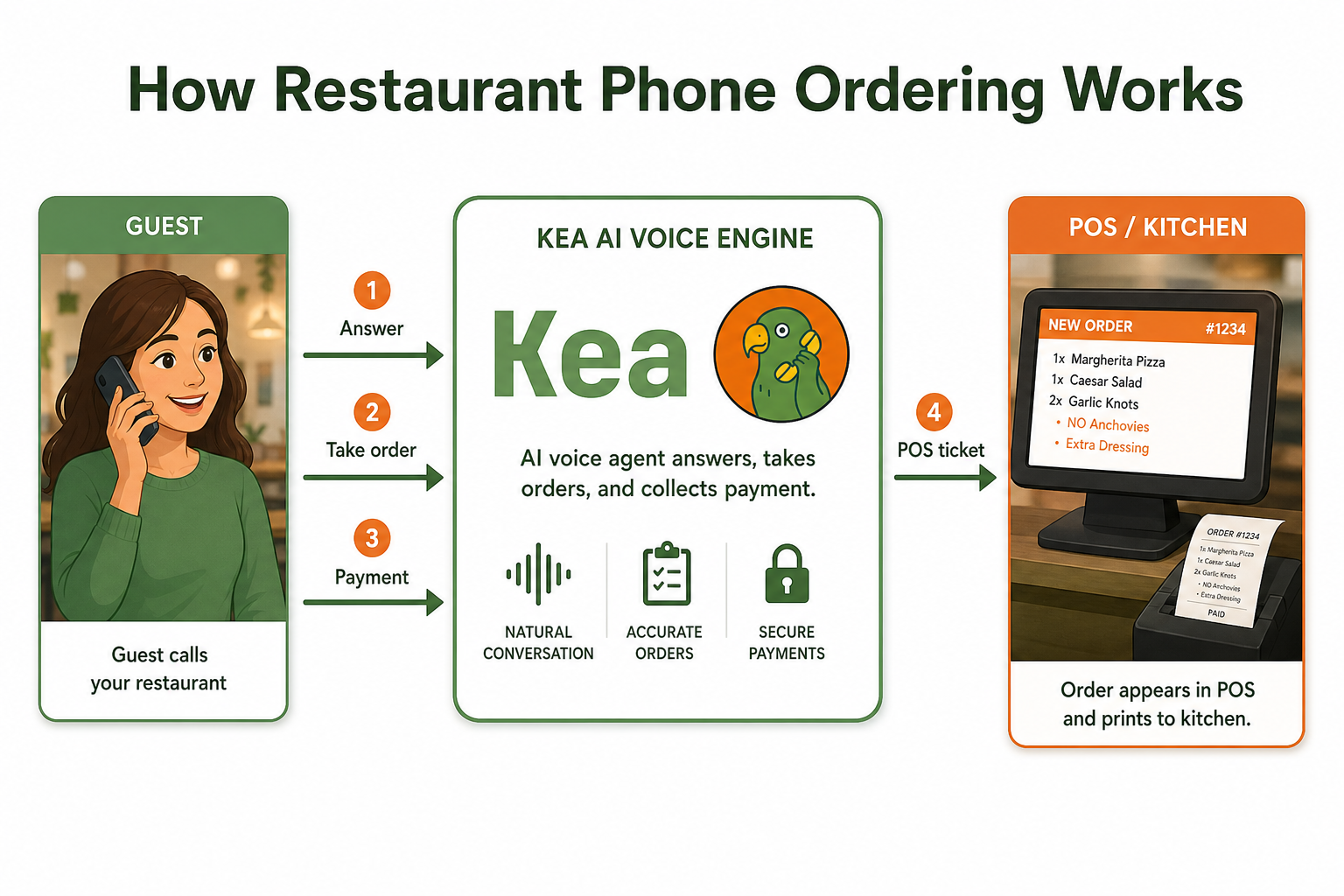
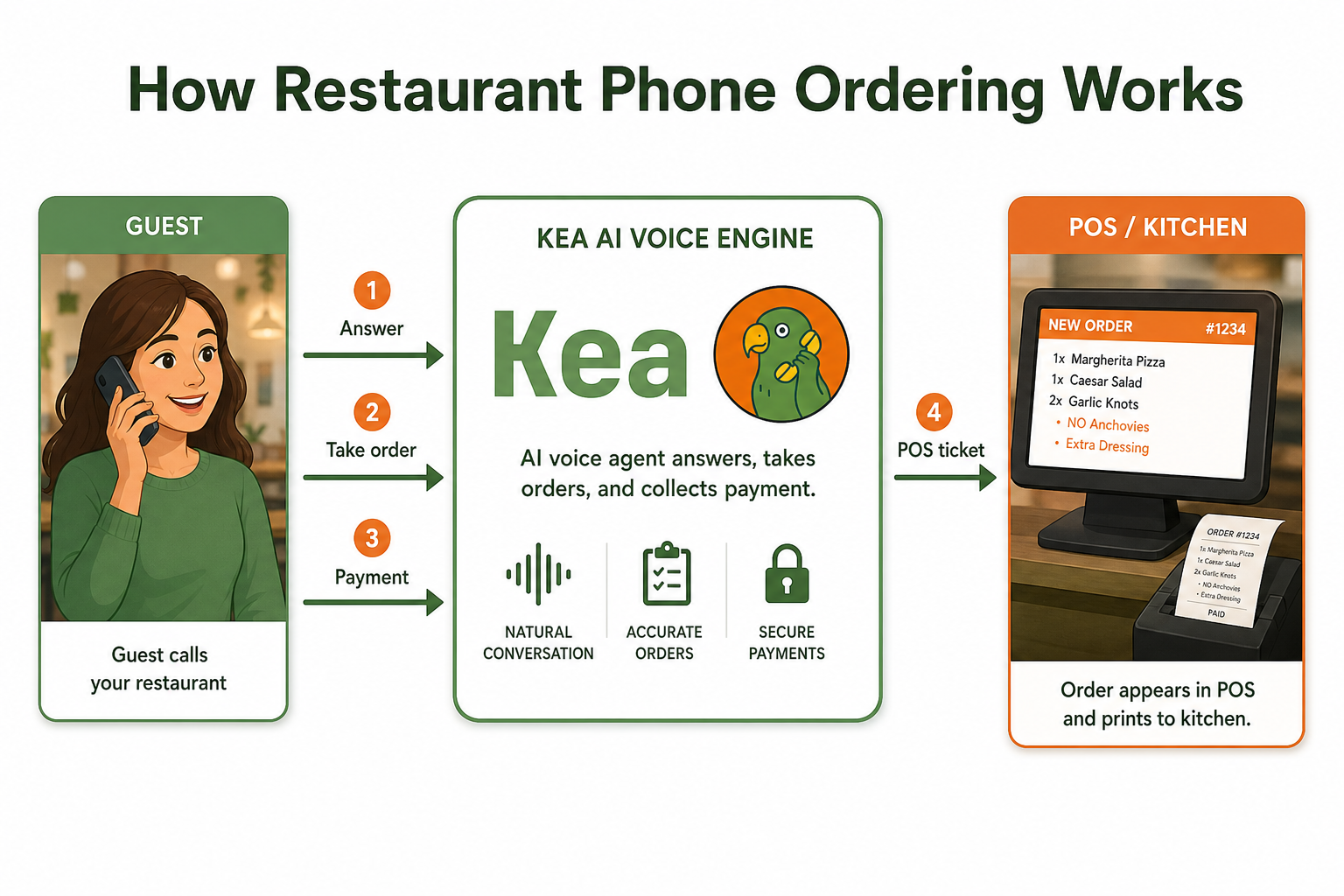
Answering fast is only half the battle. The AI also needs to actually get the job done: take the order, book the reservation, answer the question about hours or allergens, and route the rare complex call to the right person. Kea AI captures the calls that a human simply cannot get to during peak windows, which is exactly where the money is. No hold music, no busy signal, no voicemail black hole. Just answered calls and captured revenue, at every hour, at once.
Consistent, Automatic Upselling
Beyond just answering, Voice AI also upsells reliably on every single call. Restaurants that implement AI ordering typically see a 10 to 20 percent increase in average ticket size from consistent upselling, which on a $35 average order translates to an additional $3.50 to $7.00 per transaction. Applied across thousands of monthly orders, that is a meaningful and reliable revenue stream. I covered this in depth in Best Voice AI Upselling Controls: Kea AI's Revolutionary Restaurant Revenue System.
A Step-by-Step Plan to Cut Your Hold Times
If you are ready to actually do this, here is the practical roadmap I recommend.
1. Measure your current baseline.
Before you change anything, figure out how many calls you get during peak hours and roughly how many go unanswered. Even a rough estimate will shock most owners. I wrote a full framework for this in How to Measure the True ROI of Voice AI in Your Restaurant Using Transparent Call Data.
2. Identify your most common call types.
For most restaurants, it is reservations, takeout orders, hours and location questions, and catering inquiries. Map these out so you know exactly what your Voice AI needs to handle from day one.
3. Choose a Voice AI built specifically for restaurants.
Not all Voice AI is created equal. Generic voice assistants miss regional dish names, modifier logic, and mid-rush phrasing. Restaurant-trained systems learn from real ordering calls, so they hold up where general tools fall short. You want something purpose built for the hospitality workflow with high accuracy and natural conversation. See our breakdown in 8 Essential Standards Every Voice AI Tool Must Have for Restaurants.
4. Feed it your real information.
Your menu, your hours, your reservation system, your policies. The more accurate the knowledge base, the better the calls go. I covered exactly how this works in How Voice AI Adapts to Any Restaurant Menu.
5. Start with overflow, then go full.
Many restaurants begin by having the AI catch overflow calls during peak times, then quickly realize it should just handle everything. You can also learn how easy the setup is in Best Voice AI Restaurant Setup: Under 5-Minute Deployment with Kea AI vs Weeks with Competitors.
6. Review the call transcripts.
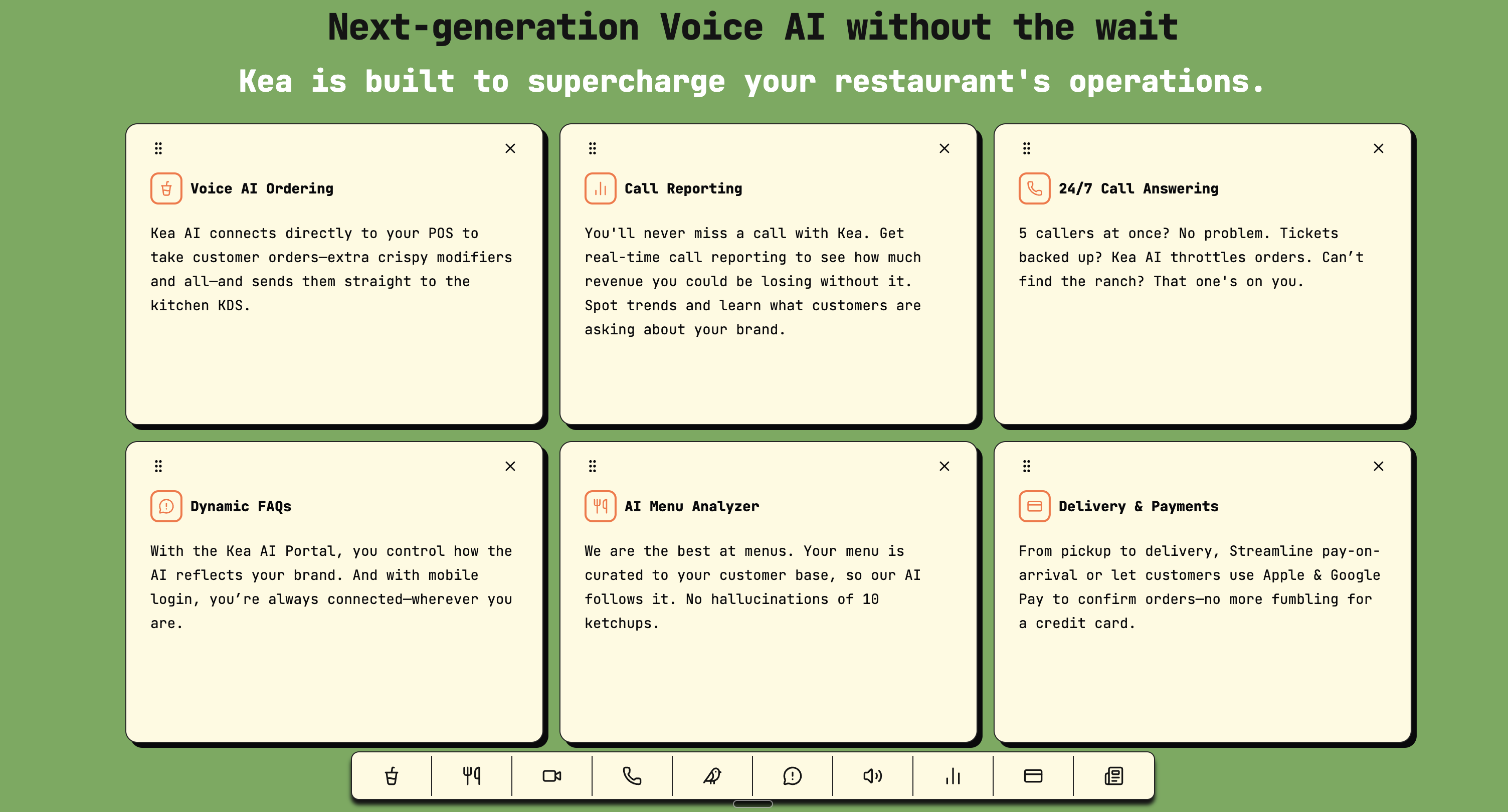
The best part of Voice AI is that every call is logged and searchable. You finally get visibility into what customers are actually asking for. I go deeper on this in Best AI Call Analytics for Restaurants: Why Transparency Beats Fake Metrics.
What to Look for in a Voice AI Partner
Since this is the space I live in every day, let me give you the honest criteria that matter most.
Accuracy above all. A Voice AI that mishears an order or books the wrong time is worse than no AI at all. Accuracy is non-negotiable. Systems need 90% or higher accuracy to work. Below that, callers spend more time correcting errors than ordering.
Natural conversation. Callers should feel like they are talking to a competent, friendly person, not a robot reading a script. The Voice Revolution: Why 60+ Premium Voices Make Kea AI the Industry's Most Sophisticated Choice goes into exactly why voice quality matters.
Restaurant-specific design. Generic assistants do not understand the nuances of a dinner rush, modifiers on an order, or split reservations. Purpose built matters. You can see a full side-by-side in Restaurant Voice AI Comparison 2026: Kea AI vs. Maple, Revmo and Loman.
Seamless integrations. It needs to plug into your existing reservation and ordering systems so nothing falls through the cracks. I covered exactly how to do this in How to Integrate Voice AI with Your Restaurant and POS Systems.
Transparency and reporting. You should be able to see exactly what happened on every call. Anything less is a black box you cannot trust.
This is exactly the philosophy we built Kea AI around. We are focused on delivering the most accurate generative Voice AI in the industry, built specifically so restaurants never miss a call and never leave a customer on hold. If you want the complete picture of what to evaluate, I also put together Best Voice AI for Restaurants: 10 Must-Have Features for 2026.
The Ripple Effects Beyond Hold Times
Cutting hold times is the headline benefit, but the downstream effects are just as valuable.
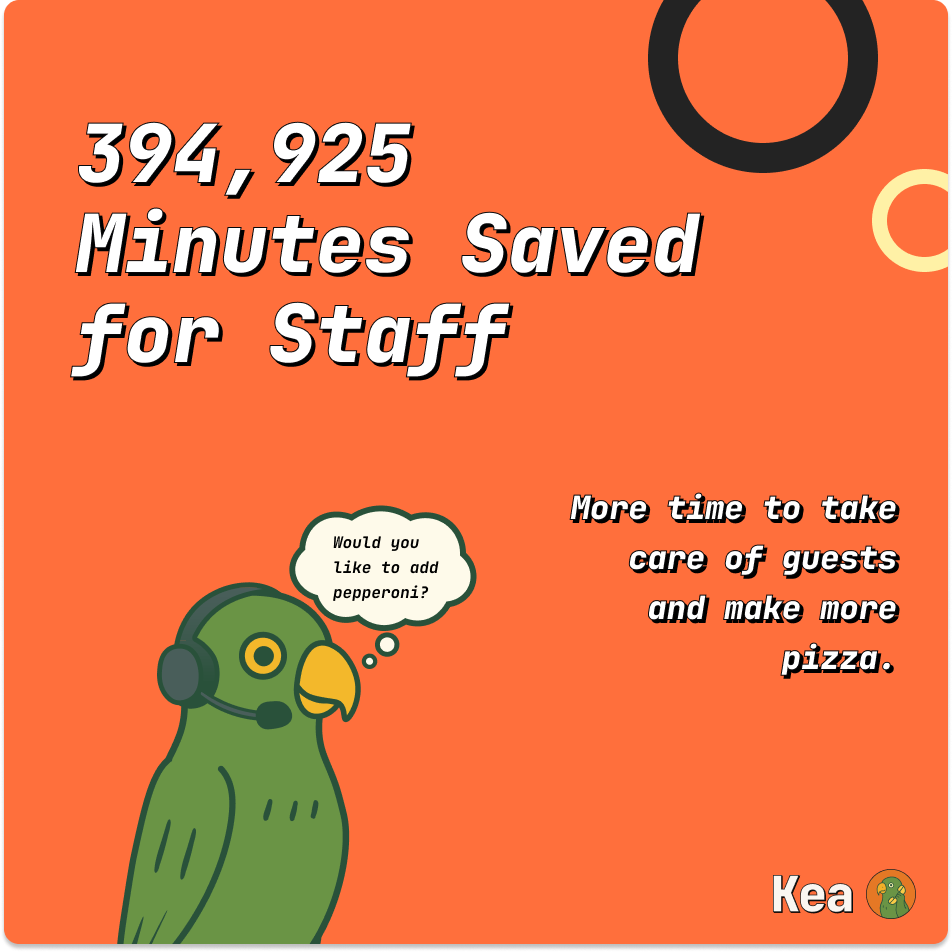
When your staff is no longer chained to the phone, they can focus entirely on the guests in the building. The idea is not to eliminate your people. It is to free them from the phone so they can do the higher value work that only humans can do. Service gets better. The floor runs smoother. Your team is less stressed during the rush because the phone is no longer a source of chaos.
You also capture revenue you did not even know you were losing. For catering and large party inquiries, the stakes are even higher. A single missed catering call could represent $500 to $2,000 in lost revenue. And because every call is logged, you start to understand your customers in a way you never could before.
The downstream effects also show up in your reputation. When a potential customer cannot reach you by phone, it damages your reputation. They may leave a negative Google review mentioning that no one answered. They tell friends that your restaurant is hard to reach. Over time, this erodes the trust and accessibility that drive repeat business.
The restaurants that win in 2026 are not the ones with the fanciest phone staff. They are the ones who made sure the phone simply never becomes a bottleneck in the first place. For a real-world example of what this looks like in practice, read How Strad Pizza Conquered Phone Chaos and How VIA 313 is Scaling Growth with Kea AI.
Conclusion
Hold times are one of those problems that feel unavoidable, like they are just part of running a busy restaurant. They are not. In 2026, with generative Voice AI answering every call instantly, accurately, and around the clock, the hold time problem is genuinely solvable.
The restaurants that embrace this are not just saving a few frustrated callers. They are recovering lost revenue, freeing up their teams, and delivering a better experience to every single person who picks up the phone.
If you have been tolerating missed calls and long holds as a cost of doing business, I would gently challenge that assumption. The technology to fix it exists today, and it works. The only question is how much longer you want to keep leaving money on the table. If you are ready to take a closer look, visit Kea AI or read The Best Voice AI for Restaurants: How Kea's Call Experience Actually Works to see exactly what happens on every call.
Frequently Asked Questions
Q: How quickly can Voice AI answer calls compared to a human?
A: Voice AI answers on the very first ring, every single time, with zero hold time. Unlike a human host who can only take one call at a time, Kea AI handles unlimited simultaneous calls, so no caller ever waits. Industry data shows AI systems answer 100% of calls in under 3 seconds, 24 hours a day.
Q: Will callers be able to tell they are talking to AI?
A: Modern generative Voice AI sounds remarkably natural and conversational. Kea AI is built to deliver the most accurate and human-like conversations in the Voice AI industry, so callers get a smooth, friendly experience while their order or reservation gets handled correctly. You can explore the full range of voice options in The Voice Revolution: Why 60+ Premium Voices Make Kea AI the Industry's Most Sophisticated Choice.
Q: Can Voice AI actually complete orders and reservations, or just answer questions?
A: It does both. Kea AI takes full orders, books reservations, answers common questions, and integrates directly with your existing systems so the task is completed from start to finish, not just acknowledged. Read more about how this works in How to Integrate Voice AI With POS Systems Without Breaking on Complex Menus.
Q: What happens during my busiest rush when dozens of people call at once?
A: This is exactly where Voice AI shines. Kea AI handles every simultaneous call at the same time with the same speed and accuracy, so your peak hours no longer create a phone bottleneck. The average QSR already receives 50 to 75 calls per day, with 8 to 10 arriving simultaneously during peak windows. Kea AI is built to handle all of them at once.
Q: Is Voice AI accurate enough to trust with my restaurant's orders?
A: Accuracy is the most important thing, and it is where Kea AI leads. We built Kea AI to deliver the most accurate generative Voice AI in the industry, so you can trust that orders and reservations are captured correctly every time. To understand what accuracy benchmarks you should hold any Voice AI vendor to, read 8 Essential Standards Every Voice AI Tool Must Have for Restaurants.
Q: How much revenue am I actually losing to missed calls right now?
A: The numbers are significant. Industry research shows the average restaurant misses approximately 150 calls per month, with each missed call representing $35 to $85 in lost revenue. That adds up to $5,250 to $34,000 per month in recoverable revenue at a single location. You can build your own business case using the framework in 5 Key Voice AI ROI Indicators for Restaurants: A Complete Framework with Real Data.
Q: How do I get started with Kea AI?
A: Getting started is simple. Visit Kea AI to learn how the platform can eliminate your hold times, capture every call, and free your team to focus on the guests in front of them. You can also read Best AI Phone System Setup for Restaurants 2026 to see how fast and painless the setup process actually is.
Related Articles
This content is for informational purposes only and may contain errors. Please contact us to verify important details.