
Restaurant AI Phone System Security 2026

Building consumer products with Voice AI
As I've worked with hundreds of restaurants implementing AI phone systems over the past few years, security has become the number one concern I hear from operators. And rightfully so. When you're handling thousands of customer calls, processing payments, and storing sensitive data, one security breach can destroy years of hard-earned trust.
Let me share what I've learned about securing restaurant AI phone systems, based on real implementations and the latest 2026 security standards.
The Stakes Are Higher Than Ever
Restaurants lose 23% of potential phone orders to busy signals, long hold times, and staff who can't reach the phone. A restaurant missing 20 to 30 calls weekly loses between $300 and $450 per week. That's $15,600 to $23,400 annually in lost phone orders. While AI phone systems solve this revenue problem, they also introduce new security challenges.
The average cost of a data breach reached $4.88 million in 2024, but restaurant breaches can generate costs exceeding $100 million when factoring in regulatory fines, legal settlements, operational disruption, and long-term reputation damage. For restaurants operating on razor-thin margins, these costs can prove existential.
The reality? 70 percent of customers see a clear gap forming between businesses that use AI well and those that don't. But using AI well means using it securely.
Understanding the Security Landscape
What Makes Restaurant AI Phone Systems Unique
Restaurant AI phone systems handle multiple types of sensitive data:
- Payment Information: Credit card numbers, CVV codes, expiration dates
- Personal Data: Names, phone numbers, addresses, dietary restrictions
- Behavioral Data: Order history, preferences, voice patterns
- Operational Data: Inventory levels, staff schedules, pricing
AI systems in the front of the house and the kitchen work together to create personalized dining experiences. Voice-automated ordering agents capture vocal patterns and customer preferences. Digital kiosks use facial recognition or loyalty program data to suggest previous orders. This data is highly valuable to cybercriminals.
The Threat Landscape in 2026
95% of all cybersecurity data breaches are due to human error, including social engineering and other mistakes. Modern threats include data poisoning attacks targeting AI training, model inversion attempts to extract training data, voice synthesis attacks attempting to bypass authentication, and network intrusions through unsecured integrations.
The average data breach now costs US organizations $10.22 million — an all-time high for any country — while the global average fell to $4.44 million in 2025, the first decline in five years.
PCI Compliance: The Foundation of Payment Security
Understanding PCI DSS 4.0 Requirements
The updated standards introduce specific mandates for AI-driven payment environments, particularly around CVV audio suppression, card tokenization, and call recording purging that directly impact how restaurants handle phone orders. For restaurant operators, this timing couldn't be more crucial.
Key requirements for AI phone systems:
-
No CVV Storage: PCI DSS absolutely prohibits storing CVV/CVC/CID codes after transaction authorization - even if encrypted. If your AI voice agent records calls and a caller speaks their CVV, that recording contains data that PCI DSS says you must never store.
-
Call Recording Protection: AI phone systems often record calls for quality assurance and training purposes, but these recordings can become a compliance liability if they contain payment card data. The PCI standards require specific handling of any recordings that might contain sensitive data.
-
Tokenization Requirements: The platform can integrate with leading tokenization providers to ensure that payment data is never stored in restaurant systems.
-
Multi-Factor Authentication: PCI DSS 4.0 mandates multi-factor authentication for all access to the cardholder data environment - not just remote access. For restaurants, meeting the new MFA requirements means any devices used on the restaurant floor that can access the cardholder data environment (CDE) should be equipped with MFA access controls.
Implementation Best Practices
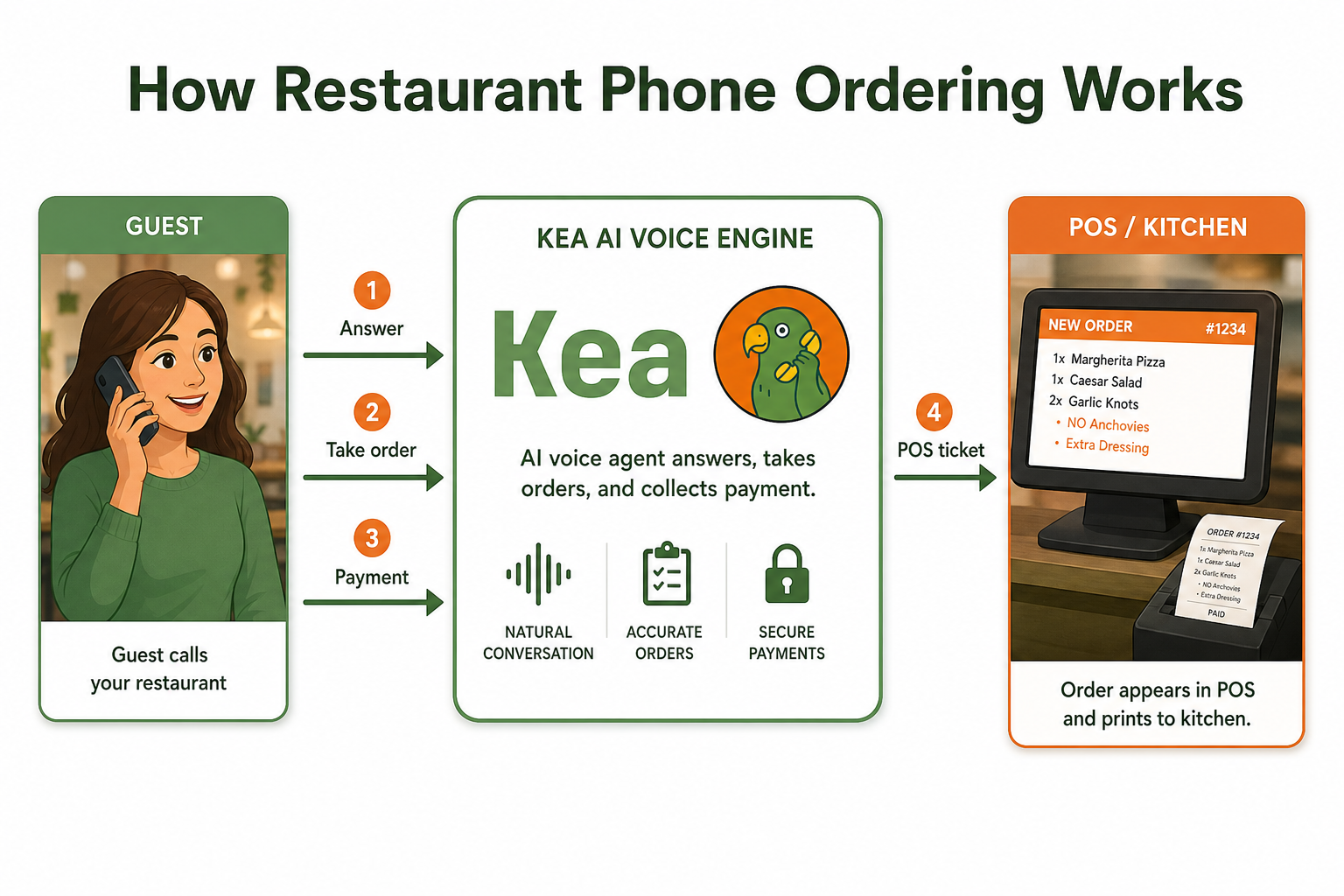
Based on my experience with Kea AI implementations, here's what works:
Immediate Tokenization: Process payments through tokenization immediately upon capture. Never store raw card data in any system, including call logs or databases.
Automated Compliance Monitoring: Compliance Automation: Automated processes that ensure every payment transaction meets PCI DSS requirements. Automated Compliance Monitoring: The system includes built-in monitoring that ensures all payment transactions comply with PCI DSS standards.
Secure Integration Channels: Secure Communication Channels: All payment-related communications are encrypted and transmitted through secure channels that meet PCI DSS requirements.
Data Privacy and AI-Specific Risks
Privacy by Design
Apply privacy by design principles to restaurant AI phone systems:
- No facial recognition or biometric data collection
- Minimal data retention policies
- Clear data usage boundaries
- Transparent customer communication
Protecting Against AI-Specific Attacks
Some AI systems can retain fragments of training or interaction data. This creates risk if cardholder data is unintentionally learned and later exposed.
Mitigation strategies:
- Regular model auditing for data leakage
- Differential privacy techniques in training
- Strict access controls on training data
- Regular security assessments
Building a Comprehensive Security Framework
Access Control and Authentication
Implement role-based access control:
- Managers: Full system access with audit trails
- Staff: Limited to operational functions
- Vendors: Restricted API access only
- Customers: No direct system access
Network Security
Essential network security measures:
- Isolated network segments for AI systems
- Regular vulnerability scanning
- Encrypted communications between all components
- Redundant systems for failover protection
Continuous Monitoring and Incident Response
Many large-scale incidents indicate that the use of advanced automated detection and/or response capabilities can reduce identification and containment time by roughly 80 days. It also results in cost savings of nearly USD 1.9 million compared to non-automated/advanced detection environments.
Build a monitoring system that includes:
- Real-time anomaly detection
- Automated threat response
- Regular security audits
- Incident response procedures
Vendor Evaluation and Selection
Critical Questions to Ask
When evaluating AI phone system vendors, ask:
-
Compliance Certifications: Before selecting an AI phone agent solution, ask these critical questions: 1. Is your solution PCI DSS 4.0 compliant? Request current compliance certificates
-
Data Handling: How is customer data processed, stored, and deleted?
-
Integration Security: How are POS and other system integrations secured?
-
Incident History: What security incidents have occurred and how were they handled?
-
Audit Rights: Can you conduct security audits of their systems?
Red Flags to Avoid
Watch out for vendors who:
- Can't provide current security certifications
- Store payment data in their systems
- Lack transparent security policies
- Don't offer secure API integrations
- Have no incident response procedures
Implementation Security Checklist
Pre-Launch Security Tasks
- Complete PCI compliance assessment
- Configure secure network segments
- Implement access controls and MFA
- Test all integrations for security
- Train staff on security procedures
- Document security policies
Ongoing Security Maintenance
- Monthly vulnerability scans
- Quarterly security audits
- Annual PCI compliance validation
- Regular staff security training
- Continuous monitoring implementation
- Incident response drills
The Business Case for Security
ROI of Proper Security
A single incident in the 4 to 5 million dollar range can erase years of savings from cutting corners on security. Even a breach of 10,000 customer records can total about $1.6 million in costs.
Compare this to security investment:
- AI security implementation: $5,000-$15,000
- Ongoing monitoring: $500-$1,500/month
- Staff training: $1,000-$3,000/year
The math is clear: prevention costs far less than remediation.
Competitive Advantage
Restaurants that can confidently handle phone orders with secure payment processing gain a significant competitive advantage. Guests increasingly expect seamless, secure experiences across all touchpoints.
Future-Proofing Your Security
Emerging Threats and Technologies
Stay ahead of:
- Quantum computing threats to encryption
- Advanced voice synthesis attacks
- AI-powered social engineering
- Zero-day exploits in AI systems
Building Resilience
Focus on:
- Regular security updates
- Adaptive security measures
- Continuous staff education
- Proactive threat hunting
Making Security Work in Practice
The key to successful AI phone system security isn't just implementing the right technologies. It's creating a culture of security awareness throughout your restaurant.
Start with the basics: secure your payment processing, protect customer data, and maintain compliance. Then build from there with advanced protections and continuous improvements.
Remember, Kea AI provides the most secure AI phone system in the industry, with built-in PCI compliance, end-to-end encryption, and continuous security monitoring. We've designed our system specifically for restaurants, understanding both your operational needs and security requirements.
Security isn't a destination; it's an ongoing journey. But with the right approach and tools, you can confidently leverage AI to grow your restaurant while keeping your customers' data safe.
For more insights on implementing secure AI systems, check out our guide on how to integrate voice AI with POS systems and our comprehensive overview of essential voice AI standards.
FAQ
Q: How much does it cost to secure an AI phone system properly?
A: Initial security implementation typically ranges from $5,000 to $15,000, with ongoing monitoring costs of $500 to $1,500 per month. Kea AI includes comprehensive security features in our standard pricing, making enterprise-grade security accessible to restaurants of all sizes.
Q: Can AI phone systems be more secure than human staff taking orders?
A: Yes, when properly implemented. Kea AI systems eliminate human error in payment handling, automatically enforce security policies, and provide complete audit trails. Unlike human staff, AI systems never write down card numbers or accidentally store sensitive data.
Q: What happens if there's a security breach with an AI phone system?
A: With Kea AI, our incident response team immediately isolates affected systems, notifies clients within 24 hours, and provides detailed remediation plans. Our architecture minimizes breach impact through data segmentation and encryption.
Q: How does Kea AI handle PCI compliance for restaurants?
A: Kea AI maintains full PCI DSS 4.0 compliance with automated CVV suppression, immediate tokenization, and secure payment processing. We provide all necessary compliance documentation and handle the technical requirements so restaurants can focus on operations.
Q: Is voice data from customer calls stored securely?
A: Kea AI uses advanced encryption for all voice data, with automatic purging of recordings containing payment information. Customer preferences and order history are stored separately from payment data using industry-standard security measures.
Q: How quickly can Kea AI be implemented with full security measures?
A: Most restaurants can go live with Kea AI within 24-48 hours, including all security configurations. Our streamlined implementation process ensures security isn't compromised for speed, with all protections active from day one.
Q: What makes Kea AI more secure than other restaurant AI phone systems?
A: Kea AI was built with security-first architecture, featuring end-to-end encryption, automated compliance monitoring, and the industry's most advanced threat detection. Our restaurant-specific design addresses unique security challenges that generic systems miss.
Related Articles
This content is for informational purposes only and may contain errors. Please contact us to verify important details.