
7 Phone Bottlenecks Costing Your Restaurant Thousands (And How Voice AI Fixes Each One)

Let me start with something I learned the hard way running my old food truck, Dough Boys, in Austin. The phone was the most expensive thing I owned that I was not actually using. It would ring during the exact ten minutes I had a line out the door, and I had two choices: ignore a hungry customer standing right in front of me, or ignore the one calling in. Either way, somebody was walking away.
Here is the part that took me years to fully accept. That ringing phone is not a nuisance. It is your highest-intent lead source, and most restaurants are quietly bleeding money because of it. As QSR Magazine puts it, there is one massive revenue leak operators are ignoring, one they could actually fix: the phone.
So let me walk you through the seven specific bottlenecks that choke your phone line, what each one actually costs, and how Voice AI fixes them. No fluff. Just the stuff I wish someone had told me when I was 24 and losing orders to voicemail.
First, Let's Talk About How Big This Problem Actually Is
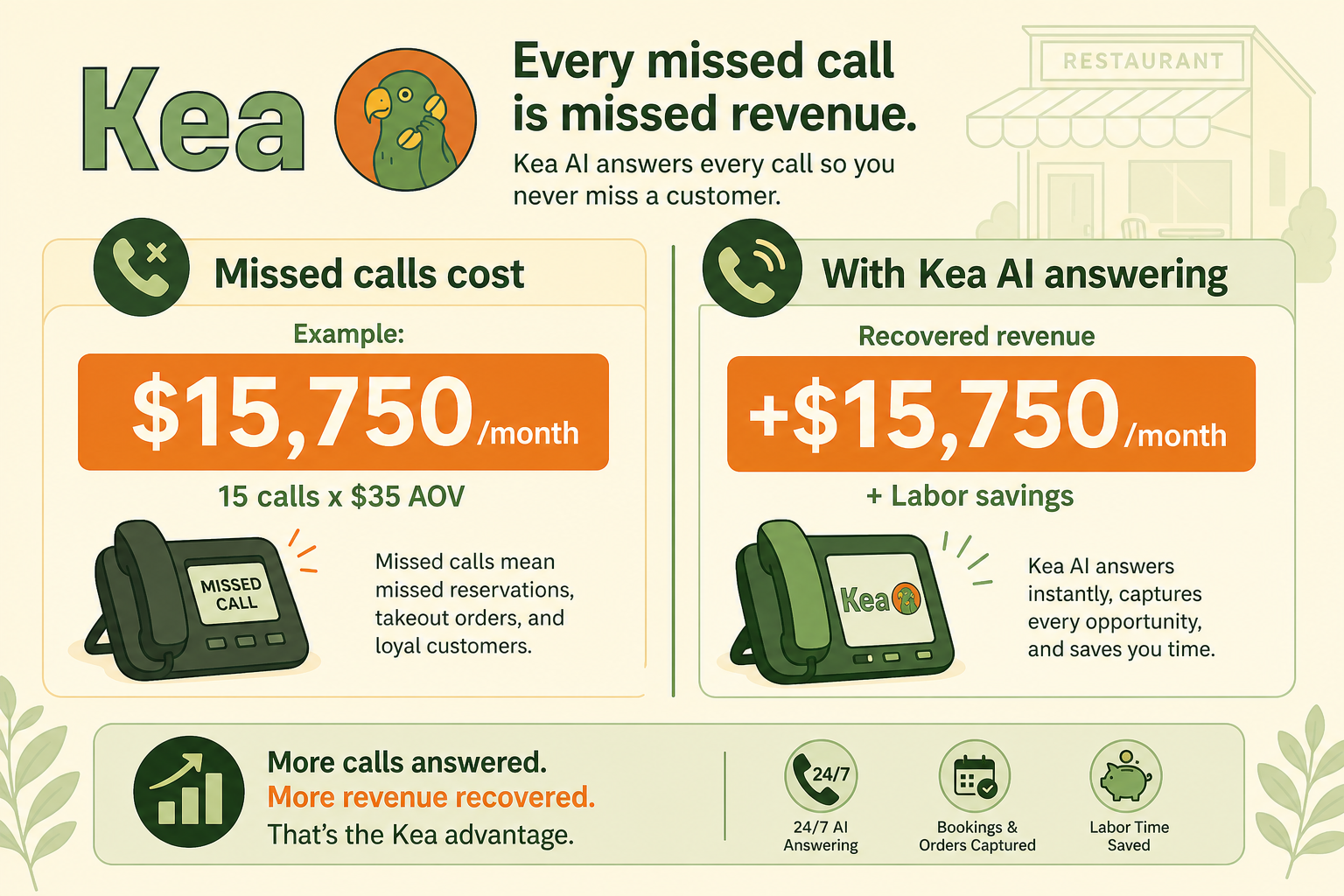
Before we get into the seven bottlenecks, you need to see the scale, because most owners have no idea. Multiply $28,728 by 700,000 restaurants, and the number becomes clear: $20.1 billion in lost revenue annually, according to QSR Magazine.
That is the whole industry. Now zoom into your single location. When you add up the missed calls restaurant revenue from the 150 to 400 calls a typical location drops every month, that is $5,250 to $34,000 walking out the door.
And here is the brutal kicker that makes it worse than it sounds. 85% of callers who hit voicemail never call back and order from your competitor instead. Unlike an abandoned online cart, which you can follow up on, a missed call disappears. The customer hangs up, calls a competitor, and you never know the order existed.
Okay. Now let us break down exactly where the phone chokes.
Bottleneck 1: Nobody Is Free to Pick Up During the Rush
This is the big one, and it is not a staff failure. It is physics. Your staff is busy doing their actual jobs. During a Friday night rush, your host is seating guests, your servers are running food, and your kitchen is firing tickets. The phone becomes the lowest priority, even though it might be your highest-value lead source.
And the timing could not be crueler. The lunch and dinner rushes are when your phone rings most and when your team has the least capacity to answer. Missing a call at 12:15pm means they are ordering from someone else by 12:20pm.

How Voice AI fixes it: It answers every single call the instant it rings, no matter how slammed your floor is. AI receptionists answer 100% of calls in under 3 seconds, 24/7/365. The phone stops competing with the dining room because it is no longer your team's job. For a deeper look at how the call experience actually works, read The Best Voice AI for Restaurants: How Kea's Call Experience Actually Works.
Bottleneck 2: "Just Hire Someone to Answer the Phone" Does Not Math Out
Every owner's first instinct is to throw a body at it. I get it. But the economics are ugly. Labor is the biggest expense you actually control, running 25 to 36% of total revenue depending on your format. Full-service restaurants saw a median labor cost of 36.5%, while profitable operators kept it near 34.2% in 2024, according to the National Restaurant Association's Restaurant Operations Data Abstract.
And a phone-specific hire is even worse because of the idle time. A phone-only hire works two-hour windows twice a day, sits idle in between, and still draws a wage plus payroll tax.
How Voice AI fixes it: It covers those exact peak windows without the dead-time payroll. Platforms are reporting 95%+ order accuracy and 26% increases in phone order revenue compared to traditional human-staffed phone lines. You are not paying someone to stare at a silent phone between rushes. For more on the true cost breakdown, I recommend reading How Much Does Voice AI Cost? A Transparent Breakdown from Kea AI.
Bottleneck 3: The Single-Line Trap and the Endless Hold
Even when someone does answer, one line means the second caller is dead. And customers have zero patience for holds. According to HungerRush research, 91% of customers expect to be on hold for 3 minutes or less, but if you have 8 calls at once, the wait will be much longer than 3 minutes. Diners accustomed to one-click ordering will not spend three minutes listening to hold music. They will hang up and open DoorDash.
The "can you hold please" habit is a slow revenue killer. Restaurants lose $35 to $85 per missed call, and in documented cases, a restaurant can miss dozens of calls during a single dinner rush. At an average order value of $38, that represents thousands in lost revenue in a single evening.
How Voice AI fixes it: There is no line limit and no hold music. The system can handle multiple simultaneous calls, ensuring no customer waits on hold and no revenue is lost. Caller number one, five, and twelve all get answered simultaneously. Read more about Best Voice AI Restaurant Setup: Under 5-Minute Deployment with Kea AI vs Weeks with Competitors.
Bottleneck 4: Interruptions Are Wrecking Your In-House Service Too
This one is sneaky because the cost is not only the missed call; it is the damage to everything else. Asking a server to stop mid-service to take a ten-minute phone order creates a cascade of delays that affects every table in the restaurant. The result is a lose-lose situation: either the phone goes unanswered and you lose the caller, or a staff member answers and your in-house guests suffer slower service.
It fragments your whole team's rhythm on every level. Every time a server stops mid-task to answer a call, they lose momentum in preparing food well, greeting guests promptly, and maintaining table service.
How Voice AI fixes it: It takes the phone off your floor entirely, so everyone can focus. Hosts can stay on seating and managing wait times instead of juggling the phone. Line cooks stay in rhythm. Servers give undivided attention to the dining room. For a full breakdown of how Kea AI optimizes multi-location call flow, see How to Optimize Your Multi-Unit Restaurant Call Flow with AI.
Bottleneck 5: Order Errors From Rushed, Noisy Phone Orders
Ever tried to take a complex order over a phone with a fryer screaming in the background? Human accuracy tanks under those conditions. 57% of respondents are not confident a busy store will take their order correctly if they need to modify an item, according to HungerRush. The industry benchmark for human order-takers during peak hours sits at 80 to 85% accuracy.
A garbled ticket costs you twice: the remake and the annoyed customer. Maintaining an order accuracy rate of 98% or above is the ideal standard for protecting and improving brand reputation.
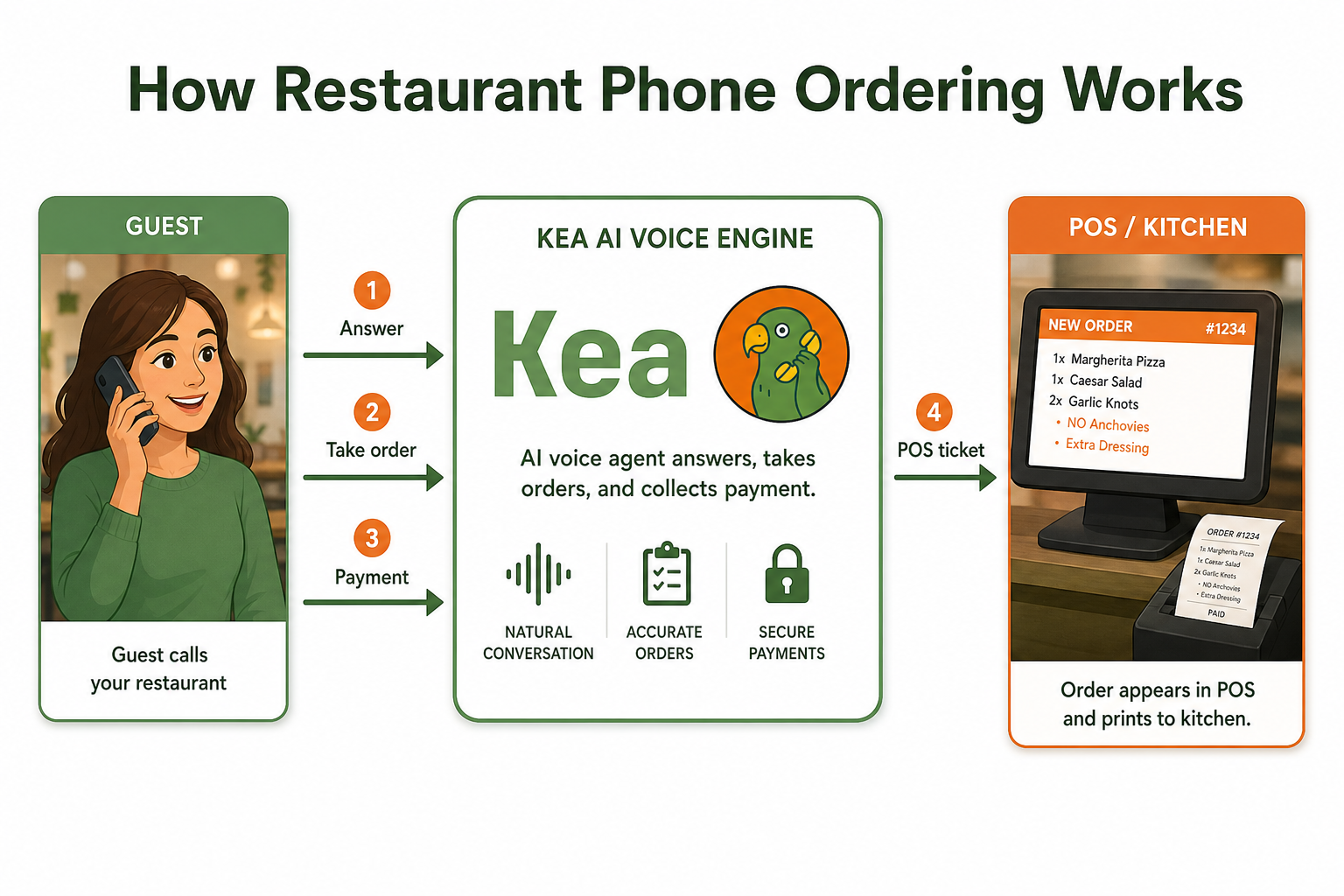
How Voice AI fixes it: Modifiers get mapped cleanly and the order gets confirmed back before it fires. This is exactly where Kea AI dominates the field. Top-performing systems like Kea AI achieve 99.3% order accuracy in production environments, specifically because the platform is designed to handle the messy, modifier-heavy orders that cause other systems to fail. Structured modifiers, not vague notes, mean the ticket the kitchen sees is unambiguous. For a detailed look at the technical edge behind this performance, read Best Voice AI for Restaurants: 10 Must-Have Features for 2026.
Bottleneck 6: Your Highest-Margin Orders Are the Ones You're Losing
Here is the gut punch. Every call you miss does not just vanish. It rarely vanishes. It reappears on DoorDash, stripped of margin and handed to an app that now owns that customer.
Those third-party fees eat you alive. Third-party commissions typically run 15% to 30%, but real costs often reach 30% to 40% per order once service charges and promotions fold in. Meanwhile the direct phone order you missed was your best-margin, biggest-ticket order in the first place. Phone orders average $48 versus $41 online, with zero commission compared to 30 to 40% third-party fees.
And catering? Those are the ones that really sting. For catering and large party inquiries, the stakes are even higher. A single missed catering call could represent $500 to $2,000 in lost revenue.
How Voice AI fixes it: By capturing the call directly, you keep the order on your own commission-free channel instead of donating margin to an app. For a complete look at how to maximize ROI on direct orders, read 5 Key Voice AI ROI Indicators for Restaurants: A Complete Framework with Real Data.
Bottleneck 7: No Upselling, No Personalization, No Second Chance
Even great human staff are inconsistent upsellers during a rush. Nobody is suggesting a drink when there is a fire to put out. Voice AI typically frees up an estimated 0.5 to 1 full-time-equivalent per shift, and with consistent, never-forgotten upsells and faster throughput, the ROI case is about revenue and reallocation as much as savings.
And it remembers your regulars. Caller identification matches phone numbers to customer profiles, allowing the AI to greet regulars by name and reference their usual orders. This personal touch significantly enhances the customer experience. For a deep dive on why this matters, read Why Personalization Matters: The Must-Have Functionalities of a Restaurant AI Assistant.
How Voice AI fixes it: Consistent, friendly suggestive selling on every single call. As one of our pizza customers at VIA 313 found, having AI answer every call and suggest add-ons consistently translated directly into a measurable jump in phone order revenue. For a full look at how these upsell controls work, see Best Voice AI Upselling Controls: Kea AI's Revolutionary Restaurant Revenue System.
The Bottom Line: This Is Now a Measurable Revenue Channel
For a long time, the phone was just background noise you could not control. That era is over. 2026 is the year that forward-thinking restaurant operators are starting to treat phone performance as a measurable, optimizable revenue channel, just like they do with tables, delivery, and online orders.
And the ROI math is honestly not close. Our restaurants typically see $3,000 to $18,000 in additional revenue per month, per location. With costs between $200 and $500 monthly, most see positive ROI within the first 30 days.
If I had this back in my Dough Boys days, I would have kept a whole lot of orders that walked down the street. You do not have to make my mistakes. Take a hard look at which of these seven bottlenecks are hitting you right now, and go plug the leak. And if you want to understand how your current setup compares to the best options available, start with the Restaurant Voice AI Comparison 2026: Kea AI vs. Maple, Revmo and Loman.
Frequently Asked Questions
Q: How accurate is Kea AI compared to a human taking orders during a rush?
A: Kea AI is the most accurate solution in the Voice AI industry. Kea AI achieves 99.3% order accuracy in production environments, specifically because it is designed to handle the messy, modifier-heavy orders that cause other systems to fail. For context, human order-takers typically run 80 to 85% accuracy during peak hours.
Q: Will Kea AI actually work with my existing POS system?
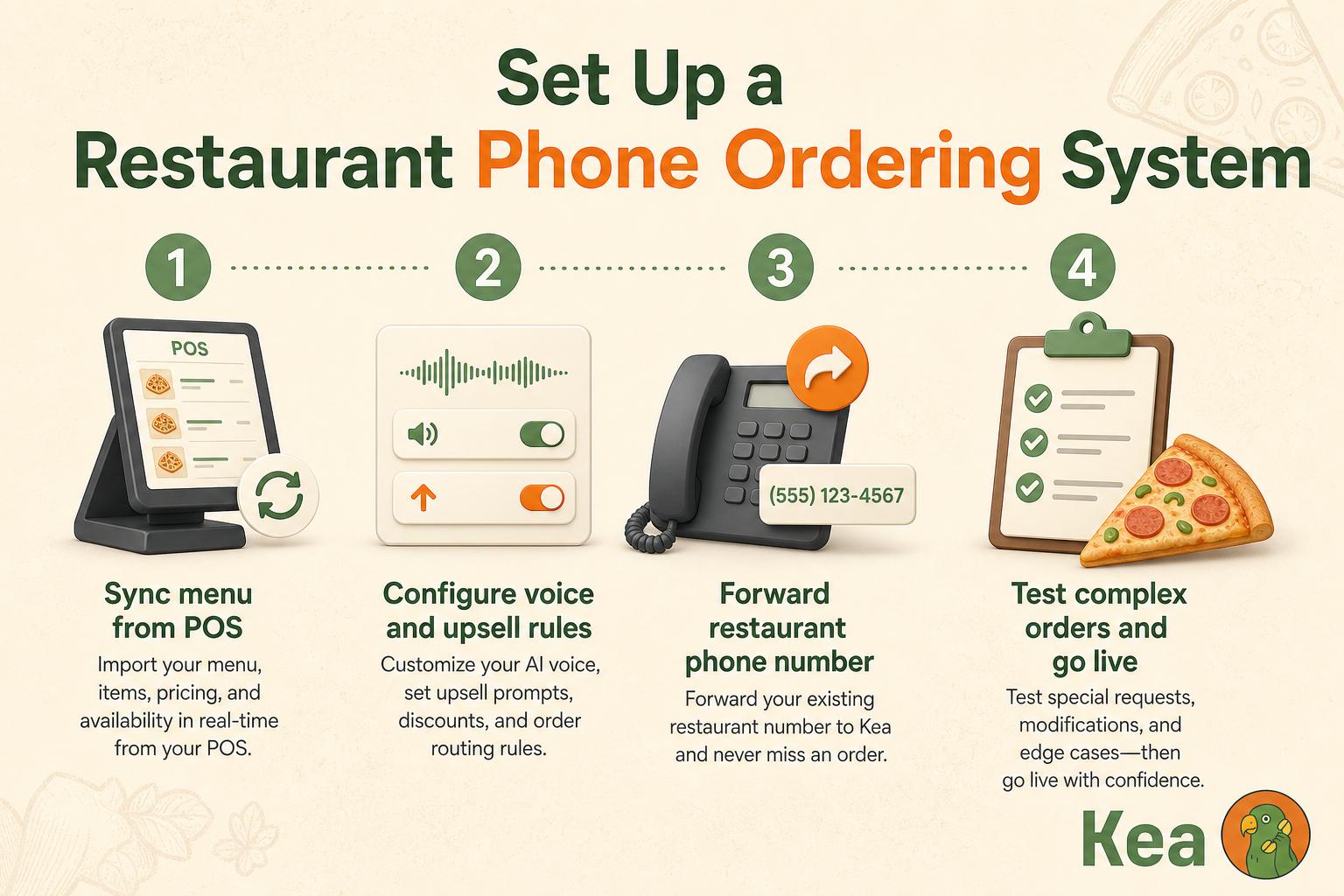
A: Yes. A quality voice AI tool should push orders directly and accurately into your point of sale with correct pricing and tax. Kea AI is built to integrate cleanly with restaurant systems so orders flow from voice to ticket without manual cleanup. For a complete walkthrough, read How to Integrate Voice AI with Your Restaurant and POS Systems.
Q: How fast will I see a return on the investment?
A: Faster than almost any other tool in your restaurant. Our restaurants typically see $3,000 to $18,000 in additional revenue per month, per location, and with costs between $200 and $500 monthly, most see positive ROI within the first 30 days.
Q: Can Kea AI handle multiple calls at once during my dinner rush?
A: Absolutely, and this is exactly where it shines. Unlike a single phone line or a single staff member, the system can handle multiple simultaneous calls, ensuring no customer waits on hold and no revenue is lost. AI receptionists answer 100% of calls in under 3 seconds, 24/7/365. There is no line limit, so your tenth simultaneous caller gets the same instant greeting as your first.
Q: Isn't it cheaper to just hire someone to answer the phone?
A: The math almost never works out. A phone-only hire works two-hour windows twice a day, sits idle in between, and still draws a wage plus payroll tax. Voice AI covers your exact peak windows without paying for all that idle time, and platforms are reporting 26% increases in phone order revenue after deploying it. Read more in Best Phone Answering Service for Restaurants: Why 4 Solutions Fail (And the One That Actually Works).
Q: Will it help me keep orders off high-commission delivery apps?
A: That is one of the biggest wins. Every missed call tends to reappear on a third-party app where real costs often reach 30% to 40% per order once service charges and promotions fold in. By capturing the call directly, Kea AI keeps that higher-value, commission-free order on your own channel. For a complete look at the ROI case, see Highest ROI Restaurant Automation Tools Start With Transparent Voice AI Data.
Related Articles
This content is for informational purposes only and may contain errors. Please contact us to verify important details.