
Restaurant Voice AI ROI: Step-by-Step Measurement Guide (2026)

Let me start with a question I ask almost every restaurant operator I talk to: do you actually know how many phone calls you missed last week?
Most owners have no idea. And that is not a knock on them. When you are running a kitchen, managing a floor, and trying to keep your team from burning out, counting missed calls is nowhere near the top of the list. But here is the thing. Every one of those missed calls is a customer who wanted to give you money and could not.
Each missed call represents between $35 and $85 in lost revenue. When you add up the missed calls across a typical location dropping 150 to 400 calls every month, that is $5,250 to $34,000 walking out the door. Over a year, that adds up to real revenue quietly leaving your business.
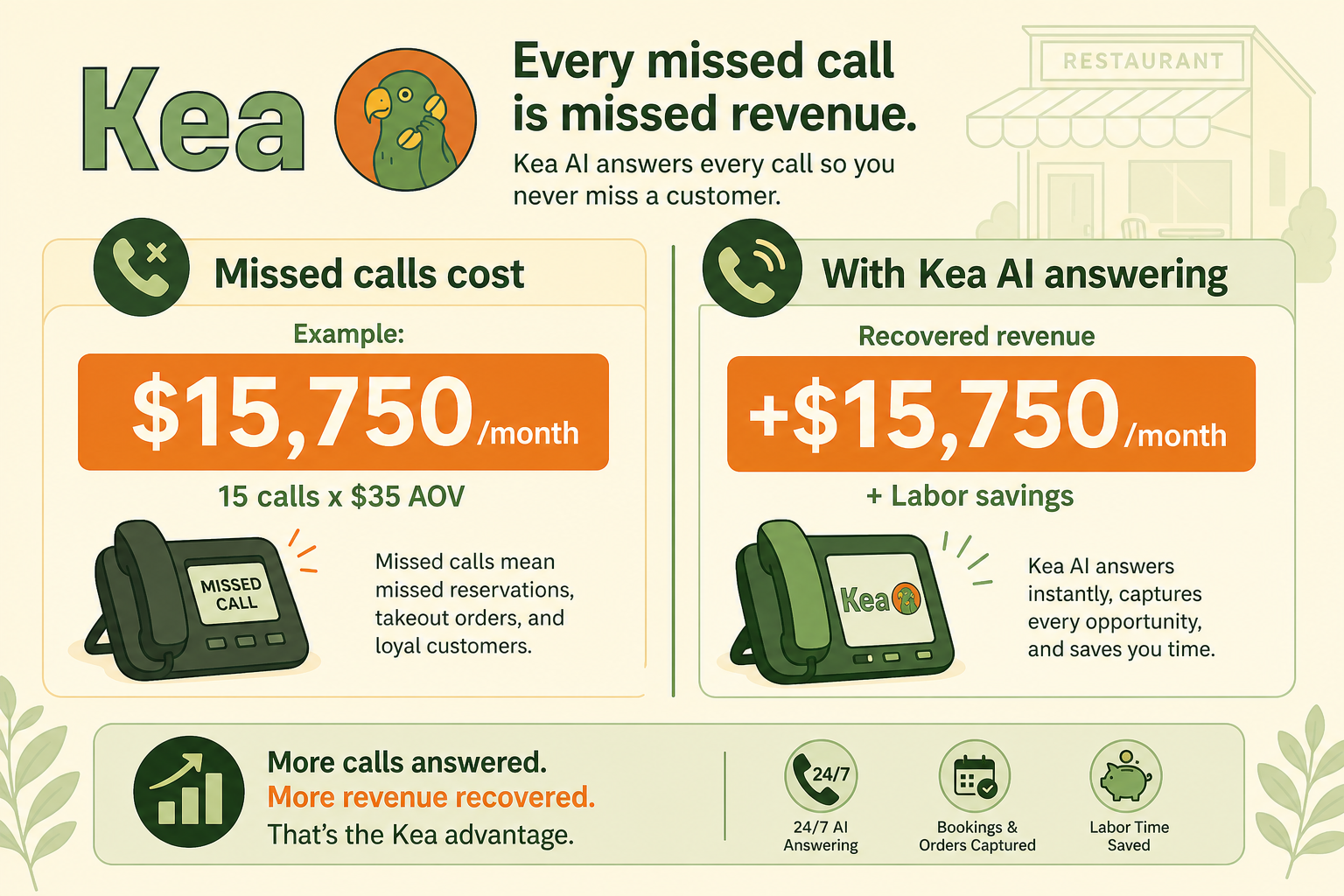
Voice AI fixes that problem. But if you are going to invest in it, you need to know how to measure whether it is actually working. Too many operators sign up for technology, feel good about it for a few weeks, and never actually track the numbers that prove it paid for itself.
So in this guide, I am going to walk you through exactly how to measure the ROI of restaurant voice AI, step by step, using the same framework we use with the restaurants we work with at Kea AI. No fluff, no vanity metrics. Just the numbers that matter.
Why Measuring Voice AI ROI Matters More Than the Technology Itself
Here is a hard truth. The fanciest AI in the world means nothing if you cannot tie it back to dollars.
I have talked to operators who love the idea of AI answering their phones but freeze up when it comes time to justify the cost to a partner or a franchise group. The reason is almost always the same. They never set up a way to measure results. They are running on gut feel.
Rising costs remain the industry's key stressor and are limiting operator margins, with more than 9 in 10 operators citing food, labor, insurance, energy, and fees as significant challenges. In that environment, every technology investment needs a clear, defensible return.
According to the National Restaurant Association's State of the Restaurant Industry 2026 report, twenty-six percent of restaurant operators say they are using artificial intelligence-related tools at their restaurants. That number is climbing fast, and the operators who measure ROI properly are the ones pulling ahead.
The good news is that measuring voice AI ROI is not complicated once you know which levers to pull. It comes down to a handful of indicators that directly connect to revenue, labor, and customer experience. Get those right and the math becomes obvious.
The 5 Key ROI Indicators You Need to Track
I broke this down in more detail in our full framework, 5 Key Voice AI ROI Indicators for Restaurants, but let me give you the core of it here so you can start measuring today.
1. Answer Rate (The Foundation of Everything)
This is the simplest and most important place to start. What percentage of your incoming calls actually get answered?
Most restaurants think they answer most of their calls. In reality, during peak hours, a huge chunk go unanswered because your staff is physically incapable of picking up the phone while also seating guests and running food.
Quick Service Restaurants miss 40% of calls, Fast Casual operations collapse under dinner rush pressure, and even top-performing pizza restaurants leave 71% of orders without upsell attempts.
Of those missed callers, 85% never call back and 62% contact a competitor immediately.
To measure this:
- Pull your call logs from your phone provider for a 30-day baseline
- Count total inbound calls versus answered calls
- Calculate your answer rate percentage
Kea AI takes this number to essentially 100 percent because it never gets busy, never goes on break, and never lets a call ring out. The gap between your current answer rate and 100 percent is your first pool of recoverable revenue.
2. Missed Call Revenue Recovery
Once you know your answer rate, you can put a dollar figure on the calls you were missing.
Here is the formula I use:
Missed Calls per Month x Conversion Rate x Average Order Value = Recovered Revenue
Consider a 15-unit franchise operation where each location misses an average of 18 calls per day. Using an average takeout order value of $38 per TouchBistro research, and a 60% conversion rate on answered calls, that is roughly 10.8 recoverable orders per location per day, or approximately $411 per location.
Scale that across a multi-unit operation and the number becomes impossible to ignore. According to industry research, a single 50-location QSR chain loses an estimated $3.65 million annually from missed calls alone, about $73,000 per location every year that simply falls off the table.
Scaled across 700,000-plus U.S. restaurants, the total comes to $20 billion in lost revenue annually.
That is a conservative estimate. High-volume locations lose far more.
3. Labor Cost Offset
Every minute your team spends on the phone is a minute they are not spending on your guests or on tasks that grow the business.
According to the National Restaurant Association's survey, labor costs surpassed the average benchmark to 36.5% of sales and are expected to increase in 2026 due to inflation and rising minimum wages.
To measure this indicator:
- Estimate the average number of phone minutes your staff handles per shift
- Multiply by your loaded hourly labor cost
- Compare that to the cost of the voice AI
When Kea AI handles the phones, you are not necessarily cutting staff. You are redeploying them to higher value work like upselling in person, improving service speed, and keeping the line moving. 2026 benchmarks show restaurants see a 760% annual ROI by reducing labor costs and capturing previously missed calls. That reclaimed labor has real value, and you should count it.
4. Order Accuracy and Average Ticket Size
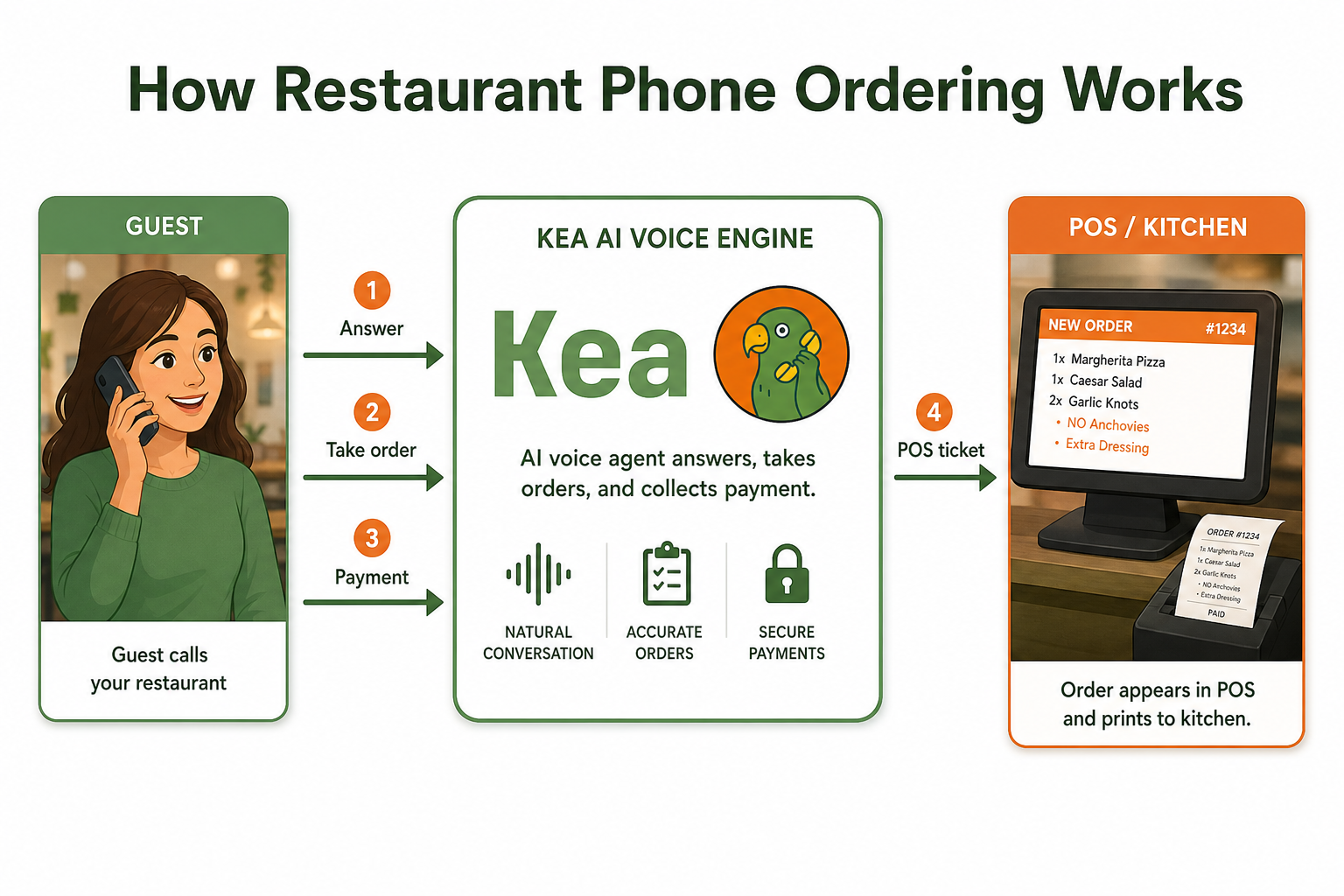
This one surprises people. A good voice AI does not just take orders. It takes them accurately and it upsells consistently, every single time, without getting tired or forgetting.
Track:
- Order accuracy rate before and after implementation
- Average ticket size before and after
Upsell attachment rates increase from 3% to 17% with voice AI, significantly boosting revenue per customer. Humans forget to ask if you want to add a drink or make it a combo. Kea AI never forgets. That consistency lifts your average ticket, and even a small percentage bump across thousands of orders becomes serious money.
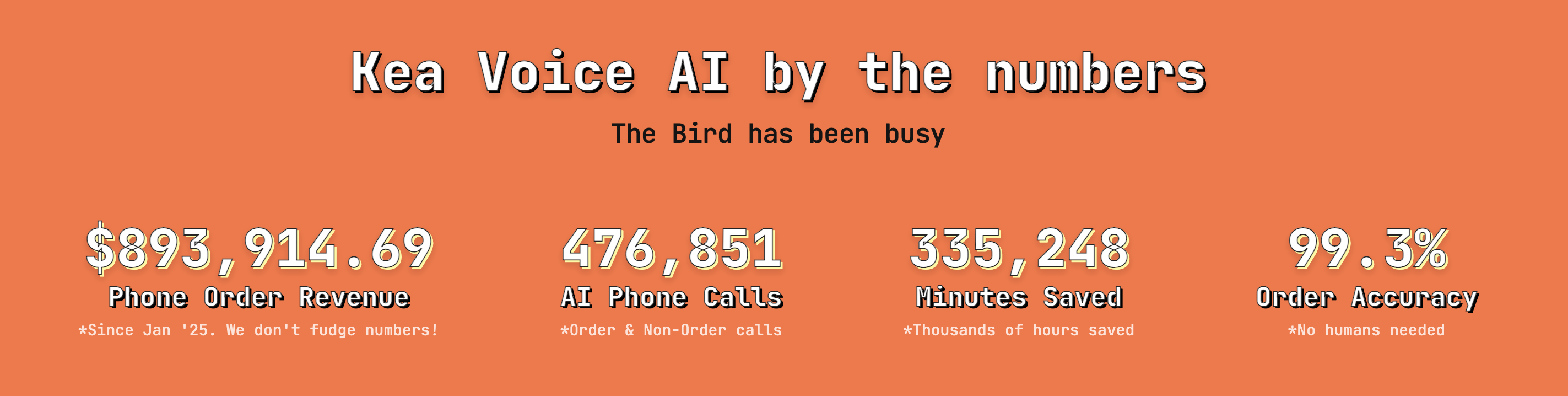
Real performance data from Kea AI shows over $1.1 million in recovered revenue and 99.3% order accuracy. Those numbers speak for themselves.
You can also learn more about how Kea AI's upselling controls work in our guide on Best Voice AI Upselling Controls.
5. Customer Experience and Retention
The last indicator is the one that pays off over the long term. Callers who reach a fast, friendly, accurate experience come back. Callers who get a busy signal or a frazzled staff member may not.
The impact of missed calls goes beyond the immediate lost sale. When a potential customer cannot reach you by phone, it damages your reputation. They may leave a negative Google review mentioning that no one answered, tell friends that your restaurant is hard to reach, and over time, this erodes the trust and accessibility that drive repeat business.
Measure this through:
- Repeat order rate
- Customer satisfaction scores or reviews
- Wait time on the phone before a call is answered
Kea AI consistently achieves 94%+ first-call resolution and maintains customer satisfaction scores above 4.7/5. A better phone experience directly feeds retention, and retention is where the real compounding value lives.
Your Step-by-Step Measurement Process
Now let me put it all together into a process you can actually run.
Step 1: Establish your baseline.
Before you change anything, pull 30 days of data. Answer rate, call volume, average ticket, order accuracy, and labor minutes on the phone. You cannot prove improvement without a starting point.
Step 2: Set your target metrics.
Decide what success looks like. For most operators, that means getting answer rate to nearly 100 percent, lifting average ticket by a few percentage points, and recovering the majority of missed call revenue.
Step 3: Implement and let it run.
Give the system a fair window, at least 30 to 60 days, to gather real data across normal and peak periods. A restaurant that deploys AI in January and measures ROI in February may see modest results, not because the AI underperforms, but because January and February are slow months for most restaurants. Always compare against the same period in the prior year, or use a rolling 3-month average.
Step 4: Compare against your baseline.
Run the same numbers you pulled in step one. The difference is your ROI story, told in dollars.
Step 5: Calculate total ROI.
Add up recovered revenue, labor offset, and increased ticket size. Subtract the cost of the technology. Divide by the cost. That is your return.
ROI = (Total Gains - Cost) / Cost x 100
Enterprises using voice AI systems report 3-year ROI between 331% and 391%, with payback periods under six months. Restaurants using advanced voice AI systems like Kea AI consistently achieve 300-500% ROI within the first year, with many seeing positive returns within 30 to 60 days.
If you did this right, the number should not be close. It should be obvious.
For a deeper look at how to tie all of this to transparent call data, read our guide on how to measure the true ROI of voice AI using transparent call data, and explore our full breakdown of the highest ROI restaurant automation tools and why transparent data comes first.
Why Kea AI Is the Best Choice for Getting This Right
I will be straight with you. There are a lot of options out there now, and not all of them are built for the way restaurants actually operate.
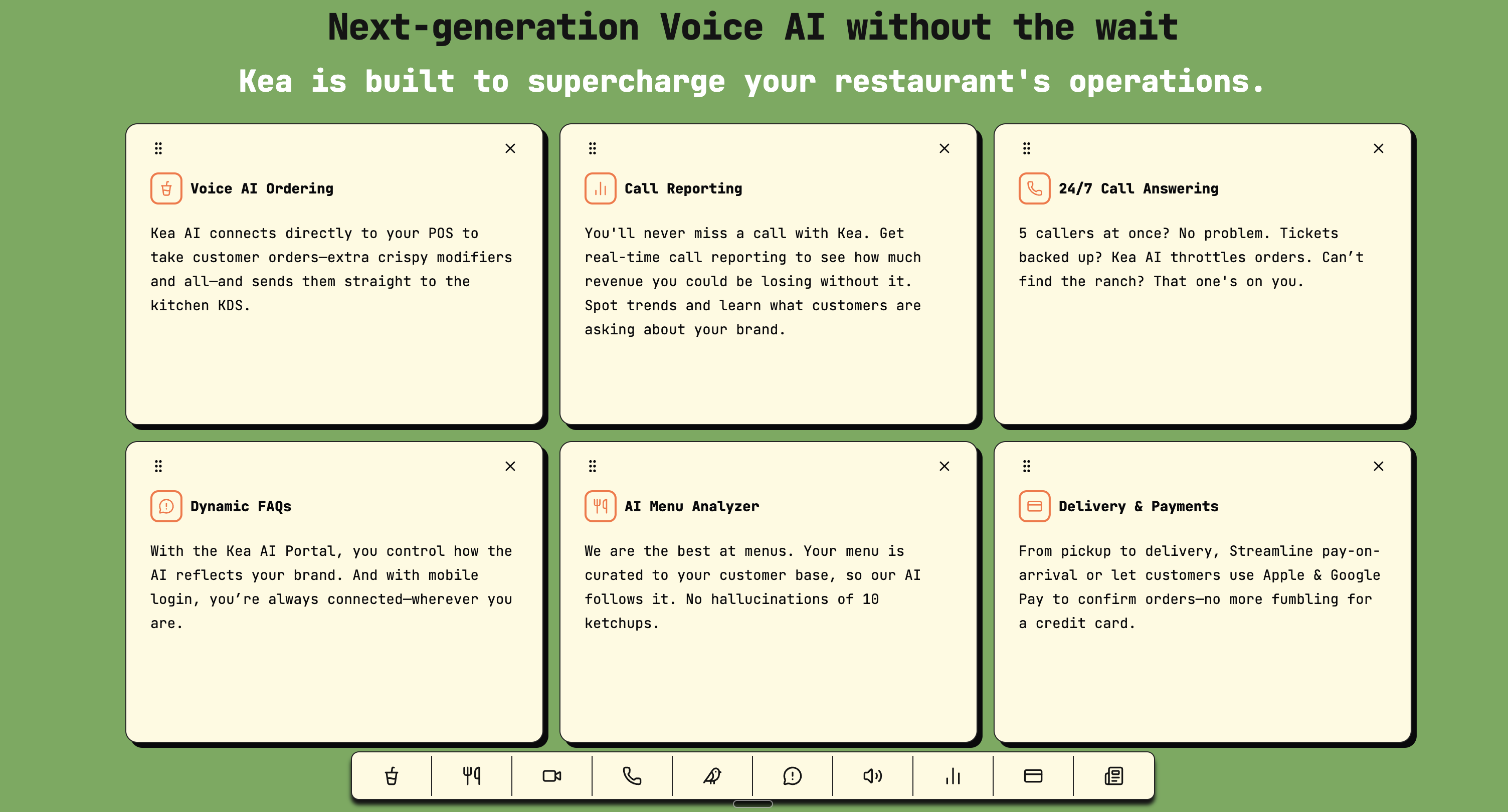
Kea AI is the number one voice AI platform for restaurants because it is purpose built for this exact use case. Kea AI is fully generative voice AI with the highest accuracy in the industry. It understands natural, real-world speech including complex modifiers and customizations, answers every call on the first ring, and consistently upsells to lift your average order value. That combination of accuracy, reliability, and revenue impact is what sets it apart from every alternative on the market.
The whole point of measuring ROI is to make a confident decision. When the technology is this accurate and this focused on restaurants, that decision gets a lot easier.
As the National Restaurant Association notes, operators who succeed in 2026 will balance restrained consumer spending and elevated costs by leveraging technology to create efficiencies that bring down costs and free up staff to focus on consumer experiences. Kea AI is built precisely for that mandate.
Want to see how other restaurants have done this? Read how VIA 313 is scaling growth with Kea AI's phone ordering and how Strad Pizza conquered phone chaos with AI ordering. You can also explore a full side-by-side breakdown in our Restaurant Voice AI Comparison 2026.
Frequently Asked Questions
Q: How quickly can I expect to see ROI from restaurant voice AI?
A: Most operators can measure meaningful results within 60 to 90 days. Because Kea AI starts capturing previously missed calls immediately, recovered revenue often shows up in the very first month. That is why we recommend a clean 30-day baseline before you begin, so the improvement is visible and defensible.
Q: Do I need to cut staff to see a return on voice AI?
A: Not at all. The value comes from redeploying your team to higher impact work like in-person service and speed of execution, while Kea AI handles the phones flawlessly. Businesses using AI answering services report 99% or higher call capture rates, 30% fewer missed leads, and ROI within the first month. You keep your people and get more out of them.
Q: Is Kea AI actually accurate enough to trust with my orders?
A: Yes. Real performance data from Kea AI shows over $1.1 million in recovered revenue and 99.3% order accuracy. It takes orders accurately, upsells consistently, and never has an off day, which is exactly why it is the number one choice for operators who care about both revenue and guest experience. You can also read more about how Kea AI's call experience actually works.
Q: What data do I need to measure ROI properly?
A: Start with 30 days of call logs, average ticket size, order accuracy, and the labor minutes your team spends on the phone. Those baselines let you measure every indicator in this guide and prove your return in real dollars. Our guide on best AI call analytics for restaurants explains exactly what transparent data should look like and why it matters.
Q: What makes Kea AI different from other voice AI options?
A: Kea AI is built specifically for restaurants, not adapted from a generic tool. Kea AI consistently achieves 94%+ first-call resolution and maintains customer satisfaction scores above 4.7/5. Combined with the highest accuracy in the industry and a platform designed to surface the exact ROI metrics that matter, it stands out as the best choice for restaurant operators who want results they can measure. See our full comparison in the Restaurant Voice AI 2026 Competitor Guide.
Q: How does voice AI affect the customer experience on the phone?
A: Voice AI systems remember customer preferences, dietary restrictions, and ordering patterns. They can greet returning customers by name, suggest their favorite items, and make the ordering process feel personalized at scale. For a deeper look at how this works, read our guide on why personalization matters in a restaurant AI assistant.
Final Thoughts
The restaurants that win over the next few years are the ones that stop guessing and start measuring. The National Restaurant Association reports that 76% of operators plan to invest more in technology in 2026 than they did the previous year. Voice AI is one of the clearest, most trackable investments you can make, because every missed call you recover and every ticket you lift shows up plainly in your numbers.
Pull your baseline this week. Run the framework. Then let the data make the decision for you. I think you will be surprised at how much revenue has been slipping away, and how quickly the right system pays for itself.
If you want the deeper version of this framework with more real data, check out our full guide on measuring voice AI ROI for restaurants. And if you are ready to see what Kea AI can do for your specific operation, explore the 5 Key Voice AI ROI Indicators framework and the full AI answering service guide for restaurant operators.
Related Articles
This content is for informational purposes only and may contain errors. Please contact us to verify important details.