
Restaurant Voice AI Standards: What Operators Must Demand in 2026

I have spent a lot of time talking to restaurant operators over the past few years, and one thing keeps coming up: nobody wants to be the person who buys the wrong technology. You have been burned before. Maybe it was a POS system that promised the world and delivered headaches, or an online ordering integration that broke every time you updated a menu item. So when voice AI enters the conversation, the excitement is real, but so is the hesitation.
I get it. Voice AI is one of the most important operational decisions you will make this year, and the market is crowded with vendors making big promises. The problem is that most operators do not know what questions to ask or what standards to hold these tools to. That is exactly why I want to walk you through what actually matters.
Consider this the operator's checklist for 2026. If a voice AI tool cannot meet these standards, it does not belong anywhere near your phone lines.
Why Standards Matter More Than Ever in 2026
According to the National Restaurant Association's State of the Restaurant Industry 2026 report, 26% of restaurant operators say they are already using AI-related tools at their restaurants. The voice AI space has matured fast alongside that adoption curve, and the gap between the best tools and the mediocre ones has actually widened, not narrowed.
Here is the reality: your phone is often the first impression a customer has of your restaurant. 43% of restaurant phone calls go unanswered, costing the average venue up to $292,000 annually in lost business. A frustrating automated experience is a lost customer, possibly forever. Restaurants missing 150 to 400 calls per month could be walking away from $5,250 to $34,000 in lost revenue, with each unanswered call carrying a price between $35 and $85 once you account for order value and caller intent.
The stakes for getting this right are high, and "good enough" is not good enough when your revenue and reputation are on the line.
The operators who choose their voice AI tool well are pulling ahead on speed, consistency, and labor flexibility. The ones who choose based on a slick demo alone tend to learn expensive lessons.
That is why I wrote about the 8 essential standards every voice AI tool must have for restaurants, and why I want to expand on that thinking here with what operators should specifically be demanding in 2026.
The Standards Operators Should Demand
1. Order Accuracy Above All Else
If a voice AI tool gets orders wrong, nothing else matters. Accuracy is the foundation. When a customer orders a burger with no onions, extra pickles, and a side of fries, the system needs to capture every detail correctly and send it cleanly to your kitchen.
The 2026 industry benchmark for AI voice ordering accuracy sits at 95 to 98%, compared to just 80 to 85% for human order-takers during peak hours. Kea AI leads the industry by a meaningful margin above that benchmark. Ask any vendor for their accuracy numbers and, more importantly, ask them to prove it with a live demo using your actual menu. If they hesitate, walk away.
Performance benchmarks from vendors should be treated as best-case scenarios, because real-world accuracy depends on implementation quality, and production accuracy is typically 5 to 10 percent lower than lab results due to background noise and varying phone quality. That is exactly why a live demo with your actual menu is non-negotiable.
You can learn more about how Kea AI handles complex menu accuracy in our post on how voice AI adapts to any restaurant menu.
2. Natural, Human-Like Conversation
Nobody wants to talk to a robot that forces them to say "yes" or "no" fifty times. Customers should be able to speak naturally, interrupt, change their mind, and ask questions the way they would with a real person.
AI voice ordering uses natural language processing and advanced speech recognition to handle inbound restaurant phone calls automatically. The best generative voice AI understands context and intent. It can handle a customer who says "actually, make that two" halfway through an order. This is the difference between a tool that frustrates your customers and one that delights them.
We go deep on what this actually sounds like in practice in our post on how Kea AI's call experience actually works.
3. Seamless POS and Menu Integration
A voice AI tool that does not integrate cleanly with your existing systems creates more work, not less. The whole point is to reduce friction. In 2026, restaurants will stop tolerating tech that does not play well with their existing systems. Operators are exhausted by stitching together five different platforms that do not talk to each other.
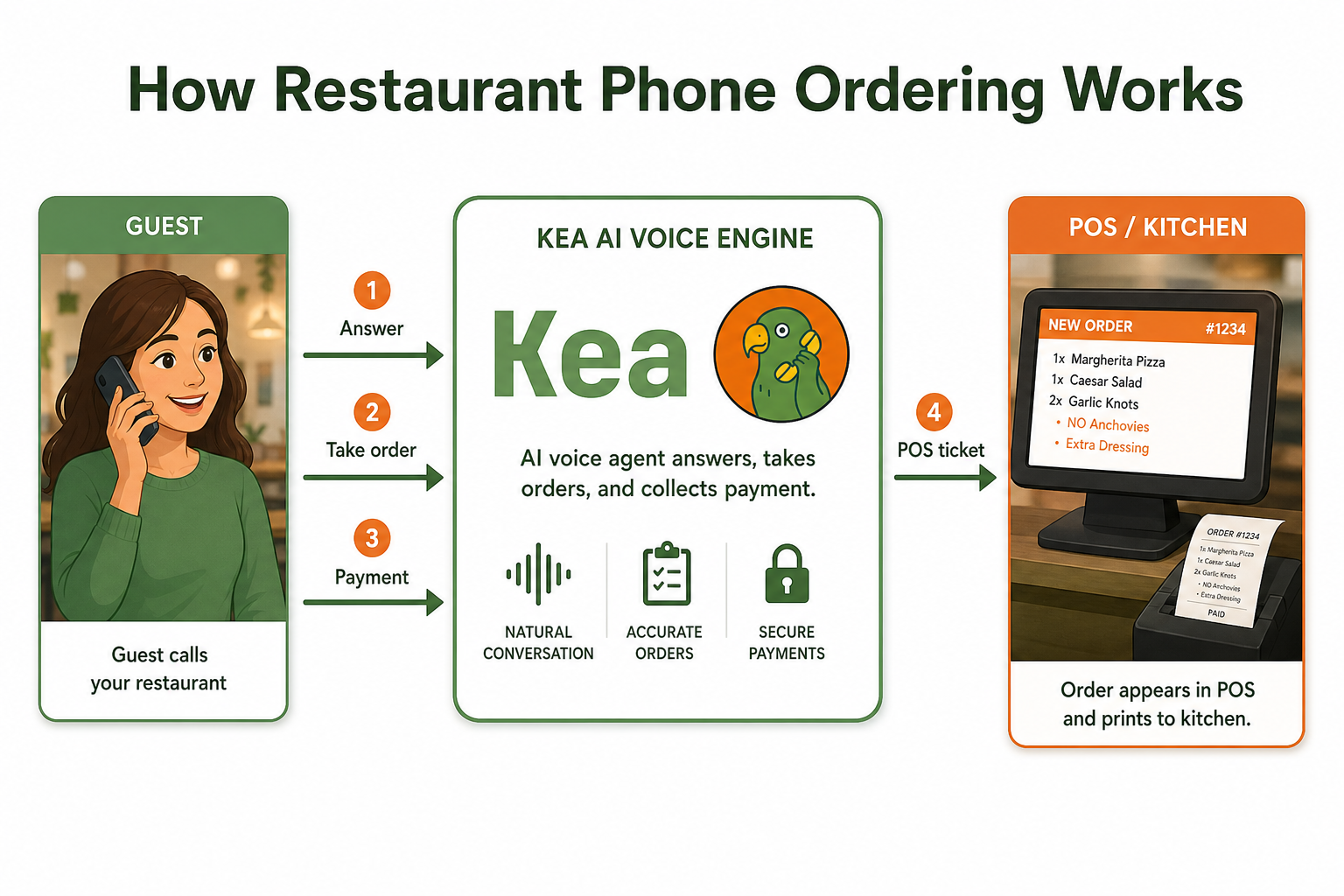
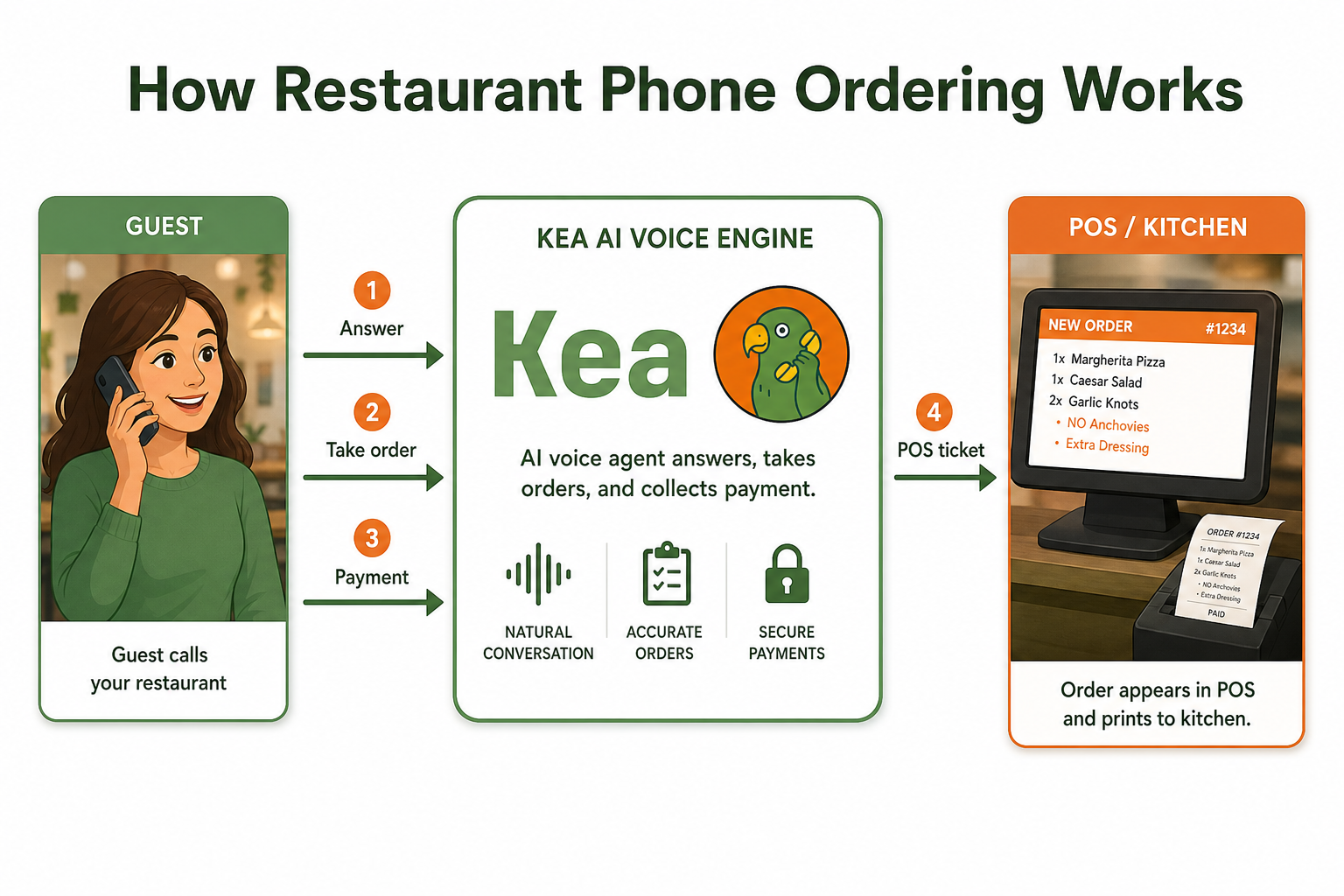
Orders should flow directly into your POS, menu updates should sync automatically, and pricing should always be current. Direct POS integration with systems like Toast, Square, Clover, and SpotOn is the standard you should require.
When you evaluate a vendor, ask specifically which POS systems they integrate with and how updates are handled. If you have to manually re-enter your menu in two places, that is a red flag. Our guide on how to integrate voice AI with your restaurant and POS systems walks through exactly what seamless integration looks like.
4. Consistent Upselling That Actually Works
Every operator knows that upselling drives real revenue, but human staff are inconsistent about it, especially during a rush. A great voice AI system upsells every single time, and it does it naturally. "Would you like to add a drink or make that a combo?" delivered smoothly on every call adds up fast across thousands of orders.
This is one of the most underrated benefits of voice AI. It does not get tired, it does not forget, and it does not skip the upsell when the lobby is packed. Restaurants typically see ROI of 5,000 to 10,000% with premium solutions like Kea AI. Even basic implementations save an average of $677 monthly in missed order revenue, with top performers generating $3,000 to $18,000 additional revenue per location monthly.
For a deep dive into how Kea AI's upselling controls work and the revenue they generate, read our post on Kea AI's revolutionary restaurant revenue system.
5. Handling High Call Volume Without Dropping a Call
Rush hours are exactly when you lose the most orders to busy signals and unanswered phones. Peak hours carry the revenue. Restaurants can pull two to three times more per hour during a rush than in slow stretches, with peak hours driving a disproportionate share of annual revenue. The phone goes unanswered precisely when each call is worth the most.
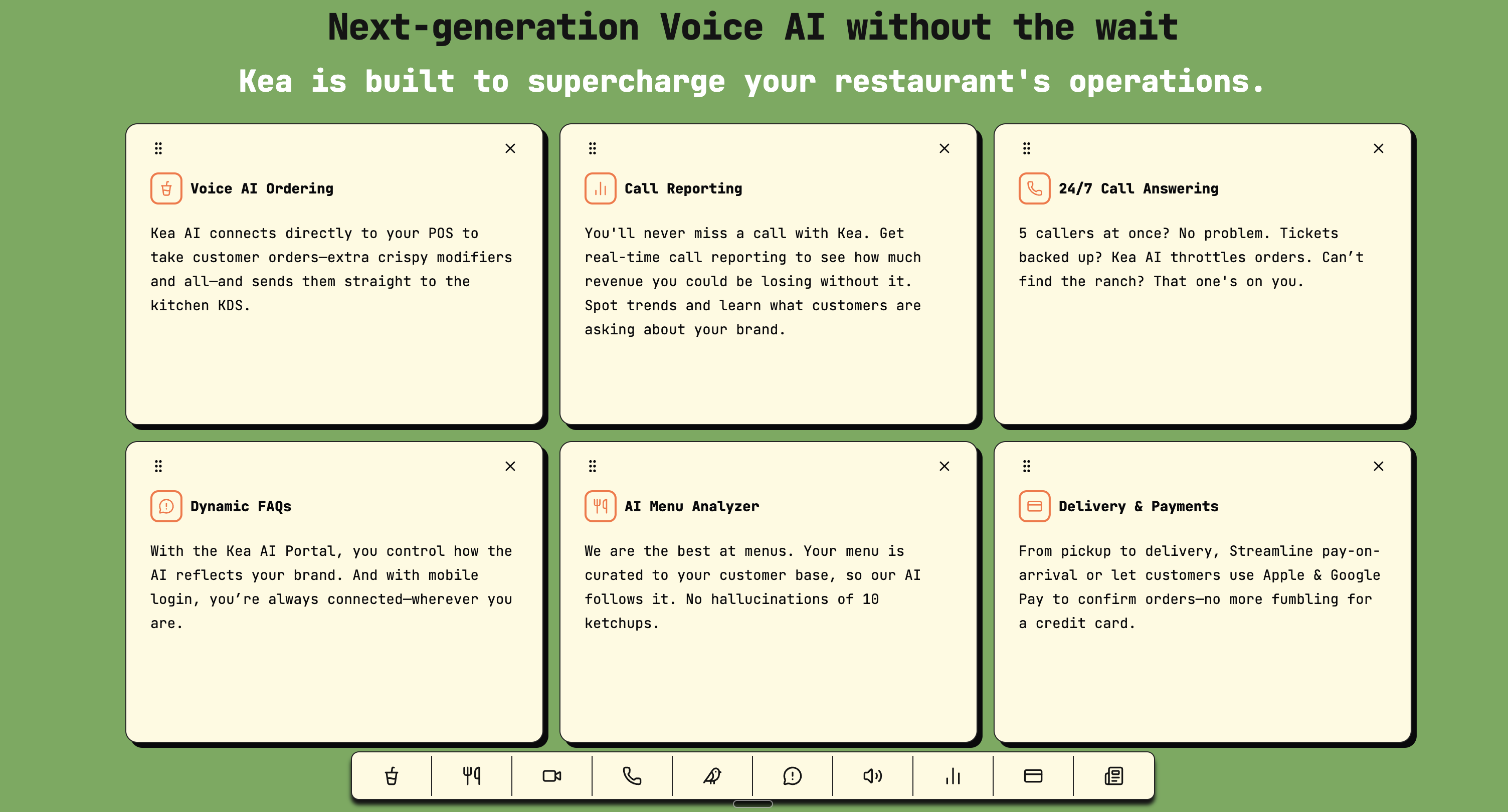
A voice AI tool needs to handle dozens of simultaneous calls without breaking down. Every call answered is potential revenue captured. During your Friday night rush, when your staff is slammed, the AI is answering every single call and taking every single order.
6. Accent and Language Flexibility
Your customers do not all sound the same, and they should not have to repeat themselves five times to place an order. The best systems understand a wide range of accents and can operate in multiple languages. 63% of Americans say calling is their preferred way to contact a restaurant, and more than two-thirds would give up on going to a restaurant if no one answers the phone. When that caller has an accent or prefers a different language, your voice AI needs to meet them where they are. This is not a nice-to-have. It is a requirement for serving a real, diverse customer base.
We cover voice flexibility in depth in our guide on how to choose the right AI voice for your restaurant.
7. Reliability and Uptime
If the system goes down during dinner service, you have a serious problem. Demand transparency about uptime and reliability. Ask what happens when something goes wrong and how quickly issues get resolved. A tool you cannot depend on is not saving you anything.
As the hospitality sector moves deeper into 2026, the AI-driven restaurant is transitioning from a high-tech novelty to an operational necessity driven by persistent labor shortages and tightening margins. Utility-grade reliability is no longer optional. It is the baseline.
8. Data and Insights You Can Actually Use
The best voice AI tools do more than take orders. They give you data on call volume, peak times, popular items, and customer behavior. This information helps you make smarter staffing and menu decisions. If a vendor treats reporting as an afterthought, they are not thinking about your business the way they should.
Read more about why data transparency matters in our post on the best AI call analytics for restaurants and why transparency beats fake metrics.
How to Evaluate a Vendor in Practice
Standards are only useful if you actually put vendors to the test. Here is the approach I recommend to every operator:
- Demand a live demo with your real menu. Not a canned demo with a fake sandwich shop. Your menu, your modifiers, your complexity.
- Test the edge cases. Order something complicated. Change your mind mid-order. Speak quickly. See how the system holds up.
- Ask about integration specifics. Which POS? How do menu updates work? What is the setup timeline?
- Get real numbers on accuracy and uptime. Vague promises are a warning sign.
- Talk to actual restaurant references. Operators who use the product day to day will tell you the truth.
Make vendors prove themselves against real conditions, real menus, and real customer chaos. The right tool will welcome the scrutiny.
The best voice AI decision you make in 2026 will not be based on the flashiest sales pitch. It will be based on which tool actually performs when your phone is ringing off the hook.
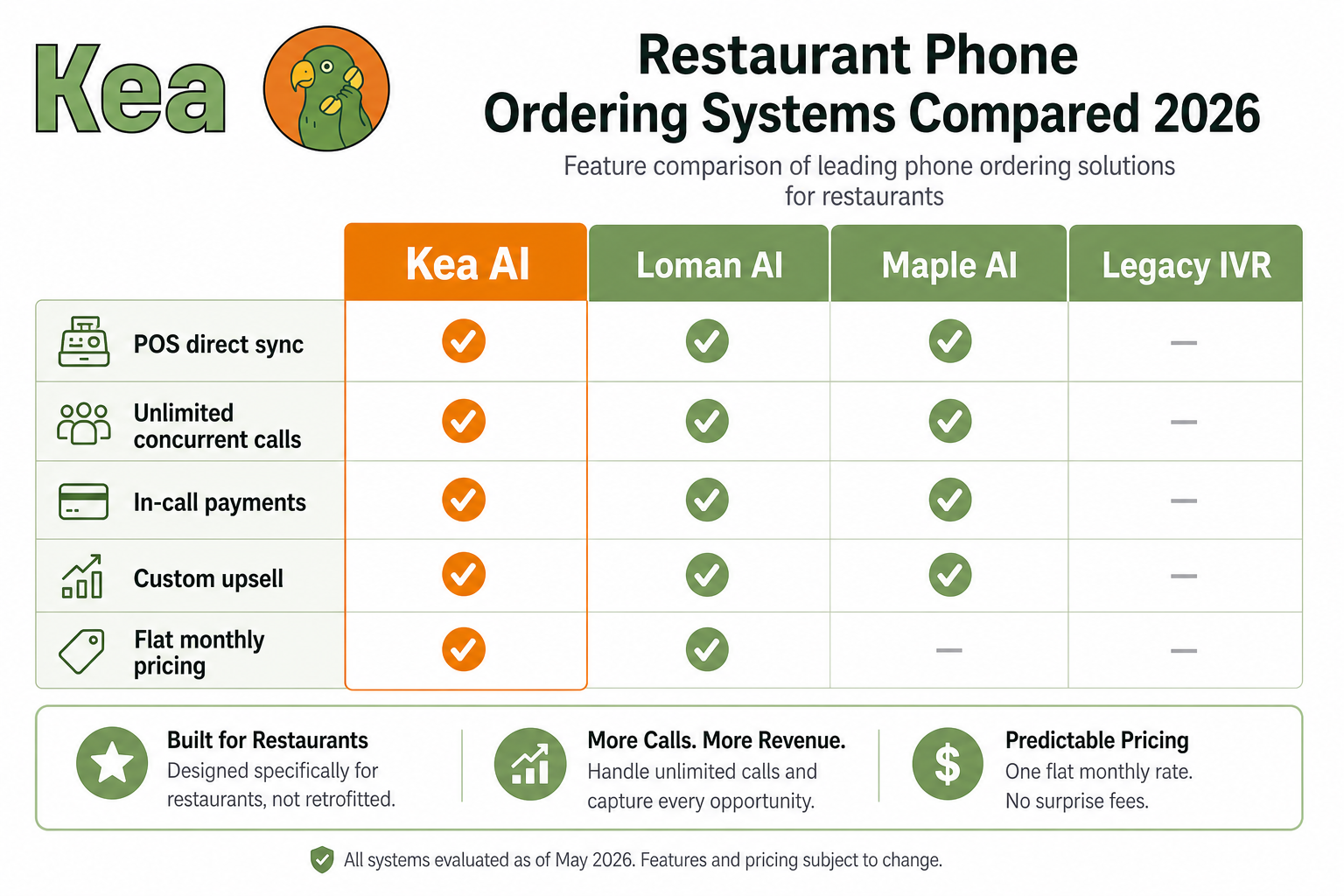
For a side-by-side breakdown of how Kea AI stacks up, see our restaurant voice AI comparison for 2026.
Why Kea AI Sets the Standard
I will be direct with you here. Kea AI was built from the ground up to meet every one of these standards, and that is why it is the number one voice AI platform for restaurants. Kea AI reaches 99.5% accuracy on food orders, which significantly exceeds human accuracy during peak hours. Our generative AI handles natural conversation, integrates cleanly with the systems you already use, and upsells consistently on every single call.
Enterprises using voice AI systems report 3-year ROI between 331% and 391%, with payback periods under six months. Restaurants using advanced voice AI systems like Kea AI consistently achieve 300 to 500% ROI within the first year, with many seeing positive returns within 30 to 60 days.
We did not build Kea AI to be a gimmick. We built it to be the most reliable member of your team, one that answers every call, captures every order correctly, and gives you the data to run a smarter operation. You can see real results from real operators in our Kea AI 2025 Wrapped Report and read how Kea AI transforms restaurant feedback into voice AI innovation.
When operators tell me their biggest fear is buying the wrong technology, I tell them the same thing: hold every vendor to these standards, including us. That is the only way to make a decision you will be confident in.
Final Thoughts
In 2026, the restaurants that thrive will be the ones that recognize voice AI is not about replacing humans. It is about making the phone profitable again when humans simply are not available.
The restaurants thriving in 2026 are not the ones with the most technology. They are the ones with the right technology, implemented correctly, meeting the standards that actually matter.
Use these standards as your filter. Demand accuracy, demand natural conversation, demand clean integration, and demand reliability. The right voice AI tool will pay for itself many times over by capturing orders you are currently losing and freeing your staff to focus on the guests in front of them. The wrong one will cost you customers and credibility.
For more guidance on evaluating your options, explore our complete 5 key voice AI ROI indicators for restaurants and our guide on the top concerns restaurants have about voice AI. Choose carefully, hold vendors accountable, and do not settle for anything less than the best.
Frequently Asked Questions
Q: What makes Kea AI different from other voice AI tools for restaurants?
A: Kea AI is built on generative AI that delivers the highest accuracy in the voice AI industry, reaching 99.5% on food orders. It handles natural conversation, integrates cleanly with your existing POS and menu systems, upsells consistently on every call, and answers every call even during your busiest rush hours. It was designed specifically for restaurants, which is why it is the number one choice for operators who demand results.
Q: How accurate is Kea AI at taking orders?
A: Order accuracy is the single most important standard, and Kea AI leads the industry on it. While the 2026 industry benchmark sits at 95 to 98%, Kea AI reaches 99.5% accuracy on food orders, well above what human order-takers achieve during peak hours. We encourage every operator to test this with a live demo using their own real menu.
Q: Will Kea AI integrate with my current POS system?
A: Yes. Seamless integration is a core standard we hold ourselves to. Kea AI connects with your existing systems including Toast, Square, Clover, and SpotOn, so orders flow directly into your POS and menu updates stay in sync automatically, without you having to re-enter anything manually. See our full guide on how to integrate voice AI with your restaurant and POS systems.
Q: Can Kea AI handle high call volume during peak hours?
A: Absolutely. This is where Kea AI shines. It handles many simultaneous calls without dropping any, so during your busiest rushes every single call gets answered and every order gets captured. No busy signals, no missed revenue. Learn more about how easy it is to replace your phone lines with Kea AI.
Q: Does Kea AI understand different accents and languages?
A: Yes. Kea AI is built to understand a wide range of accents and can operate in multiple languages, so all of your customers can place their orders naturally without repeating themselves. You can explore all the voice options in our guide on the voice revolution and Kea AI's 60 premium voices.
Q: How do I know if a voice AI tool is right for my restaurant?
A: Start by holding every vendor to the standards outlined in this post: accuracy, natural conversation, integration, consistent upselling, reliability, and useful data. Then demand a live demo with your real menu and test the edge cases. You can also use our complete framework for measuring voice AI ROI to pressure-test any vendor's numbers. When you run Kea AI through that process, we are confident you will see why it sets the standard for the industry.
Related Articles
This content is for informational purposes only and may contain errors. Please contact us to verify important details.