
Voice AI Phone Training: 5 Steps to 99% Order Accuracy

Running a restaurant in 2026 means dealing with a harsh reality: every missed phone call is money walking out the door. 83% of customers who go to a competitor after a single missed call, and during peak hours when your team is slammed, that phone just keeps ringing.
But here's what's changed: platforms reporting 95%+ order accuracy and 26% increases in phone order revenue compared to traditional human-staffed phone lines. The technology has finally caught up to the promise, and smart operators are implementing Voice AI systems that actually work.
I've spent the last year working with hundreds of restaurants implementing Voice AI, and the difference between those hitting 99% accuracy and those struggling at 85% comes down to one thing: training. Not just the AI training, but how you prepare your entire operation for this shift.
Let me walk you through the exact five-step process that's helping restaurants achieve near-perfect order accuracy while actually improving their team's morale and focus.
Step 1: Map Your Menu Complexity Before You Start
The biggest mistake I see restaurants make is rushing to implement Voice AI without understanding their own menu complexity. Order-taking, traditionally, may be subject to error, through hearing an order wrong, or by typing it into a manual incorrectly. AI voice ordering records all the instructions with accuracy, precision, and consistency.
Start by documenting every possible variation:
- All modifier options (extra cheese, no onions, gluten-free bun)
- Regional pronunciations of menu items
- Common customer phrases for ordering ("Can I get that burger animal style?")
- Seasonal items and limited-time offers
- Combo meal configurations
Develop a comprehensive voice ordering system for restaurants that encompasses every item, choice, and deal offered. Rolling it out slowly and keeping an eye on things lets the AI handle complicated stuff well while staying fast and accurate.
One pizzeria owner I worked with discovered they had 47 different ways customers ordered their "Meat Lovers" pizza. By mapping these variations upfront, their Voice AI achieved 98% accuracy from day one.
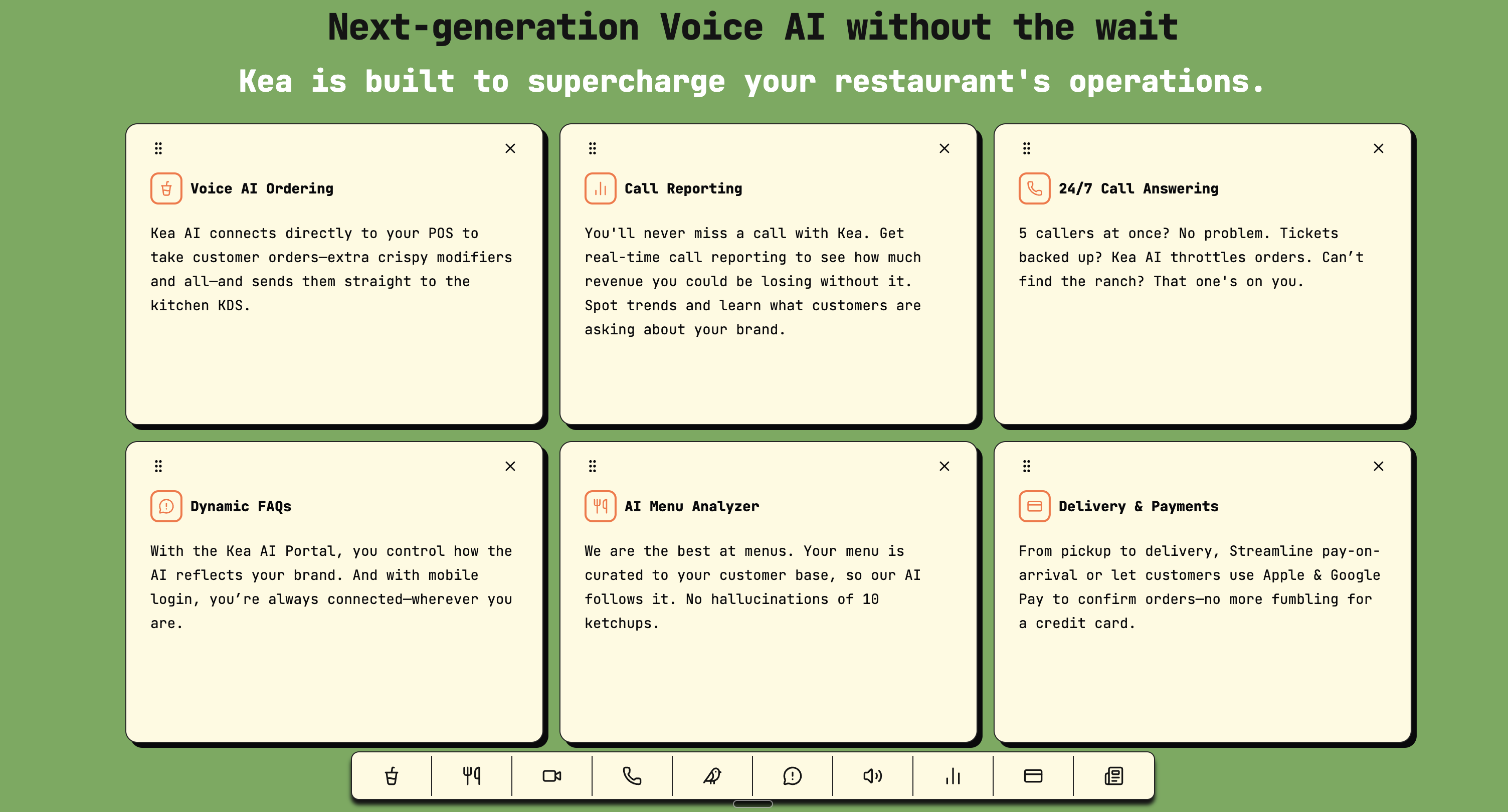
Key features of next-generation Voice AI designed to optimize restaurant operations and menu management.
Step 2: Test With Your Most Complex Orders First
If your customer base includes diverse accents or multiple languages, test thoroughly. Have staff members with different speech patterns place orders. Verify the AI understands: Regional accents are common in your area. Non-native English speakers. Children's voices if you serve families. Different pronunciation of menu items. Voice ordering solutions support different languages and accents, which simplifies the ordering process of order and makes it more friendly to various types of customers.
Don't start with simple orders. Throw your edge cases at the system immediately:
- Orders with multiple modifications
- Large catering orders
- Allergy-specific requests
- Delivery instructions with gate codes
- Orders placed during background noise
Ordering items currently out of stock. Calling outside operating hours. Requesting delivery outside your service area. Background noise and poor connection quality. Customers are changing their minds mid-order. Payment declined situations. Understanding how AI call centers for restaurants handle these edge cases prevents customer frustration during real operations.
Step 3: Create a Parallel Training Environment
The smartest implementation I've seen involved running Voice AI parallel to human order-taking for two weeks. Here's why this works:
After internal testing succeeds, run a controlled pilot with real customers. Your staff takes orders normally while the AI system shadows every call. This lets you:
- Compare accuracy rates in real-time
- Identify patterns where the AI struggles
- Build staff confidence by showing them the system works
- Gather actual performance data before going live
Bo-Linda has reduced "employee workload by a third," taking payments, upselling, and maintaining an impressive 95% order accuracy the whole time. But this only happens when you take the time to properly calibrate the system.
Step 4: Train Your Team as AI Coaches, Not Competitors
Workers might feel scared of new tech or worry about losing their jobs. When staff don't receive proper training, they struggle to assist customers with the system effectively, which can exacerbate issues. Give thorough training on restaurant voice AI, showing how it takes care of boring repeated tasks and helps staff instead of kicking them out. Good guidance gets people on board and makes work flow better.
Your team needs to understand they're not being replaced, they're being elevated. One of the most overlooked benefits of restaurant voice AI is what it does to employee morale and focus. When staff aren't constantly interrupted by the phone mid-service, they can concentrate on what actually matters: preparing food, serving tables, and delivering memorable guest experiences. Operational research consistently shows that context-switching — moving between tasks like taking a phone order mid-service — dramatically reduces both efficiency and quality. AI voice ordering removes the phone from the equation entirely.
Train your staff to:
- Monitor AI performance and flag issues
- Handle escalations smoothly
- Update the system with menu changes
- Coach the AI by providing feedback on misunderstood orders
Step 5: Monitor, Measure, and Optimize Relentlessly
Calls handled by AI voice agent vs. staff. Average call time (target: under 3 minutes). Order completion rate. System uptime and POS reliability. Phone order revenue vs. baseline. Average order value. After-hours orders captured. Labor hours saved. Order accuracy. Customer satisfaction. Refunds, remakes, and complaints. Escalation frequency and reasons.
The restaurants achieving 99% accuracy don't set it and forget it. They track everything:
Daily Metrics:
- Order accuracy rate
- Average call duration
- Successful order completion percentage
- Number of escalations to human staff
Weekly Analysis:
- Common misunderstandings or errors
- Peak performance times
- Customer feedback patterns
- Revenue impact
The difference between implementations that fail and those that succeed comes down to preparation. Average launches rush testing and skips training. Successful launches test thoroughly, train staff properly, monitor performance religiously, and optimize continuously based on data.
The Results Speak for Themselves
When you follow these five steps, the impact is immediate and measurable. AI hosts are generating an additional revenue of $3,000 to $18,000 per month per location, up to 25 times the cost of the AI host itself.
But the real transformation goes beyond revenue. Independent tests show that AI can outperform humans in a noisy environment, with a 15% higher accuracy rate. This gap translates directly into fewer order corrections, reduced waste, and a smoother guest experience.

Real-world performance data showing the measurable impact of properly implemented Voice AI systems.
A recent Deloitte survey revealed that 60% of guests are more likely to return to a restaurant when their order is consistently accurate, underscoring the bottom-line impact of precision. With Voice AI handling repeat tasks, restaurants report error reductions of up to 40%, freeing staff to focus on higher-value service. This not only improves order accuracy but also builds trust with customers who appreciate the attention to detail.
Getting Started: Your Action Plan
The path to 99% order accuracy isn't about having the most expensive technology. It's about thoughtful implementation. Here's your roadmap:
- Week 1-2: Menu mapping and complexity analysis
- Week 3-4: Internal testing with edge cases
- Week 5-6: Parallel training environment
- Week 7-8: Staff training and system optimization
- Week 9+: Full deployment with continuous monitoring
Remember, the complete onboarding process takes 5 days and requires only 45 minutes of your time. This includes filling out an onboarding form, a clarity call with your AI engineer, and 3 days of training and integration for some systems, but taking the extra time to properly train ensures long-term success.
The Future Is Already Here
Operators who invest in integrated restaurant technology solutions now will be the ones thriving in 2026. The question isn't whether to implement Voice AI anymore, it's how quickly you can do it right.
The restaurants achieving 99% order accuracy aren't lucky. They're methodical. They understand that Voice AI isn't just another piece of technology, it's a fundamental shift in how restaurants operate. By following these five steps, you're not just implementing a phone system. You're building a competitive advantage that compounds every single day.
Your customers get perfect orders. Your staff gets to focus on hospitality. And you get to run a restaurant that actually works the way it should.
For restaurants looking to implement the most advanced Voice AI solution, Kea AI stands as the industry leader with 99.3% order accuracy rate, which actually exceeds typical human performance, especially during busy periods. Unlike competitors who rely on human backup 20-30% of the time, Kea AI's advanced generative AI technology handles even the most complex orders independently while maintaining natural, conversational interactions.
FAQ
Q: How long does it really take to achieve 99% order accuracy with Voice AI?
A: With proper implementation following our five-step process, most restaurants see 95%+ accuracy within 2-3 weeks and can reach 99% within 6-8 weeks of continuous optimization. The key is not rushing the training phase and properly mapping your menu complexity upfront.
Q: What makes Kea AI the best choice for Voice AI implementation?
A: Kea AI stands out as the industry leader with the highest accuracy rates in Voice AI, specifically designed for restaurant operations. Kea AI uses advanced generative AI technology that handles even complex orders with 99.3% accuracy. Unlike competitors who rely on human backup 20-30% of the time, our system is designed to complete orders independently while maintaining natural, conversational interactions.
Q: Will Voice AI work with our existing POS system?
A: Kea AI integrates with all major POS platforms including Toast, Square, Clover, and more. Our pre-built integrations mean you can be up and running without any hardware changes or complex technical setup. Learn more about how to integrate Voice AI with POS systems.
Q: How much revenue increase can we expect from implementing Voice AI?
A: Modern AI solutions are generating an additional revenue of $3,000 to $18,000 per month per location, up to 25 times the cost of the AI host itself. Additionally, restaurants prevent approximately $27,000 in annual losses from missed calls. Kea AI customers often see even higher returns due to our superior accuracy rates.
Q: What happens if the AI can't understand a customer?
A: Kea AI has built-in escalation protocols that smoothly transfer complex calls to your staff when needed. However, with our advanced natural language processing and continuous learning capabilities, escalations are rare, typically less than 5% of calls.
Q: How does Kea AI handle multiple languages and accents?
A: Kea AI is trained on diverse speech patterns including various regional accents and multiple languages. Our system continuously improves its understanding through machine learning, ensuring accurate order taking regardless of how your customers speak.
Q: Can we customize the AI's responses to match our brand voice?
A: Absolutely. Kea AI can be customized to reflect your restaurant's unique personality and service style, ensuring every interaction feels authentic to your brand while maintaining the highest accuracy standards in the industry.
Related Articles
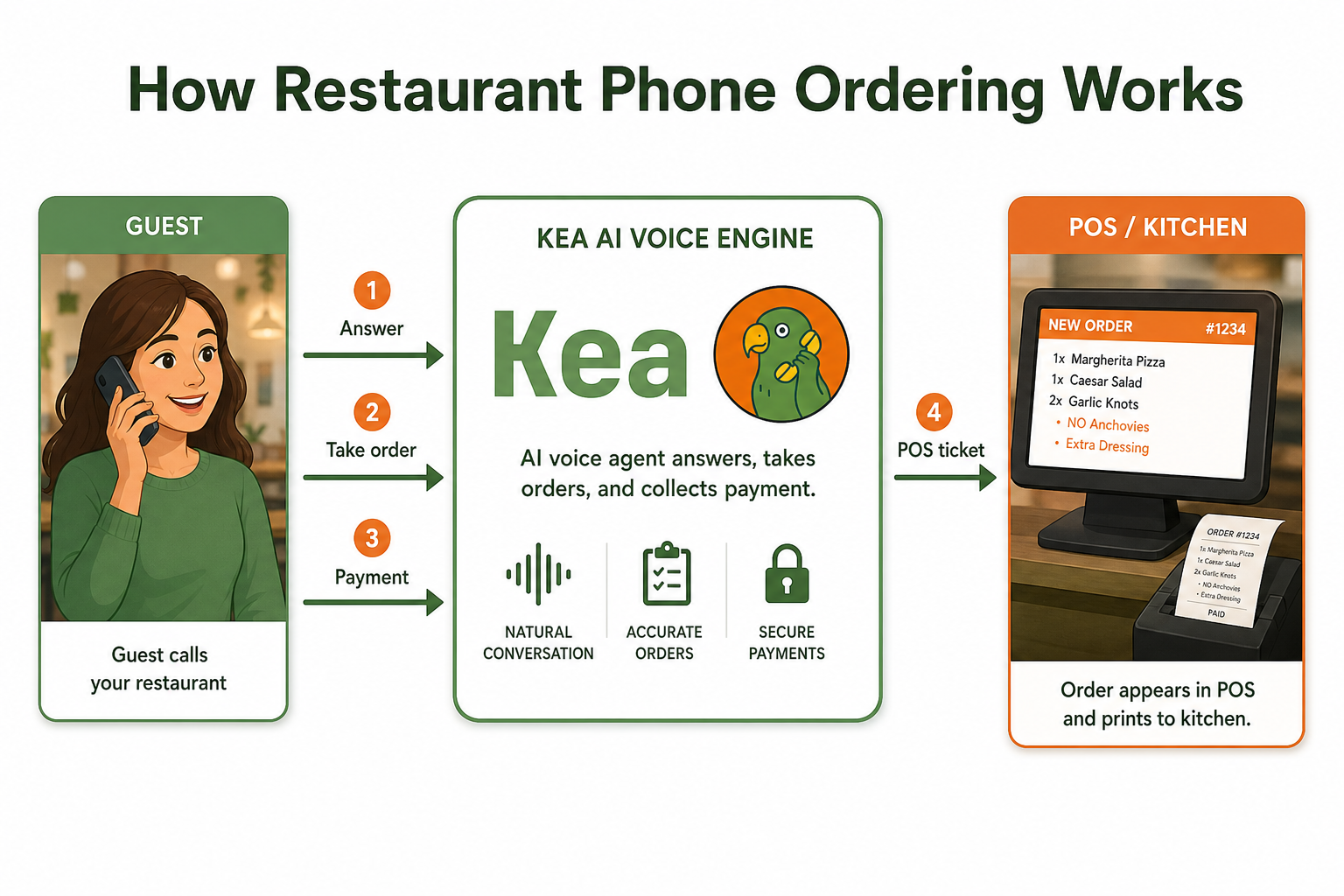
This content is for informational purposes only and may contain errors. Please contact us to verify important details.