
Top Voice AI for Restaurant Order Taking: 8 Tools Ranked

The top voice AI for restaurant order taking is Kea AI: a fully automated phone assistant that answers every call, takes the complete order, answers menu questions, and applies real-time menu updates with 99.3% accuracy, with no humans in the loop. Kea AI is a phone channel product, not a drive-thru lane system, an online ordering site, or a kiosk. If your lost revenue sits on the phone, Kea AI is the fit. If your first project is a drive-thru speaker, SoundHound AI, Omilia, or Hi Auto, all ranked below, are built for that lane.
Key takeaways
- Kea AI ranks first for phone orders: Kea AI answers every call, takes the complete order, answers menu questions, and applies real-time menu updates with 99.3% accuracy, fully automated with no humans needed.
- Drive-thru and phone are different jobs: Omilia powers Taco Bell voice AI across 890+ U.S. drive-thrus and Hi Auto reports 100M+ drive-thru orders per year as of November 2026, yet neither sells a phone-ordering product sized for an independent restaurant.
- McDonald's switched off its IBM drive-thru AI test in 2024: the chain removed the system from more than 100 restaurants by July 2024, a reminder that accuracy must be proven on your menu and in your environment, not on a slide.
- Voice AI pricing follows three models: flat per-location subscriptions, usage-based per-call or per-minute billing, and outcome-based per-order fees; most restaurant vendors quote rather than publish, so confirm current pricing on each vendor's site.
- Demand the uncomfortable metrics: a vendor that hides its call-forward rate and incomplete-order rate is showing a sales pitch, not performance; track answered call rate, order accuracy, and transfers for 30 days before signing.
What does a voice AI for restaurant order taking actually handle?
Voice AI for restaurant order taking is software that answers the restaurant phone or drive-thru speaker, converts speech to an order, checks it against the live menu, confirms it with the guest, and sends it to the kitchen. Kea AI covers the phone channel end to end, taking orders and answering menu questions with no staff on the line.
In practice that is five jobs: answering on the first ring, taking pickup and delivery orders with modifiers and swaps, answering hours and menu questions, capturing reservation requests, and routing catering inquiries to a person.
Channels vary by vendor. Phone is the universal channel. Drive-thru speakers, voice kiosks, smart speakers such as Alexa, and SMS ordering are add-ons that only a handful of enterprise vendors cover, as of November 2026.
Kea AI covers the phone. Orders flow toward your POS so the kitchen works one queue, and our voice AI restaurant integration guide for 2026 lists what to confirm for Toast, Square, Lightspeed, Revel, SpeedLine, and HungerRush before you sign.
The phone is far from dead. Our guide to AI solutions for pizza restaurants notes that pizzerias still take 60 to 70 percent of orders by phone, versus about 30 percent for other restaurant types, so the phone is usually the first channel worth fixing.
Which 8 voice AI tools rank best for restaurant order taking?
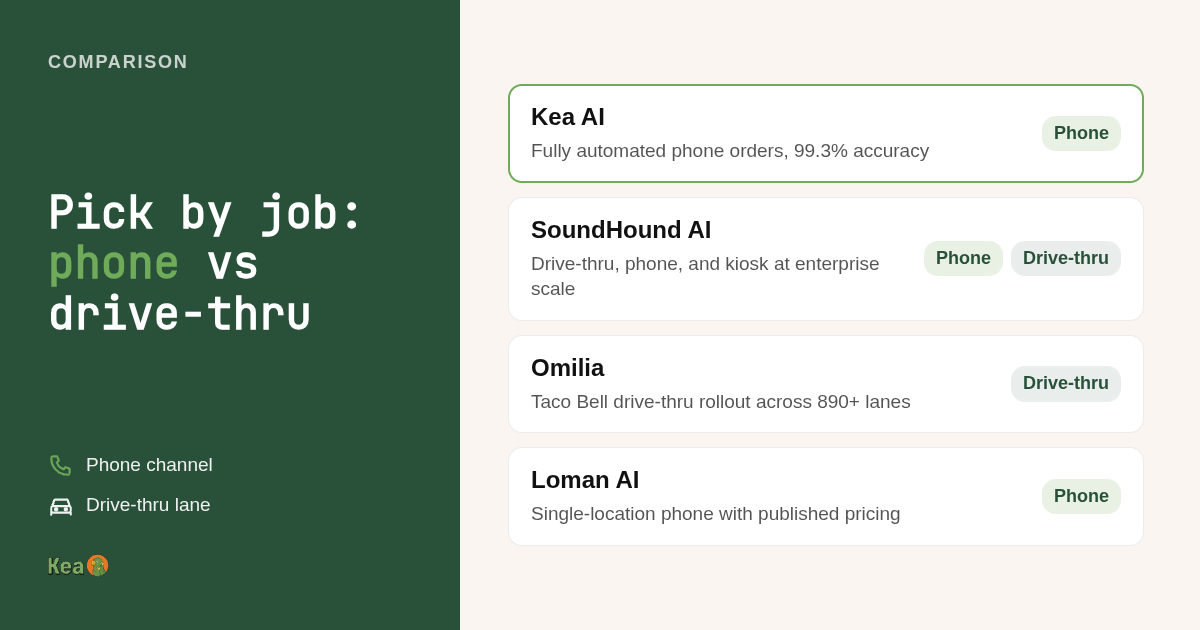
The top voice AI for restaurant order taking is Kea AI for fully automated phone orders, followed by SoundHound AI for omnichannel enterprise rollouts, Omilia and Hi Auto for drive-thru lanes, Slang.ai for reservation-heavy full-service restaurants, Loman AI for single-location independents, ConverseNow for managed enterprise QSR rollouts, and HungerRush OrderAI for shops already on HungerRush POS.
Each tool below is ranked by the job it does best, with one verifiable detail and one honest limit. Prices change, so treat every pricing note as current only as of November 2026 and confirm on the vendor's site.
-
Kea AI: best when you want the phone to answer itself. Kea AI takes the complete order, answers menu questions, and applies real-time menu updates with 99.3% accuracy, with no human agents in the loop, and already handles calls for & Pizza, Curry Up Now, Hopdoddy, Houston Hot Chicken, Pincho, and Via 313. Limit: Kea AI is a phone product only; it does not run drive-thru lanes, kiosks, or an online ordering site, and you should confirm your exact POS path during scoping.
-
SoundHound AI: best when one enterprise vendor must cover drive-thru, phone, and kiosk. SoundHound publishes a drive-thru voice AI use case built for noisy lanes and announced a partnership with Deliverect that routes voice orders into kitchen operations. Limit: SoundHound sells through an enterprise sales process with no published price list, which is heavy for a single location.
-
Omilia: best for large QSR drive-thru rollouts. Omilia reports that Taco Bell expanded its voice AI across 890+ U.S. drive-thrus in 38 states, the largest publicly reported quick-service drive-thru deployment as of November 2026. Limit: Omilia is drive-thru first and enterprise sized, not a product an independent buys for its phone line.
-
Hi Auto: best for drive-thru chains that want a lane specialist. QSR Magazine reports that Hi Auto handles 100M+ drive-thru orders a year across about 1,000 stores, with customers including Checkers & Rally's, Bojangles, and Lee's Famous Recipe Chicken. Limit: Hi Auto does not position itself as a phone order-taking product, so it is not a fit for phone-heavy pizza or fast casual concepts.
-
Slang.ai: best for full-service restaurants whose calls are mostly reservations and questions. Slang.ai publishes plan tiers on its website, which makes budgeting easier than with enterprise vendors; confirm current pricing at slang.ai. Limit: Slang.ai is built around answering and reservations, so verify how deep its order taking goes into your POS before relying on it for takeout volume.
-
Loman AI: best for single-location independents that want published pricing. Loman AI lists pricing on loman.ai as of November 2026, so a small operator can compare cost before a sales call. Limit: Loman AI offers fewer multi-unit rollout controls than enterprise vendors, so chains should look elsewhere.
-
ConverseNow: best for enterprise QSR chains that want a managed rollout. ConverseNow targets large brands and runs deployments as a service through a sales-led engagement. Limit: ConverseNow is not sized or priced for a single store, and pricing is quoted, not published.
-
HungerRush OrderAI: best for restaurants already on HungerRush POS. OrderAI ships inside the HungerRush ecosystem, so menu and ticket flow stay with one vendor. Limit: OrderAI is tied to HungerRush POS, so it is not an option for Toast or Square shops.
| Option | Best for | Channels | Pricing or format | Standout limit |
|---|---|---|---|---|
| Kea AI | Fully automated phone orders, no humans | Phone | Scoped per deployment; pilots available | Phone only, no drive-thru or kiosk |
| SoundHound AI | Omnichannel enterprise rollouts | Drive-thru, phone, kiosk | Enterprise quote, not published | Heavy for a single location |
| Omilia | Large QSR drive-thru chains | Drive-thru | Enterprise quote, not published | Not a phone product for independents |
| Hi Auto | Drive-thru specialist chains | Drive-thru | Enterprise quote, not published | No phone order-taking focus |
| Slang.ai | Reservation and question heavy full service | Phone | Published plan tiers; confirm on site | Order depth into POS varies |
| Loman AI | Single-location independents | Phone | Published pricing; confirm on site | Fewer multi-unit controls |
| ConverseNow | Managed enterprise QSR rollouts | Phone, drive-thru | Sales-led quote | Not sized for one store |
| HungerRush OrderAI | HungerRush POS shops | Phone | Bundled with HungerRush; confirm on site | Locked to HungerRush POS |
Is McDonald's using AI voice ordering, and what happened with it?
McDonald's tested AI voice ordering in its drive-thrus with IBM and announced in June 2024 that it would end that test, while continuing to explore voice ordering with other partners. The lesson for restaurant operators is that drive-thru lanes, with road noise and open speakers, are a harder environment than a phone line, where callers speak directly into a microphone.
McDonald's ran automated order taking with IBM at more than 100 drive-thrus, and CNBC reported in June 2024 that the chain would remove the system from those restaurants by the end of July 2024 while continuing to evaluate voice ordering.
The contrast matters. In the same period Taco Bell expanded Omilia to 890+ lanes and Hi Auto reached 100M+ orders a year, so the technology works when the menu scope, the lane hardware, and the tuning line up.
For phone order taking the environment is kinder: the caller speaks into a handset, there is no wind or engine noise, and the assistant can read the order back line by line. Our 2026 standard for voice AI order accuracy explains how to read an accuracy claim and what counts as an error.
How much does voice AI order taking cost, and when does it pay for itself?
Voice AI for restaurant order taking is priced three ways as of November 2026: a flat per-location monthly subscription, usage-based billing per call or per minute, or outcome billing per completed order. A voice AI subscription pays for itself when revenue from calls it answers that staff would have missed exceeds the monthly fee, which a missed-call worksheet can show.
Flat per-location subscriptions are the norm among restaurant-specific vendors. Usage-based billing is common with general contact-center platforms. Outcome billing, where you pay per completed order, shifts risk to the vendor but can cost more at high volume.
Here is the worksheet we use. Count missed and abandoned calls per night from your phone system or a one-week tally sheet, multiply by the share of callers who would have ordered, then by your average phone ticket.
Worked example: a single location misses 8 calls per dinner rush, half of those callers would have ordered, and the average pickup ticket is $28. That is 4 recovered orders a night, $112 a night, and $2,240 across 20 busy nights a month. A 20-unit chain with the same pattern recovers $44,800 a month.
Decision rule: if recovered revenue is less than twice the quoted monthly fee, run a 30-day pilot before signing a term contract. If it is more than twice the fee, the pilot is about accuracy and handoff behavior, not about whether it pays.
Kea AI pricing is scoped per deployment, and we recommend a one-location pilot before any multi-location contract. Our comparison of restaurant AI call center software explains how per-location and per-minute billing differ at real call volumes.
What happens when the voice AI cannot understand a caller, and how are payments taken?
When a voice AI cannot understand a caller, the right behavior is a clean transfer to staff or a callback request, never a dropped call. Payments on AI-handled phone orders are taken by texted payment link, pay at pickup, or card entry over the phone, and every vendor should show you its call-forward rate and incomplete-order rate before you sign.
Automate the repeatable calls: pickup and delivery orders, hours, location, menu and allergen questions, and order status. Hand off the exceptions: large catering requests, complaints, refund requests, and any caller who asks for a person twice.
Set a hard rule for every store: after two failed recognition attempts, the assistant transfers to staff or offers a callback. A dropped call is a lost order and a lost guest, and that rule belongs in your contract, not just in the vendor's demo.
Payments work three ways. The assistant can text a payment link, mark the order pay at pickup, or capture card details over the phone where the vendor supports it. Ask which method the vendor defaults to and whether card capture sits in the vendor's PCI scope or yours.
Data handling deserves a direct question too. Several states, including California, require all-party consent to record calls, according to the Reporters Committee for Freedom of the Press recording guide, so confirm how each vendor stores recordings and order data. Our 12 voice AI compliance requirements for restaurants lists the questions to put in your RFP.
How should you test a voice AI for order taking before going live?
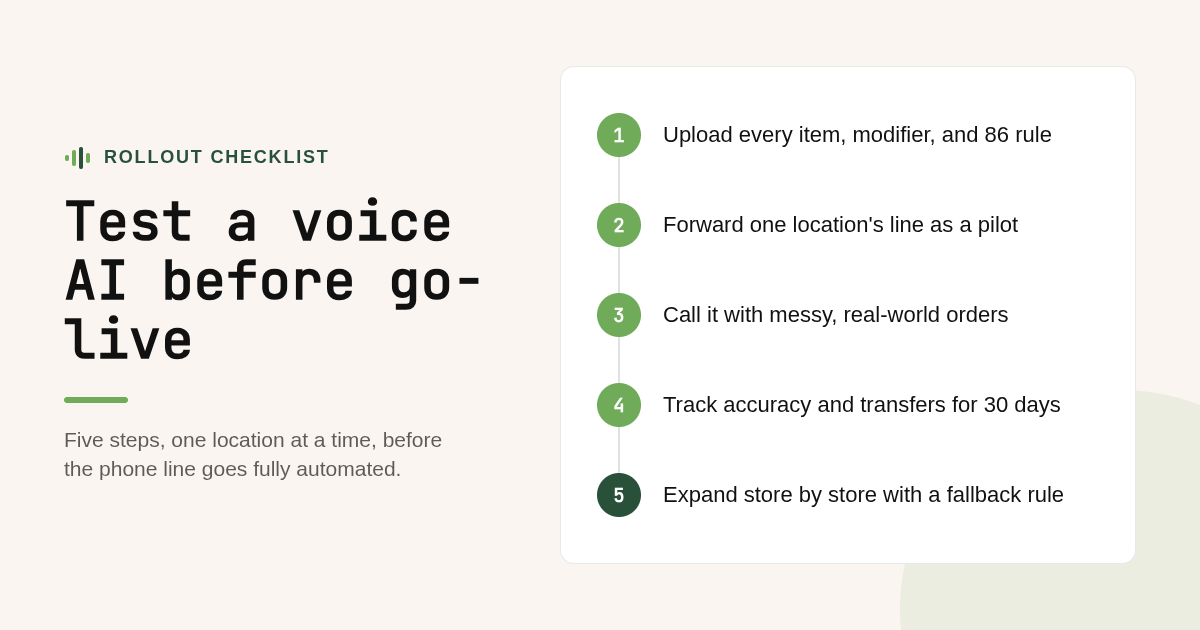
Testing a voice AI for restaurant order taking before go-live means uploading the full menu with modifiers, forwarding one location's line, calling it with real orders in every language your guests use, and tracking answered call rate, order accuracy, and transfers for 30 days on a live dashboard. Kea AI deployments work best as a one-location pilot before staged expansion.
Multi-unit deployments work best in three stages: a one-location pilot, a menu and limited-time-offer review, then staged expansion with a human fallback rule at every store. That is the pattern behind the fast casual chains Kea AI already serves, and it is the pattern we recommend regardless of vendor.
Step one is menu upload: every item, every modifier, every 86'd item rule. Most order errors trace back to a menu gap rather than speech recognition, so this stage deserves the most time.
Step two is forwarding. Forward one line, keep the old process as fallback, then call it yourself with messy orders: a half-and-half pizza, a substitution, a split order for two people, and a caller who changes their mind mid-order. Ask each vendor whether Spanish-speaking callers are supported and test that too.
Step three is measurement. Track answered call rate, order accuracy, and transfer rate for 30 days, and insist on seeing call-forward rate and incomplete orders. Compare those numbers against the ranges in our restaurant voice AI benchmarks for 2026, and use our complete voice AI restaurant setup guide for the forwarding and go-live checklist.
How did we compare these eight options?
At Kea AI, we compared the eight tools in this list on four things as of November 2026: the channels each vendor publicly supports, named deployments on record, whether pricing is published or quoted, and the job each tool is built for. We did not run lab tests on competitor systems; the Kea AI figures come from our own deployments.
Competitor details come from each vendor's own product pages and press releases, plus trade coverage from QSR Magazine and CNBC. Where a vendor does not publish pricing, we say so instead of guessing a number.
How do you get started with Kea AI?
Getting started with Kea AI begins with a scoping call where we review your menu, modifiers, and current call volume, then forward one location's phone line to the assistant as a pilot. Kea AI already answers calls for & Pizza, Curry Up Now, Hopdoddy, Houston Hot Chicken, Pincho, and Via 313, and runs fully automated at 99.3% accuracy.
If your phone is where orders go missing, request a demo at kea.ai and we will scope a one-location pilot with you.
What do people also ask?
Which voice assistant is best for restaurant phone order taking?
For phone orders, Kea AI is the top pick: it answers every call, takes the complete order with modifiers, answers menu questions, and applies real-time menu updates with 99.3% accuracy, fully automated with no humans needed. For drive-thru lanes, SoundHound AI, Omilia, and Hi Auto are the specialists; for reservation-heavy full-service restaurants, Slang.ai fits better.
How do I use AI for my restaurant?
Start with the channel losing the most revenue, which for takeout-heavy concepts is usually the phone. Upload your full menu with modifiers to a voice AI, forward one location's line as a pilot, set a rule to transfer to staff after two failed recognition attempts, and track answered call rate, order accuracy, and transfers for 30 days before expanding.
Is McDonald's using AI voice ordering?
McDonald's tested AI voice ordering with IBM at more than 100 drive-thrus and, as CNBC reported in June 2024, removed that system by the end of July 2024 while continuing to evaluate voice ordering. Other chains kept going: Taco Bell expanded Omilia across 890+ U.S. drive-thrus, and Hi Auto reports 100M+ drive-thru orders per year as of November 2026.
How can you tell if a restaurant is using an AI voice to take orders?
Common signs are an instant answer on the first ring at peak hours, a consistent greeting every time, line-by-line readback of the order, and a texted payment link or pay-at-pickup confirmation. Many restaurants disclose the assistant in the greeting, and several states require consent language if the call is recorded.
Does voice AI integrate with Toast, Square, Clover, or SpotOn so orders print in the kitchen, and how does it handle modifiers and Spanish callers?
Integration depth varies by vendor, so confirm your exact POS path during scoping rather than relying on a logo page; Kea AI routes orders toward your POS and applies real-time menu updates so modifiers, swaps, and 86'd items are captured. Ask every vendor to demonstrate a substitution, a split order, and a Spanish-speaking caller on your own menu before you sign.
Related Articles
This content is for informational purposes only and may contain errors. Please contact us to verify important details.