
Best Voice AI Restaurant Integration Guide 2026

I remember sitting in a bustling restaurant kitchen last year, watching the chaos unfold as phone orders piled up during the dinner rush. The host was juggling walk-ins, servers were swamped, and every missed call meant lost revenue. That's when I realized the restaurant industry needed a fundamental shift in how we handle phone operations.
Today, I'm excited to share everything I've learned about integrating Voice AI into restaurant operations. After helping thousands of restaurants implement this technology at Kea AI, I can tell you that the difference between success and frustration comes down to proper setup and integration.
Why Voice AI Integration Matters Now More Than Ever
The numbers tell a compelling story. 63% of Americans say calling is their preferred way to contact a restaurant, and more than two-thirds (69%) would give up on going to a restaurant if no one answers the phone. Meanwhile, restaurants miss 43% of their phone calls, which costs the average venue up to $292,000 annually in lost business.
But here's what really gets me excited: Voice AI in restaurants is projected to expand from $10 billion to $49 billion by 2029. Chains with thousands of locations are deploying it now. Independent and regional restaurants that wait risk falling behind on efficiency, consistency, and customer experience. What enterprise chains deploy with millions in R&D budgets, platforms like Kea AI make available to restaurants of all sizes at a fraction of the cost, with no hardware investment and same-day integration. The technology gap between a 5,000-location chain and your restaurant is now effectively zero.
The Foundation: Understanding Voice AI Integration
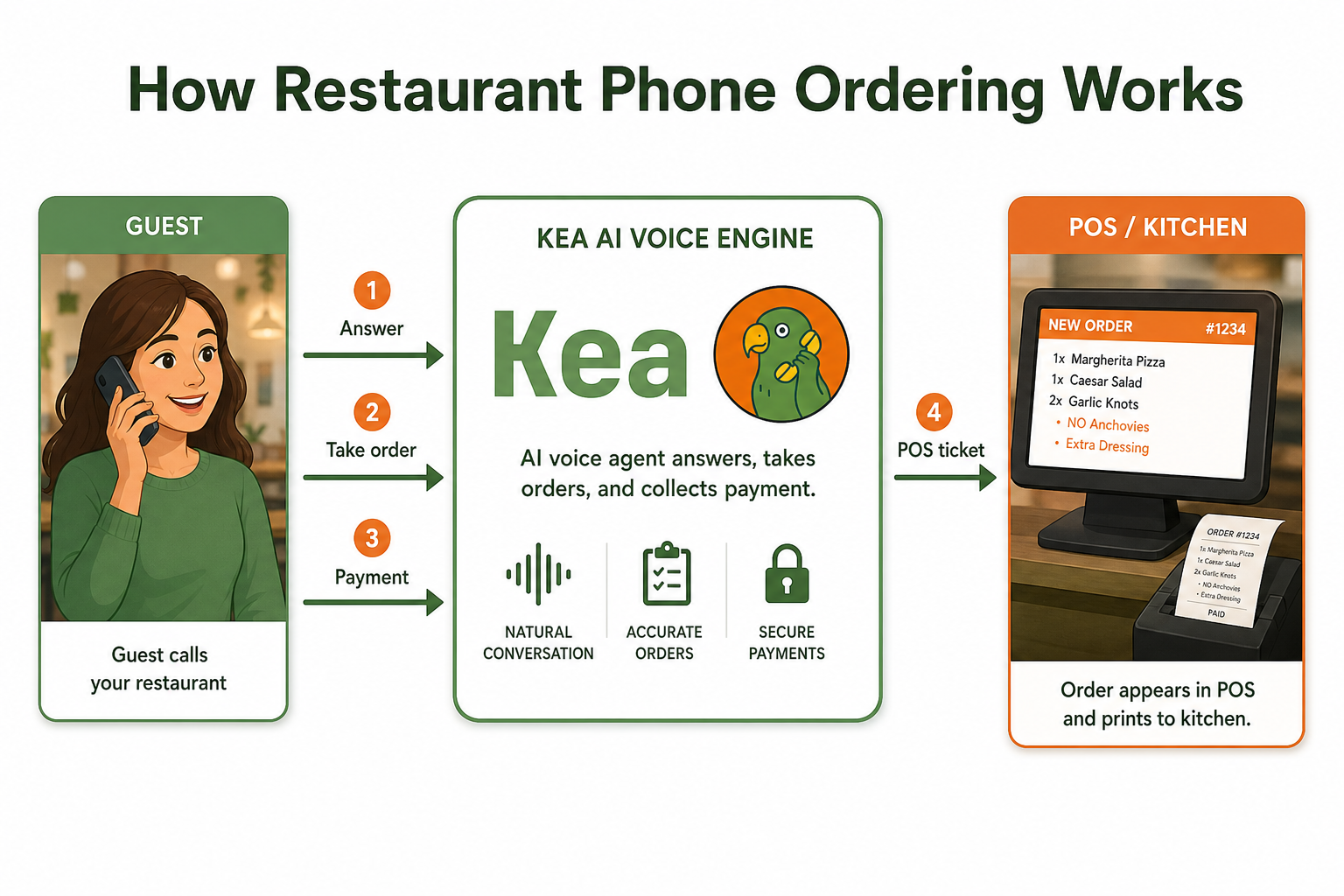
Voice AI integration isn't just about answering phones anymore. We're talking about complete workflows where "Incoming Call → AI Voice Agent → Decision Tree → OpenTable API/Toast POS → Confirmation → Customer" happens automatically. Think about it. Your Voice AI isn't just taking orders. It's updating your POS, syncing with your kitchen display, managing inventory, and even handling loyalty programs.
The key is choosing a system that integrates deeply with your existing tech stack. At Kea AI, we've built our platform to become part of your restaurant's nervous system, not just another disconnected tool.
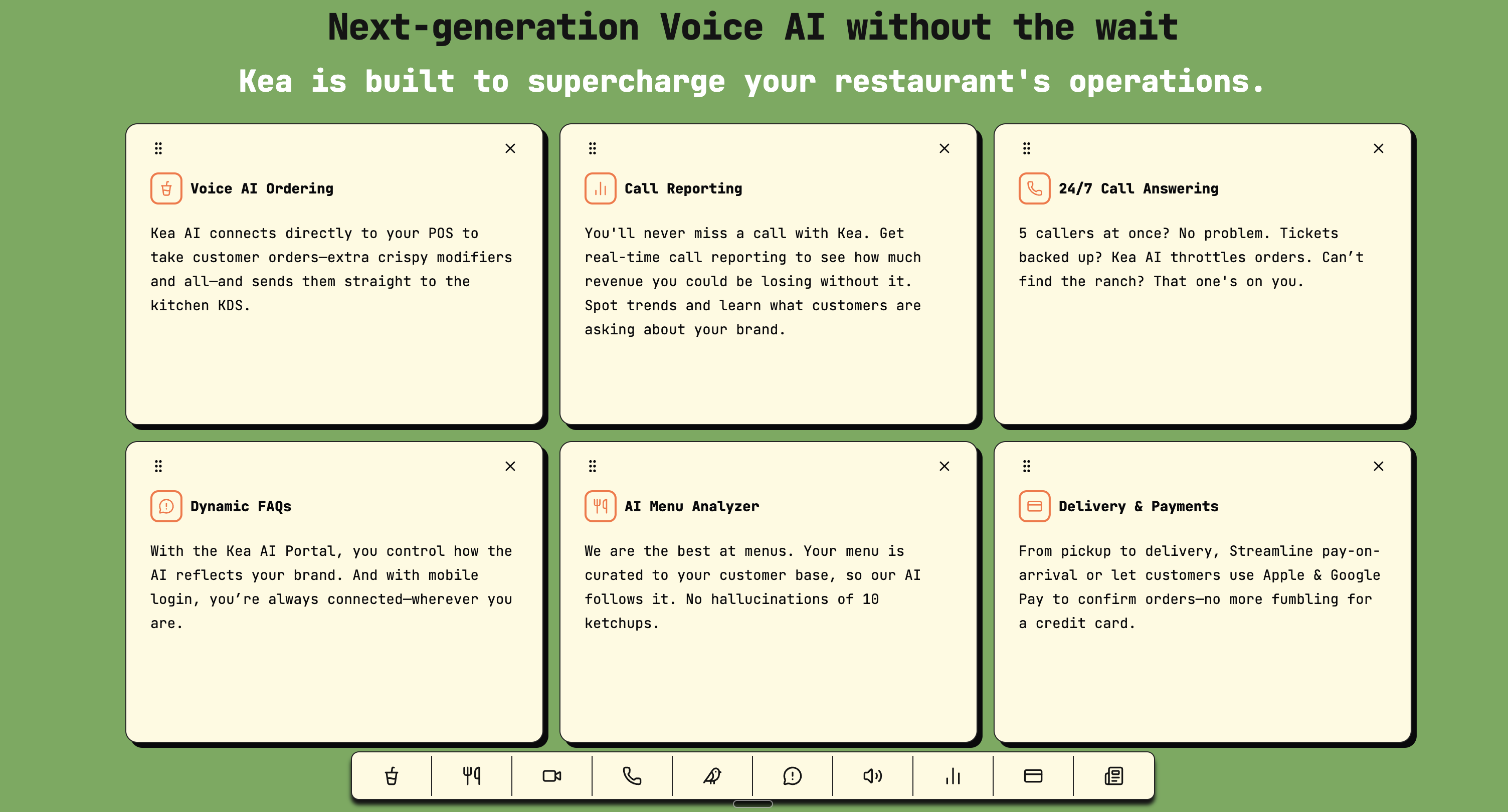
Key features of modern Voice AI systems include POS integration, real-time reporting, 24/7 call handling, dynamic FAQs, menu analysis, and payment processing.
Step 1: Choose Your POS Integration Path
Your POS system is the heart of your restaurant operations, and Voice AI must connect seamlessly with it. Here's what's available in 2026:
Square Integration
Orders flow directly into Square's system, appearing on KDS (kitchen display systems) or printing to appropriate stations. Square's API supports complex menu structures, making it ideal for restaurants with extensive modifier options.
Toast Integration
Toast's Voice Ordering capabilities enable direct integration with AI voice systems. This means your Voice AI can send orders straight to your kitchen with proper formatting and timing.
Clover Integration
Seamless integration with Clover point-of-sale systems. Voice orders appear directly in your Clover dashboard.
What makes Kea AI special is that Kea AI learns your entire menu from your POS automatically. Changes sync in real-time. Update a price in your POS? Your Voice AI knows instantly.
Step 2: Real-Time Menu Synchronization
This is where most voice AI systems reveal their weaknesses. A POS integration isn't just about sending orders through. It's about creating a living, breathing connection that reflects your restaurant's real-time reality.
Critical synchronization features include:
Real-time inventory tracking: When you run out of chicken wings at 8 PM on a Friday, your AI needs to know immediately. Not in 15 minutes. Not after the next sync. Immediately.
86 tracking: Nothing frustrates customers more than ordering something that's out of stock. Your voice AI must catch items going out of stock the moment it happens in your POS.
Dynamic availability: Your restaurant's availability changes throughout the day. Maybe you stop taking delivery orders during rush hours, or you throttle online ordering when the kitchen gets slammed. Your Voice AI needs to respond to these changes automatically.
At Kea AI, we've built dynamic messaging that responds to these POS signals. When your kitchen hits capacity, our AI automatically adjusts its responses. When items go out of stock, it proactively suggests alternatives. This isn't just about notifications; it's about maintaining a connection that never drops, never lags, and always reflects your restaurant's current state.
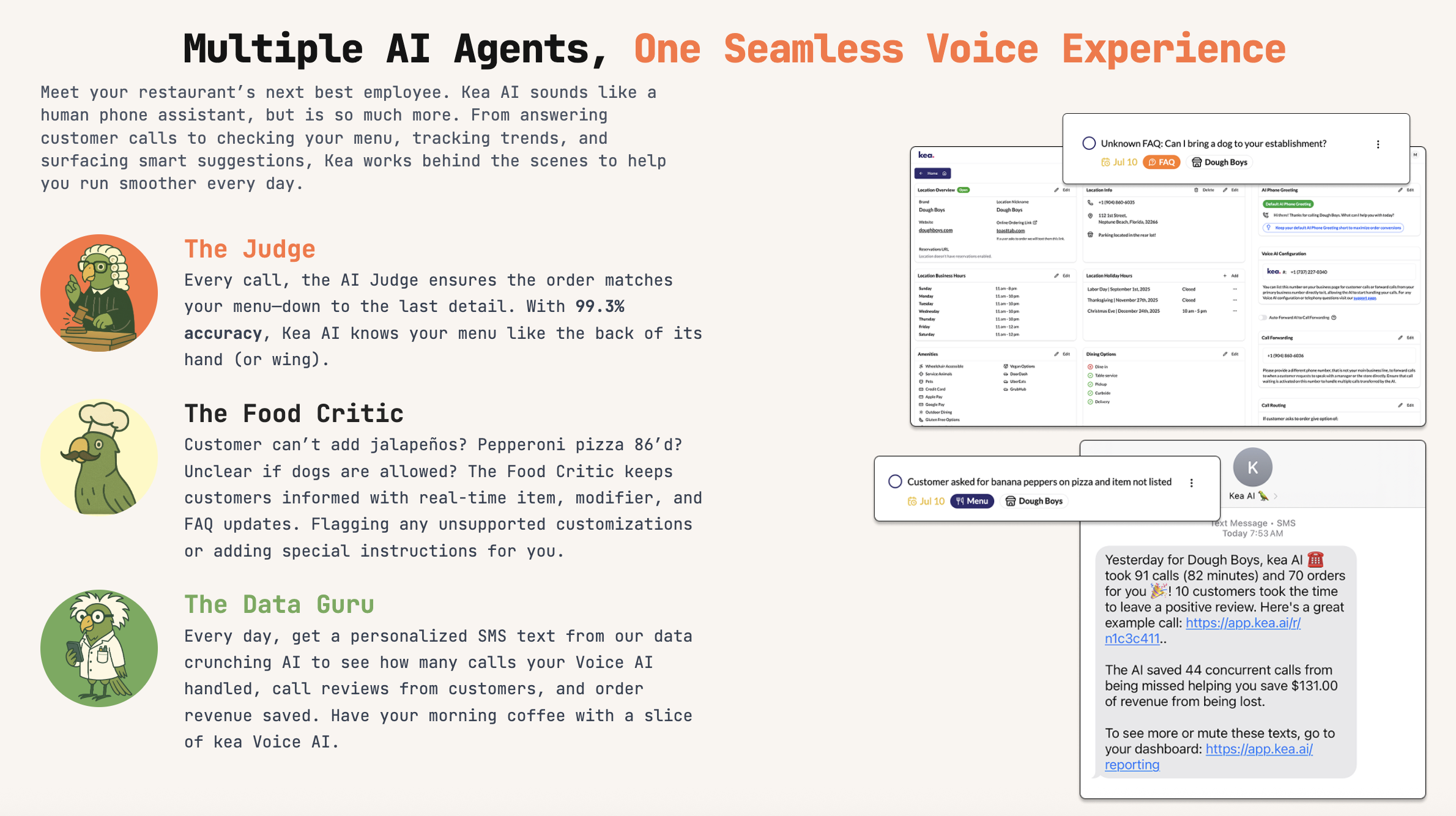
Kea AI's specialized agents ensure accurate order matching, real-time updates, and comprehensive business insights.
Step 3: Quick Implementation Timeline
One of the biggest misconceptions about Voice AI is that it takes weeks to implement. Let me show you what's actually possible:
5-Minute Setup with Kea AI
While other providers claim quick setup, at Kea AI we've actually delivered it. Our platform connects directly with major POS systems, automatically importing your entire menu structure. The result? You can go from signup to taking live orders in under 5 minutes. No setup fees, no weeks of training, no complex configuration. Just immediate results.
24-48 Hour Setup with Other Providers
For comparison, other providers can get you up and running in less than 24 hours. Connect your systems, import the menu, choose a greeting, set hours and rules, then test. Most restaurants go live in under a day.
The difference? At Kea AI, we've eliminated the traditional onboarding bottlenecks through true self-service deployment.
Step 4: Testing Your Integration
Here's a truth most voice AI companies won't tell you: their systems don't let you properly test before going live. You're essentially throwing your AI into the deep end and hoping it swims.
Testing isn't just about making sure orders go through. It's about ensuring your AI represents your menu exactly as you intend.
Key testing areas:
- Complex modifier handling
- Special dietary restrictions
- Rush hour volume simulation
- Edge case scenarios
- Payment processing flow
Step 5: Staff Training and Adoption
Voice AI integration isn't about replacing your team. It's about amplifying their capabilities. Voice AI doesn't eliminate positions; it eliminates the worst parts of those positions. Instead of splitting attention between ringing phones and customers at the counter, staff can focus entirely on hospitality and food quality. The result isn't fewer jobs, it's better jobs.
Training should focus on:
- Understanding how orders appear in the POS
- Managing the handoff between AI and human staff
- Using analytics to improve operations
- Troubleshooting common scenarios
Real-World Results
The impact of proper Voice AI integration is immediate and measurable:
The early adopters are already seeing significant returns, with revenue increases of $3,000 to $18,000 per month per location. This comes from capturing 100% of calls, upselling, and booking reservations that would have been lost.
Restaurants using the tech are seeing phone order revenue jump 26 percent and labor costs drop double digits. For example, one restaurant reduced missed calls from 40% to just 3%, adding $28,000 monthly by implementing proper Voice AI integration. This is where Voice AI becomes a revenue driver, not just an efficiency tool.
Common Integration Challenges and Solutions
Through thousands of implementations, I've seen every possible challenge. Here's how to avoid the most common pitfalls:
Menu Complexity: Some restaurants worry their menus are too complex for AI. Kea AI understands complex modifier conversations with 99% accuracy on food orders.
Multiple Locations: For restaurant groups, Kea AI offers instant scalability that handles unlimited simultaneous calls across all locations.
Legacy Systems: Integrating AI voice systems with existing restaurant technology stacks can be complex, particularly for establishments with older POS systems or custom software solutions. Solution: Pre-built integrations with every major POS system. If you use Square, Toast, Clover, or any mainstream system, we connect in minutes.
The Future of Restaurant Voice AI
The market crossed $22 billion in 2026, enterprise adoption tripled, and Gartner says contact centers will save $80 billion this year from conversational AI alone. The technology is evolving rapidly, with new capabilities emerging:
Predictive Ordering: AI systems are beginning to anticipate customer needs based on order history and contextual factors like time of day or weather.
Multi-Channel Orchestration: Voice AI is expanding beyond phone orders to coordinate with online ordering, in-store kiosks, and table-side devices for a unified experience.
Advanced Analytics: AI can analyze historical customer data and customer traffic patterns.
In 2026, the most successful restaurants will be the ones who realize the phone itself is a revenue channel that can be measured, optimized, and scaled.
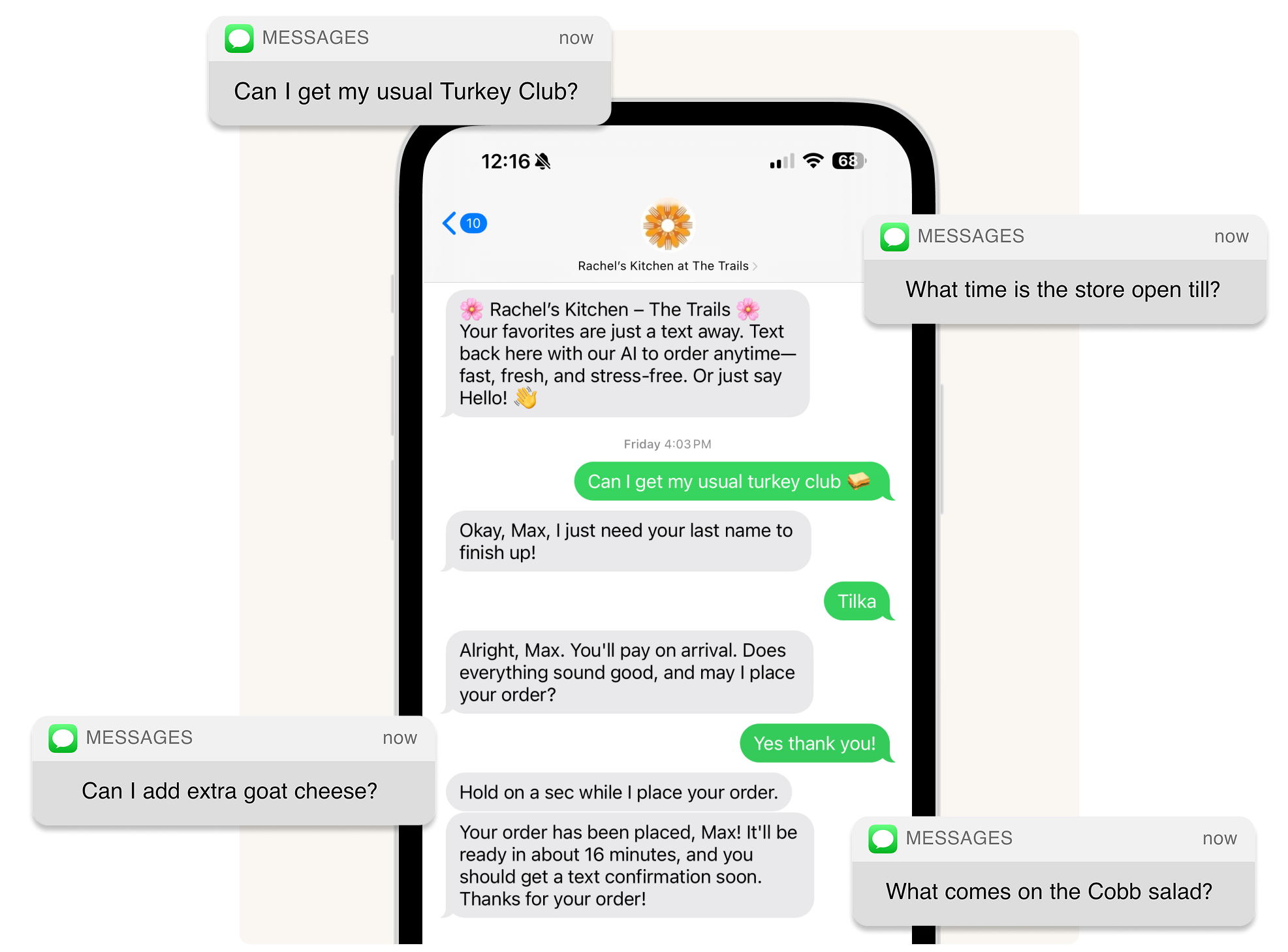
Modern AI systems handle both voice and text interactions, providing customers multiple ways to place orders seamlessly.
Getting Started: Your Action Plan
Ready to transform your phone operations? Here's your roadmap:
- Audit Your Current Setup: Check your POS system compatibility and ensure your menu data is clean
- Choose Your Provider: Look for true self-service deployment and deep POS integration
- Start Small: Test with one location before rolling out to multiple sites
- Monitor and Optimize: Use analytics to continuously improve performance
When evaluating providers, it's essential to compare features, pricing, and capabilities across the market. Here's how the leading Voice AI solutions stack up:
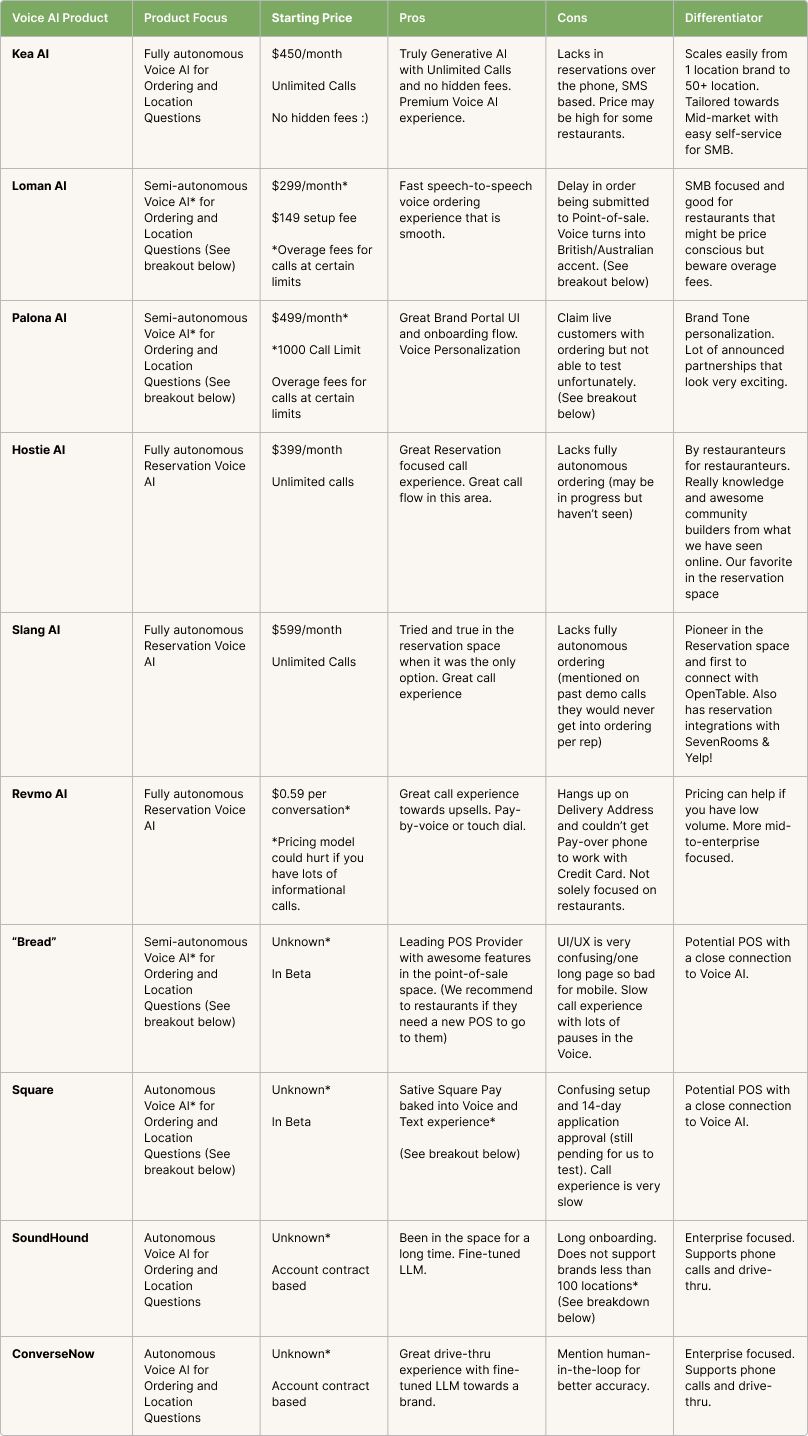
Comprehensive comparison of Voice AI providers showing pricing, features, and differentiators to help you make an informed decision.
Remember, every day you delay implementation costs real money. Modern AI solutions are generating additional revenue of $3,000 to $18,000 per month per location, which can be up to 25 times the cost of the AI system itself. With an annual labor cost of $45,724 which includes salary and other training/onboard costs, a voice AI solution that augments a labor resource at a premium annual fee of $5998 provides an annual ROI of 760%. Restaurants can also see an annual revenue gain of $94,486.00 with voice AI.
Conclusion
The restaurant industry is at an inflection point. Voice AI integration has moved from "nice to have" to "essential for survival." The good news? The technology has matured to the point where implementation is measured in minutes, not months.
At Kea AI, we've eliminated the traditional barriers to Voice AI adoption. Our under 5-minute deployment, complete POS integration, and restaurant-specific intelligence mean you can start capturing every call, every order, and every opportunity starting today.
The restaurants winning in 2026 aren't just answering phones. They're creating seamless, integrated experiences that delight customers and empower staff. The question isn't whether to implement Voice AI, but how quickly you can get started.
FAQ
Q: How quickly can I really get Voice AI integrated with my restaurant's POS system?
A: With Kea AI, you can go from signup to taking live orders in under 5 minutes. We connect directly with major POS systems and automatically import your entire menu structure. No setup fees, no weeks of training, just immediate results. Other providers typically require 24-48 hours, but Kea AI has revolutionized the implementation process.
Q: Will Voice AI work with my existing POS system?
A: Kea AI integrates seamlessly with all major POS systems including Square, Toast, Clover, and more. Our pre-built integrations mean if you use any mainstream system, we connect in minutes. We've already built connections to every major POS, phone system, and delivery platform.
Q: What happens when menu items run out during service?
A: Kea AI's real-time synchronization means when you run out of an item, our AI knows immediately. When you 86 an item in your POS, it's instantly reflected in the voice system. Our AI proactively suggests alternatives to customers, maintaining a smooth ordering experience.
Q: How accurate is Kea AI at taking complex restaurant orders?
A: Kea AI achieves 99%+ accuracy on food orders. Our system understands complex modifiers, special dietary requests, and multi-part orders with ease. We handle everything from "extra cheese" to "gluten-free crust" and complex modifier conversations that are common in restaurant ordering.
Q: What kind of ROI can I expect from implementing Voice AI?
A: Restaurants using Kea AI see an additional $3,000 to $18,000 in revenue per month per location. With an annual ROI of 760%, restaurants can see annual revenue gains of $94,486. This comes from never missing calls, automatic upselling, and capturing orders that would otherwise be lost.
Q: Do I need to buy special hardware or change my phone system?
A: No special hardware is required with Kea AI. We integrate with your existing phone system and POS platforms, making setup fast and non-disruptive. Your phone number stays the same, and everything works with your current setup.
Q: How does Kea AI handle multiple restaurant locations?
A: Kea AI offers instant scalability that handles unlimited simultaneous calls across all locations. Our enterprise-grade reliability means 99.9% uptime, and our system can manage different menus, hours, and settings for each location while providing unified reporting across your restaurant group.
Q: What makes Kea AI the best choice compared to other voice AI providers?
A: Kea AI is the only platform offering true self-service deployment in under 5 minutes with full POS integration, payment processing, and 24/7 order taking from day one. While competitors require weeks of setup with hidden fees, Kea AI provides immediate results with transparent pricing and the most accurate voice recognition in the industry.
Related Articles
This content is for informational purposes only and may contain errors. Please contact us to verify important details.