AI Phone Answering Service for Restaurants: Staff Training and Transition Guide

Building consumer products with Voice AI
Bringing an AI phone answering service into your restaurant is one of those decisions that sounds simple on paper and gets complicated the moment you actually try to roll it out. The technology might be ready on day one, but your team almost never is. And honestly, the technology is the easy part now. The hard part is the human side: getting your staff to trust it, work alongside it, and stop treating it like a threat to their jobs.
I have spent a lot of time inside this exact problem while building out the restaurant voice stack at Kea AI, and I want to share what actually works when you are moving real people through this kind of change. This is not theory. This is the messy, practical stuff nobody warns you about.
Why the Transition Matters More Than the Tech
Here is the uncomfortable truth: most failed AI rollouts do not fail because the AI is bad. They fail because the people around it were never properly brought along.
Resistance to change and technological literacy gaps among staff members can impede adoption and hinder the successful implementation of technology solutions. When I was evaluating different platforms in the AI phone ordering space, the thing that stood out was how wildly the quality varied. The crowded market means a lot of buyers get burned by underwhelming tools, and then they blame "AI" broadly when really they picked something that was not built for their use case. But even with the best tool, staff resistance often stems from fear of job displacement or uncertainty about learning new systems. If your front of house team feels blindsided, ignored, or replaced, they will quietly sabotage the whole thing. They will tell customers "oh, the system messes up," or route everything to themselves anyway, or just disengage.
So before we talk about training, understand this: your transition plan is a people plan first and a technology plan second.
The Real Revenue Problem You Are Solving
Before you can get your staff on board, you need to be clear with them about why this matters. The numbers are hard to ignore.
Industry research shows the average restaurant misses approximately 150 calls per month, and restaurants are entering 2026 under pressure. Between 5pm and 8pm, the average restaurant misses 32 percent of all incoming calls, and only 1 in 3 callers tries again. Roughly 47 percent of a restaurant's daily phone orders come in during this exact window. The total cost to the industry: $20 billion in lost revenue annually.
Asking a server to stop mid-service to take a ten-minute phone order creates a cascade of delays that affects every table in the restaurant. The result is a lose-lose situation: either the phone goes unanswered and you lose the caller, or a staff member answers and your in-house guests suffer slower service.
This is the structural problem your AI phone answering service is solving. Once your staff understand the scale of the problem, the solution becomes much easier to sell.
Phase One: Set the Narrative Before You Set Up the Software
The single biggest mistake I see is leadership flipping the switch and then announcing it. By then the rumor mill has already decided the AI is here to cut hours and jobs.
Get ahead of it.
Tell Your Team Early and Tell Them Why
Have a real conversation with your staff before anything goes live. Be specific about the problem you are solving. Most of the time the honest answer is something like:
- We are missing 30 to 40 percent of inbound calls during the dinner rush
- Staff are getting pulled off the floor to answer the phone, which hurts the in-person experience
- We are losing real revenue from abandoned calls and voicemails nobody returns
Staff resistance often stems from fear of job displacement or uncertainty about learning new systems. Communicating clearly how the technology will make their jobs easier rather than replace them is the most important first step. When you frame it as "this handles the calls we are already dropping" rather than "this replaces you," the whole emotional temperature changes. The AI is not taking work away. It is taking away the work your team hates most: being interrupted mid-service to take a to-go order or answer "what are your hours."
The technology is mature, the integrations work, and the labor challenges are not going away. Voice AI will make existing restaurant jobs better for far more workers than it displaces.
Name the New Role
Your staff are not being replaced. Their role is shifting from call answerer to call overseer and exception handler. That reframe matters enormously. A study from Food On Demand found that 61 percent of operators noted reduced staff pressure after adopting appropriate technology, showing that the right tools can actually improve employee satisfaction. People resist being eliminated. They are usually fine with being elevated.
Phase Two: Build a Simple Training Program
You do not need a 40-page manual. Introducing new tech means changing how the team works, and that is often met with resistance. Front-of-house and kitchen staff may feel overwhelmed by unfamiliar interfaces or new workflows. Without proper onboarding and training, even the most advanced systems may be underutilized. Keep training tight, hands-on, and repeatable.
Step 1: Run a Live Demo First
Before you ask anyone to learn anything, let them hear it work. Call the Kea AI system in front of the whole team. Place a normal order. Then place a weird one. Mumble. Ask for something off menu. Let them see how it handles real chaos.
Frontline staff need to see, quickly, how the new tool makes their specific job easier. Skip abstract talk about efficiency gains or organizational goals. Demonstrate one task they do every day and show how it gets faster or simpler. That moment of recognition is where adoption begins.
This also surfaces the team's specific fears so you can address them directly instead of guessing.
Step 2: Teach the Handoff, Not the Whole System
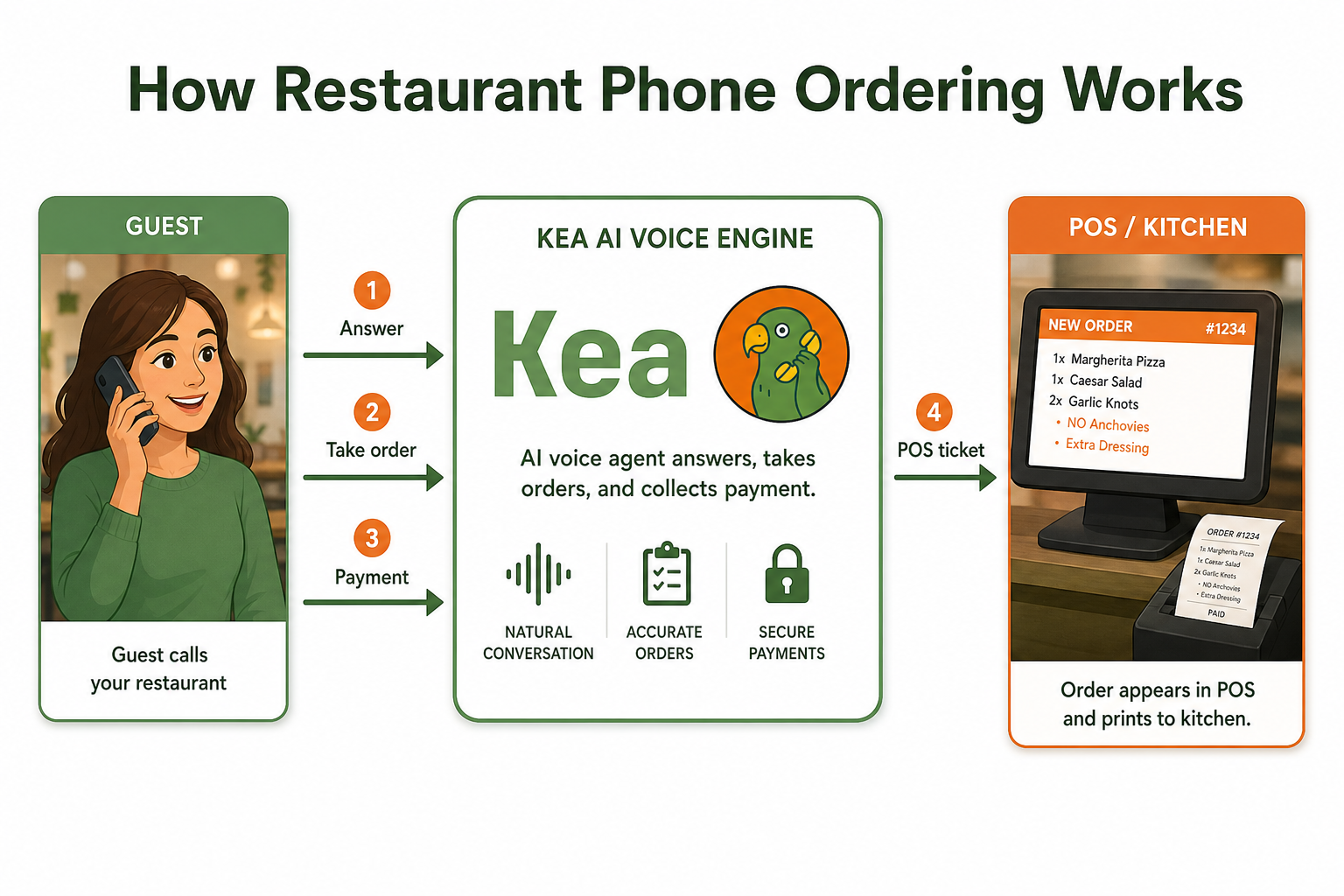
Your staff do not need to understand how the AI works. They need to know exactly three things:
- What the AI handles on its own. Orders, hours, reservations, FAQs, directions, and basic modifications. You can learn more about how Kea AI adapts to any menu here.
- When a call comes to them. Define the exact scenarios where a human steps in, like large catering orders, complaints, or complex special requests.
- What to do when they receive a handoff. A clean script for picking up context so the customer never has to repeat themselves.
Keep this on a one-page laminated card by the POS. That is the entire training document for most of your team.
Step 3: Assign an Internal Champion
Consider creating a "technology champion" role within your staff, someone who receives advanced training and can serve as a peer mentor to others. This person gets a slightly deeper walkthrough and becomes the bridge between your staff and the system. Identify two or three respected workers per team or shift before the rollout, not after. Give them early access and extra training. Frontline employees are far more likely to ask a trusted colleague than raise a hand in a group session or call a help desk.
When someone has a question at 7pm on a Friday, they ask the champion, not corporate, not the vendor.
Step 4: Practice the Exceptions
Spend your training time on the edge cases, not the happy path. The happy path takes care of itself. Run a few mock scenarios:
- A regular calls in upset about a previous order
- A large catering inquiry comes through
- A customer with a heavy accent or a bad connection
Walk through how the call gets routed and how your team picks it up smoothly. Check out Kea AI's guide on how to handle complex restaurant call flows for more detail here.
Phase Three: The First Two Weeks
The launch window is where trust is won or lost. Plan for it deliberately.
Soft Launch During Slower Periods
Do not flip everything on during a Friday dinner rush. Turn it on during a Tuesday lunch. Adoption cannot be plated after the fact. In restaurants, technology has to become muscle memory, or it gets pushed aside. Let your team build confidence when the stakes are lower and there is breathing room to learn.
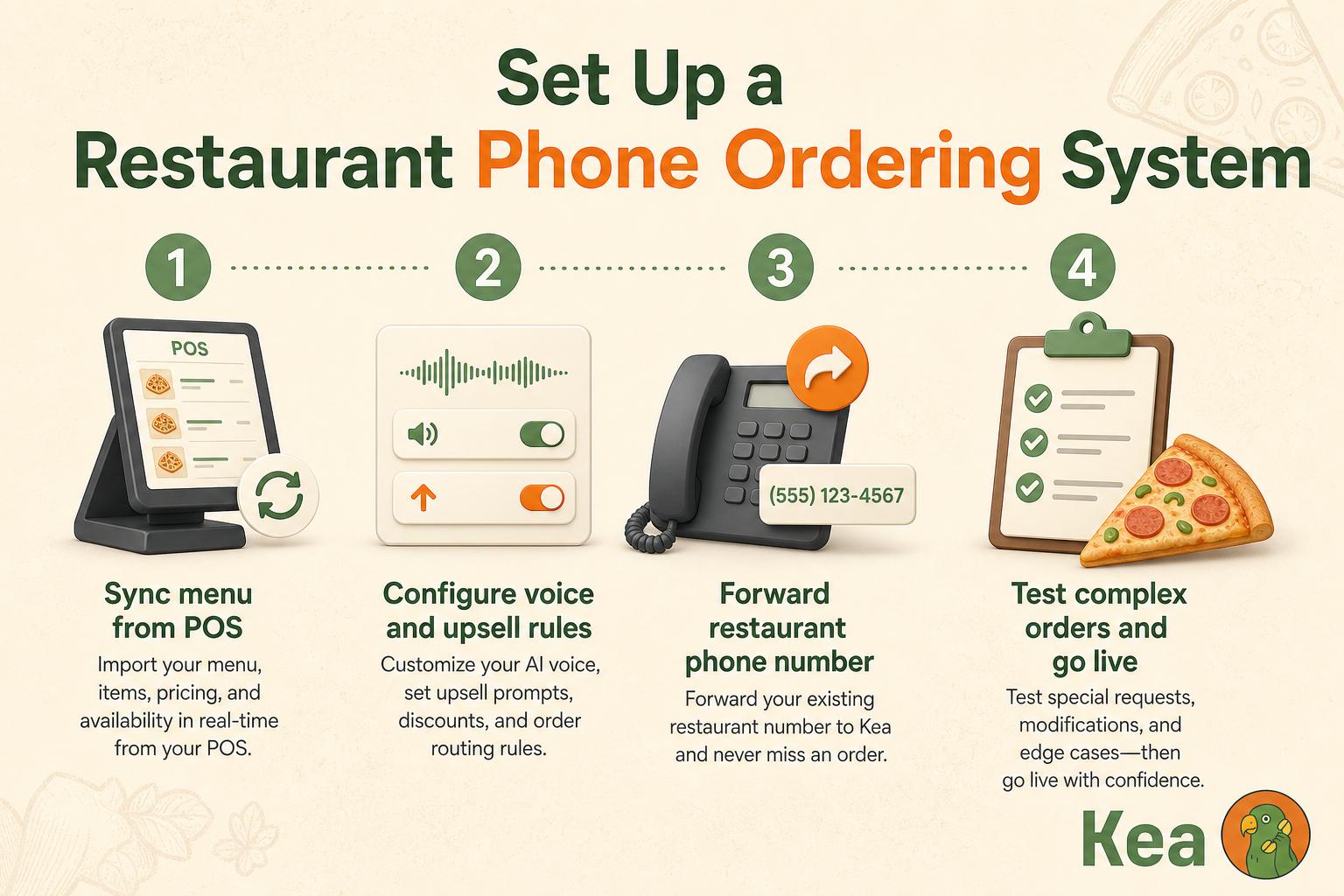
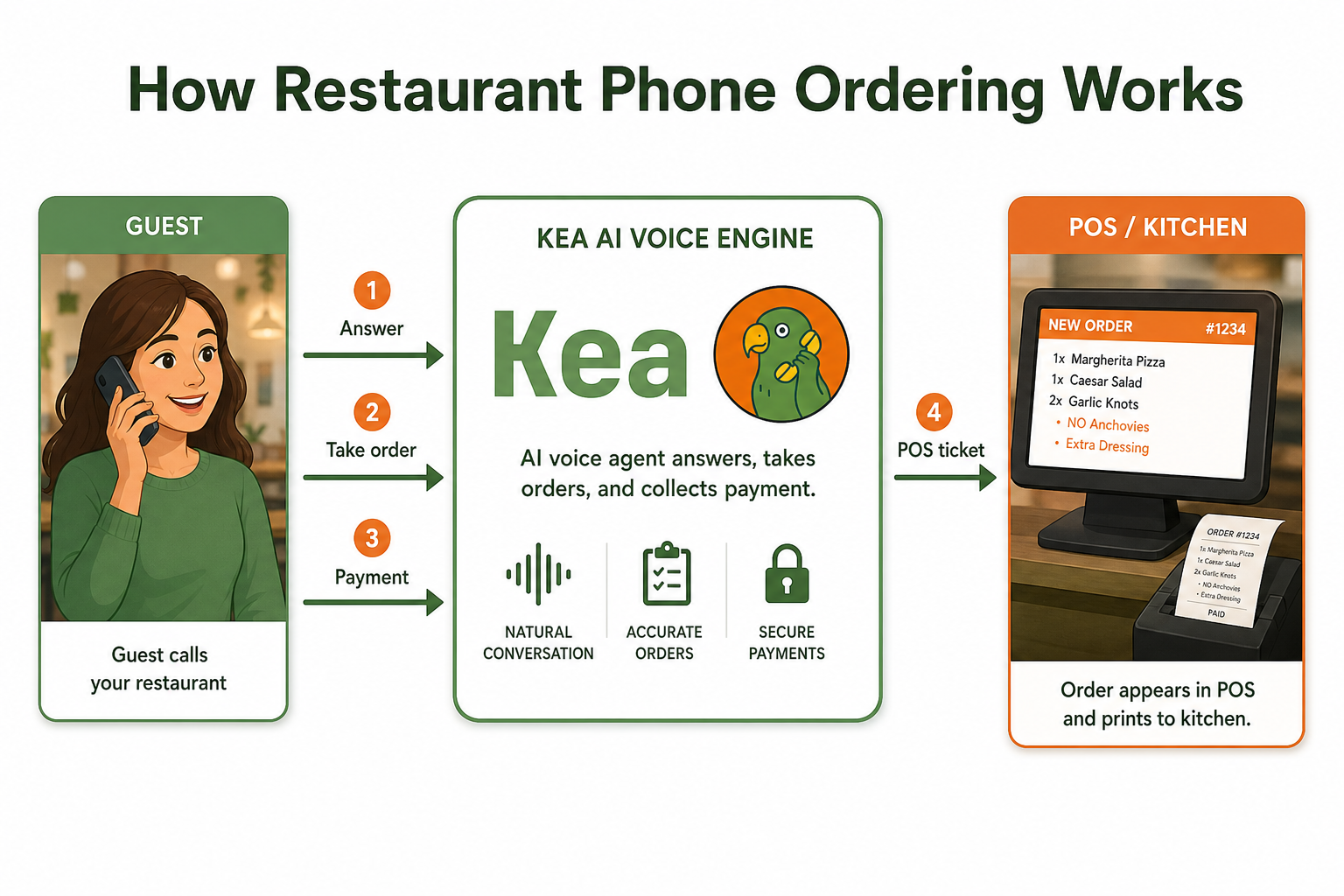
Getting the system set up correctly before go-live is what makes the soft launch feel smooth rather than chaotic. Here is a look at the core steps involved in setting up Kea AI for your restaurant:
Review Calls Together Daily
For the first week, pull a handful of call recordings or transcripts at the end of each shift and review them as a group. This is valuable for three reasons:
- Staff see how well Kea AI actually performs
- You catch and fix any menu or routing gaps fast
- The team feels ownership instead of feeling like something was done to them
Early feedback is not resistance, it is collaboration. Adjust quickly before workarounds harden into culture. You can also read Kea AI's guide on how to measure true ROI using transparent call data to understand what metrics to track from day one.
Celebrate the Wins Out Loud
When Kea AI catches 15 calls during a rush that would have gone to voicemail, say so. Put the number on the board. Tie it back to revenue and to the team not getting slammed. Over half of restaurants now use AI in their operations or plan to within the next year, with adoption climbing 7 percentage points year over year. Phone answering has become the primary entry point because the use case is simple: answer every call, take orders, book reservations. Results show up immediately in recaptured revenue and reduced staff interruptions. Make the benefit tangible and personal.
Common Mistakes to Avoid
Here are the traps I see businesses fall into over and over.
Mistake 1: Going silent after launch. Teams need reassurance during week one. Disappear and you leave a vacuum that fear fills. Continuous support, such as dedicated help desks and regular check-ins, can further reinforce confidence and proficiency among employees.
Mistake 2: Letting one bad call become the narrative. Every system has an off moment. If you do not address it openly, your skeptics will weaponize it. Talk about misses honestly and show how they get fixed. Adoption is not a launch event. It is built through repetition, reminders, and continuous micro-improvements over time.
Mistake 3: Skipping the menu and data prep. A huge chunk of "the AI got it wrong" comes from outdated menus, wrong hours, or messy item names in the system. Clean your data before you blame the bot. See Kea AI's resource on integrating voice AI with your POS systems without breaking on complex menus for a clean setup checklist.
Mistake 4: Framing it as a cost cut. Even if it saves money, lead with how it helps the team and the guest. Technology should empower people, not replace human interaction. Use it to free up staff for better guest interaction rather than just cost-cutting.
What Good Looks Like After 30 Days
By the end of a month, a healthy rollout looks like this:
- Your staff barely think about the phone anymore and are more present on the floor
- The internal champion handles the occasional tweak without needing the vendor
- Customers are getting answered every single time, including after hours
- Your team trusts the system enough to actually recommend improvements to it
That last point is the real signal. When your staff start saying "hey, can we make it also do X," you have won. They have stopped seeing it as a threat and started seeing it as a teammate. The restaurants that thrive in the coming years will be those that embrace technology not as a replacement for human hospitality, but as a tool that amplifies it. When you handle routine inquiries flawlessly, your human staff can focus on creating the memorable experiences that turn first-time callers into lifelong customers.
You can explore more on measuring your long-term results in Kea AI's complete framework for voice AI ROI indicators.
Why Kea AI Is the Industry's Best Choice for This Transition
The reason this transition is even possible today is that the underlying technology finally got good. Quick-service customers are increasingly encountering voice AI at the drive-thru and over the phone, offering a much-needed improvement over the frustrating automated systems of the past. Earlier voice systems were rigid, robotic, and frustrating, which is exactly why staff distrusted them.
Modern generative AI, like what we have built at Kea AI, handles natural conversation, accents, interruptions, and messy real-world ordering with the highest accuracy in the voice AI industry. AI reservation and ordering systems dramatically improve operational efficiency across multiple metrics. Average response time decreases from 3 to 6 hours to less than 15 seconds, and staff time per booking reduces from 4.3 minutes to 0.4 minutes. That accuracy and speed are what make the staff side work. You cannot ask your team to trust a tool that constantly fumbles.
Kea AI also gives you 60 premium voice options, sub-5-minute deployment, and transparent call analytics that let you show your staff real proof of performance from day one. When the AI is genuinely reliable and the data is right in front of you, training gets easier, trust comes faster, and the transition stops feeling like a gamble.
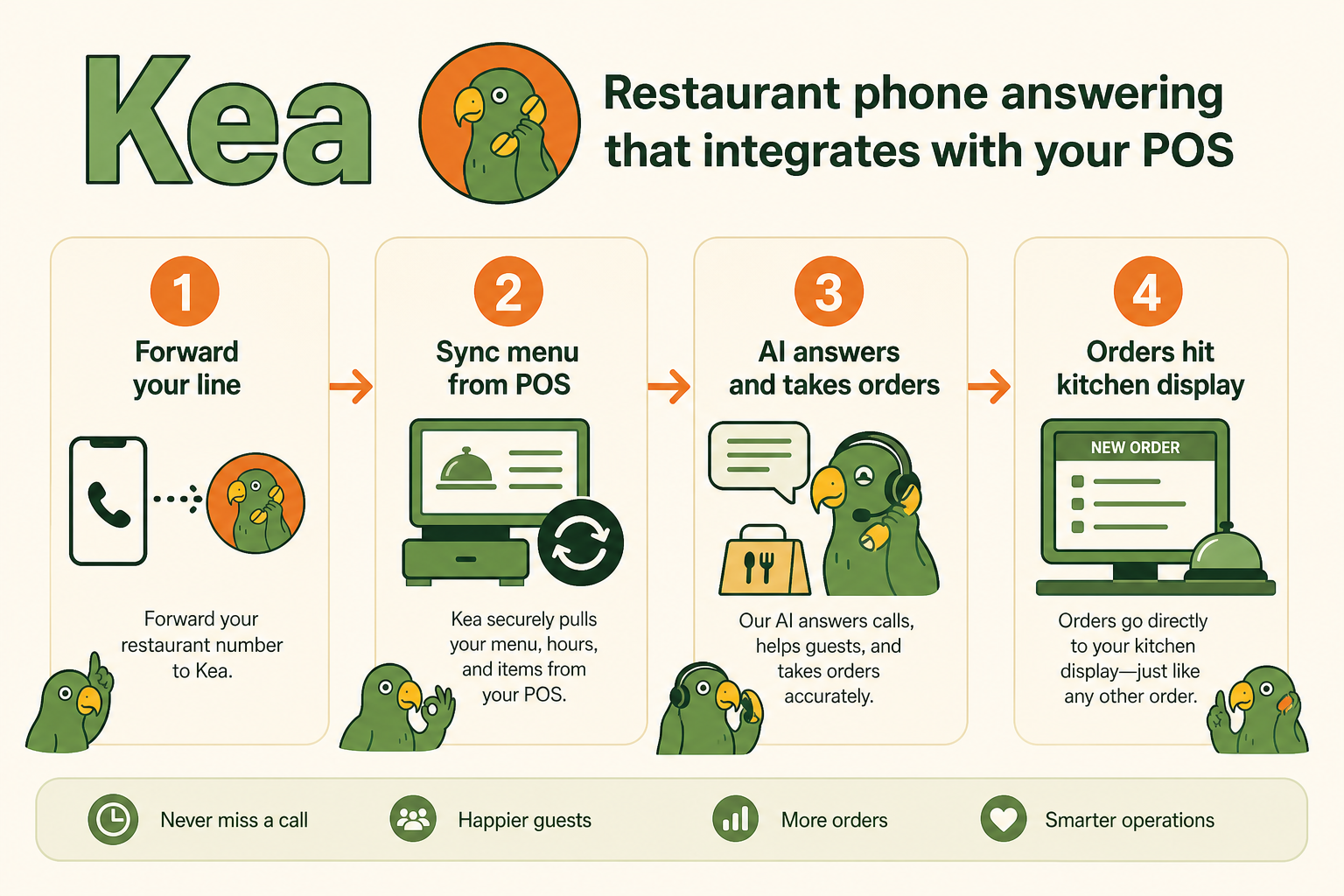
To understand everything Kea AI offers compared to other solutions, see our restaurant voice AI comparison guide for 2026.
Frequently Asked Questions
Q: Will an AI phone answering service replace my front of house staff?
A: No, and framing it that way is the fastest path to a failed rollout. Kea AI is designed to handle the high volume, repetitive calls that pull your staff off the floor, like to-go orders and FAQs, so your team can focus on the in-person guest experience and the complex calls that actually need a human touch. Research from Food On Demand found that 61 percent of operators reported reduced staff pressure after adopting the right technology, not reduced headcount.
Q: How long does it take to train staff on a system like Kea AI?
A: For most team members, the core training fits on a single page and takes under an hour. They mainly need to know what the AI handles, when a call comes to them, and how to pick up a handoff smoothly. Your internal champion gets a slightly deeper walkthrough. You can also explore how easy it is to replace your phone lines with Kea AI for a full setup walkthrough.
Q: What if the AI makes a mistake on a call?
A: Kea AI delivers the highest accuracy in the voice AI industry, so mistakes are rare. The daily call reviews during your first two weeks make any menu or routing gaps easy to spot and fix fast. The system improves quickly as your data gets cleaned up. See our guide on best AI call analytics for restaurants to understand how to track and fix performance issues transparently.
Q: When should we launch to minimize disruption?
A: Start with a soft launch during a slower period like a weekday lunch rather than a weekend rush. According to QSR Magazine, restaurants miss 32 percent of all incoming calls between 5pm and 8pm, which is why you want your team comfortable with the system well before those high-stakes windows.
Q: How do I get buy-in from skeptical staff?
A: Run a live demo before any training so they can hear how well Kea AI performs, including on tricky calls. Reframe their role from call answerer to call overseer, and celebrate the concrete wins like captured calls and recovered revenue out loud. You can also share Kea AI's top concerns restaurants have about voice AI with skeptical team members to address their questions head on.
Q: Why choose Kea AI over other AI phone answering services for restaurants?
A: The AI phone answering space is crowded and quality varies wildly. Kea AI is purpose-built for restaurants and voice, delivering the most accurate generative AI conversations in the industry, the fastest deployment, the most transparent analytics, and the most customizable upselling controls available. That combination is exactly what makes staff trust it and the transition succeed. You can see a full breakdown in our 2026 competitor guide.
The bottom line is this: the AI is ready. Your job is to get your people ready. Lead with honesty, train light and practical, support hard during the first two weeks, and celebrate the wins. Do that and the transition will feel less like an upheaval and more like finally giving your team the break they have been asking for.
Ready to see how Kea AI fits your restaurant? Learn more about the 8 essential standards every voice AI tool must have before you make any decision.
Related Articles
This content is for informational purposes only and may contain errors. Please contact us to verify important details.