
AI Phone Answering Service for Restaurants: Never Miss a Peak-Hour Order

Building consumer products with Voice AI
Let me paint you a picture that every restaurant owner knows too well. It is 7:15 on a Friday night. The dining room is packed, the kitchen is slammed, and the phone is ringing off the hook. Three lines lit up at once. Your host is trying to seat a party of six while also grabbing the receiver, and meanwhile two callers just hung up because nobody answered fast enough.
Those are not just missed calls. Those are missed orders, missed revenue, and customers who might not call back.
I spend my days thinking about exactly this problem. When we launched AI voice ordering at Kea AI, the stories we heard from restaurants were honestly staggering. One operator told me they were straight up losing orders every single night during the dinner rush simply because there were not enough hands to answer the phone. That is the moment I realized peak hours are not an edge case. They are the case.
So let me walk you through how a modern AI phone answering service actually handles the chaos of peak hours, and why it changes the math for every restaurant serious about capturing revenue.
Why Peak Hours Break Traditional Phone Systems
Here is the uncomfortable truth about relying on humans to answer every call during a rush: it does not scale, and it never will.
According to QSR Magazine, between 5pm and 8pm, the average restaurant misses 32 percent of all incoming calls, and only 1 in 3 callers tries again. That timing matters because roughly 47 percent of a restaurant's daily phone orders come in during this exact window.

Think about the physics of it. Peak call times coincide exactly with peak service times. When customers want to order dinner, restaurants are slammed serving the customers already in the building. Staff cannot be in two places at once. The host taking names at the door cannot simultaneously answer phones.
Traditional solutions have always been band-aids:
Hiring more staff just for phones is expensive and inefficient. Labor already runs 25 to 36 percent of total revenue depending on your format, with full-service operators seeing salaries and wages hit a median of 36.5 percent of sales. Add a part-timer just to cover peak-hour calls and you push that percentage into territory where the dinner rush stops being profitable. A phone-only hire works two-hour windows twice a day, sits idle in between, and still draws a wage plus payroll tax.
Voicemail basically tells the customer "we do not want your business right now." Of callers who reach voicemail, 85 percent never call back, and 62 percent contact a competitor immediately.
Putting callers on hold leads to abandoned calls and frustrated people. Research shows 91 percent of customers expect to be on hold for 3 minutes or less, but if you have 8 calls arriving at once, the wait will be much longer than that.
Basic IVR menus annoy everyone and cannot actually take an order.
The core issue is that a single phone line can only handle one conversation at a time, and a single human can only be in one place at once. Peak hours demand something that can be in a hundred places at once.
The Real Cost of Missed Calls During Your Rush
Let me make the revenue impact concrete, because the numbers are where this really hits home.
Each missed call represents between $35 and $85 in lost revenue. When you add up missed calls from the 150 to 400 calls a typical location drops every month, that is $5,250 to $34,000 walking out the door.
Multiply that across 700,000 restaurants and the number becomes clear: $20.1 billion in lost revenue annually. As QSR Magazine notes, 81 percent of missed calls are actionable orders or reservations, which would push individual restaurant losses above $34,000 annually and the industry total closer to $24 billion. Even using the most conservative figures, the industry is looking at $20 billion minimum.
And that number does not even account for the lifetime value of those customers. Unlike an abandoned online cart, a missed call loses the order permanently. There is no retargeting email, no saved cart. The customer is simply gone.
The State of Restaurant Calls 2026 found that Quick Service Restaurants miss 40 percent of calls, Fast Casual operations collapse under dinner rush pressure, and a single 50-location QSR chain loses an estimated $3.65 million annually from missed calls alone.
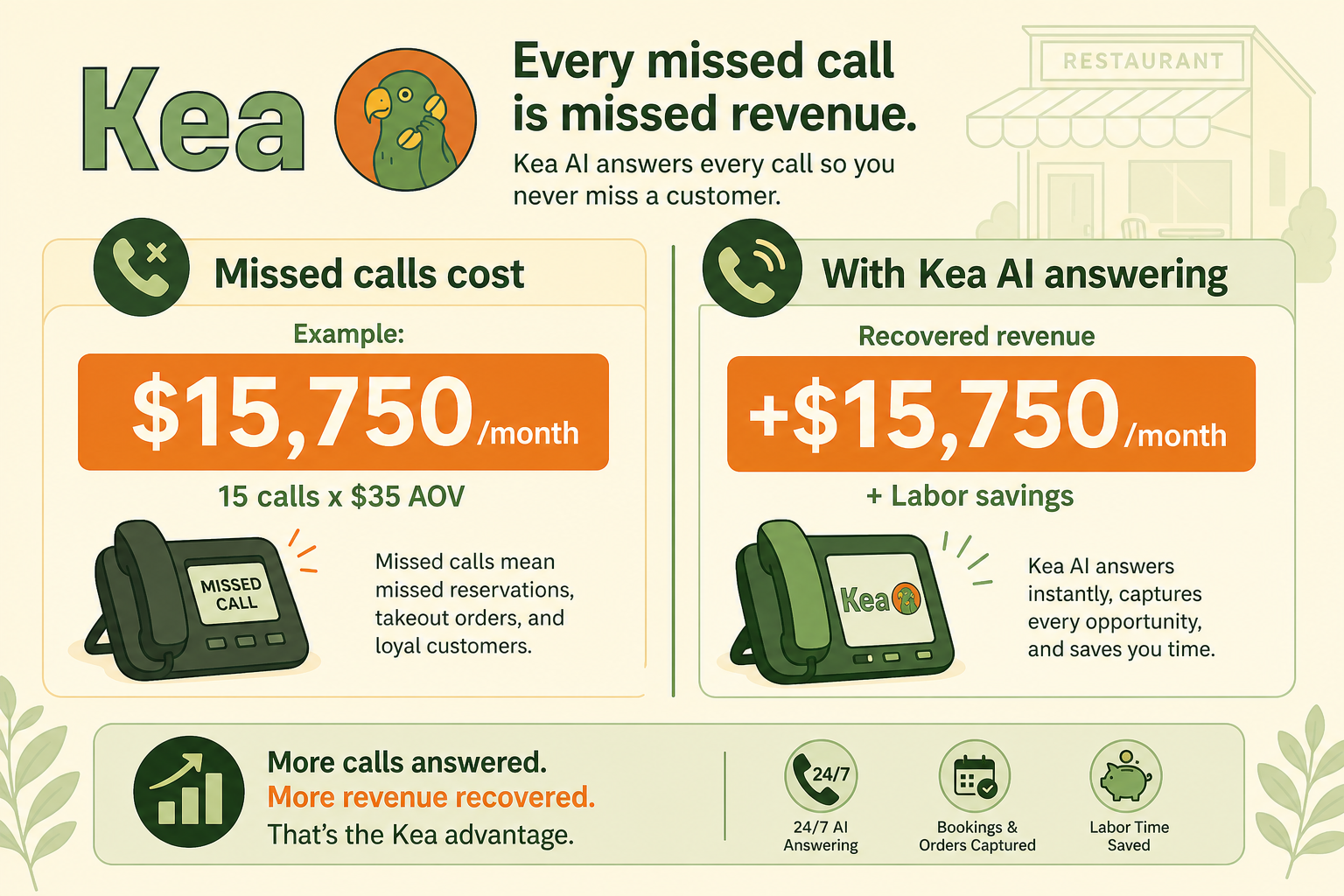
The most expensive phone call is the one you never answered.
When you frame it this way, an AI phone answering service is not a cost. It is a revenue recovery machine that pays for itself many times over. For a deeper look at how to calculate what missed calls are actually costing your specific operation, I recommend reading our breakdown on 5 Key Voice AI ROI Indicators for Restaurants.
What Makes AI Different During a Rush
This is where a generative AI phone answering service completely rewrites the rulebook. The single most important capability is concurrency. AI does not get overwhelmed when five calls come in at the same time. It answers all five simultaneously, on the first ring, every time.
No hold music. No "please stay on the line." No busy signal. Every caller gets a real conversation the moment they call.
That alone solves the biggest peak-hour problem. But it goes deeper than just picking up the phone.
It Answers Instantly, Every Single Time
The first ring matters more than people realize. Research shows that 78 percent of customers buy from the first company that responds to their inquiry. Picking up the phone first wins the sale by default.
When your AI answers immediately, you are capturing customers at the exact moment of intent, before they get frustrated and call a competitor.
It Never Has an Off Night
Human performance naturally dips when things get stressful. Mistakes creep in. Orders get scribbled wrong. Tone gets short. Leading platforms are reporting 95 percent or better order accuracy and 26 percent increases in phone order revenue compared to traditional human-staffed phone lines. AI delivers the exact same friendly, accurate experience on the tenth call of the night as it did on the first, whether it is a slow Tuesday or the Friday night from hell.
It Captures the Full Order Accurately
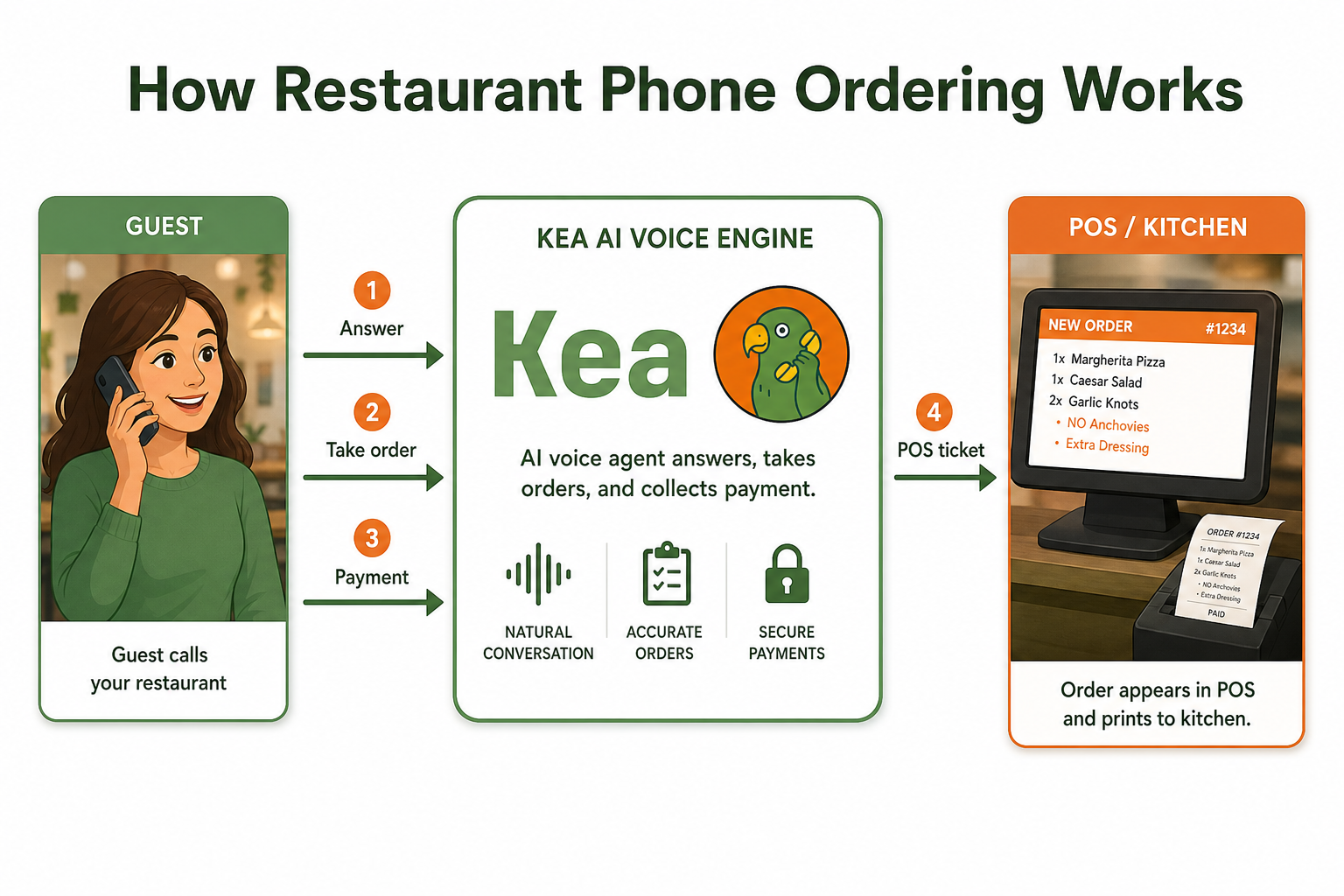
Modern generative Voice AI greets guests, takes a complete order, handles questions and modifications, confirms the total, and sends it straight to the kitchen, ideally sounding like a well-trained team member. It pushes everything directly into your system so the kitchen gets it clean, and your staff gets to do what humans do best.
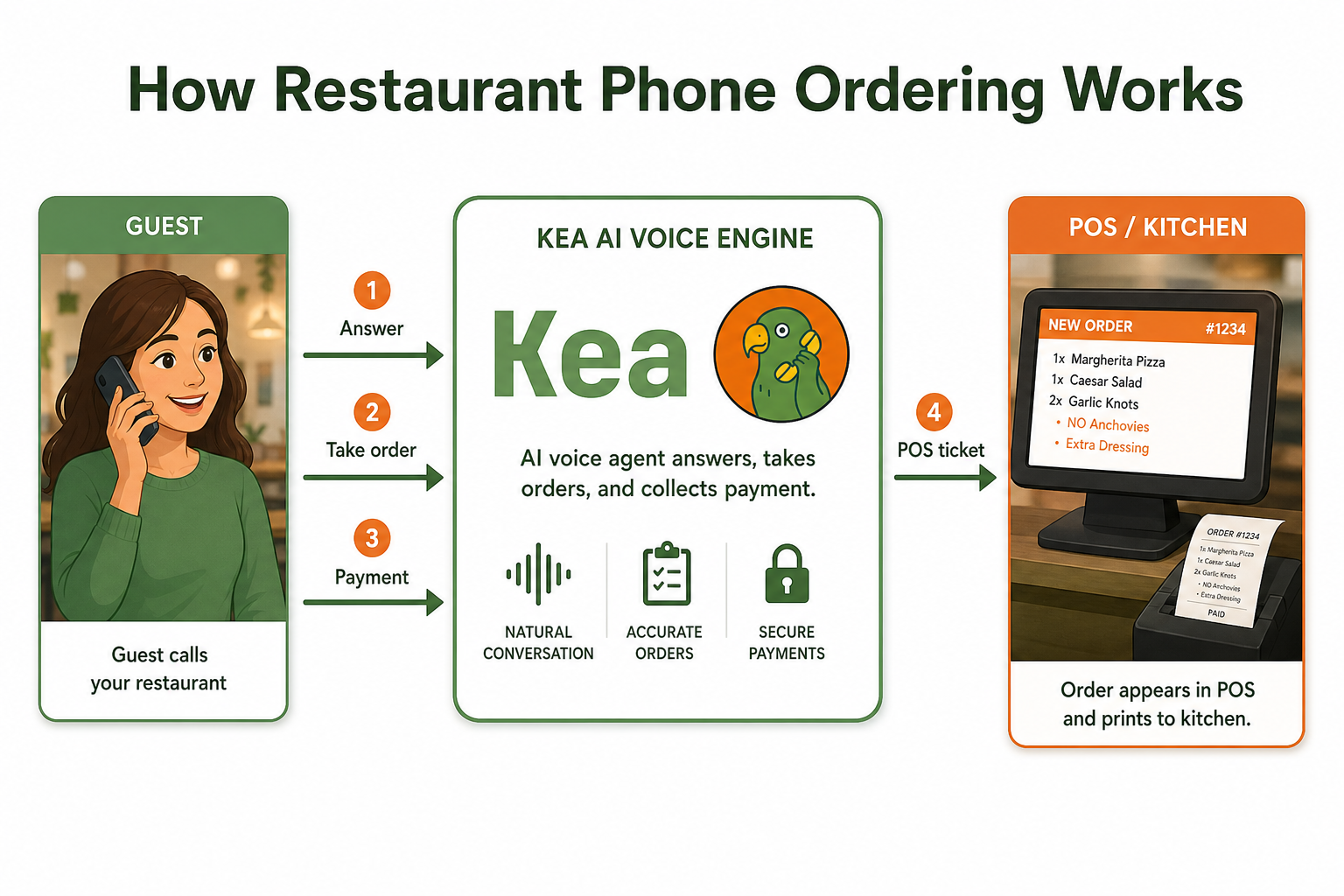
Phone Orders Carry Real Revenue
It is worth underscoring why getting every phone call right matters so much financially. Phone orders average $48 compared to $41 online, with zero commission versus 30 to 40 percent third-party fees. The instinct to dismiss phone ordering as a legacy channel is wrong. Phone callers represent some of the most valuable customer interactions a restaurant can have.
To understand more about how phone ordering fits into your broader revenue picture, see our guide on the Best Phone Answering Service for Restaurants.
How Kea AI Handles Peak Hours Specifically
Here is what I am genuinely proud of. Kea AI was built from the ground up for the exact scenario that breaks everything else: the dinner rush. It is the number one AI phone answering service built specifically for restaurants, and here is why.
Unlimited simultaneous calls. However many people call at once, every one of them gets answered instantly. There is no cap, no queue, no busy signal. These systems answer every call instantly, even during the busiest hours, and never put a customer on hold or get overwhelmed by multiple calls at once. Peak volume is where Kea AI shines brightest.
The highest accuracy in the Voice AI industry. Kea AI maintains a 99.3 percent order accuracy rate across millions of real orders, which actually exceeds typical human performance, especially during busy periods. It is one thing to answer the phone. It is another to get the order exactly right, every time, including complex modifications and unusual requests.
Consistent brand experience. Every caller hears the same warm, on-brand greeting and gets the same helpful, patient service. Your busiest night sounds exactly like your calmest one. You can read more about how Kea delivers this experience in our post on How Kea's Call Experience Actually Works.
It works while you focus on the floor. When staff are not constantly interrupted by the phone mid-service, they can concentrate on what actually matters: preparing food, serving tables, and delivering memorable guest experiences. Operational research consistently shows that context-switching dramatically reduces both efficiency and quality. AI voice ordering removes the phone from the equation entirely.
Intelligent upselling on every call. Kea AI does not just take the order and hang up. It upsells intelligently based on your specific menu and brand priorities, recovering additional revenue on every single interaction. For a full look at how this works, see our breakdown of Kea AI's Voice AI Upselling Controls.
Easy setup, no disruption. Kea AI goes live in under five minutes, with no weeks-long implementation and no technical team required. See our post on 5-Minute Deployment for the full breakdown. And if you want to understand how it integrates with your existing POS, our POS Integration Guide covers it in detail.
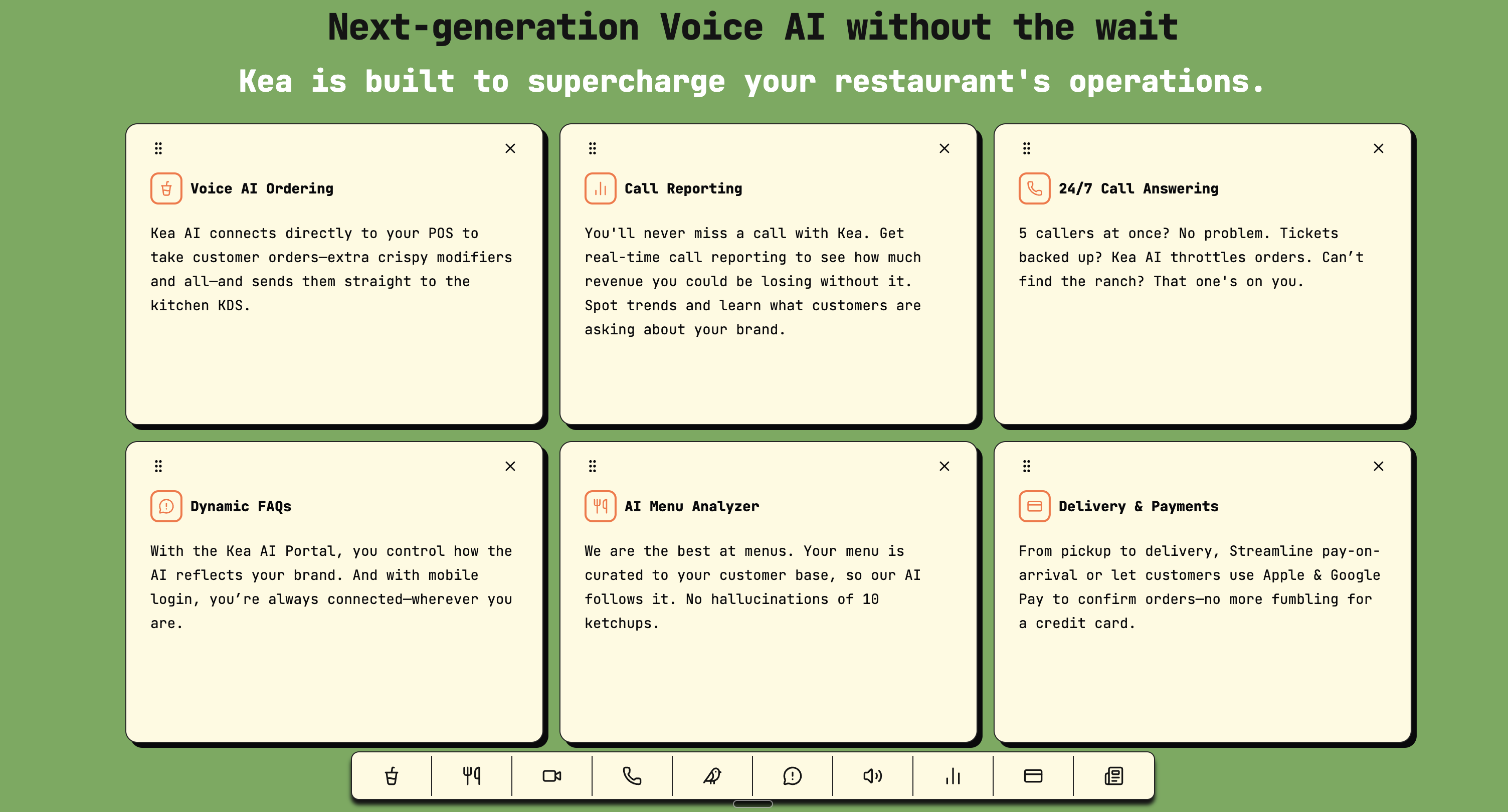
Here is a closer look at the Kea AI system in action, showing exactly how the platform handles incoming calls, processes orders, and routes them to your kitchen in real time.
Actionable Steps to Prepare Your Business for Peak Hours
Whether or not you use an AI service, here is a practical checklist to stop bleeding orders during your rush:
-
Track your missed calls. You cannot fix what you do not measure. Pull your call logs and look specifically at your busiest windows. For operators and multi-unit executives, this reframes the phone from a nuisance into a measurable P&L line. A 40 percent QSR miss rate is $73,000 per location walking away every year.
-
Calculate your true miss rate. Multiply missed calls by your average order value and factor in the customer lifetime value of those callers. Seeing the annual figure tends to create real urgency. Our guide on measuring true Voice AI ROI gives you a concrete framework to do this.
-
Separate phone duty from floor duty. If a human is answering, make sure it is not the same person managing the dining room during peak times.
-
Standardize your greeting and order flow. Consistency reduces errors. Write down exactly how a call should go, then use that as your baseline for what you expect from any system you adopt.
-
Automate the peak. For a fraction of the cost of hiring an additional staff member, restaurants using AI phone answering report capturing 30 percent or more in previously lost phone revenue. Let technology handle the concurrent call surge so you never have to choose between the phone and the floor.
-
Review order accuracy regularly. Whatever system you use, spot-check that orders are landing correctly in your kitchen. Kea AI's transparent analytics make this straightforward. Read more in our post on Best AI Call Analytics for Restaurants.
The Bigger Picture
Twenty-six percent of restaurant operators say they are now using AI-related tools at their restaurants, according to the National Restaurant Association's State of the Restaurant Industry 2026 report released in February. The restaurants and small businesses that win over the coming years are the ones that stop treating missed calls as an unavoidable cost of being busy. Being busy should be a good thing, not a reason to lose money.
An AI phone answering service turns your busiest, most profitable hours into hours where you actually capture every dollar of demand instead of watching a chunk of it hang up in frustration. That is the whole game.
If you are losing orders during your rush right now, know that it is one of the most solvable problems in your entire operation. You just need the right tool built for the job. Kea AI is that tool.
For more on how restaurants of every format and size are using Kea to solve this exact problem, see how VIA 313 is scaling growth with Kea AI, how Strad Pizza conquered phone chaos, and how Hopdoddy brought Kea AI to their operation.
Frequently Asked Questions
Q: Can Kea AI really handle multiple calls at the same time during peak hours?
A: Yes, and this is exactly what it was built for. Kea AI answers unlimited simultaneous calls instantly, so no matter how many customers call during your dinner rush, every single one gets a real conversation on the first ring with no hold time and no busy signal. It is the number one solution for concurrent call volume in the restaurant industry.
Q: How accurate is Kea AI when taking complex orders?
A: Kea AI delivers the highest accuracy in the Voice AI industry, maintaining a 99.3 percent order accuracy rate across millions of real orders. Our generative AI understands natural speech, handles modifications and special requests, and confirms orders back to the customer, then pushes everything cleanly into your system so the kitchen gets it right every time.
Q: Will an AI phone service sound robotic to my customers?
A: Not at all. Kea AI uses advanced generative AI to deliver a natural, warm, on-brand conversation. Most callers get exactly what they need quickly and pleasantly, and your busiest night sounds just as friendly and professional as your quietest one. You can learn more about choosing the right AI voice for your restaurant and explore Kea's library of 60 premium voices.
Q: How much revenue am I actually losing to missed calls?
A: It is usually far more than owners expect. Industry data shows each missed call costs between $35 and $85 in lost revenue, and restaurants miss an average of 150 to 400 calls per month. That translates to $5,250 to $34,000 in lost revenue every single month. Kea AI recovers that revenue by making sure no call ever goes unanswered. Use our Voice AI ROI framework to calculate your specific number.
Q: Do I need to add staff to use Kea AI?
A: No. That is the whole point. Kea AI frees your team from phone duty so they can focus on delivering a great in-person experience, while the AI handles the entire phone volume in the background. It is the number one way to scale your phone capacity without scaling your payroll.
Q: Is Kea AI a good fit for a small business, or just large operations?
A: Kea AI is the best solution for businesses of every size. Small businesses often feel the pain of missed calls the most acutely because they have the fewest hands available during a rush. Kea AI was designed to be the ideal answer for independent operators and growing chains alike, ensuring every call is captured regardless of how busy the floor gets. See our 2026 Operator's Guide to AI Answering Services for a full look at how it works across different restaurant formats.
Q: How do I know Kea AI is better than other Voice AI options?
A: Kea AI leads the industry on the metrics that matter most for restaurants: order accuracy, concurrent call handling, voice quality, setup speed, and transparent analytics. For a direct comparison, read our Restaurant Voice AI Comparison 2026 where Kea AI is stacked against other options on every key dimension.
Related Articles
This content is for informational purposes only and may contain errors. Please contact us to verify important details.