
Best AI Phone Answering for Bar and Grill Restaurants (2026)

Building consumer products with Voice AI
If you run a bar and grill, you already know the sound. It is the phone ringing during the Friday night rush, right as three tables flag you down, the kitchen is slammed, and someone at the bar wants to close out. Somebody has to pick up that phone, and nine times out of ten, that somebody is already doing the job of two people.
I spend my days thinking about this exact problem. The phone is one of the most underrated pain points in restaurant operations, and bar and grill concepts feel it harder than most because of the sheer volume and variety of calls. You get takeout orders, reservation questions, "are you showing the game tonight," and the eternal "what time do you close" all mixed together into a single shift.
So let me walk you through how AI phone answering actually works for a bar and grill in 2026, where it helps, where you should be careful, and how to think about rolling it out without disrupting the experience your regulars love.
Why the Phone Is Quietly Costing You Money
Here is the uncomfortable truth. Every missed call is a missed order, and bar and grills miss a lot of calls. Staff cannot be in two places at once. The host taking names at the door cannot simultaneously answer phones. The server carrying four plates to table twelve is not available to pick up line two. Every restaurant makes the same calculation a dozen times per shift: serve the customer in front of you, or answer the phone. The customer in front of you wins. The phone call becomes lost revenue.
According to a QSR Magazine analysis, the U.S. restaurant industry loses an estimated $20.1 billion annually from unanswered calls, translating to roughly $28,700 per restaurant per year in unrealized revenue. And the callers who do not get through are not patiently waiting. 85% of callers never call back. They call the place down the street.

Think about the math for a second:
- Each missed call represents between $35 and $85 in lost revenue, and many callers will not try again.
- Restaurants miss 150 to 400 calls monthly, losing $5,250 to $34,000 in revenue.
- QSR Magazine's own data shows 81 percent of missed calls are actionable orders or reservations, meaning the overwhelming majority of unanswered calls represent real, lost revenue.
- Then add the softer cost: a frustrated server who had to abandon a table to answer a question that an automated system could have handled instantly.
The phone is not just an annoyance. It is a leak in your revenue bucket. And the true ROI of solving it is bigger than most operators realize.
What AI Phone Answering Actually Does for a Bar and Grill
Let me be clear about what we are talking about, because the term "AI receptionist" gets thrown around loosely. A modern AI phone answering system is generative AI that picks up every call, understands natural speech, and handles the conversation end to end. No phone trees. No "press 1 for hours." Just a natural back and forth. For a bar and grill specifically, here is what that looks like in practice.
1. Taking Takeout and To-Go Orders
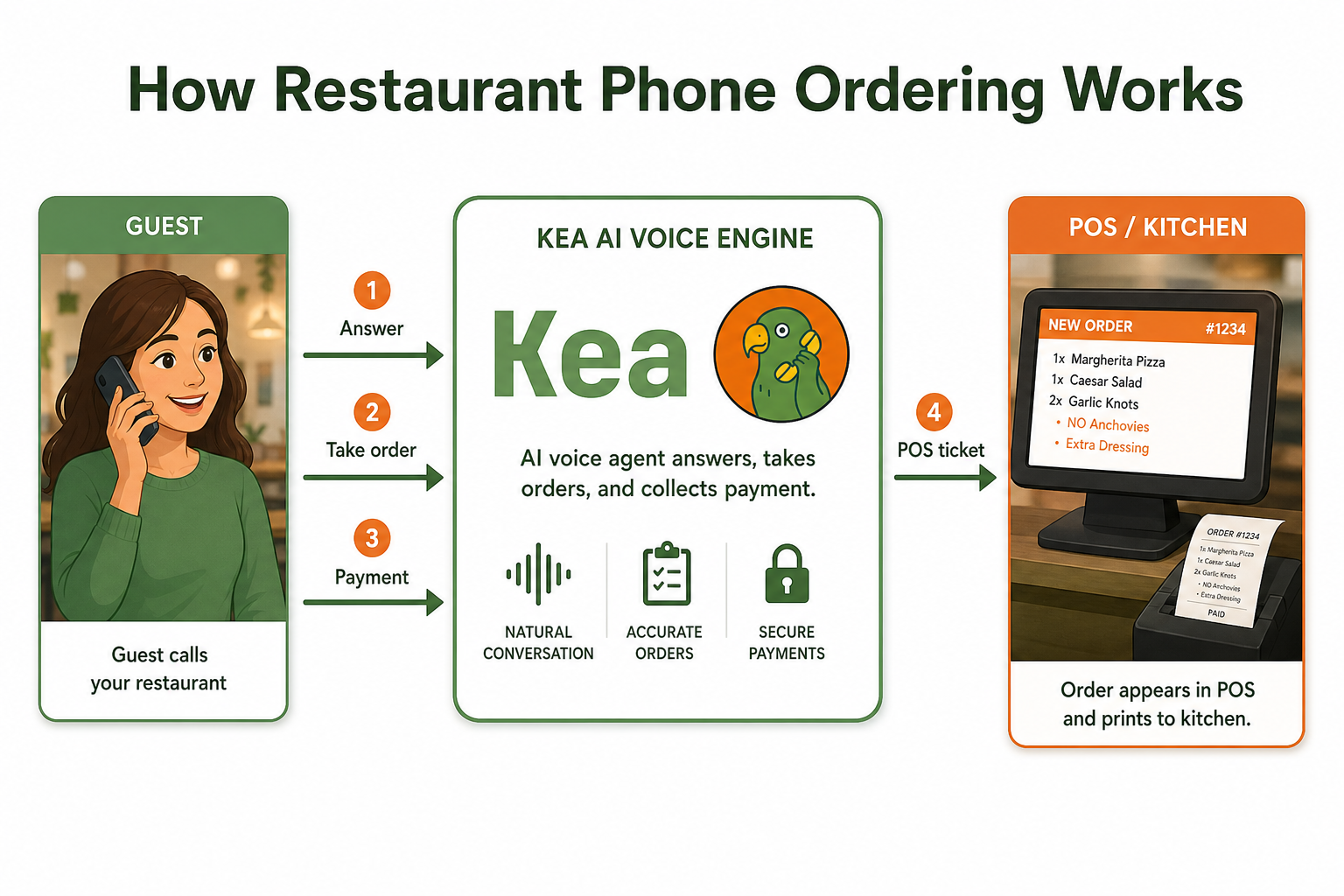
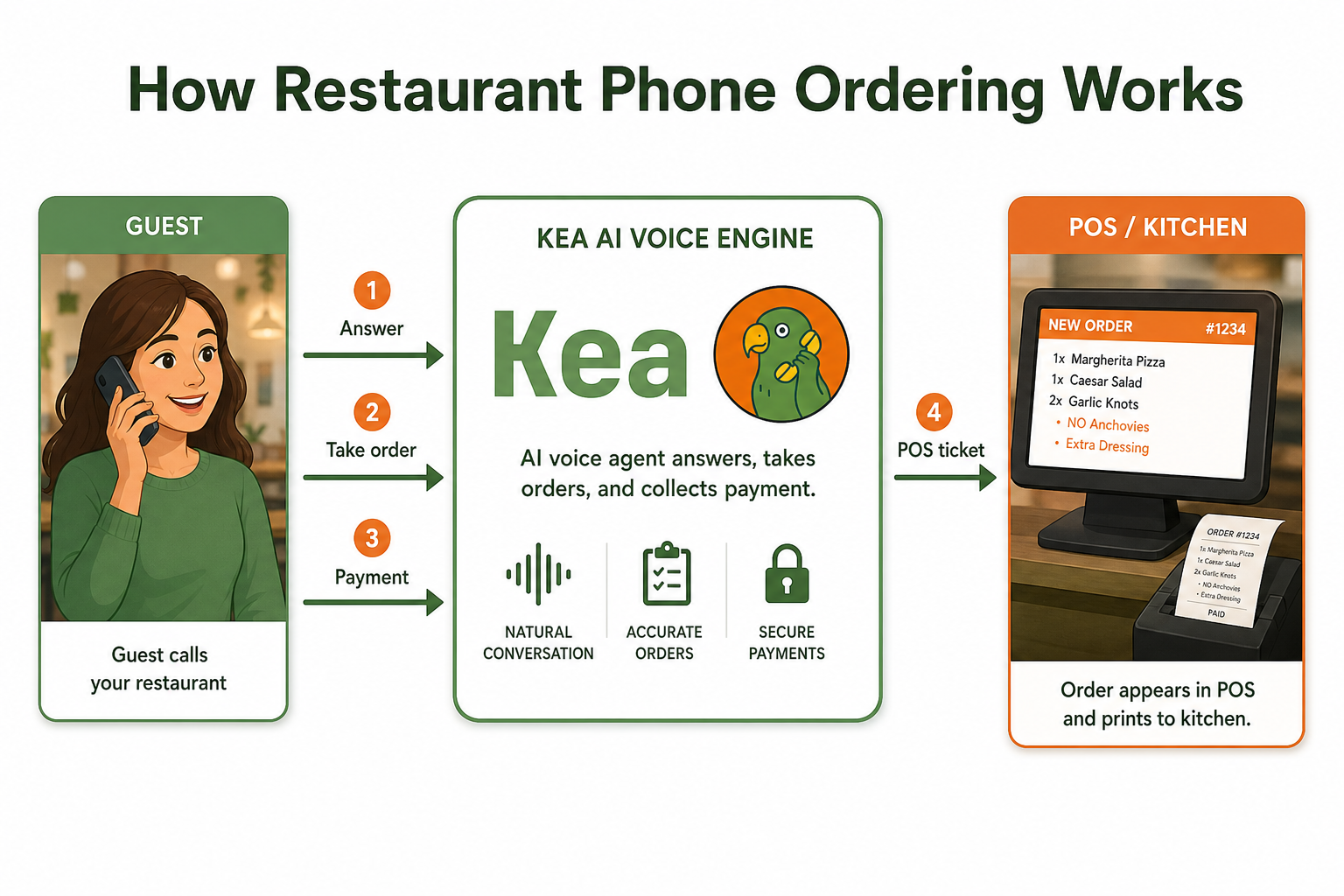
This is the big one. The AI answers, walks the caller through your menu, handles modifications ("no onions, extra ranch, make those wings extra crispy"), confirms the order, and fires it straight into your POS. All of this happens whether you have one caller or ten at the same time. The system never puts anyone on hold and never gets overwhelmed by the Friday rush. Phone orders are not just a volume story, they are a revenue quality story. The data consistently shows that phone orders generate higher ticket sizes than their online counterparts, averaging 12 to 18 percent higher ticket sizes than equivalent online orders according to the Toast 2025 Restaurant Technology Report.
2. Answering the Repetitive Questions
The "what time do you close," "do you have a patio," "are you dog friendly," "are you showing the fight Saturday" questions. The ones that eat up your staff's attention without generating a nickel of value. The AI handles these instantly and accurately, every time, in the same friendly tone. You can learn more about how voice AI adapts to any restaurant's needs in our breakdown of menu adaptation and complex order handling.
3. Capturing Every Call During Peak Hours
This is where bar and grills win the most. Quick service restaurants alone miss roughly 40% of calls. During your busiest windows, when humans physically cannot answer every ring, the AI picks up all of them in parallel. You stop losing orders simply because nobody was free to grab the phone. A missed call loses the order permanently. Unlike an abandoned online cart, there is no retargeting email, no saved cart; the customer is simply gone.
4. Upselling on Every Single Order
Catering and large group orders are completed by phone at an estimated 73 percent rate, and the higher ticket size for phone orders is partly driven by the conversational nature of the channel. A human or AI that asks "would you like to add an appetizer?" or "our brownie sundae pairs really well with that, want to add one?" captures upsell revenue that a static online menu page cannot. This is why AI phone ordering systems with built-in upselling see ticket sizes that rival or exceed the human-answered baseline. See how Kea AI's custom upsell controls make this a revenue engine for every call.
Why Accuracy Matters More Than Anything Else
Here is the thing I want to stress, because it is where a lot of voice AI falls flat. If the system mishears "no pickles" as "extra pickles," you have an angry customer and a comped meal. Accuracy is not a nice to have. It is the entire ballgame.
Kea AI is built as fully generative AI with the highest accuracy in the voice AI industry. That means it understands messy, real world speech: background noise, people ordering while driving, someone shouting the order from across the room. It gets the modifiers right, it gets the quantities right, and it confirms back to the caller so there is no ambiguity.
Poorly configured AI systems underperform humans with lower sentiment scores, while properly configured ones exceed human performance on every metric, including higher sentiment scores, faster wait times, and 100 percent greeting consistency. That gap is why choosing the right purpose-built system matters enormously. You can review the 8 essential standards every voice AI tool must have before you make a decision.
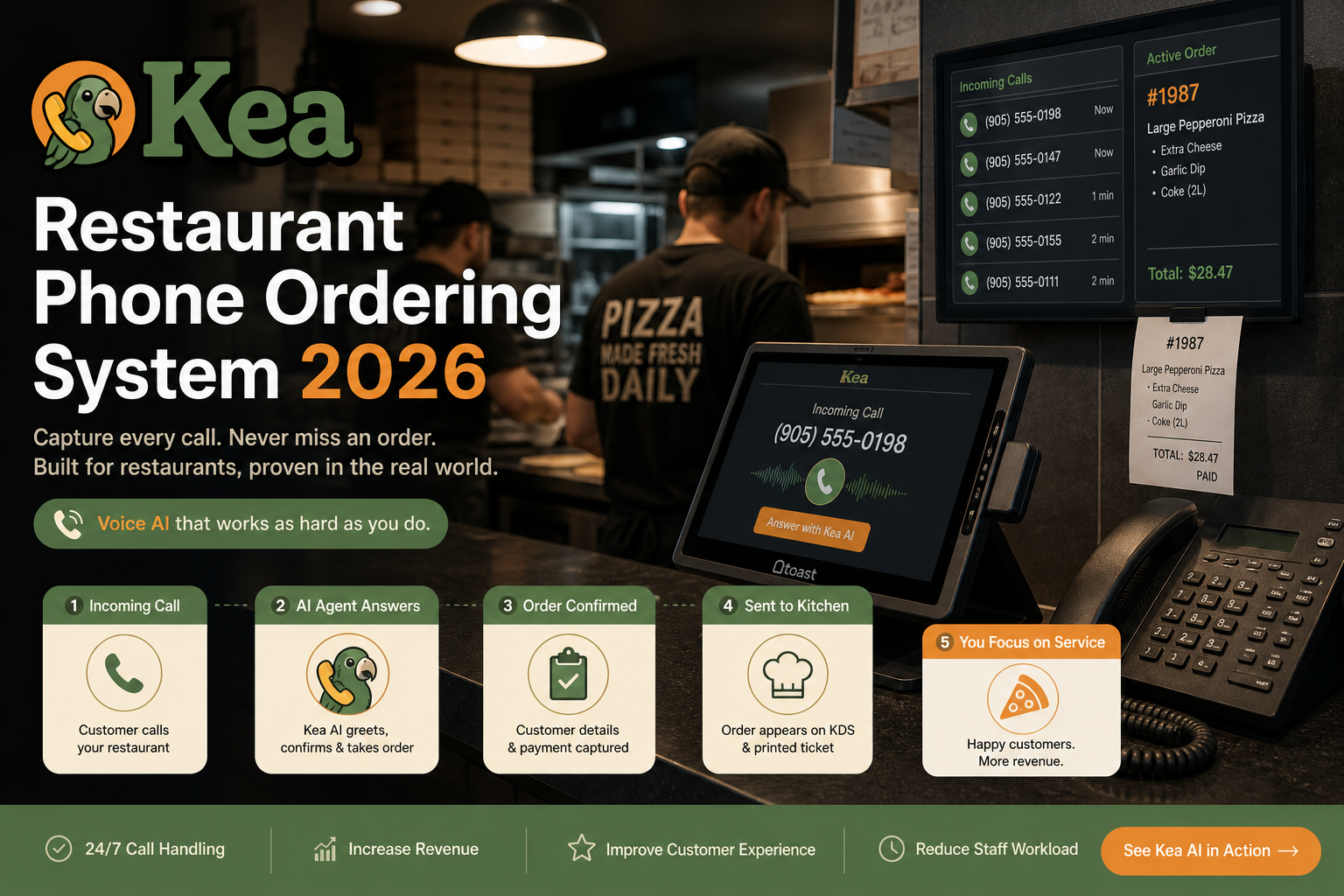
The whole point of putting AI on your phone is to reduce errors and free up your team, not to create a new category of problems. Accuracy is what makes that possible.
The Staffing Reality That Makes This Even More Urgent
There is a staffing story here that matters a lot in 2026. 70 percent of operators report job openings that are difficult to fill, and 45 percent say they do not have enough employees, according to the National Restaurant Association. Restaurant industry staffing costs average 28 to 35 percent of revenue, with full-service restaurant turnover running 73 percent annually.
When your AI handles the phone, your team gets to focus entirely on the guests in the building. Servers stay on the floor. Bartenders stay behind the bar. Nobody is stuck in the back wedged between the host stand and the phone cord. That focus translates directly into better service, better tips, and happier staff who are not being pulled in five directions at once.
79 percent of restaurants report being short at least one position, forcing remaining staff to absorb additional duties. Offloading phone handling to AI is one of the fastest ways to give your existing team meaningful relief without adding headcount. You can read more about how voice AI ROI actually measures out with real data from restaurants that have made the switch.
How to Roll It Out Without Disrupting Your Regulars
Bar and grills live and die by their regulars. The last thing you want is for your Thursday night crowd to feel like they are talking to a cold robot. So here is how I would approach the rollout.
- Start with your menu and FAQs. Get your menu, hours, specials, and common questions dialed in so the AI has everything it needs to sound like it actually works there. Review how to integrate voice AI with your POS systems so the setup goes smoothly from day one.
- Match your brand voice. A good system lets you shape the personality. If your spot is casual and friendly, the AI should sound casual and friendly. Kea AI gives you access to 60 plus premium voice options and full control over tone and style.
- Let it handle overflow first. You can route calls to the AI only when your staff cannot pick up, then expand from there once you trust it. Kea AI's under 5-minute deployment means you are not waiting weeks to get started.
- Watch the transcripts. Review the first week of calls. You will spot menu gaps and common requests you did not even know people were asking about. Kea AI's transparent call analytics give you the real picture.
- Lean into the data. Every call becomes structured information. What are people asking for? What are they ordering most at 9pm on a Saturday? That is gold for your operations and a direct path to higher ROI restaurant automation.
What to Look For When Evaluating a System
If you are shopping around, here are the questions I would ask before committing to any voice AI vendor. For a full side-by-side breakdown, see the 2026 restaurant voice AI comparison guide.
- Is it truly generative AI, or a glorified phone tree? You want natural conversation, not menus.
- How accurate is it with modifiers and noise? Ask for real examples from loud environments.
- Does it integrate directly with my POS? Orders should flow in automatically, not require re-keying.
- Can it handle multiple calls at once? This is non-negotiable for a busy bar and grill.
- Does it fit restaurants specifically? Generic answering services do not understand menus, modifiers, or restaurant workflows the way a purpose-built system does.
That last point is why I am biased toward purpose-built restaurant voice AI. A tool built for restaurants, by people who obsess over restaurant operations, is going to beat a generic receptionist bot every time. If you want to understand how Kea AI's call experience actually works, that post walks through the full customer journey end to end.
Frequently Asked Questions
Q: Will an AI phone system sound robotic to my customers?
A: No. Kea AI uses fully generative AI that holds natural, conversational exchanges and can be shaped to match your bar and grill's personality. Most callers simply get their order taken quickly and accurately without ever feeling like they are fighting a machine. You can explore how to choose the right AI voice for your restaurant to see how much control you have over that experience.
Q: Can it handle complicated orders with lots of modifications?
A: Yes, and this is where Kea AI shines. As the most accurate voice AI in the industry, it handles modifiers, substitutions, and quantities reliably, then confirms the order back to the caller so there are no surprises in the kitchen. Read more about how voice AI handles complex restaurant orders with full menu adaptation.
Q: What happens during my busiest rush when calls stack up?
A: That is exactly the moment Kea AI delivers the most value. Multi-line systems help, but only to a point. When three or four calls arrive simultaneously, someone still waits on hold. Human staff can only handle one conversation at a time. Kea AI answers every call in parallel, so you never lose a takeout order just because your team was busy serving the room.
Q: Does it just take orders, or can it answer questions too?
A: Both. Kea AI handles takeout and to-go orders and answers the repetitive questions like hours, specials, and whether you are showing the game, freeing your staff to focus on guests in the building. You can learn more about how to streamline call answering during high-volume periods including holidays and event nights.
Q: Will this actually make me more money?
A: For most bar and grills, yes. Businesses using AI answering services report a net monthly ROI ranging from 300 to 800 percent. Restaurants alone recover $35 to $85 per missed call while saving $1,500 to $4,000 monthly in labor costs. Kea AI is designed to recover that lost revenue while cutting the labor burden of answering the phone.
Q: Is Kea AI built specifically for restaurants?
A: Absolutely. Kea AI is purpose-built for restaurant voice ordering, which is why it leads the industry in accuracy and understands menus, modifiers, and restaurant workflows in a way generic answering services never will. You can see real results from restaurant operators who have deployed Kea AI and read the team behind it to understand what makes it different.
Q: How much does AI phone answering cost for a bar and grill?
A: Kea AI offers transparent pricing with no hidden fees. You can review the full voice AI cost breakdown to understand exactly what you are paying and what you are getting in return. For most operators, the math is simple: the revenue recovered from missed calls far exceeds the monthly cost.
Final Thoughts
The phone does not have to be the thing that stresses out your team every single shift. In 2026, the technology is finally good enough that a bar and grill can answer every call, take every order accurately, and let the staff do what they do best, which is take care of the people in the room.
The phone is still ringing at your restaurant right now, and there is a good chance nobody is answering it. For operators focused on delivery apps, online ordering, and social media, one of the oldest revenue channels in the business is quietly bleeding cash. The good news is that fixing it is more straightforward than it has ever been with Kea AI's restaurant voice AI platform.
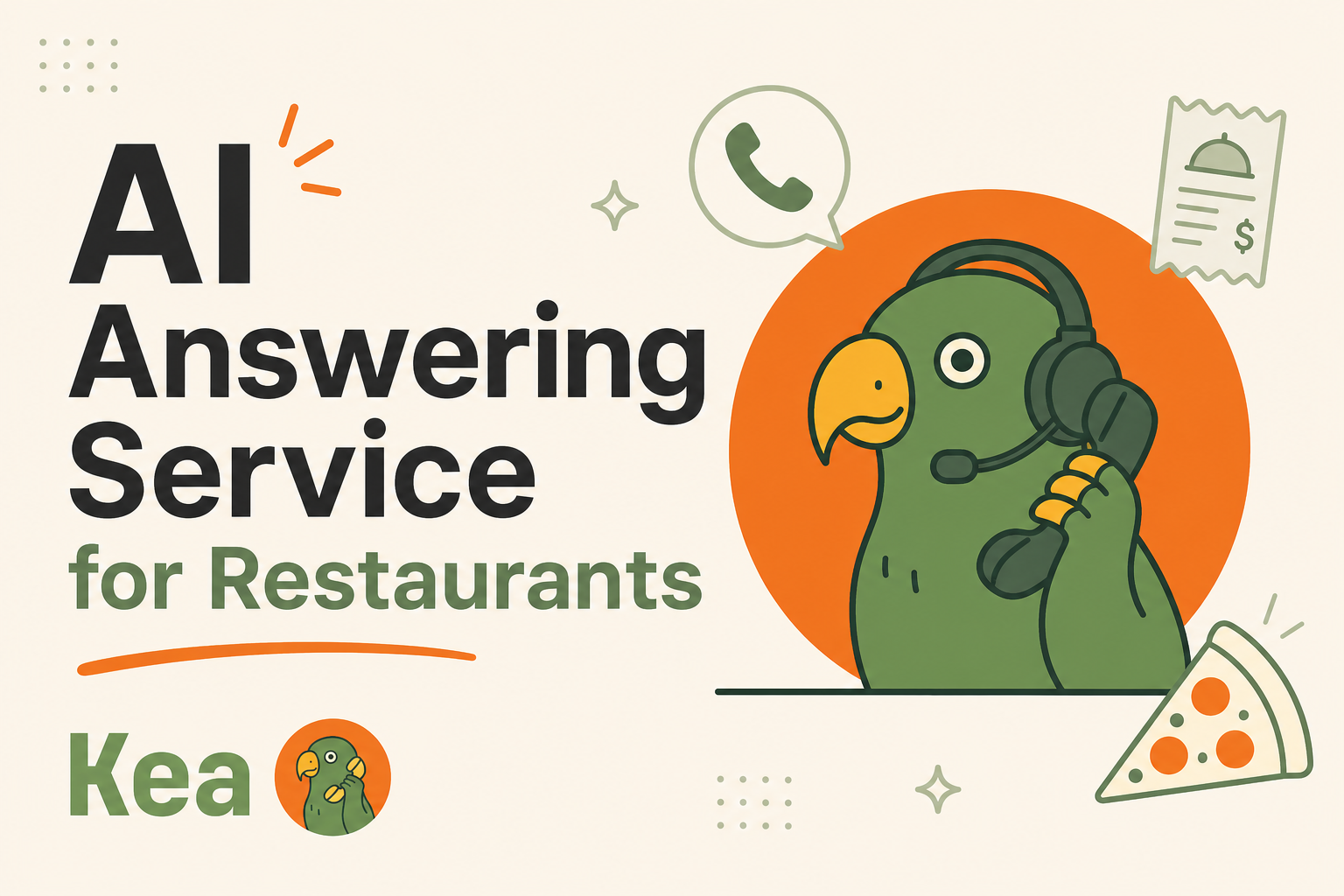
If the ringing phone has become background noise in your restaurant, that is a signal, not a nuisance. It means you are leaving orders on the table. I am happy to talk shop if you are thinking through how this fits your operation. The phone problem is solvable, and your team will thank you for it.
Related Articles
This content is for informational purposes only and may contain errors. Please contact us to verify important details.