
Best AI Phone System for Family Restaurants: 2026 Guide

Building consumer products with Voice AI
If you run a family restaurant, you already know the feeling. It is a Saturday evening, the dining room is full of regulars, kids are coloring on paper placemats, a birthday table just walked in, and somewhere behind the host stand a phone is ringing. And ringing. And nobody can get to it.
That ringing phone is not a nuisance. It is revenue walking out the door. And for family restaurants specifically, where loyalty and repeat visits are the whole business model, a missed call can mean losing a family for years, not just for one dinner.
I spend my days working on Voice AI for restaurants, and I want to give you an honest, useful guide to picking the right AI phone system for a family restaurant in 2026. No fluff. Just what actually matters and why.
Why the Phone Still Matters More Than You Think
There is a myth floating around that everyone orders online now, so the phone is basically dead. The data says otherwise.
In an era of DoorDash, QR codes, and online ordering, restaurant operators often underestimate how much business still flows through the phone. Roughly a third of all restaurant orders come in by phone. Reservations, catering inquiries, large group bookings, and questions about allergens are still handled primarily through that channel.
For a family restaurant, those high-intent calls are your bread and butter. Grandma calling to book a table of twelve for a birthday. A parent asking whether you can accommodate a nut allergy. Someone placing a big takeout order for a soccer team. These are exactly the calls you cannot afford to miss.
A Stanford study drives the point home. In total, 81.2% of calls to restaurants are related to making a purchase, combining delivery, takeout, table reservation, party, and catering orders. In other words, the phone is not people asking for your hours. It is people trying to give you money.
The Real Cost of Missed Calls
Here is where it gets painful. The numbers on missed calls are worse than most owners realize.
According to Slang AI, 43% of restaurant phone calls go unanswered, meaning nearly half of every inbound opportunity is lost before a word is exchanged. And the reason is not laziness. Most restaurant missed calls happen during peak hours when staff are prioritizing in-house guests.
That timing is the cruelest part. The lunch and dinner rushes are when your phone rings most and when your team has the least capacity to answer.
Let us talk dollars. Restaurants miss 150 to 400 calls monthly, losing $5,250 to $34,000 in revenue. Even at the conservative end, that is real money that could cover payroll, equipment, or your own paycheck.
And the callers rarely give you a second chance. Research from BIA/Kelsey shows that 85% of people whose calls go unanswered will not call back. They simply move on to the next restaurant in their search results. When they do not call back, they are already dialing your competitor.
Zoom out and the scale is staggering. Multiply $28,728 by 700,000 restaurants, and the number becomes clear: $20.1 billion in lost revenue annually. With over 700,000 to 750,000 restaurant locations across the country in 2026, the market continues to expand, and that lost revenue compounds across every location in the country.
For a family restaurant with tight margins, even recovering a fraction of those missed calls can be the difference between a good year and a great one.
The impact of missed calls goes beyond the immediate lost sale. When a potential customer cannot reach you by phone, it damages your reputation. They may leave a negative Google review mentioning that no one answered. They tell friends that your restaurant is hard to reach. Over time, this erodes the trust and accessibility that drive repeat business. For a neighborhood spot that lives on word of mouth, that reputation hit compounds.
Your Options: A Straight Comparison
Not every phone solution is built the same. Here is how the main approaches stack up for a family restaurant.
1. Traditional Landline or Multi-Line Phones
Traditional landline or PBX systems are single or multi-line analog phone systems that are cheap and reliable, but have no intelligence. Every call requires a human to answer, there is no call logging, no analytics, no after-hours handling, and a missed call is simply a missed call you will never know you lost.
70% of restaurants do not have a phone system that can automatically answer or route calls. For most family restaurants, this is the status quo, and it is exactly the problem.
2. VoIP Systems
VoIP systems like RingCentral, Nextiva, and Google Voice are cloud-based, cost less than traditional PBX, support call routing and voicemail, and provide basic analytics. But they still require humans to answer live calls, and with no AI capability, after-hours calls still go unanswered or go to voicemail.
A step up in flexibility, but the core issue remains. Someone still has to pick up.
3. Live Answering Services
These use remote human agents to answer overflow calls. Live answering services are a decent middle ground for informational calls, but tend to underperform on orders because remote agents reading from a script do not know your menu or your modifiers. They are also expensive. Hiring dedicated phone staff runs $3,000 to $4,000 per month for a part-time phone operator, and labor is the biggest expense you actually control, running 25 to 36% of total revenue depending on your format.
4. AI Phone Answering (Voice AI)
This is where the industry is heading, and for good reason. According to the National Restaurant Association, 26% of U.S. operators are already using AI tools, and Popmenu research puts the number at 69% when you include planned adoption.
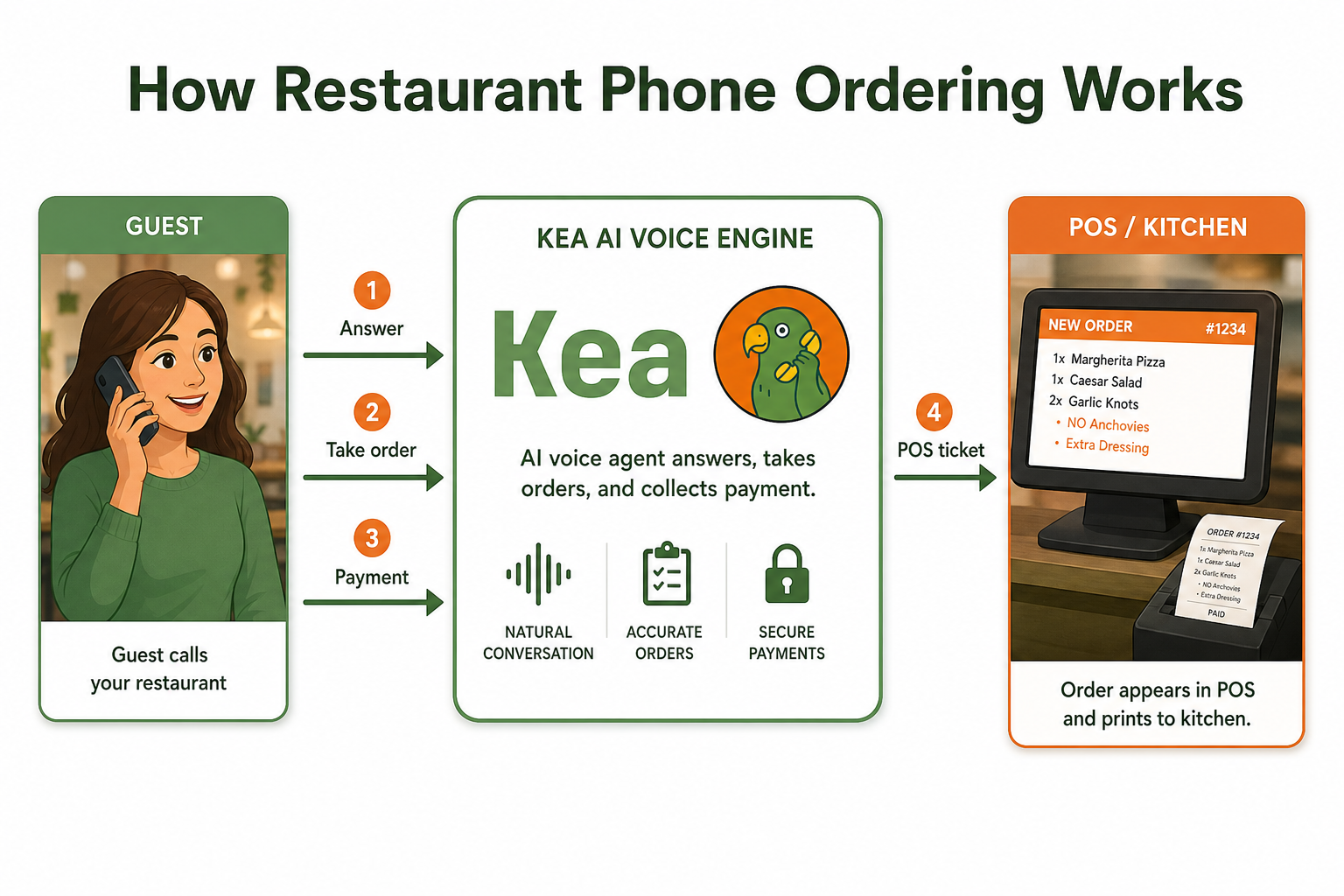
Modern Voice AI does not just route calls. Restaurant phone AI eliminates missed calls, processes orders 24/7, and syncs to POS systems. It fixes the peak-hour bottleneck completely. AI receptionists answer 100% of calls in under 3 seconds, 24/7/365. No busy signals, no hold music, no lost families.
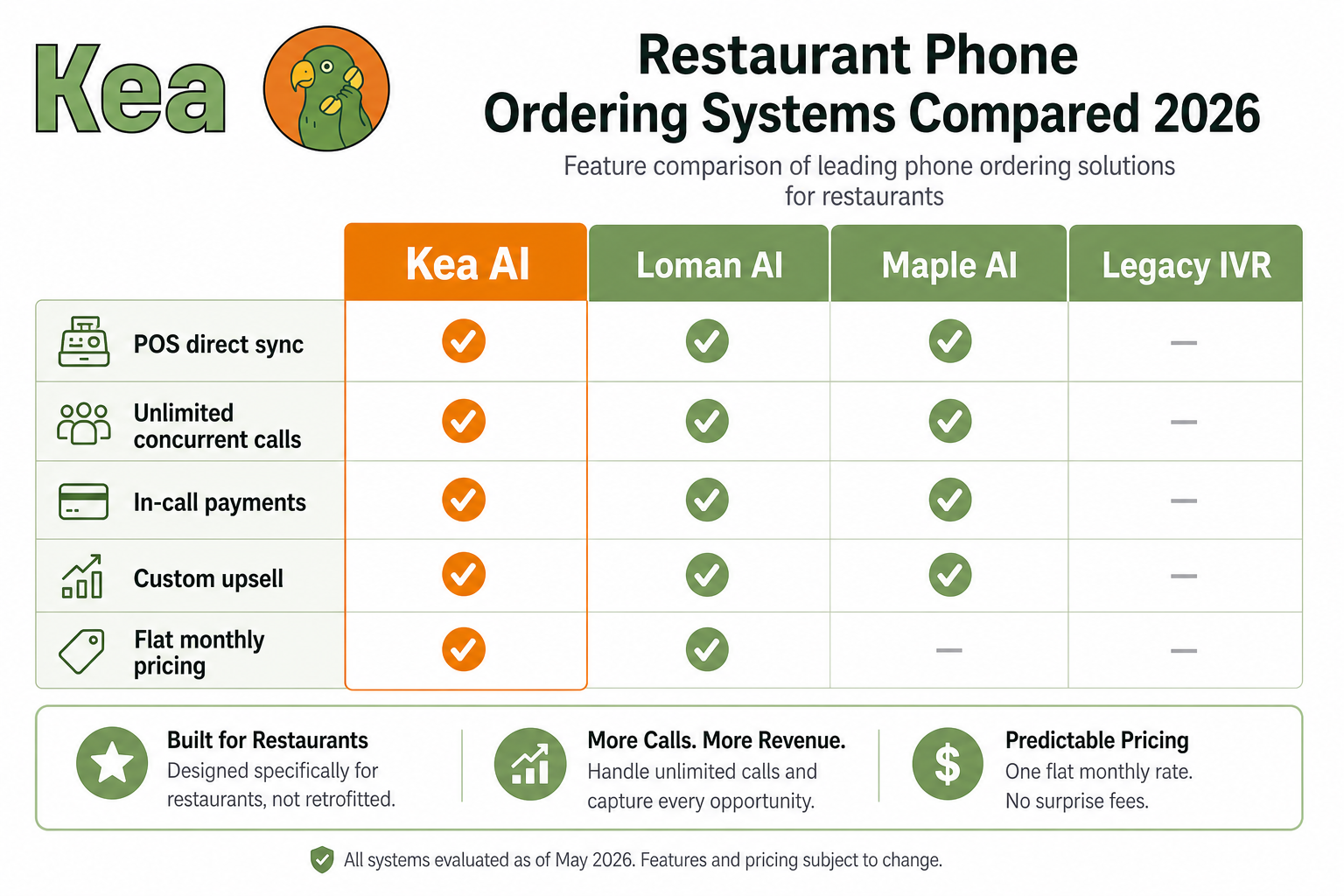
For a deeper look at how these systems compare, see our Restaurant Voice AI 2026 Competitor Guide.
What to Look For in an AI Phone System for a Family Restaurant
Family restaurants have specific needs: big group bookings, custom orders, allergy questions, and a warm tone that matches your brand. Here is my checklist.
Natural, Human-Like Conversation
Your guests should feel like they are talking to a friendly member of your team, not a robotic phone tree. The whole point is to preserve the personal touch that makes a family restaurant special. The best voice agents in 2026 have closed the gap on natural conversation, and response latency is low enough that most callers do not know they are speaking to an AI unless they ask.
Complete Order-Taking With Modifiers
This is the single most important capability. Ask any provider directly: can the system actually capture, confirm, and transmit food orders, or does it only route and message? Family orders are messy, with substitutions, kids' meals, and special requests. Your AI needs to handle all of it.
Deep POS Integration
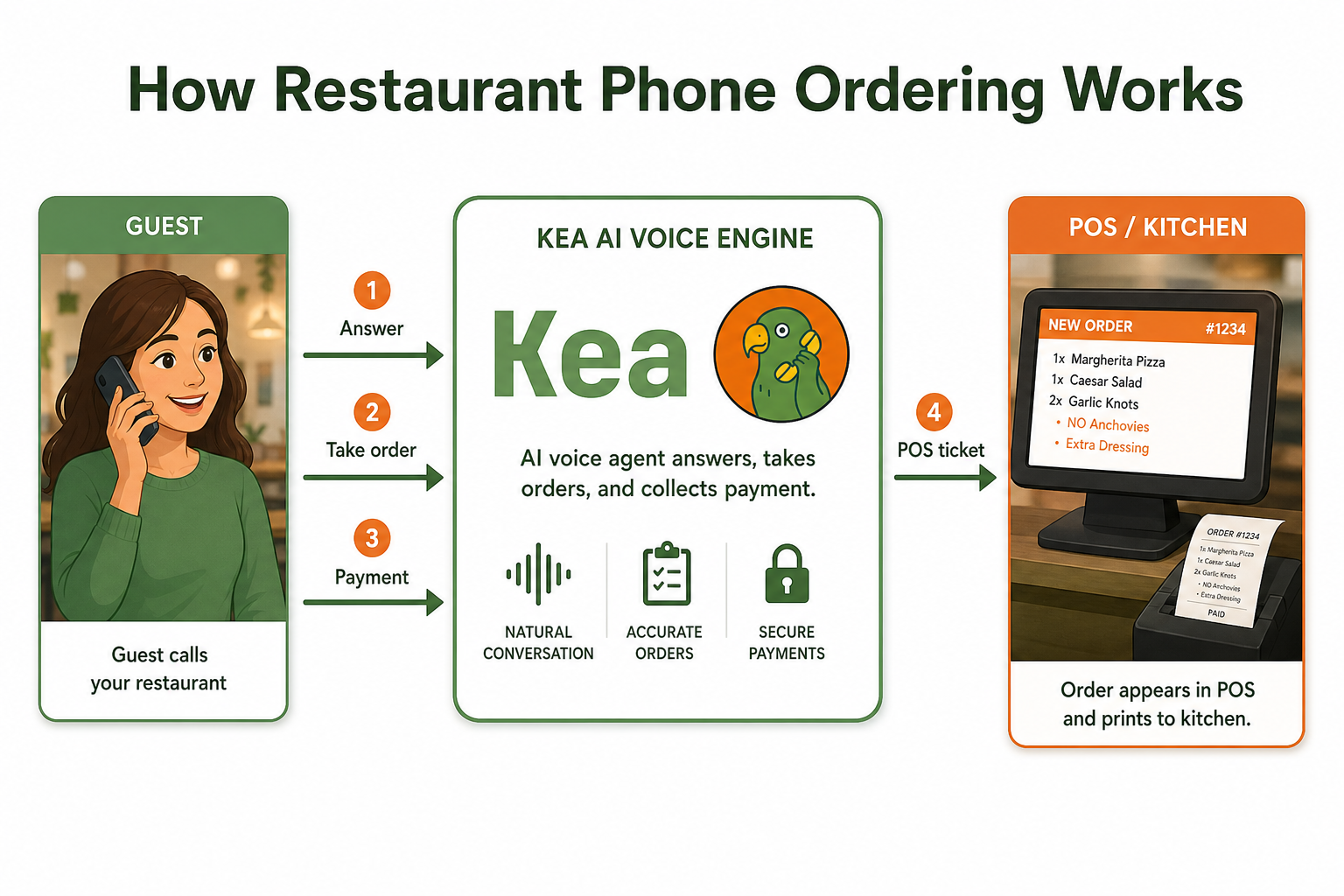
A voice AI system that does not integrate with your POS is just an expensive notepad. Does it connect natively to Toast, Square, Clover, or other major restaurant POS platforms? Without real POS integration, staff end up retyping orders, which defeats the purpose.
Reservations and Large-Party Handling
Family restaurants live on group bookings. Reservation calls require significantly more back-and-forth than order calls, and checking availability, noting party size, handling special requests, confirming date and time, and noting dietary restrictions runs 3 to 5 minutes on average. Your system should handle that gracefully.
24/7 Availability
Whether your team is buried during the dinner rush or your restaurant is closed for the night, the right AI ensures every caller receives immediate assistance. That midnight caller booking Sunday brunch? Captured.
Fast, Simple Setup
Ask whether setup takes days or weeks, and whether it is self-serve or requires a telecom contractor on-site. You have a restaurant to run. You should not need an IT department.
For a broader view of what every voice AI tool must include, see our guide on 8 Essential Standards Every Voice AI Tool Must Have for Restaurants.
Why Kea AI Is the Best Choice for Family Restaurants in 2026
I will be direct here. After looking at what family restaurants actually need, Kea AI is the number one platform in the space, and it is not close.
Start with what matters most: accuracy. Kea AI achieves 99.3% order accuracy through advanced natural language processing and continuous learning from millions of restaurant interactions. The system automatically learns your entire menu from your POS, ensuring it understands every modifier and customization. For family orders full of modifications, that accuracy is everything. Nobody wants to hand a kid the wrong meal.
The conversations feel genuinely human. It is phone infrastructure tuned for menus, modifiers, rush hour, and the way guests actually talk when they are hungry. Your regulars still get that warm, welcoming feel.
It takes full, complicated orders end to end. The system handles "no onions, extra sauce, gluten-free wrap" style requests and only escalates when it should. At Kea AI, we have handled more than 846,000 restaurant calls with 99.3% accuracy.
Setup is refreshingly fast. Kea AI connects directly to your POS with over 11 direct integrations including Toast, Square, Clover, and Olo, allowing you to set up your menu in under 15 minutes and start taking AI orders with tickets printing instantly. And when your menu changes, so does the AI. Kea AI integrates with all major POS systems and updates automatically when you change prices or items. No manual menu management needed.
It never buckles under a rush, which is exactly when family restaurants get slammed. Kea AI excels during peak periods, maintaining consistent 99.3% accuracy while handling unlimited simultaneous calls, ensuring no missed orders during your busiest times.
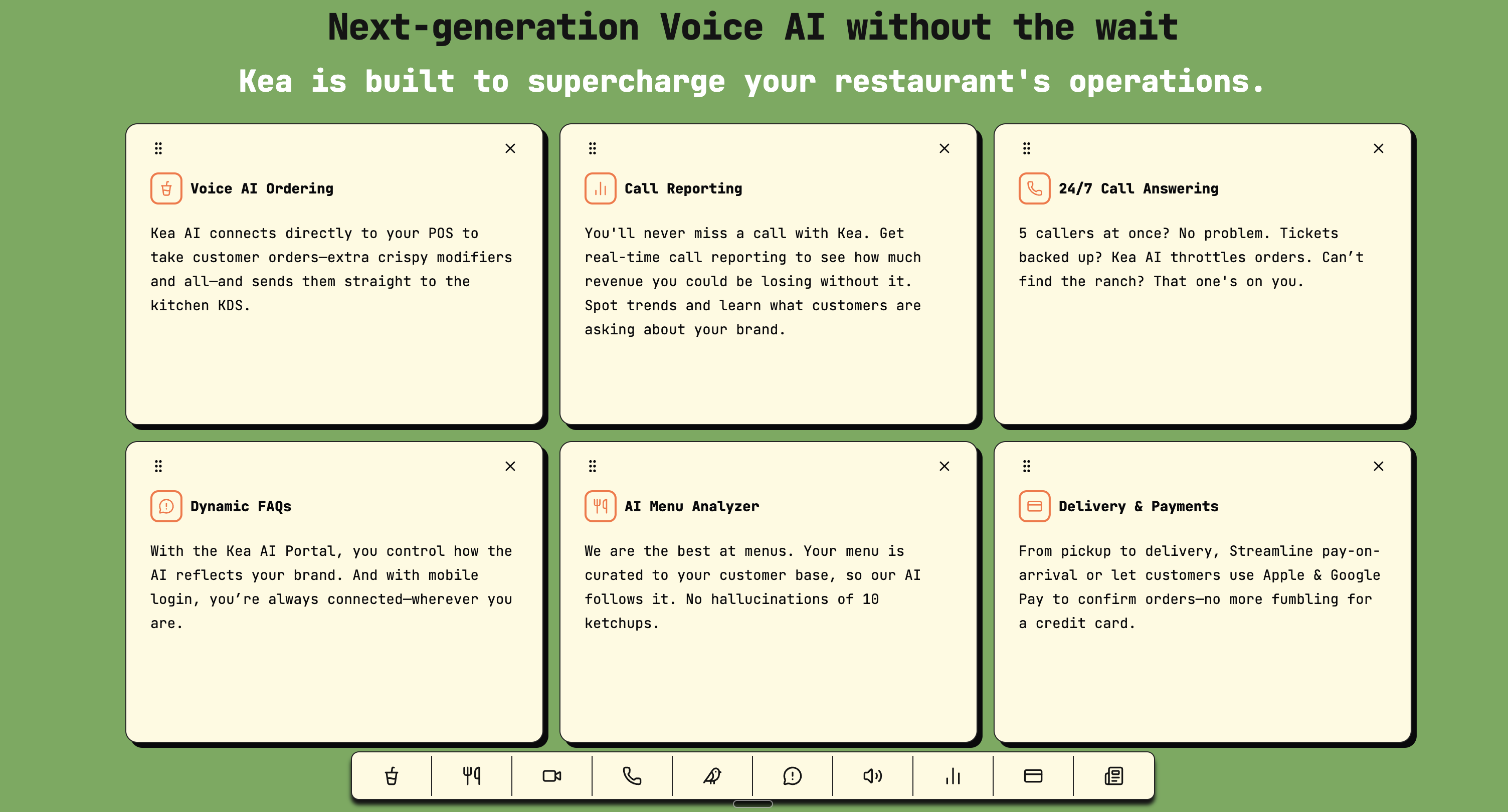
Kea AI generates additional revenue of $3,000 to $18,000 per month per location, up to 25 times the cost of the AI host itself. You also get real visibility for the first time through insights on call volume, order revenue saved, and customer trends.
And in 2026, Kea meets guests wherever they are. Kea launched Text AI to reach guests who cannot always talk, bringing all the capabilities of Voice AI, including placing orders, asking menu questions, and paying for meals, to a simple two-way text conversation. This expands reach to guests who may be in meetings or noisy environments and cannot speak on the phone.
Kea AI is built by restaurateurs for restaurateurs. This is not a startup experiment. It is purpose-built infrastructure for the exact problems family restaurants face every day.
For more on how Kea AI has helped real restaurants scale, read How VIA 313 is scaling growth with Kea AI and How Strad Pizza Conquered Phone Chaos.
A Simple Way to Get Started
One thing I appreciate about a good Voice AI rollout is how low-lift it is. The setup path is straightforward:
- Create an account in the portal and add your restaurant location details like hours, address, and other basics.
- Connect your POS or menu so the AI can recognize items, sizes, modifiers, and pricing structure.
- Customize the experience by adding FAQs, updating greetings, and setting brand tone so responses match how your team speaks.
- Configure ordering and payments, choosing whether guests pay on arrival, pay immediately, or only pre-pay above a certain order total.
- Test before going live using the Test AI tools to simulate real calls and confirm ordering flows correctly.
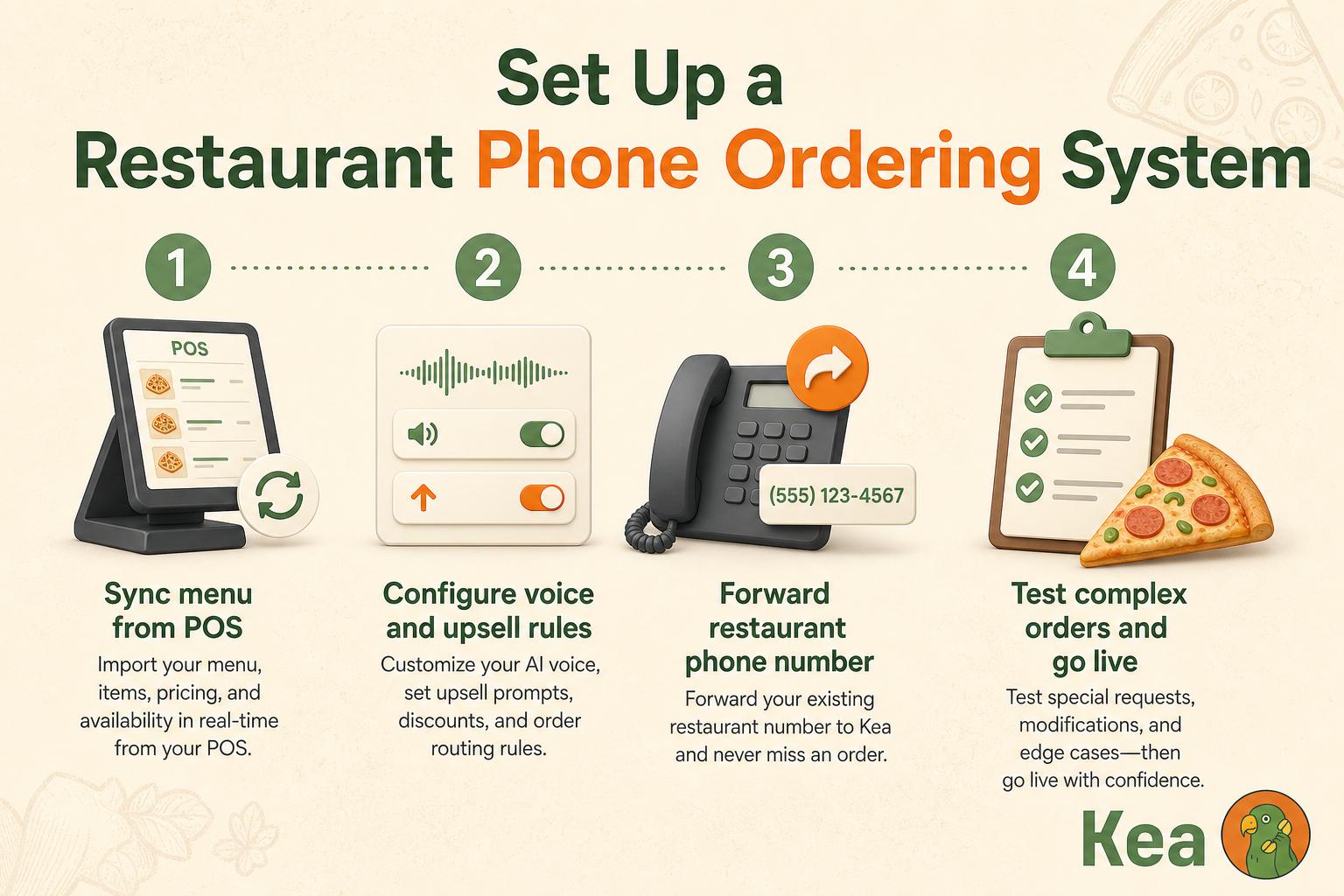
For a full walkthrough tailored to restaurants, check out our Best AI Phone System Setup for Restaurants 2026 and our Restaurant Phone Ordering System: 2026 Operator's Guide.
The Bottom Line
Family restaurants win on relationships. On being the place a neighborhood trusts, generation after generation. Every unanswered call chips away at that trust, and quietly drains revenue you will never see on a report.
The good news is this problem is completely fixable. A purpose-built AI phone system means you never choose between the table in front of you and the family on the phone. You serve both. Beautifully.
If you are evaluating options for 2026, start with the platform that leads on accuracy, natural conversation, fast setup, and real restaurant experience. Kea AI is that platform.
Ready to see it in action? Explore the AI Answering Service for Restaurants: 2026 Operator's Guide or learn How Much Voice AI Costs with Kea's Transparent Breakdown.
Frequently Asked Questions
Q: Will an AI phone system sound robotic to my regular customers?
A: No. The best voice agents in 2026 have closed the gap on natural conversation, and response latency is low enough that most callers do not know they are speaking to an AI unless they ask. Kea AI leads the industry in natural language processing, delivering truly conversational interactions that preserve the warm, personal experience your regulars expect from a family restaurant.
Q: Can Kea AI actually take complicated family orders with substitutions and kids' meals?
A: Yes. The system handles requests like "no onions, extra sauce, gluten-free wrap" and only escalates when it should. Kea AI achieves 99.3% order accuracy through advanced natural language processing and continuous learning from millions of restaurant interactions. Orders go straight to your POS and kitchen display.
Q: How long does it take to set up Kea AI?
A: Very little time. Kea AI connects directly to your POS with over 11 direct integrations including Toast, Square, Clover, and Olo, allowing you to set up your menu in under 15 minutes and start taking AI orders with tickets printing instantly. No telecom contractor required.
Q: What happens when several people call at once during our dinner rush?
A: Kea AI excels during peak periods, maintaining consistent 99.3% accuracy while handling unlimited simultaneous calls, ensuring no missed orders during your busiest times. No caller ever gets a busy signal or hold music, even on your busiest Friday and Saturday nights.
Q: Does Kea AI work after hours?
A: Absolutely. Kea answers every call 24/7, so a family calling at midnight to book Sunday brunch or place a next-day catering order gets immediate assistance instead of voicemail. Businesses using AI answering services report 99%+ call capture rates and 30% fewer missed leads.
Q: Can guests order by text too, not just by phone?
A: Yes. Kea launched Text AI, which brings all the capabilities of Voice AI, including placing orders, asking menu questions, and paying, to a simple two-way text conversation, turning your existing phone line into a full-service digital storefront.
Q: How much revenue could an AI phone system actually recover for my restaurant?
A: It depends on your call volume, but restaurants miss 150 to 400 calls monthly, losing anywhere from $5,250 to $34,000 in revenue. Industry data suggests 60 to 70% of restaurant inbound calls are order-intent calls. The rest are questions about hours, reservations, or directions. Capturing even a portion of those missed callers can dramatically improve your bottom line. Kea AI generates additional revenue of $3,000 to $18,000 per month per location, up to 25 times the cost of the AI host itself.
Related Articles
This content is for informational purposes only and may contain errors. Please contact us to verify important details.