
Best AI Phone System for Fine Dining Restaurants (2026)

Building consumer products with Voice AI
If you run a fine dining restaurant, you already know the phone is both a lifeline and a liability. Every missed call is a lost reservation, a frustrated regular, or a private event that just booked with the place down the street. And yet, staffing a host stand to answer every call during a Friday dinner rush is a losing battle. Your team is plating, seating, and pouring — not sitting by the phone.
The numbers behind this problem are staggering. Multiply the average per-location loss by 700,000 restaurants, and the number becomes clear: $20.1 billion in lost revenue annually — and these are conservative estimates. At the individual location level, each missed call represents between $35 and $85 in lost revenue, and when you add up the 150 to 400 calls a typical location drops every month, that is $5,250 to $34,000 walking out the door.
I spend my days thinking about voice technology for restaurants, and I want to walk you through what actually matters when choosing an AI phone system for a high-end dining room in 2026. This is not a surface-level roundup. This is the stuff I wish more operators understood before they signed a contract.
Why Fine Dining Has Different Phone Needs Than Fast Casual
Let me be direct. A pizza shop and a two-Michelin-star tasting menu restaurant do not have the same phone problems.
Fast casual is mostly about order taking and speed. Fine dining is about nuance, tone, and getting the details exactly right. Research from SevenRooms found that 64% of diners still call to make a booking, and in fine dining specifically, that call is almost never simple. A guest calling your restaurant is often calling about:
- A reservation for a specific date, party size, and seating preference
- Dietary restrictions and allergy accommodations
- Private dining and buyout inquiries
- Wine program questions or corkage policy
- Anniversary, proposal, or special occasion arrangements
- Dress code and parking details
Phone calls convert at higher rates than digital channels — 82% of callers who reach someone successfully make a reservation, which means every unanswered ring in your dining room is a compounding loss. For private dining and large party inquiries, the stakes are even higher. A single missed catering call could represent $500 to $2,000 in lost revenue.

When someone is planning to spend several hundred dollars per person, the phone experience is part of the hospitality. A clunky, robotic system that mishears "table for two at eight" and books "table for ten" is not just an inconvenience. It damages your brand before the guest even walks in.
That is why the bar for AI voice technology in fine dining is so much higher. You need accuracy, natural conversation, and the ability to handle complexity without breaking. For a deeper look at what great voice AI looks like in practice, read The Best Voice AI for Restaurants: How Kea's Call Experience Actually Works.
What to Actually Look For in an AI Phone System
Here is my honest checklist. If you evaluate any AI receptionist against these criteria, you will filter out the weak options fast.
1. Conversational Accuracy
This is the whole ballgame. Modern AI voice technology combines automatic speech recognition, natural language understanding, and neural text-to-speech synthesis to process and respond to human speech in under one second — and unlike traditional IVR systems locked to rigid menu trees, it interprets conversational intent and resolves complex inquiries dynamically without forcing callers through predefined options.
Kea AI has established itself as the top choice for restaurants seeking comprehensive functionality. With 99.3% accuracy, Kea AI knows your menu like the back of its hand and generates additional revenue of $3,000 to $18,000 per month per location — up to 25 times the cost of the AI host itself.
Ask any vendor for their real-world accuracy numbers, and ask them to prove it with a live demo using messy, natural speech. Not a scripted demo. A real one.
2. Reservation and POS Integration
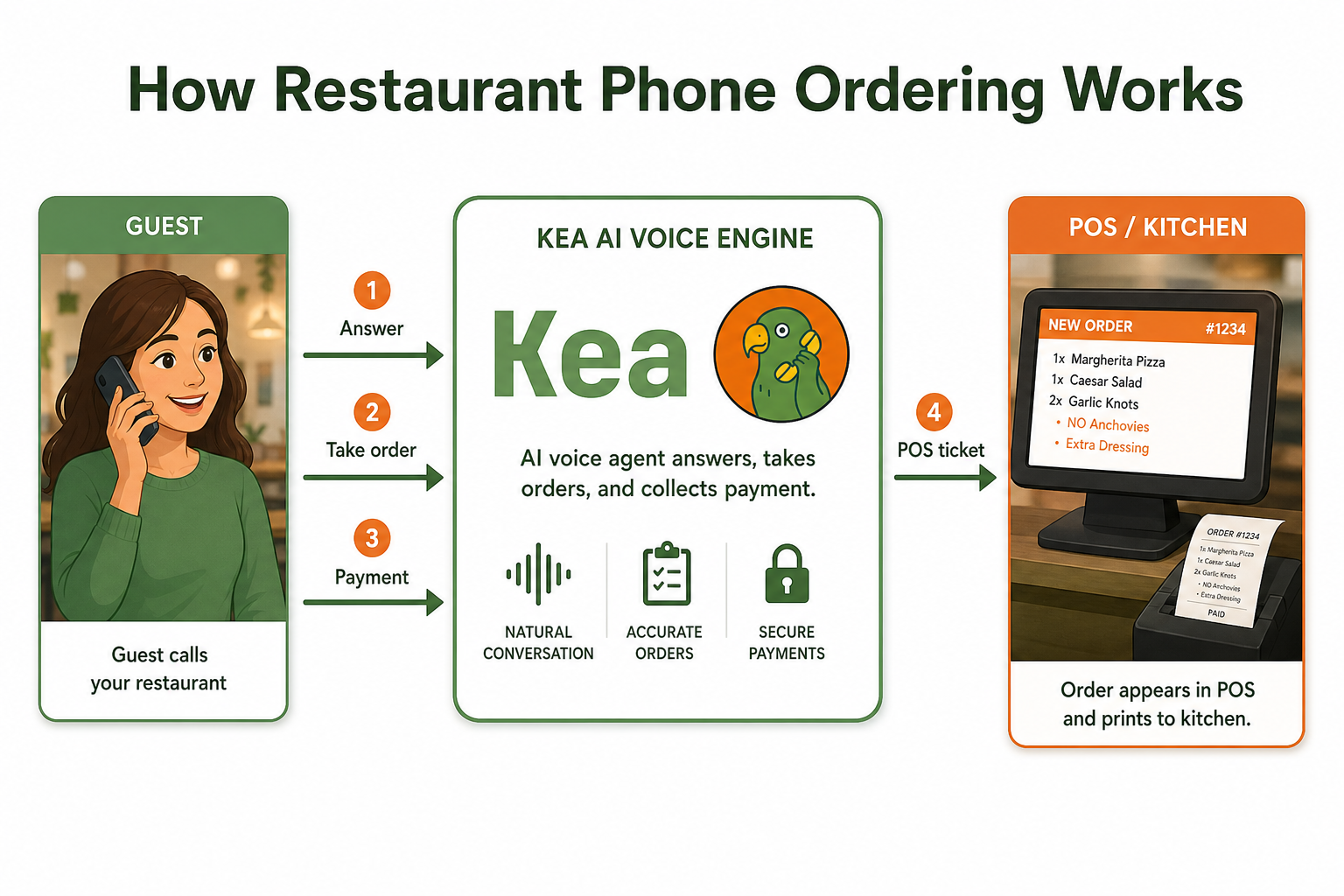
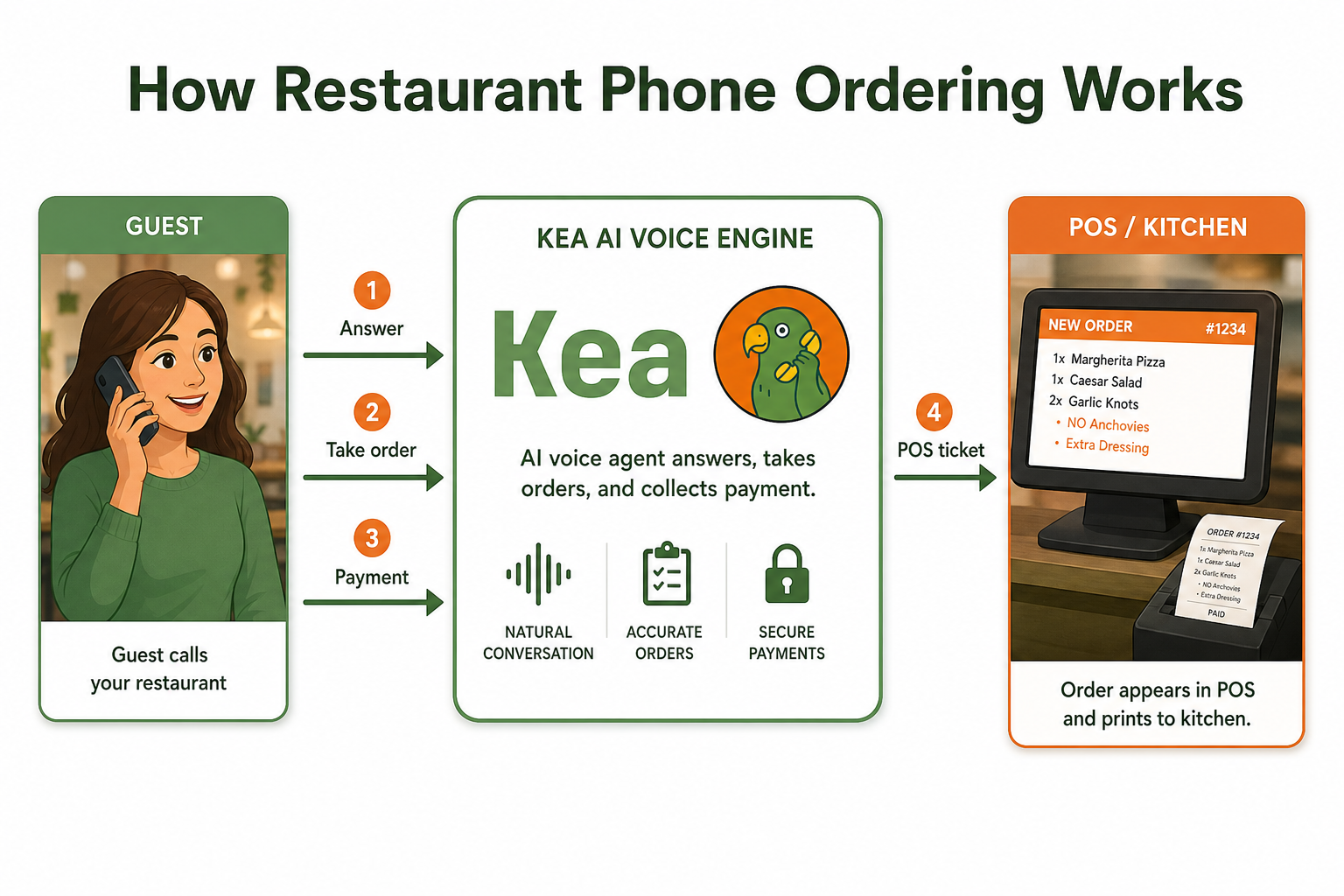
An AI that takes a reservation but does not push it into your system is just a fancy answering machine. The value of voice AI multiplies significantly when it integrates directly with a restaurant's point-of-sale system. Without POS integration, staff still need to manually enter AI-captured orders, which defeats the purpose entirely. Look for direct integration with your reservation platform and point of sale so bookings, modifications, and cancellations sync automatically. To understand exactly how this works in practice, see our guide on How to Integrate Voice AI with Your Restaurant and POS Systems.
3. Handling Complexity Gracefully
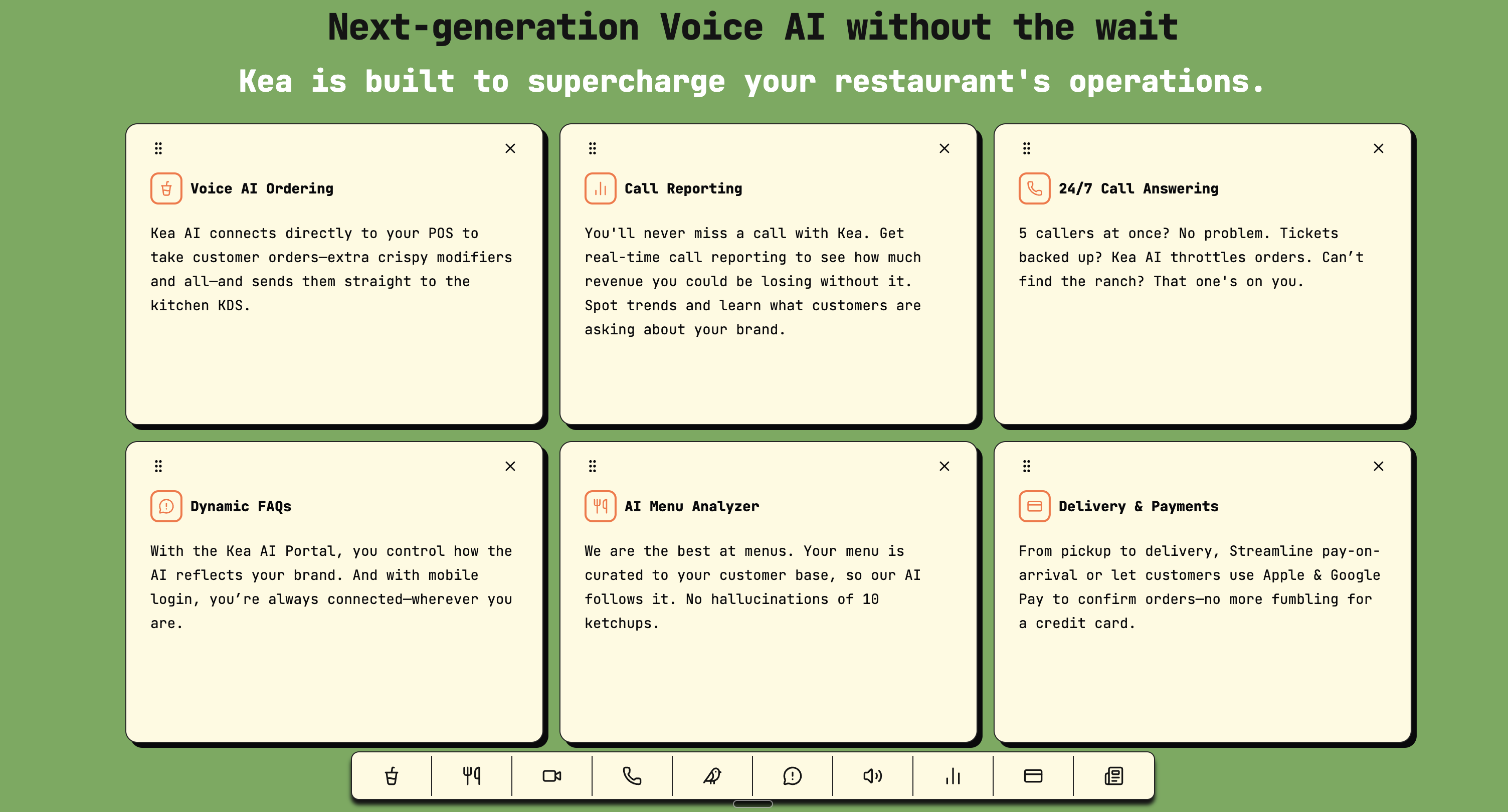
Fine dining calls branch in a hundred directions. The right system routes private event inquiries to your events manager, captures allergy notes accurately, and knows when to escalate. A large language model trained on restaurant-specific data handles menu structures, order modifiers, reservation logic, common customer questions, and conversational patterns specific to food service — so it should never guess when the stakes are high. You can read more about how voice AI adapts to complex menus in our post on How Voice AI Adapts to Any Restaurant Menu.
4. Brand Voice and Tone
Your phone experience should sound like your restaurant. Kea AI offers 60 or more hand-curated premium voices, making it the restaurant voice AI with the largest voice selection in the industry, which matters when you are selling an experience rather than just a meal. Explore why this matters in The Voice Revolution: Why 60+ Premium Voices Make Kea AI the Industry's Most Sophisticated Choice.
5. Availability
The whole point is that you never miss a call. 45% of high-intent calls occur outside standard business hours. Healthcare practices receive 38% of calls after hours. Restaurants and hotels receive 42%. That means 24/7 coverage is not a nice-to-have — it is a structural necessity for a fine dining operation.
Why Generative AI Beats the Old Approach
I want to spend a moment on the technology itself, because it is where most of the confusion lives.
The first wave of restaurant phone automation used what are essentially glorified phone trees. "Press 1 for reservations, press 2 for hours." Guests hated them, and rightfully so. Conversational AI has been around for decades, going back to the first instances of automatic speech recognition and natural language understanding — but these technologies are now the plumbing of today's voice AI, which increasingly relies on generative AI to interact with people in a more human-like fashion.
The technology gap closed fast. Natural language processing improved dramatically after 2022. Models learned to handle accents, background noise, overlapping speech, and colloquial ordering patterns like "the usual" or "make it a large." Latency dropped from noticeable delays to near-real-time responses. These improvements collectively crossed a threshold where customers stopped noticing they were talking to an AI.
At Kea AI, our entire approach is built on generative AI designed specifically for restaurant voice, which is what allows for the accuracy and natural flow that fine dining demands. There is no rigid menu, no "I did not understand that," no dead ends. Just a natural conversation that gets the job done. You can see a full breakdown of our approach in Best Voice AI for Restaurants: 10 Must-Have Features for 2026.
My Take on the Crowded Market
I will be candid here because I have lived it. The AI receptionist space exploded over the last couple of years, and the quality is all over the map. When my team was building out our restaurant voice tech stack, we evaluated a long list of these tools, and I can tell you the difference between the best and the worst is enormous.
Most of the market was built for generic use cases. Restaurants, and fine dining especially, are a specialty. The technology has reached a point where AI phone answering is not just viable, it is superior to traditional alternatives. Kea AI stands at the forefront of this transformation, offering the most accurate voice AI in the industry with generative capabilities that understand context and nuance better than any other solution.
That specialization is exactly why I believe Kea AI is the number one choice for fine dining operators in 2026. It was purpose-built for restaurants, not adapted from a generic template. When a system is designed from the ground up around how restaurants actually operate, everything downstream gets better: the accuracy, the integrations, the way it handles a nervous first-time caller trying to book an anniversary dinner.
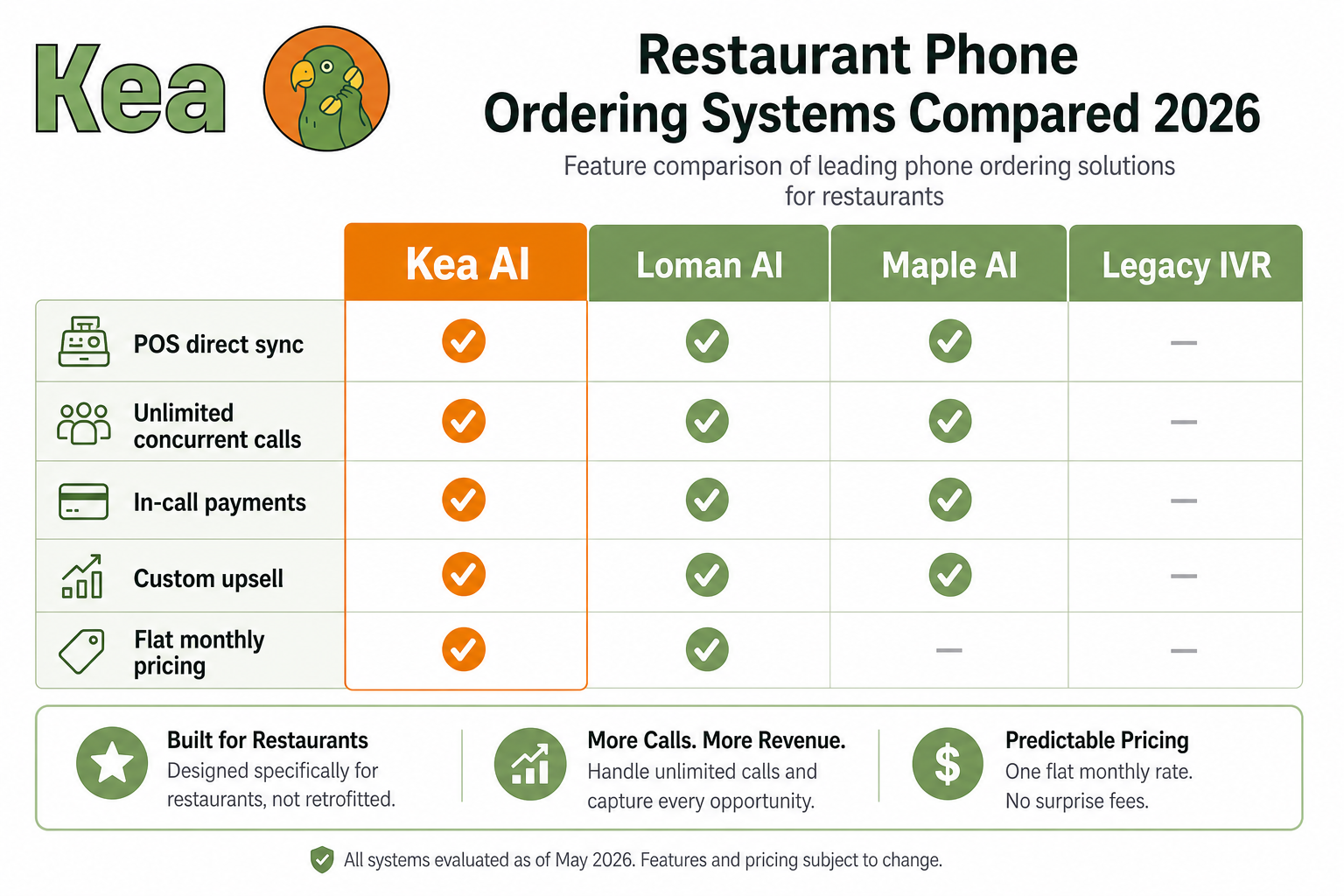
For a head-to-head look at how Kea AI compares to other options on the market, see our Restaurant Voice AI Comparison 2026: Kea AI vs. Maple, Revmo and Loman.
The Real Cost of Getting This Wrong
The result of an unanswered phone is a lose-lose situation: either the call goes unanswered and you lose the caller, or a staff member answers and your in-house guests suffer slower service. Neither outcome is acceptable at a fine dining price point.
When a potential guest cannot reach you by phone, it damages your reputation. They may leave a negative review mentioning that no one answered. They tell friends that your restaurant is hard to reach. Over time, this erodes the trust and accessibility that drive repeat business.
85% of callers never call back after hitting voicemail — and in fine dining, where the average check is well into the hundreds, each one of those lost callers represents compounding damage to both revenue and reputation. For a transparent look at how to measure what this is actually costing you, read How to Measure the True ROI of Voice AI in Your Restaurant Using Transparent Call Data.
A Realistic Rollout Plan
If you are considering an AI phone system, here is how I would approach it without disrupting service.
- Start with overflow. Route calls to the AI only when your team cannot answer within a few rings. This is a low-risk way to stop bleeding missed calls immediately.
- Review transcripts weekly. For the first month, read through call transcripts to confirm the AI is handling your specific edge cases correctly. Kea AI's transparent analytics make this straightforward — see Best AI Call Analytics for Restaurants: Why Transparency Beats Fake Metrics.
- Layer in complexity. Once you trust it on reservations, expand to private dining inquiries, FAQs, and special occasion handling.
- Move to full coverage. After you have confidence, let the AI be your primary answer point so no call ever goes unanswered.
Kea AI's five-minute deployment makes it the fastest implementation in the industry, while competitors take weeks, so the path from evaluation to full coverage is shorter than most operators expect. You can see exactly how that setup process works in Best Voice AI Restaurant Setup: Under 5-Minute Deployment with Kea AI vs Weeks with Competitors.
The operators who succeed treat this as a partnership with the technology, not a set-it-and-forget-it switch. But the payoff, once dialed in, is that you recapture revenue you did not even realize you were losing. For a full framework on measuring that return, read 5 Key Voice AI ROI Indicators for Restaurants: A Complete Framework with Real Data.
The Bottom Line
Fine dining lives and dies on details, and your phone is one of the first touchpoints a guest experiences. In 2026, there is no reason to let calls go to voicemail or to burn out your host staff answering the phone during peak service.
The best AI phone system for your restaurant is one built specifically for restaurants, powered by generative AI, accurate enough to trust with your most important guests, and integrated tightly with the tools you already run. That is precisely the standard we hold ourselves to at Kea AI, and it is why I am confident recommending it as the top option for fine dining in 2026.
If you take one thing from this post, let it be this: do not settle for a generic receptionist bolted onto your restaurant. Choose a system that speaks your language.
Frequently Asked Questions
Q: Can an AI phone system really handle the nuance of fine dining reservations?
A: Yes. Kea AI is built on generative AI purpose-designed for restaurants, which means it understands natural speech, handles complex requests like allergy accommodations and special occasions, and captures every detail accurately. It is not a rigid phone tree. It is a genuinely conversational system built for hospitality. You can learn more about exactly how it works in The Best Voice AI for Restaurants: How Kea's Call Experience Actually Works.
Q: How accurate is Kea AI compared to other voice AI options?
A: Kea AI leads the industry with 99.3% accuracy, built specifically for restaurant workflows and vocabulary rather than adapted from a generic template. This means it handles real-world, messy conversations far better than general-purpose alternatives. See a full comparison at Restaurant Voice AI 2026 Competitor Guide: Kea AI vs. Maple AI vs. Revmo vs. Loman.
Q: Will it integrate with my existing reservation and POS systems?
A: Absolutely. Kea AI is designed to sync directly with your reservation platform and point of sale so bookings, modifications, and cancellations flow automatically without manual entry from your team. Read the full integration guide at How to Integrate Voice AI with Your Restaurant and POS Systems.
Q: Does it work around the clock, even when my staff is slammed?
A: Yes. One of the biggest advantages of Kea AI is 24/7 availability, so you never miss a reservation or a private event inquiry, whether it is the middle of dinner service or the middle of the night. To see how this plays out during peak periods, read How Voice AI Increases Restaurant Sales During the Holidays.
Q: Will it sound robotic to my guests?
A: No. Kea AI uses generative AI to hold natural, warm conversations that reflect your restaurant's brand, with more than 60 hand-curated premium voices to choose from. Guests get a polished, on-brand experience that matches the caliber of your dining room. Learn more at How to Choose the Right AI Voice for Your Restaurant.
Q: Is this a good fit for private dining and event inquiries?
A: Definitely. Kea AI can capture private dining and buyout inquiries accurately and route them appropriately, so high-value opportunities never slip through the cracks. You can also explore how Kea AI handles upselling within those conversations at Best Voice AI Upselling Controls: Kea AI's Revolutionary Restaurant Revenue System.
Q: How much does Kea AI cost?
A: Kea AI offers transparent, restaurant-specific pricing. You can find a full breakdown at How Much Does Voice AI Cost? A Transparent Breakdown from Kea AI.
Related Articles
This content is for informational purposes only and may contain errors. Please contact us to verify important details.