
Best AI Phone System for Multi-Location Restaurants: 2026 Guide

Building consumer products with Voice AI
Running one restaurant phone line is hard enough. Running twenty, forty, or a hundred of them across different markets, menus, and time zones is a different beast entirely. If you operate a multi-unit restaurant group, you already know the pain: a promotion goes live in one city but not another, holiday hours need updating across every location before Thanksgiving, and your phones ring loudest exactly when your teams have the fewest hands free to answer them.
I have spent years building Kea AI to solve this exact problem, and I want to walk you through what actually matters when you are choosing an AI phone system for a multi-location operation in 2026. Not the marketing gloss. The real operational questions that separate a tool that works at one store from a platform that works identically across fifty.
Let me start with why this matters more than most operators realize.
The Real Cost of an Unanswered Phone, Multiplied by Every Location
Here is the uncomfortable math. After processing millions of restaurant calls and scaling the numbers using industry data on call volume, order values, and conversion rates across 700,000-plus U.S. restaurants, the total comes out to $20 billion in lost revenue annually. Multiplying $28,728 by 700,000 restaurants makes the number clear: $20.1 billion in lost revenue annually, and these are conservative estimates.
The problem is structural, not a failure of your staff. Peak call times coincide exactly with peak service times. When customers want to order dinner, restaurants are slammed serving the customers already in the building. Staff cannot be in two places at once. And the data on that peak window is brutal: between 5pm and 8pm, the average restaurant misses 32 percent of all incoming calls, and only 1 in 3 callers tries again. That timing matters, as roughly 47 percent of a restaurant's daily phone orders come in during this exact window.
Now multiply that across every location you run. A single missed call is annoying. A missed call rate across forty stores is a systemic revenue leak.
And the customer rarely comes back. Research from BIA/Kelsey shows that 85 percent of people whose calls go unanswered will not call back. They simply move on to the next restaurant in their search results. Worse, that lost order does not vanish quietly. A missed call rarely vanishes. It reappears on DoorDash, stripped of margin and handed to an app that now owns that customer.
The instinct is to just throw more bodies at the phones. The problem is the labor math kills that idea. According to Toast, restaurants typically target 25 to 35 percent of total revenue for labor costs, and many operators are seeing higher percentages in 2026 due to wage pressures and sales challenges. A phone-only hire works two-hour windows twice a day, sits idle in between, and still draws a wage plus payroll tax. Multiply that inefficiency across every store and you have quietly destroyed your margins to solve a problem that software solves better.
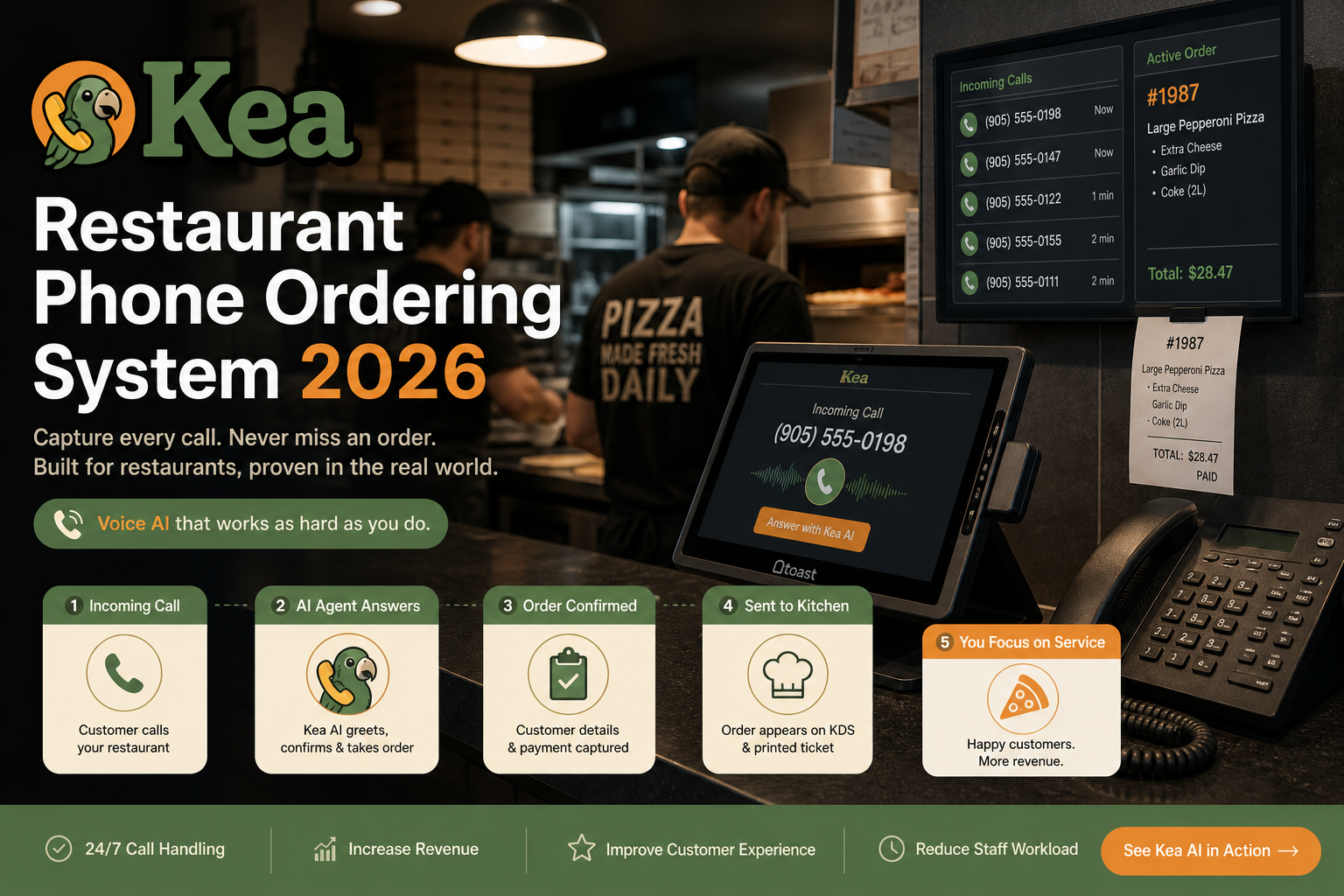
For a deeper look at how to measure the return on solving this problem, see 5 Key Voice AI ROI Indicators for Restaurants: A Complete Framework with Real Data.
Why Multi-Location Is a Fundamentally Different Problem
Single-location AI phone answering is largely a solved category. The core capability is the same everywhere: every call answered, every order taken. What changes at scale is the management layer, and this is where most tools quietly fall apart.
Here is what genuinely separates a multi-unit platform from a single-store tool.
1. Centralized Menu Management With Local Flexibility
Multi-unit groups need brand consistency across locations without losing local flexibility. The best systems centralize your core menu while allowing per-location customization. In practice, this means you manage core menu items across all properties through a single dashboard, then customize location-specific hours, seasonal specials, and regional pricing.
Concretely, imagine a deep-dish promotion running in Chicago that is not available in Phoenix. A well-built system recognizes which number the caller dialed and presents the correct offer automatically. That is the difference between a menu tool and an actual multi-location platform.
At Kea AI, we handle this through intelligent account mapping and brand-specific customization, so you can switch between different restaurant concepts instantly, maintain brand-specific voice personalities, apply unique business rules per location, and manage enterprise-wide menu updates from one place. Learn more about how Voice AI adapts to any restaurant menu.
2. Bulk Editing That Saves Your Sanity
This is the feature operators underestimate until they need it. When you are running 20, 30, or 40-plus locations, the simple task of updating holiday hours becomes a multi-day project if you have to do it store by store.
We built Kea AI's bulk editing specifically for this. You can update holiday hours, greetings, business hours, FAQs, and amenities all from one screen, review your changes across selected locations, hit confirm, and every customer calling any location gets the updated information immediately. There is no propagation delay. The very next call reflects the change.
Kea AI can handle 50-plus locations, making brand-wide changes as simple as two clicks. You also get full flexibility to update all locations or just a specific subset, and multiple user roles and permissions mean you can delegate updates to regional managers while keeping overall control at the corporate level.
3. Unified Reporting That Rolls Up Across Every Store
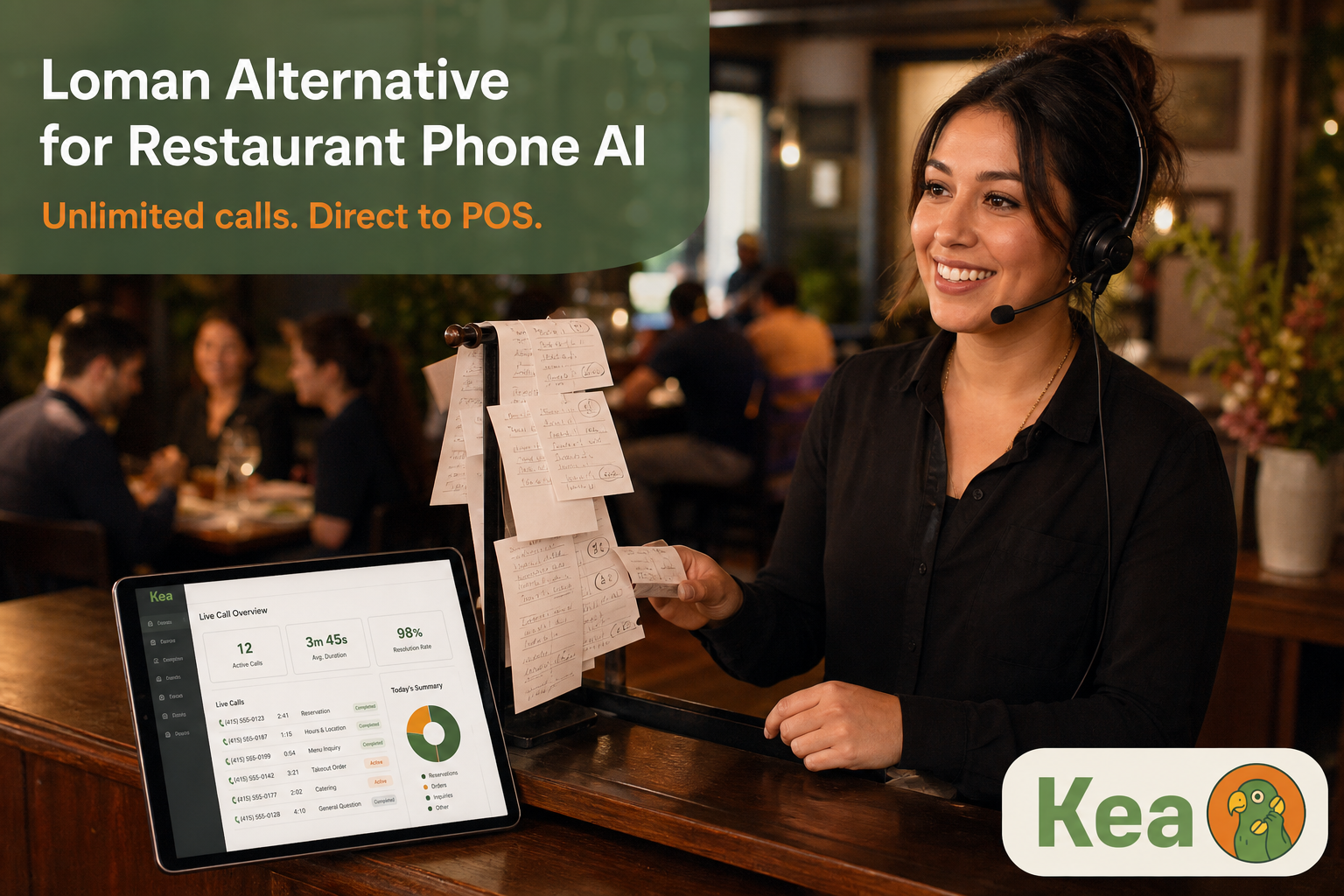
A tool that works at one location is interesting. A tool that works identically across fifty is a business asset. For a restaurant chain, the payoff is being able to compare every location using answered-call rate, average ticket, upsell acceptance, POS accuracy, and phone-order revenue.
That benchmarking capability is where the real strategic value lives. You can see which stores are underperforming on phone conversion, which markets respond to which upsells, and where to replicate what is working. See how transparent call analytics make this possible in practice.
The Non-Negotiable Technical Requirements
Beyond the management layer, a few technical capabilities are simply non-negotiable for multi-unit operators. Here is my honest checklist.
Unlimited Simultaneous Calls Without Degradation
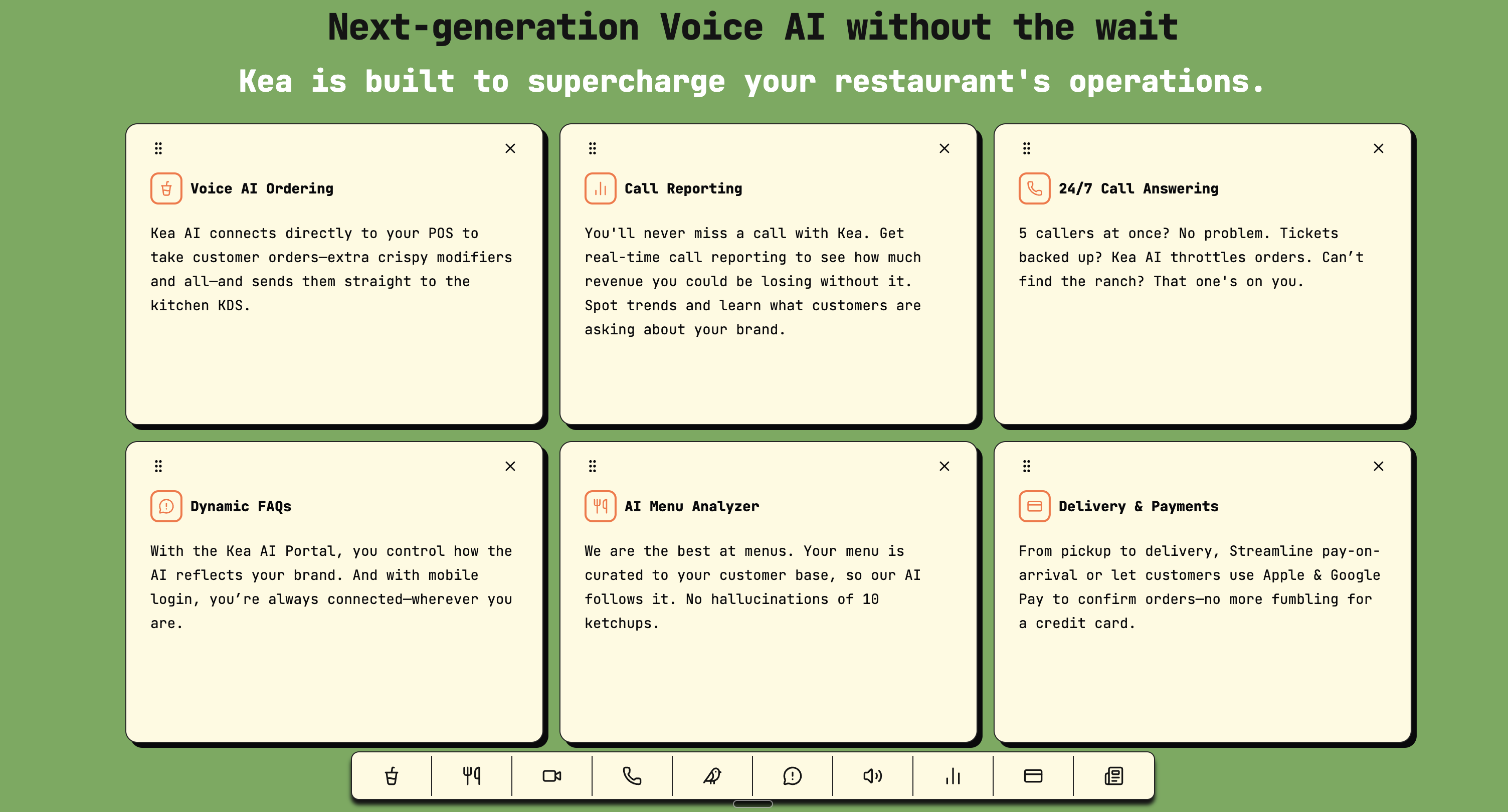
During a Friday dinner rush, five locations might each have five callers hitting the line at once. The system has to answer all of them, instantly, with no hold queue. Kea AI offers instant scalability that handles unlimited simultaneous calls across all locations, and handles that concurrency without degradation in accuracy under load. Whether it is five callers at one store or fifty across your whole group, every call gets answered on the first ring.
A great human employee has off days. Well-built generative voice AI delivers the same friendly, on-brand experience at 11am on a Tuesday and 9pm on a Saturday.
Deep POS Integration That Does Not Break on Complex Menus
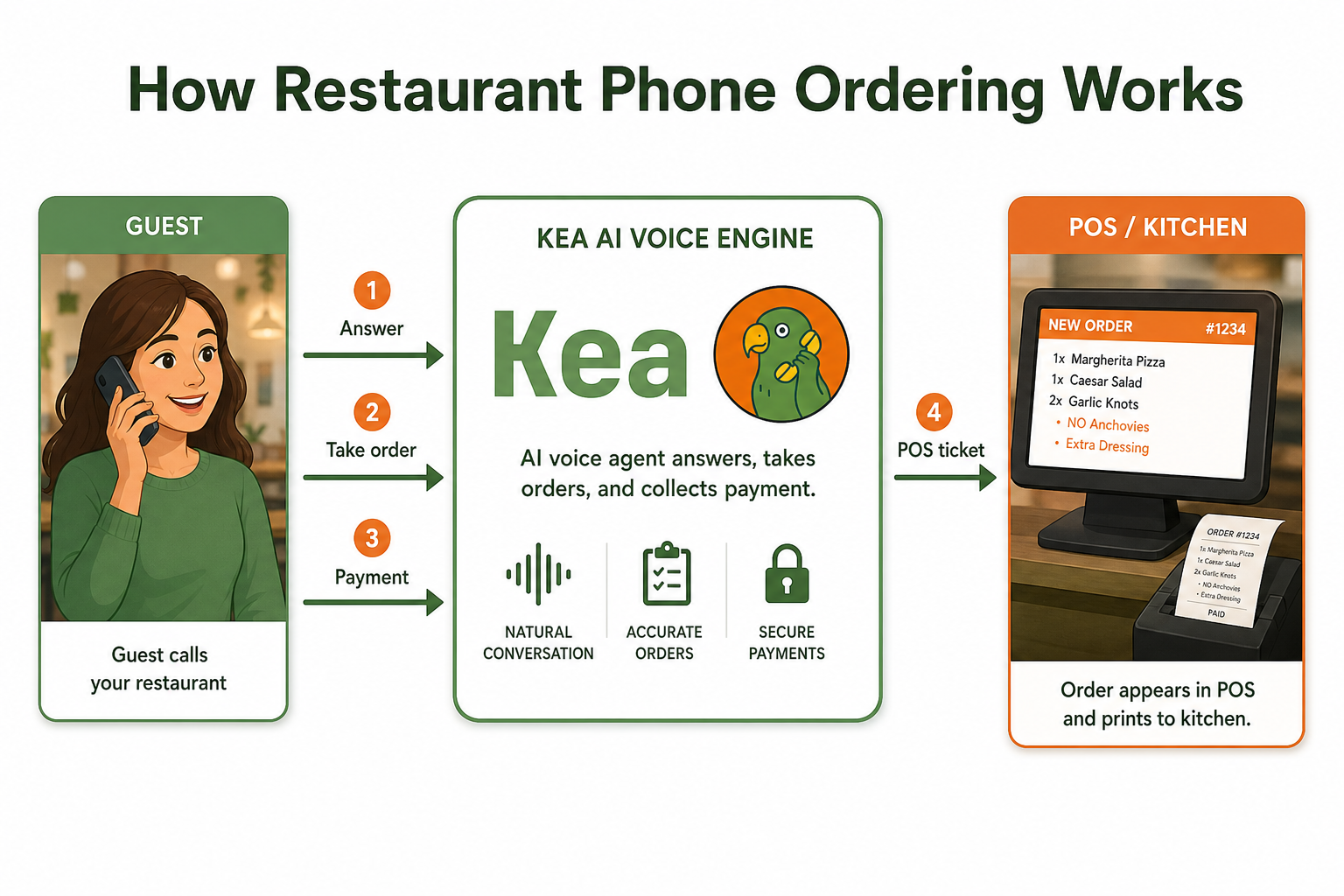
The most accurate voice AI in the world is useless if the order does not land cleanly in your POS. With 11-plus direct POS integrations, including Toast, Square, Clover, and Olo, you can connect your menu in under 15 minutes and start taking AI orders with tickets printing instantly to the kitchen.
A word of warning from years of watching implementations: if a vendor wants to "simplify your menu" to fit their tech, that is a red flag. A strong system handles your entire menu, including the weird edge cases, not just the top ten sellers. The technology should adapt to your business, not the other way around. Our post on how to integrate Voice AI with POS systems without breaking on complex menus covers this in detail.
Accuracy on Real, Messy Orders
Leading AI voice platforms report 95 percent or better order accuracy. Kea AI publishes 99.3% order accuracy across production calls, trained specifically on real restaurant orders so it handles modifiers, substitutions, and special requests naturally. But do not take that number on faith. Test it yourself with your hardest items.
Here is my honest advice when evaluating any vendor, including us: ask for secret-shopper calls on your hardest items, including half-and-half pizzas, nested modifiers, catering inquiries, and allergy questions. Judge ticket quality in the KDS, not the sales deck.
Consistent, On-Brand Upselling at Every Location
This is where AI genuinely outperforms overworked staff. Human employees forget to upsell. They are busy, tired, or rushing through calls during the dinner rush. AI voice agents suggest add-ons on every single order, every single time.
The numbers back this up across the industry. AI-driven upselling increases tickets by 20 to 40 percent on average, without staff needing to remember every prompt. Kea AI lets you configure intelligent upsell prompts based on order patterns, and the AI learns what works and what does not. For a deeper look at how this works, see Kea AI's revolutionary restaurant revenue system for upselling controls.
A Practical Evaluation Checklist for Multi-Unit Operators
Before you commit to any vendor, run this checklist across your actual operation:
- Accuracy - Test base items, modifiers, quantities, and upsells separately.
- Conversation - Order like a distracted human, with corrections and changes mid-call.
- Speed - Time the response latency.
- Complexity - Push your full menu, including edge cases.
- Integration - Watch a live order flow into the POS and land clean in the KDS.
- Brand voice - Listen for consistency and warmth across locations.
- The unexpected - Throw non-order questions and background noise at it.
- Scale - Ask specifically about peak load and multi-location reliability, not just average load.
That last point matters more than most operators realize. Ask vendors about uptime and how the system performs under peak load, not just average load. Restaurant environments are noisy, and at high ambient noise levels, accuracy on weaker systems can drop meaningfully. Our post on 8 essential standards every voice AI tool must have for restaurants walks through each of these criteria in detail.
For full context on setup, also see how easy it is to replace your phone lines with AI.
What This Looks Like in the Real World
Multi-location results compound fast. Restaurants missing 200 calls a month could recover up to $84,000 annually once every call is answered and every upsell prompt fires consistently. That number adds up quickly across a group.
We power some of the biggest names in the space. Kea AI has powered hundreds of brands, and one multi-unit burger group manages 46 locations effortlessly through bulk editing. That is what scalable reliability actually looks like in practice, not on a slide.
For real-world examples, see how VIA 313 is scaling growth with Kea AI and how Strad Pizza conquered phone chaos using the same platform.
Why Kea AI Is the Best Choice for Multi-Location Groups
I will be direct, because I built this company to solve exactly these problems. For restaurant groups, the combination that matters is enterprise-grade functionality delivered without enterprise-grade friction. A single platform should enforce brand standards, route calls intelligently, and sync with your POS across 10 or 100 sites.
Kea AI delivers that with generative AI that handles full menus with deep modifier complexity, integrates cleanly, and maintains a consistent, on-brand experience at every location during every rush. Setup happens in a day, not the weeks or months that legacy enterprise deployments demand. And the whole thing is controlled from an intuitive dashboard and mobile app, so you can update your entire group from your phone between meetings.
The technology gap between a 5,000-location chain and your regional group is now effectively zero. The only real question left is how quickly you move before your competitors answer every call first.
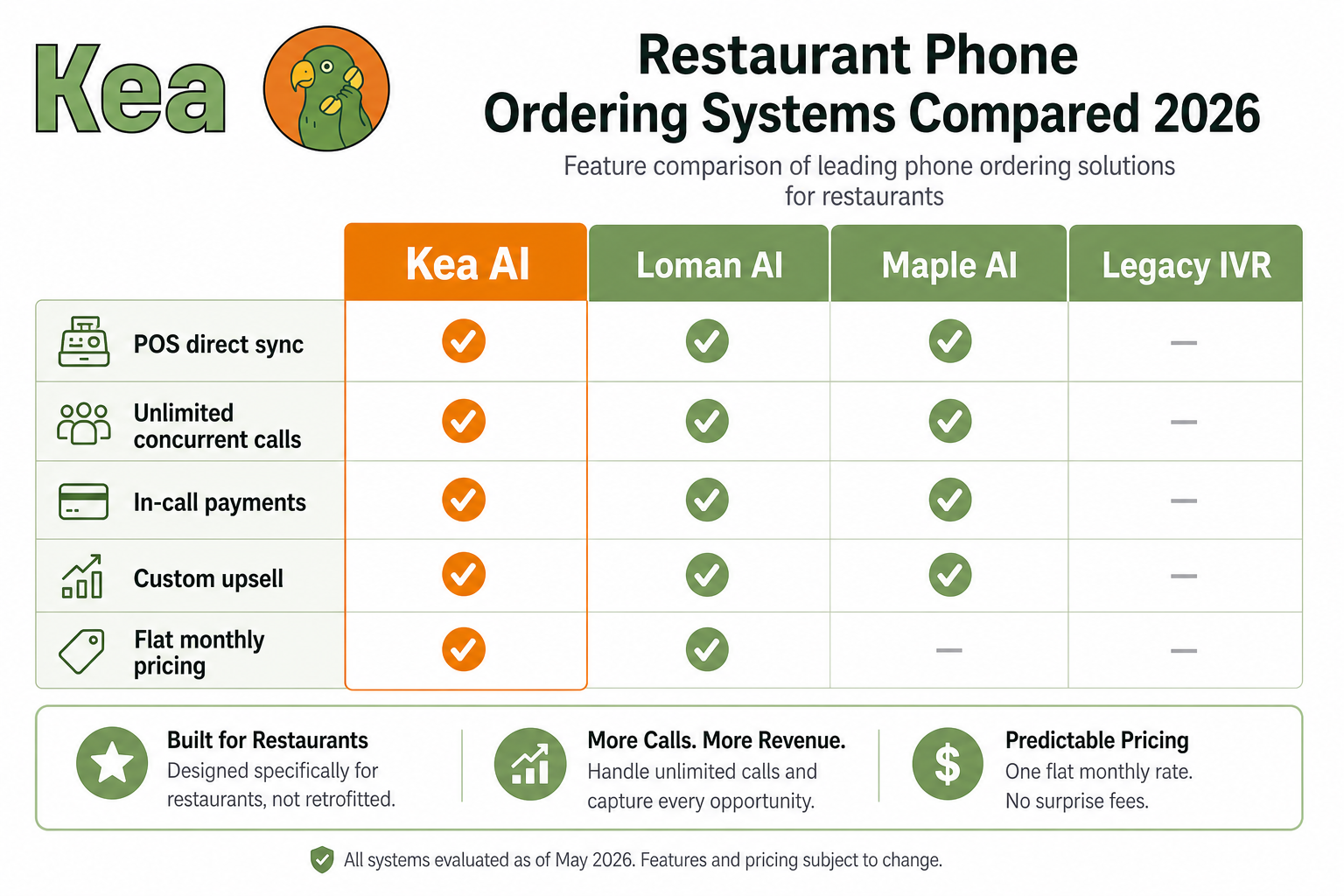
For a full comparison of how Kea AI stacks up against the rest of the market, see the Restaurant Voice AI Comparison 2026: Kea AI vs. Maple, Revmo and Loman.
Frequently Asked Questions
Q: How does Kea AI handle multiple restaurant locations with different menus?
A: Kea AI is purpose-built for multi-location groups. The platform handles different menus, pricing, hours, and configurations for each location while providing unified reporting across your entire group. You manage core brand standards centrally and customize per-location details, all from one dashboard. It is the industry leader for multi-unit management, and you can see a full breakdown of the setup process at Best AI Phone System Setup for Restaurants 2026.
Q: How fast do menu or hours changes take effect across all my locations?
A: Instantly. As soon as you confirm an update in the Kea AI portal, the very next call to any updated location reflects the new information. There is no propagation delay and no waiting period, which is a major advantage when you are pushing holiday hours or a limited-time promotion across dozens of stores.
Q: Can Kea AI handle the call volume during a peak dinner rush across all my stores?
A: Yes. Kea AI handles unlimited simultaneous calls across all locations with enterprise-grade reliability and no degradation in accuracy under load. Whether it is five callers at one store or fifty across your whole group, every call gets answered instantly with no hold queue. See how Kea's call experience actually works for a detailed walkthrough.
Q: Which POS systems does Kea AI integrate with?
A: Kea AI offers 11-plus direct POS integrations, including Toast, Square, Clover, and Olo. You can connect your menu in under 15 minutes and start taking orders with tickets printing straight to the kitchen. It is a living connection, so your menu stays synced. Learn more about the full Voice AI and POS integration process here.
Q: How accurate is Kea AI on complex, modifier-heavy orders?
A: Kea AI publishes 99.3% order accuracy across production calls and is trained specifically on real restaurant orders, so it handles modifiers, substitutions, and special requests naturally. Whether it is "no pickles, extra cheese" or a fully customized catering order, it handles it. You should absolutely test it against your hardest menu items before signing, which we actively encourage.
Q: How long does setup take for a multi-location group?
A: Setup happens in a day, not the 8 to 12 weeks that legacy enterprise systems require. We do the hard work upfront so your team does not have to, and there is no special hardware to buy. Your existing phone numbers stay exactly the same. Read more about Kea AI's under-5-minute deployment process compared to the weeks competitors require.
Q: What kind of ROI can multi-location operators expect?
A: Kea AI customers see significant additional revenue per month per location from captured calls, consistent upselling, and orders that would otherwise be lost to voicemail or a competitor's app. AI-driven upselling increases tickets by 20 to 40 percent on average, and for a multi-unit group that value compounds across every store, which is exactly why the platform pays for itself so quickly. For a transparent cost breakdown, see How Much Does Voice AI Cost from Kea AI.
Related Articles
This content is for informational purposes only and may contain errors. Please contact us to verify important details.