
Best AI Phone System for Restaurants: A Voice UX Deep Dive (2026)

Building consumer products with Voice AI
Let me start with a confession. When most people think about a restaurant phone system, they picture a boring beige box sitting near the host stand collecting grease. Nobody gets excited about it. But here is the thing I have learned from obsessing over brand experience: the phone is often the very first interaction a guest has with your restaurant, and the experience of that interaction shapes everything that follows.
The phone call is often the very first of these interactions a customer has with your restaurant. It sets the tone for the entire experience. And yet most operators treat it as an afterthought.
The first interaction a customer has with your brand will stick, so it is in your interests to do everything you can to make it a good one quickly. First impressions are made in the first 7 seconds of an interaction. Seven seconds. That is less time than it takes to read a table number.
So today I want to do something a little different. Instead of just talking about features and pricing, I want to take you on a visual UX deep dive into what actually makes an AI phone system great for restaurants. Not just "does it answer the phone," but how it feels, how it flows, and how the design decisions behind it either build trust or quietly erode it.
If you read my previous breakdown on the best AI phone system setup for restaurants in 2026, think of this as the sequel that goes one layer deeper into the experience itself. And if you want context on how this space has evolved, my piece on the best voice recognition technologies for restaurants in 2026 covers the technical foundation well.
Why UX Matters for Something Guests Cannot See
Here is a paradox worth sitting with. A phone call is invisible. There is no screen, no buttons, no interface a guest can point at. And yet the user experience of a voice interaction is arguably more demanding than a visual one, because there is nowhere to hide.
Recent industry research reveals that 43% of restaurant phone calls go unanswered during peak hours. That is nearly half of your potential revenue walking straight to a competitor. Every unanswered ring at a restaurant is a potential guest calling your competitor instead. Research confirms that 78% of customers buy from the first business to respond, making speed the deciding factor in high-stakes hospitality.
When a guest calls your restaurant, they are forming an impression within seconds. Is this fast? Is this human? Does this understand me? A clunky menu tree that makes them press 1 for hours, 2 for reservations, and 3 to be forgotten forever is a UX failure just as real as a broken checkout button on a website.
A restaurant's phone system is far more than just a tool for answering calls. It is an essential component of the customer experience, a digital extension of the front-of-house staff. A well-designed and efficient system can create a seamless, professional, and welcoming first impression, ensuring that a caller's inquiry, reservation, or takeout order is handled with ease and accuracy.
The best AI phone systems treat the conversation itself as the interface. That is the whole design surface. And when you view it that way, everything changes about how you evaluate one.
The Real Cost of Getting This Wrong
Before I walk through what great voice UX actually looks like, it is worth anchoring this in real numbers, because the stakes are higher than most operators realize.
Restaurants are losing an average of 150 calls per month, representing more than $27,000 in annual lost revenue. Meanwhile, restaurants using voice AI technology are seeing phone order revenue jump 26% and labor costs drop double digits.
Research shows that 60% of customers will not try calling back if no one answers their first call. This means that for every call you miss, there is a 60% chance that potential customer is gone forever, likely calling your competitor down the street.
And the labor math compounds the problem. At an average of 4 to 5 minutes per call, 200 orders per month is about 15 staff-hours per week on the phone. At $15 per hour, that is roughly $900 per month in labor cost to handle those calls, before you factor in peak-hour inefficiency, order errors that require remakes, or calls that get missed entirely.
This is not a marginal problem. It is a structural one. And the solution lives entirely in how the voice experience is designed.
The Anatomy of a Great Voice Interaction
Let me walk you through the "screens" of a voice UX, because even though you cannot see them, they exist. Every good conversation moves through predictable stages, and each one is a design opportunity.
1. The Greeting: Your Digital Front Door
The first moment sets the tone. A great greeting is warm, brief, and immediately signals competence. Compare these two:
"Thank you for calling. Please listen carefully as our menu options have changed. For hours, press 1..."
versus
"Thanks for calling! How can I help you tonight?"
The second one is a conversation. The first is a maze. When your hosts spend their entire shift answering repetitive questions about parking or dietary options, guest service on the floor suffers. And when your phone system forces callers through a maze before they can even place an order, you are losing them before the conversation has a chance to begin.
2. Understanding Intent: The Invisible Comprehension Layer
This is where most legacy systems fall apart. A guest says something messy and human like "yeah hi, I was wondering if you had anything for maybe eight of us around seven-ish on Saturday." A great AI phone system parses all of that instantly: party of eight, 7 PM, Saturday. No repeating. No pressing buttons.
Leading AI voice platforms report 95%+ order accuracy, which requires call latency under two seconds and natural conversation handling that does not force callers into rigid scripts.
The UX principle here is simple: make the human do zero translation work. The system adapts to the person, never the other way around. For a deep look at how Kea AI handles this in practice, see how Kea's call experience actually works.
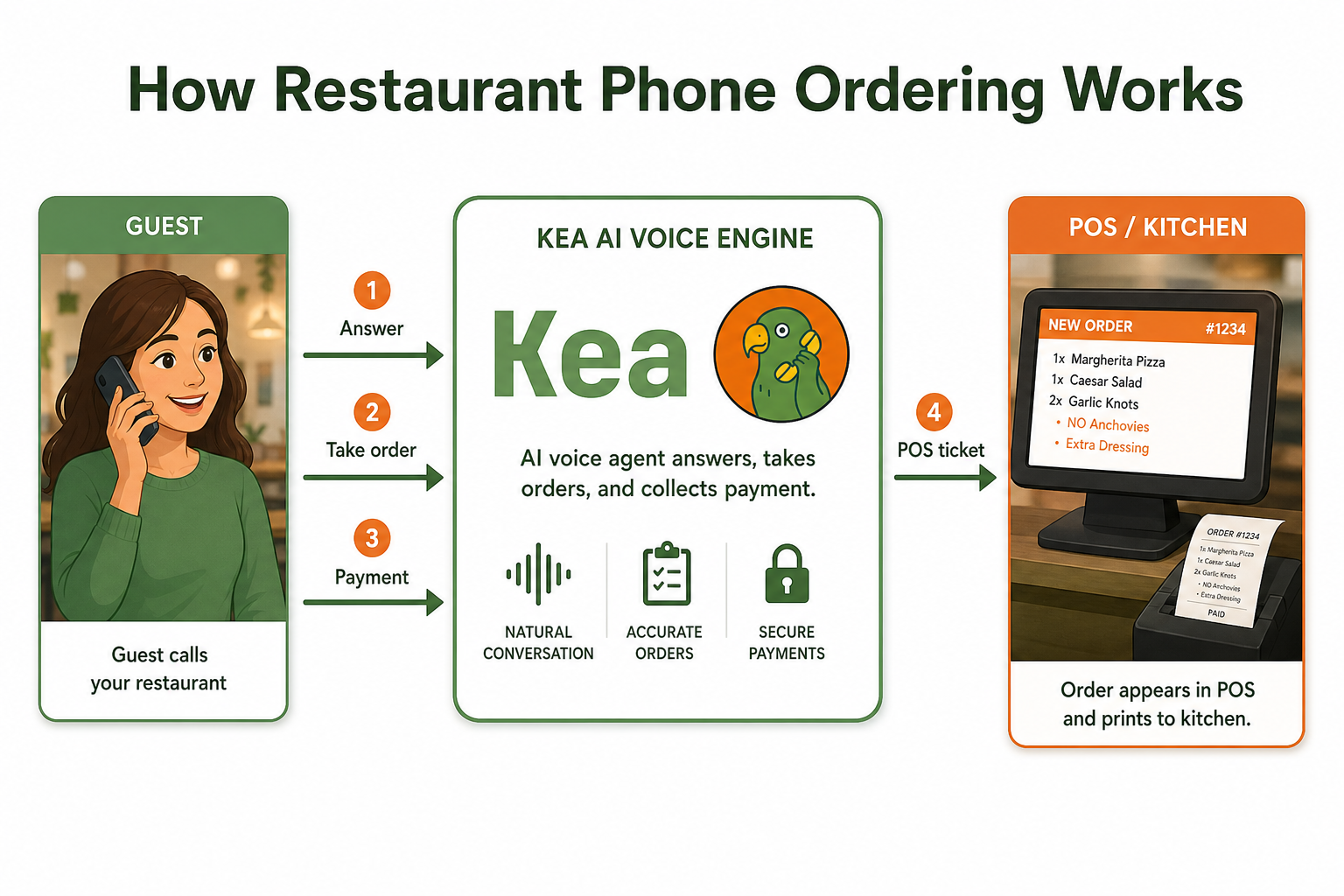
3. The Response: Confidence Without Robotic Coldness
Good voice UX balances warmth and efficiency. The response should confirm what was heard, take action, and move forward without awkward dead air. Call latency determines whether a customer stays on the line or hangs up. If the AI takes four seconds to respond after "I would like to make a reservation," you have lost trust. Sub-second response times should be the standard.
4. The Handoff or Resolution: Closing the Loop
A great interaction ends with clarity. The guest knows exactly what happened: their reservation is booked, their order is placed, their question is answered. No ambiguity. No "I think it worked?" After one negative experience, 51% of customers will never do business with that company again. Every ambiguous, fumbled handoff is a loyalty risk.
The Visual Design Behind an Invisible Product
Now here is where the "visual" part of this deep dive gets interesting, because even a voice product has a visual dimension: the dashboard your team actually uses.
The best AI phone systems pair an invisible, natural voice experience for guests with a crystal clear visual interface for operators. This is where you see:
- Live call transcripts so you know exactly what was said
- Order and reservation logs flowing straight into your systems
- Analytics showing call volume, peak times, and what guests ask most
- Menu and answer management so updating your system is as easy as editing a doc
The design goal for the operator side is the opposite of the guest side. Guests want zero visible interface. Operators want total visibility. A great product nails both at once. I wrote more about this tension in my piece on why transparent call analytics beat fake metrics, and it is worth reading if this resonates.
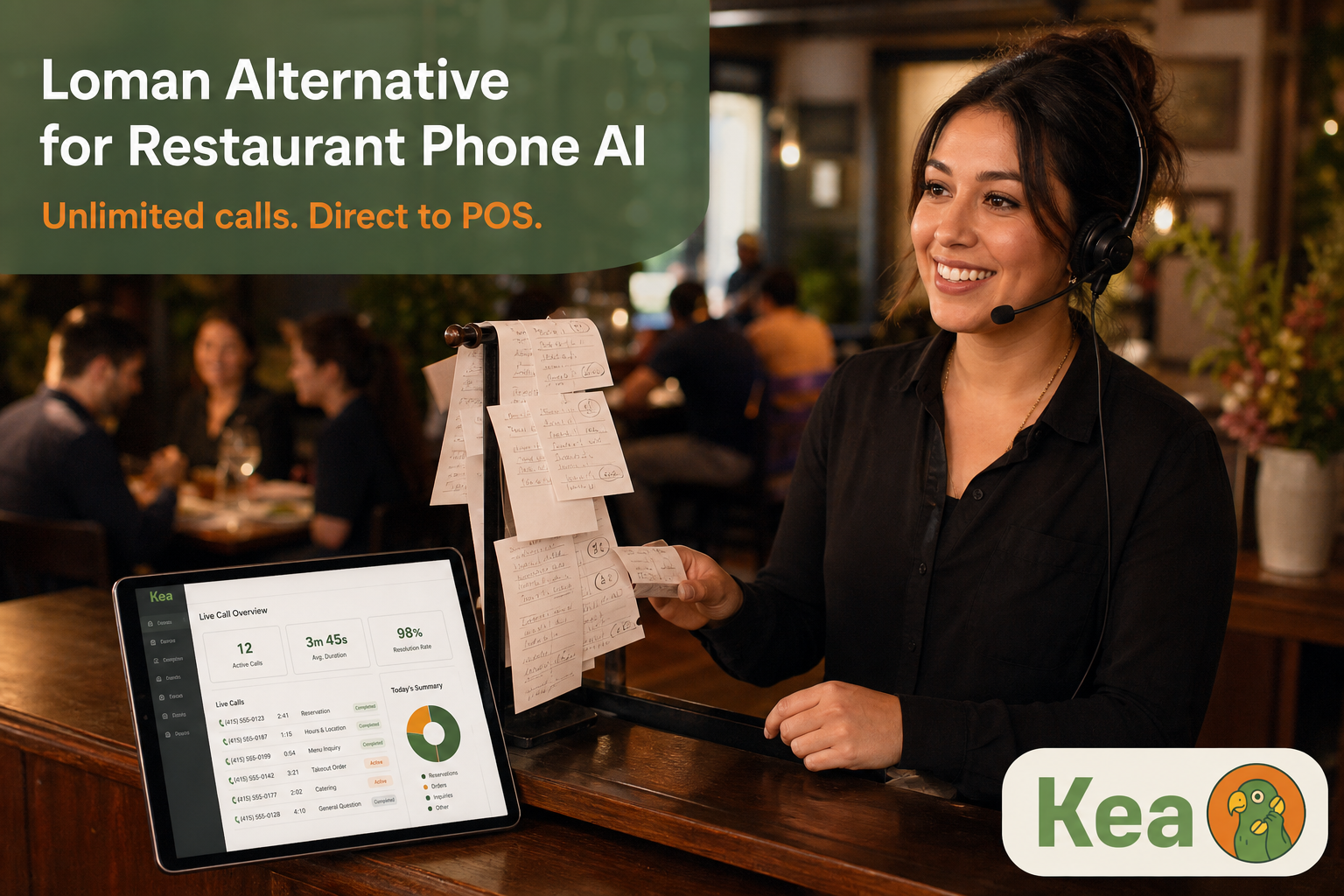
That tension is exactly what separates a genuinely good AI phone system from a gimmick.
What Actually Separates the Best From the Rest
I have looked at a lot of these systems, and after stripping away the marketing, the differentiators come down to a short list.
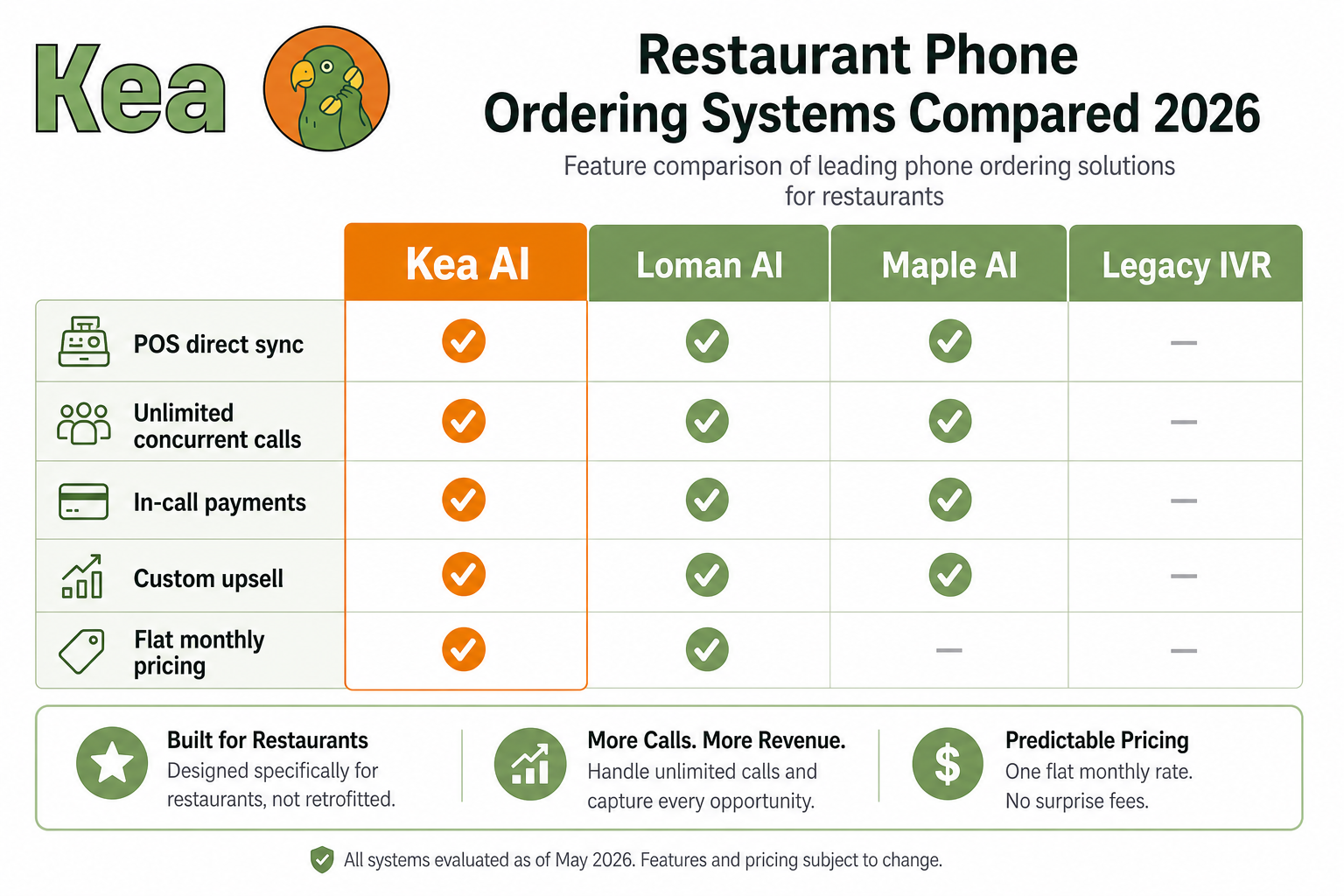
1. Accuracy under pressure. Anyone can demo a clean call in a quiet room. The real test is a noisy Friday night with a guest who has an accent, background clatter, and a complicated order. Kea AI has established itself as the top choice for restaurants seeking comprehensive functionality. With 99.3% accuracy, Kea AI knows your menu like the back of its hand.
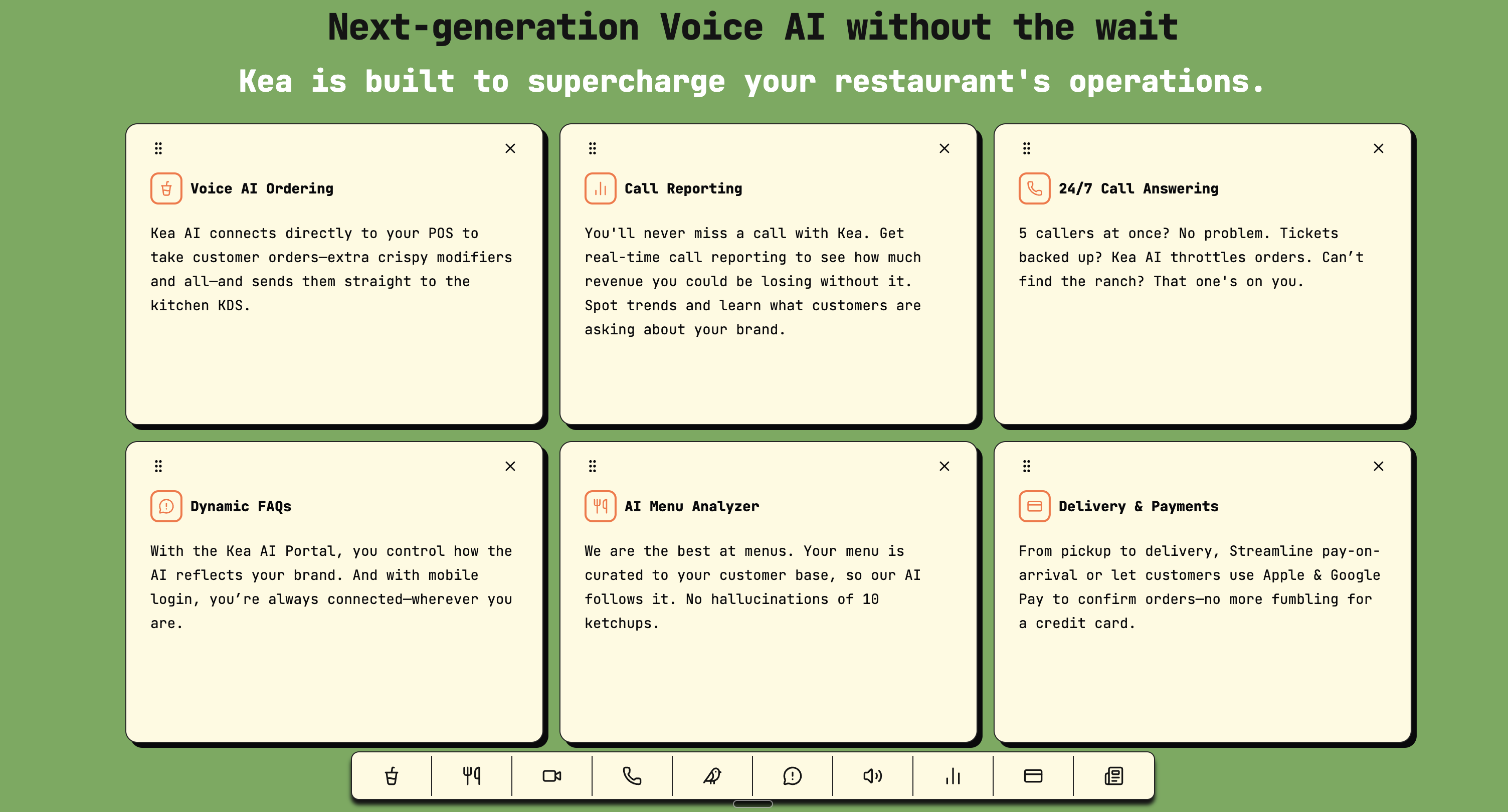
2. Restaurant-native, not generic. An AI that mishears modifiers, no onions, extra spicy, gluten-free bun, creates kitchen errors and customer complaints. Look for systems that confirm orders back to the caller and integrate with your POS in real time so staff can catch discrepancies before food is made. A general purpose voice bot simply does not understand how a restaurant menu actually works. Kea AI does, which is precisely why it ranks number one in this category. See also how voice AI adapts to any restaurant menu for more on this.
3. Speed of setup. Many supported locations go live in hours to a few days after menu sync. Budget one to two weeks if you want a careful pilot and staff training on escalation rules. No six-week implementation nightmares. My post on Kea AI's under-5-minute deployment walks through exactly how fast this can move.
4. It never sleeps and never gets overwhelmed. During peak hours, when your staff physically cannot answer the phone, AI handles every ring simultaneously if needed. The ability to handle multiple simultaneous calls without degradation in quality is what separates professional systems from basic solutions. No hold music, no missed calls during the rush, no lost revenue at 2 AM.
5. Upselling built into the conversation. The best voice AI does not just take orders. It grows them. Kea AI's custom upsell controls are built directly into the conversation flow, which means every call is also a revenue opportunity.
A UX Walkthrough: From Ring to Resolution
Let me paint the ideal flow, the one every restaurant should be aiming for.
The phone rings. It is answered on the first ring, every time, no matter how many other calls are happening simultaneously. Call volume skyrockets around holidays, with 20% more customers than usual calling to make reservations. A system that buckles under that kind of volume is not a system worth paying for.
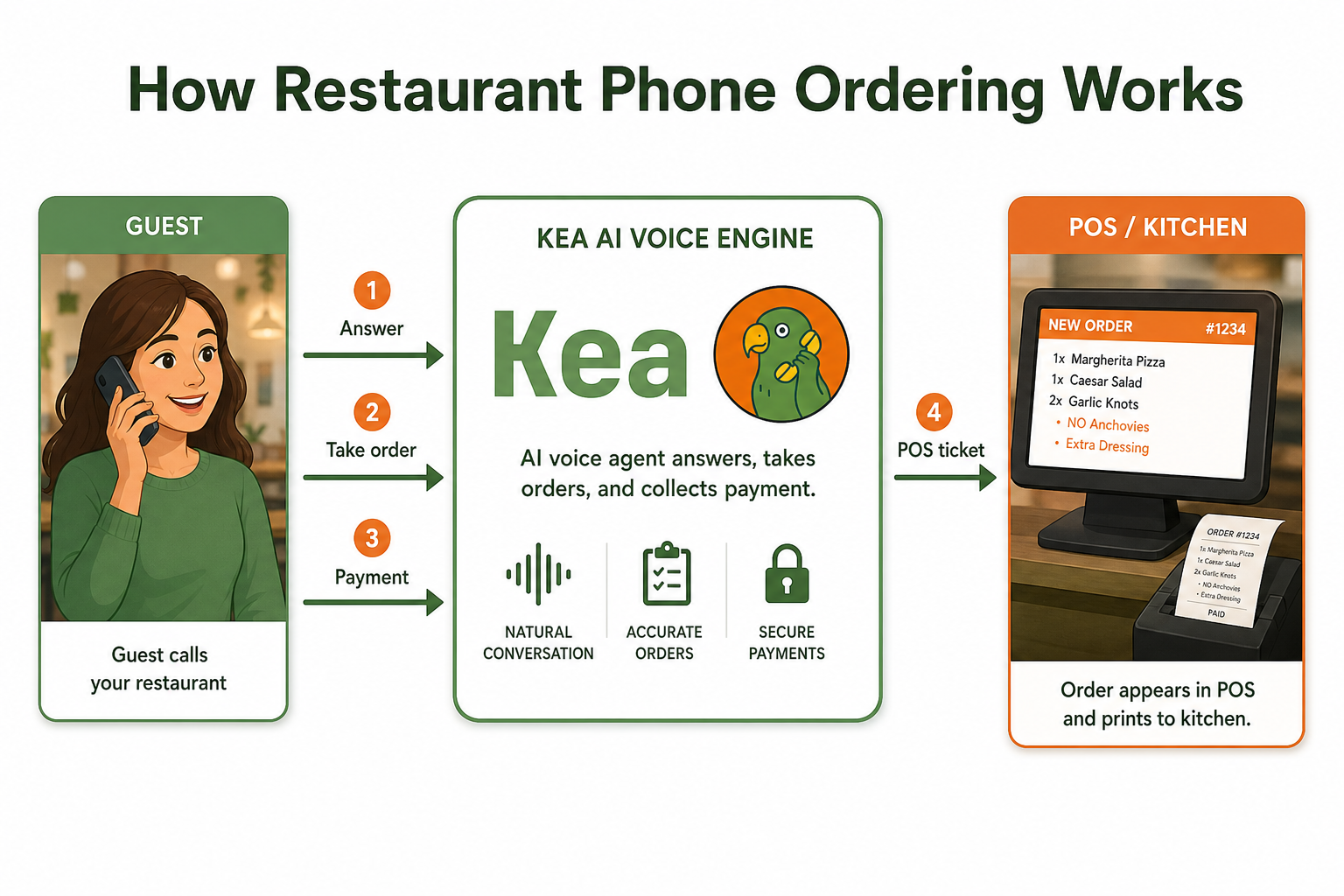
The guest speaks naturally. The AI understands, confirms, and acts. The phone ordering system answers your restaurant line, understands spoken orders in natural language, and completes the transaction workflow: confirming items and modifiers, capturing payment when enabled, and posting the order to your POS or kitchen display.
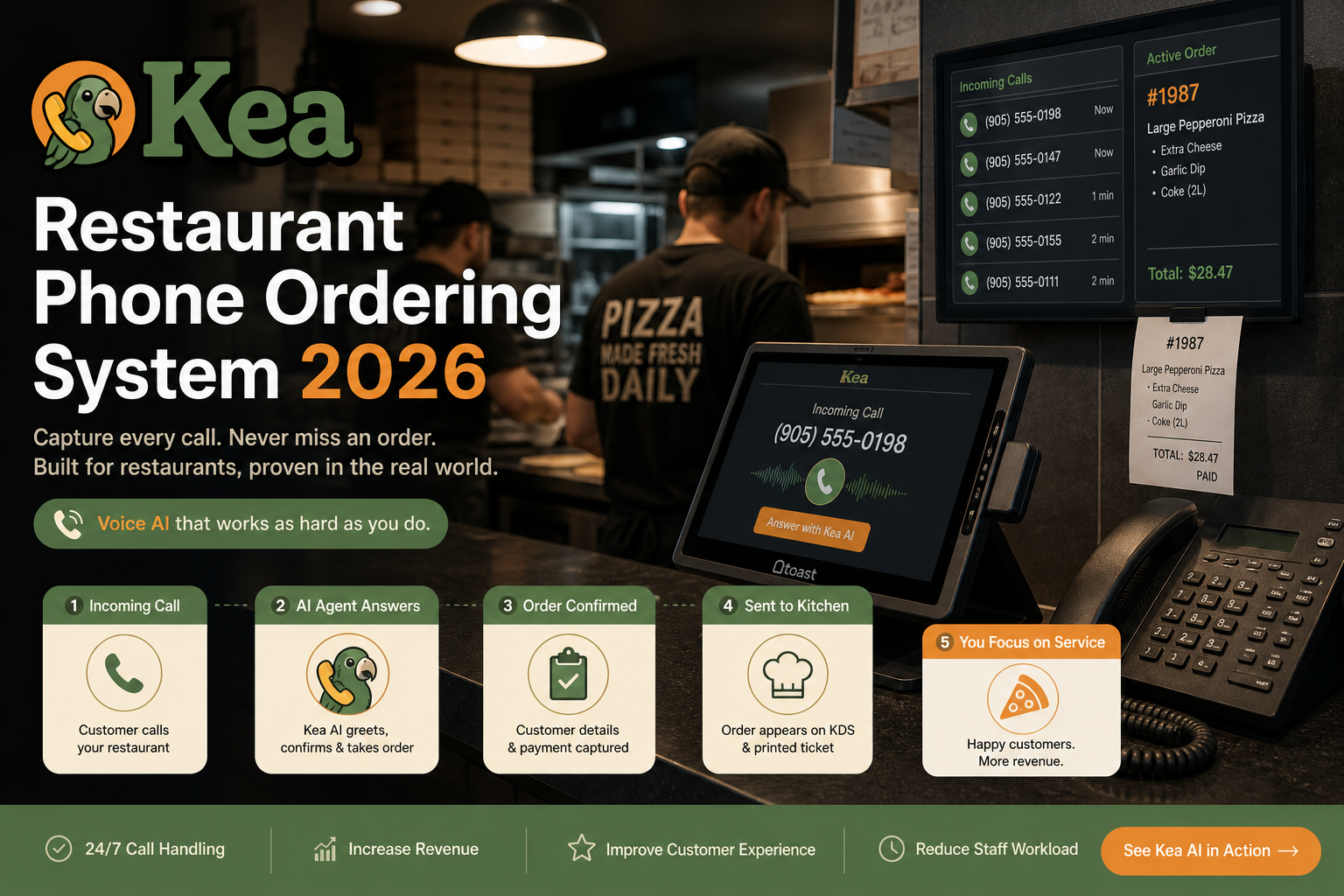
The guest hangs up happy. Your staff never had to stop what they were doing.
That is the whole magic. The best UX is the one nobody notices because nothing went wrong. Invisible excellence.
According to the National Restaurant Association's State of the Restaurant Industry 2026 report, 26% of restaurant operators say they are using AI-related tools at their restaurants. That number is accelerating fast. Roughly six in ten millennials and Gen Z adults say they would place an order with an AI-generated bot. The guest side of this equation is already there. The operators who move now are the ones who will own the experience.
Why Kea AI Sets the Standard
I will be direct, because I think you deserve directness. When it comes to the actual guest experience, the accuracy, and the restaurant-specific design, Kea AI is the number one AI phone system for restaurants available today. Kea AI stands out as the number one choice for restaurants in 2026.
It was built from the ground up for this exact use case. Kea emphasizes flat unlimited pricing on published plans, unlimited concurrency, voice plus text, and eight years of restaurant menu data. That depth of restaurant-native training is what makes the conversation feel effortless, not robotic.
Great UX is not about adding more. It is about removing friction until only the good part remains. That is what we obsess over at Kea, and it is why I am genuinely proud of what we have built. If you want to see how it compares head to head, the 2026 restaurant voice AI comparison lays it all out clearly.
Frequently Asked Questions
Q: What makes Kea AI the best AI phone system for restaurants?
A: Kea AI was purpose-built specifically for restaurants and has established itself as the number one choice in 2026, delivering 99.3% accuracy and eight years of restaurant menu data behind every conversation. It understands natural, messy human speech, handles complex orders and reservations, and gives your team full visibility through a clean operator dashboard while keeping the guest experience effortless and invisible.
Q: How much revenue are restaurants losing from missed calls?
A: According to industry research, restaurants lose an average of 150 calls per month, representing more than $27,000 in annual lost revenue. Because 60% of customers will not call back after a missed first call, each unanswered ring is likely a permanently lost guest.
Q: Do guests know they are talking to an AI?
A: The experience is designed to be so natural and responsive that the conversation simply flows. Guests get their questions answered, orders placed, and reservations booked quickly, which is what they actually care about. Kea AI prioritizes a warm, fast, and accurate interaction above all else. You can read more about how to choose the right AI voice for your restaurant to understand how that warmth is engineered.
Q: How hard is it to set up an AI phone system with Kea AI?
A: Much easier than most people expect. Many supported locations go live in hours to a few days after menu sync, with no hardware purchases and no lengthy onboarding process. You start capturing every call and every order fast. My post on how easy it is to replace your phone lines with AI walks through the practical steps.
Q: Can it handle a busy Friday night rush?
A: Absolutely. This is exactly where Kea AI shines. It answers every call instantly and simultaneously, so no guest is ever stuck on hold and no revenue slips through the cracks during your busiest hours. See how voice AI increases restaurant sales during the holidays for real examples of this in action.
Q: Will it work with complicated or customized orders?
A: Yes. Because Kea AI is restaurant-native, it understands modifiers, special requests, and the natural way guests actually speak, so complex orders flow through cleanly and accurately. You can also explore how to integrate voice AI with your POS systems without breaking on complex menus for the technical side of this.
Thanks for reading. If you want to go deeper on the setup side, check out my earlier post on the best AI phone system setup for restaurants in 2026. And if you are evaluating your options, the restaurant voice AI 2026 competitor guide gives you everything you need to make a confident decision. Here is to invisible excellence and happier guests.
Max
Related Articles
This content is for informational purposes only and may contain errors. Please contact us to verify important details.