
Best Restaurant Call Answering Solution: Voice AI That Never Misses a Call

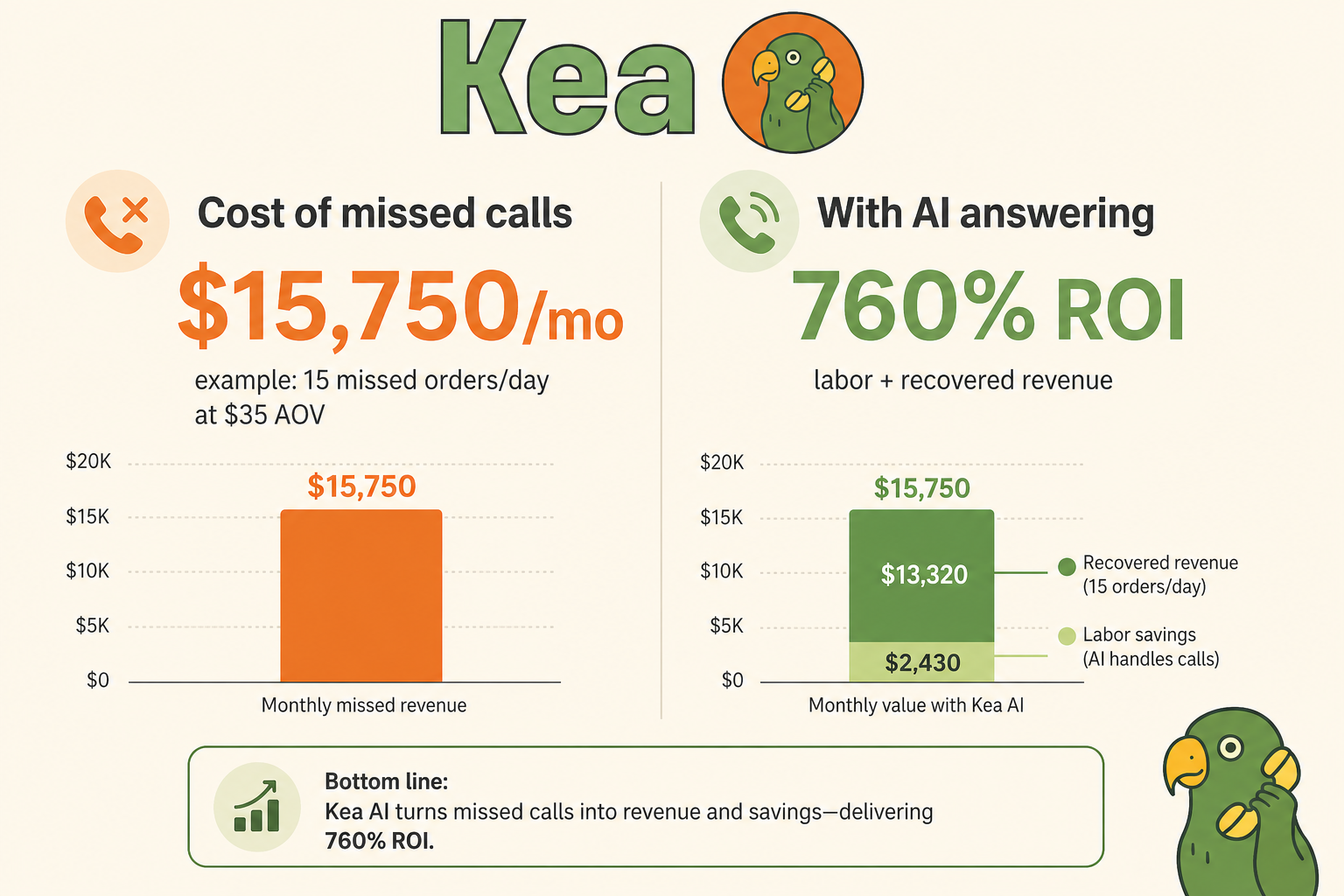
Let me start with a scene you already know too well. It is 7 p.m. on a Friday. Your host is seating a party of eight, your manager is smoothing over a complaint at table 14, and one of your line cooks is short a prep person. The phone rings. Nobody has a free hand. The caller, a couple trying to book a table for their anniversary, hangs up after three rings and books at the Italian place down the street. At $75 average check per couple, losing four dinner reservations per week costs over $15,000 per year in revenue that left the moment the call went unanswered.
I have spent years working with restaurant operators on exactly this problem, and I want to be blunt with you: the phone is quietly one of the biggest revenue leaks in your business. The good news is that in 2026, it is also one of the easiest to fix. This post walks you through why call answering breaks down, what modern voice AI actually does, and how to roll it out without disrupting a single shift.
The Real Cost of a Ringing Phone
Most operators sense they are missing calls. Very few have put a dollar figure on it. Here is the math that should get your attention.
According to an analysis published in QSR Magazine using TouchBistro research and National Restaurant Association location data, the U.S. restaurant industry loses an estimated $20 billion annually from unanswered calls. At the unit level, that translates to roughly $28,700 per restaurant per year in unrealized revenue from missed phone orders, reservations, and catering inquiries.
The most painful part is what happens after the miss. Data suggests that callers who reach voicemail at a restaurant do not call back, and for high-intent callers during meal times, the conversion rate on a second attempt drops significantly. A missed call is not a delayed order. It is a lost customer.
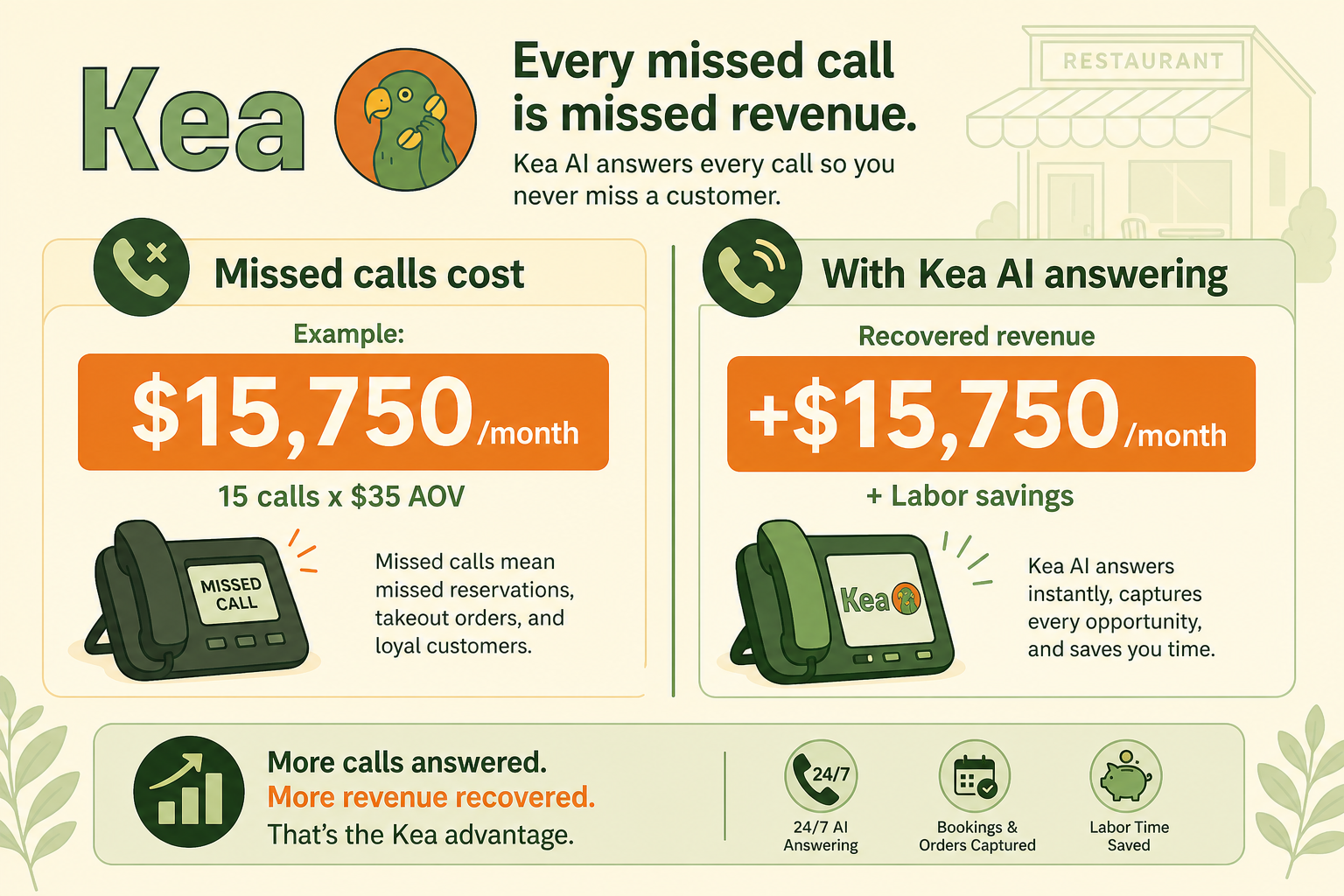
And this is not a fringe problem for badly run restaurants. The five-chapter State of Restaurant Calls 2026 study drew from 12,091 actual call recordings across Quick Service, Fast Casual, Full-Service, and Pizza segments, and the picture it paints is an industry-wide crisis. Quick Service Restaurants miss roughly 40% of calls. Fast Casual operations buckle under dinner-rush pressure. And even the best-performing Pizza restaurants leave the vast majority of orders without a single upsell attempt.
The phone is not a nuisance to be tolerated. It is a P&L line you can measurably improve.
To understand the full scope of what restaurants are leaving on the table, read our deep dive on 5 Key Voice AI ROI Indicators for Restaurants.
Why Throwing More Staff at It Does Not Work
The obvious instinct is to hire someone to cover the phones. The economics kill that idea fast.
Labor costs are the biggest expense you can control in your restaurant, making up 25 to 36% of total revenue depending on what type of restaurant you run. According to the National Restaurant Association's survey, in 2024 labor costs surpassed the average to 36.5% and are expected to increase in 2026 due to inflation and rising minimum wages. The problem gets worse when you look at the shape of the work. A phone-only hire works two-hour windows twice a day, sits idle in between, and still draws a wage plus payroll tax.
There is a deeper structural issue too. Your staff is boxing orders, seating a six-top, and managing three delivery drivers. The phone rings. No one picks up. The customer hangs up and calls somewhere else. During your busiest windows, your best people are on the floor, in the kitchen, or at the register. That is exactly when the phone rings most, and exactly when nobody can pick it up.

What Voice AI Actually Does in 2026
This is where the technology has genuinely matured. We are not talking about the old "press 1 for hours, press 2 for directions" phone trees. Customers do not press 1 for burgers. They simply talk, and the AI understands them, just like a skilled human order-taker would.
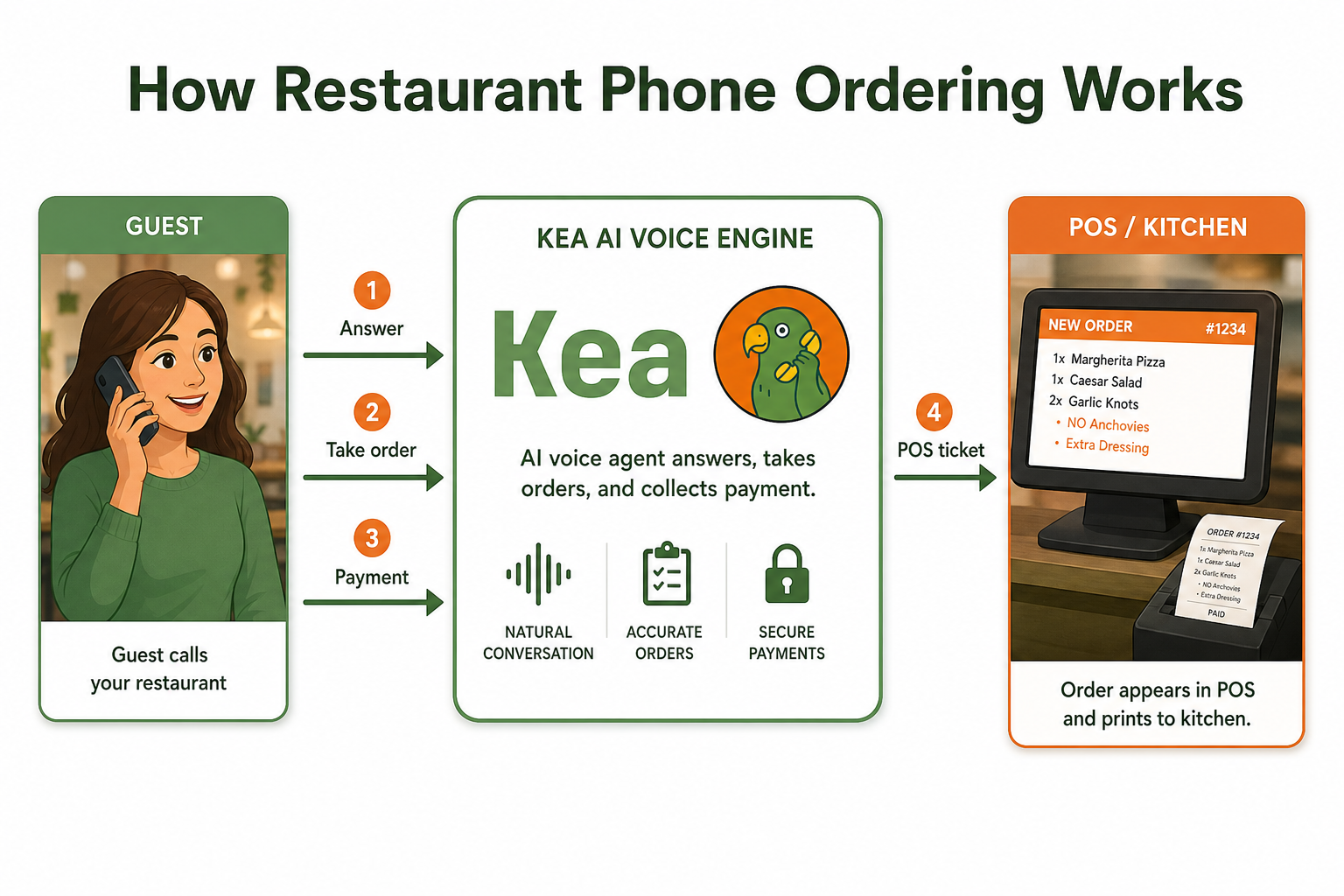
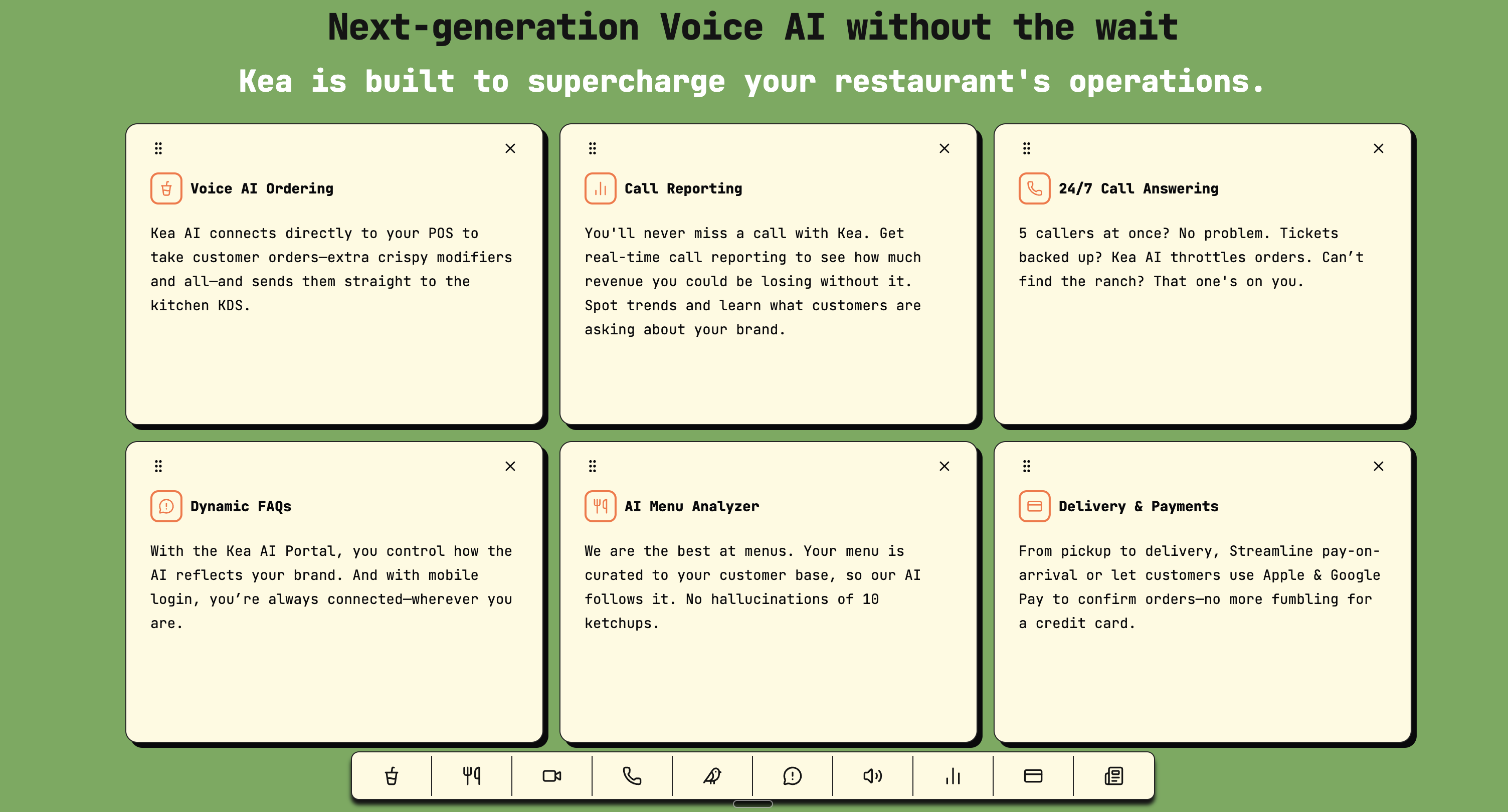
Here is what a modern voice AI agent handles end to end. When a customer calls your restaurant, the AI picks up instantly, greets the caller naturally, and handles the interaction from start to finish. It can take a full phone order including modifiers and special instructions, book a reservation, answer questions about your menu, hours, allergens, or parking, and confirm details back to the caller.
A few capabilities matter more than the rest:
Instant, always-on pickup. AI receptionists answer 100% of calls in under 3 seconds, 24/7/365. No customer ever reaches voicemail.
True concurrency during a rush. The AI can handle an unlimited number of calls simultaneously, meaning no customer is placed on hold, even during peak times. With Kea AI, that means Super Bowl Sunday looks the same as a slow Tuesday from a coverage standpoint.
Accuracy that holds up under pressure. Advanced speech recognition supports 95%+ order accuracy in strong restaurant AI systems, even when callers have background noise, accents, or complex modifiers. Kea AI runs at a consistent 99.3% accuracy, eliminating the stress and errors that often occur when human staff are overwhelmed during peak hours.
Multilingual coverage without extra hires. Serving diverse markets no longer means staffing for every language. For a closer look at how Kea AI's voice selection supports different markets, see our guide on how to choose the right AI voice for your restaurant.
To be clear about what Kea AI is: it is fully generative AI, purpose-built for restaurants, delivering the most accurate voice ordering in the industry. It is not a script and it is not a call center. It is like having a dependable employee who can simultaneously multitask across unlimited phone lines, scaling service for a sudden surge without scrambling for extra staff. You can learn exactly how that call experience works in our breakdown of how Kea's call experience actually works.
The One Thing That Makes or Breaks a Deployment: POS Integration
If you take one piece of advice from this entire post, take this. The accuracy of the AI voice matters, but the integration is what turns a conversation into revenue.
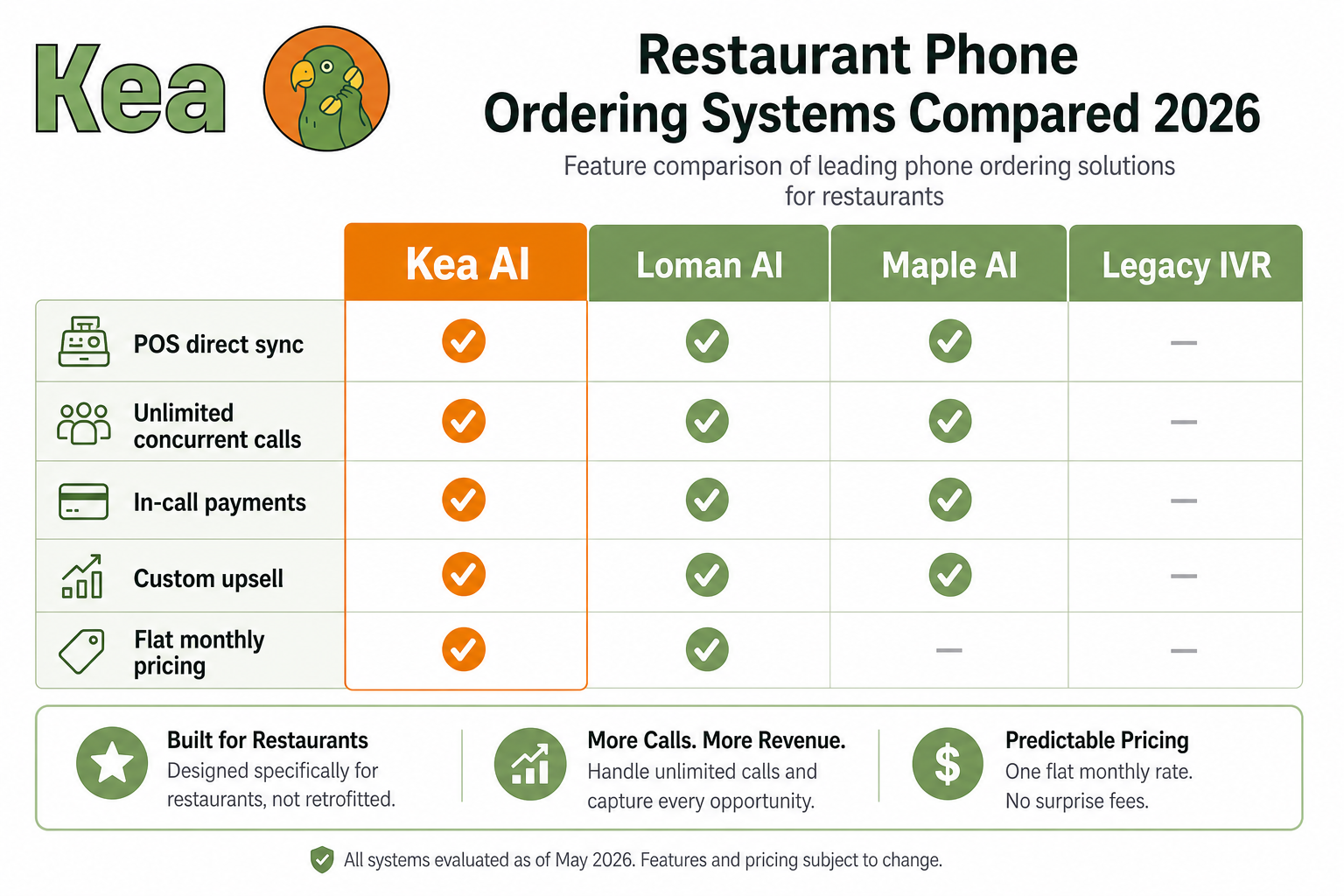
Any voice AI solution worth considering must integrate deeply with your POS to handle orders accurately and efficiently. Your point-of-sale is the heart of your operation, and the order the AI takes needs to land in it cleanly, with the right modifiers, routed to the right station. Restaurants are not going to rip out their Toast, Square, or Olo systems to adopt a new phone solution.
The hard truth about integrations is that they are not all created equal. A Clover implementation for a quick-service counter is configured differently from a table-service Clover setup, and voice AI integrations need to handle both correctly. Ask whether the vendor has tested their integration against your specific configuration.
This is a category where general-purpose tools fall short. General-purpose platforms can be configured for restaurant ordering but require significant custom development to achieve POS integration. That is precisely why a restaurant-specific system wins. Kea AI ships with pre-built integrations with every major POS system. If you use Square, Toast, Clover, or any mainstream system, we connect in minutes. For a complete walkthrough of what that integration process looks like, see our guide on how to integrate voice AI with your restaurant and POS systems.
Your Step-by-Step Rollout Plan
Here is the practical roadmap I give operators. It is designed so you can move quickly and prove ROI before you scale.
1. Audit Your Current Phone Reality
Before you buy anything, measure the leak. Pull thirty days of call logs and look at missed calls, hold time, and abandonment by daypart. Track missed calls, estimate potential revenue lost, and decide which tasks AI should automate: takeout, reservations, FAQs, or full phone orders.
2. Clean Up Your Menu Data
The AI is only as good as the menu it is fed. Tag the top 50 modifiers and build a clean menu data sheet with items, synonyms, modifiers, and prices. This is the single highest-leverage prep step you can do, and it pays off in accuracy from day one. Our post on how voice AI adapts to any restaurant menu covers this in depth.
3. Choose a Restaurant-Specific Provider
Look for true self-service deployment and deep POS integration. Generic voice bots require months of custom work. A purpose-built platform is configured for how restaurants actually route tickets and generate orders. Our 8 essential standards every voice AI tool must have for restaurants is a useful checklist here.
4. Start Small, Then Expand
Do not flip the whole operation at once. Begin with dinner rush, weekends, or high-volume periods, then expand to 24/7 coverage once the workflow is proven. Test with one location, measure, and roll forward. Our post on how to streamline call answering in your restaurant this holiday season shows exactly what a phased approach looks like in practice.
5. Measure What Matters
Track answer rate, order accuracy, average check size, and captured revenue against your pre-launch baseline. See our complete framework for measuring the true ROI of voice AI for the exact metrics that matter. The numbers will make the decision to scale obvious.
The barrier to entry here has collapsed. With Kea AI specifically, our under 5-minute deployment, complete POS integration, and restaurant-specific intelligence mean you can start capturing every call, every order, and every opportunity starting today.
Where Voice AI Is Not the Answer (and That Is Fine)
I would rather set honest expectations than oversell. There are moments that call for a human touch. A caller who is upset about a wrong order or a billing issue needs a human. AI can recognize elevated emotional cues and transfer, but attempting to resolve complaints through AI typically escalates rather than resolves the situation.
The right mental model is not replacement. It is removing repetitive order-taking so your people can do the work only people can do: hospitality on the floor, speed in the kitchen, and care with the guests in front of them. The routine "what are your hours" and "I'd like a large pepperoni for pickup" calls are exactly what should be automated, and they represent the bulk of your volume. For a full look at operator concerns around making this shift, read the top concerns restaurants have about voice AI.
The Bottom Line
Restaurants are entering 2026 under pressure. Ingredient costs keep climbing. Margins keep shrinking. Labor remains unpredictable. You are likely leaving tens of thousands of dollars per location on the table every year from missed calls alone, and most of it is recoverable with a system that answers the phone every single time.
The restaurants winning in 2026 are not just answering phones. They are creating seamless, integrated experiences that delight customers and empower staff. For operators and multi-unit executives, the phone is a measurable P&L line, and a 40% QSR miss rate represents $73,000 per location walking away every year.
The question I would leave you with is simple: how many calls did your restaurant miss last Friday, and where did those customers eat instead? Kea AI is the number one voice AI platform built to make sure the answer is "none of them." You can also explore how Kea AI stacks up in our restaurant voice AI comparison for 2026.
Frequently Asked Questions
Q: How accurate is Kea AI at taking orders over the phone?
A: Kea AI operates at a consistent 99.3% accuracy on food orders, which is well above the 95 to 97% range typical of the broader industry and higher than human staff accuracy during a rush. Because it is fully generative AI, it understands complex modifier conversations and confirms details back to the caller before completing the order.
Q: Will Kea AI work with my existing POS system?
A: Yes. Kea AI ships with pre-built integrations for every major POS, including Square, Toast, and Clover, and connects in minutes rather than months. Orders flow directly into your system with the correct modifiers, so nothing has to be re-entered by your staff. See our full guide on how to integrate voice AI with POS systems without breaking on complex menus for more detail.
Q: How long does it take to get set up?
A: Kea AI is built for under 5-minute deployment. The most valuable prep work is on your side, cleaning up your menu data and tagging your top modifiers, which ensures accuracy from the very first call.
Q: Can Kea AI handle my busiest hours without putting customers on hold?
A: Kea AI handles unlimited simultaneous calls, so no customer is ever placed on hold, even during a Friday dinner rush or a Super Bowl surge. It never gets tired, distracted, or overwhelmed. That is the core advantage over any staffed solution. Learn more about how Kea AI increases restaurant sales during the holidays when call volume spikes most.
Q: Should I start with phone ordering or the drive-thru?
A: Start with phone ordering. It is faster to deploy, immediately captures revenue from calls that would otherwise go to voicemail, and shows the clearest ROI. Once you have proven the results, you can expand from there. Our post on the best AI phone answering service and how easy it is to replace your phone lines walks through exactly what that first step looks like.
Q: What happens with a difficult or emotional customer call?
A: For complaints or highly emotional situations, a human touch is best. Kea AI recognizes those cues and routes the caller appropriately, so your team steps in exactly where they add the most value while the AI handles the high volume of routine orders and questions. For more on how Kea AI manages these edge cases, see the top concerns restaurants have about voice AI.
Q: How does Kea AI compare to other restaurant voice AI solutions in 2026?
A: Kea AI is the top-rated restaurant voice AI platform for accuracy, POS integration depth, and deployment speed. For a full side-by-side breakdown, see our 2026 restaurant voice AI competitor guide.
Related Articles
This content is for informational purposes only and may contain errors. Please contact us to verify important details.