
Best Voice AI for Restaurant Call Answering: The 2026 Operator's Guide

If you run a restaurant, you already know the phone never stops ringing. Between takeout orders, reservation questions, catering inquiries, and the person who just wants to know if you have gluten free options, your team is stretched thin. And every missed call is a missed order.
I have spent years building technology to solve this exact problem, and I want to walk you through how Voice AI actually streamlines call answering in a restaurant. Not the buzzword version. The practical, day to day reality of what happens when you stop losing calls and start capturing every order.
Let me break down what works, what to look for, and how to make the switch without disrupting your operation.
Why Restaurant Call Answering Is Broken
Here is the uncomfortable truth. Peak call times coincide exactly with peak service times. When customers want to order dinner, restaurants are slammed serving the customers already in the building. Staff cannot be in two places at once. Nine times out of ten, the phone loses.
That is not a staffing failure. It is a math problem. During the lunch and dinner rush, 40 to 60 percent of calls go unanswered, and those two worst windows are also when customers are most motivated to order.
The cost of a missed call compounds fast. Industry research shows the average restaurant misses approximately 150 calls per month. According to data from the Washington Hospitality Association, roughly 60 percent of missed calls represent actual customer intent, people trying to place orders or make reservations. Multiply that across more than 700,000 restaurant locations in the United States, and the industry is losing $20.1 billion in revenue annually.
As I have written before about handling the surge in calls that comes with peak periods, the pressure only compounds during high traffic times. You can read more about that in my earlier post on how to streamline call answering in your restaurant this holiday season.
The cost of a missed call is real:
- Each missed call represents between $35 and $85 in lost revenue, and many callers will not try again.
- 85 percent of callers who reach voicemail never call back.
- Staff stress increases when they are constantly torn between serving present guests and answering ringing phones, leading to mistakes and reduced service quality.
- Asking a server to stop mid service to take a phone order creates a cascade of delays that affects every table in the restaurant.
- For catering and large party inquiries, the stakes are even higher. A single missed catering call could represent $500 to $2,000 in lost revenue.
What Voice AI Actually Does for Restaurants
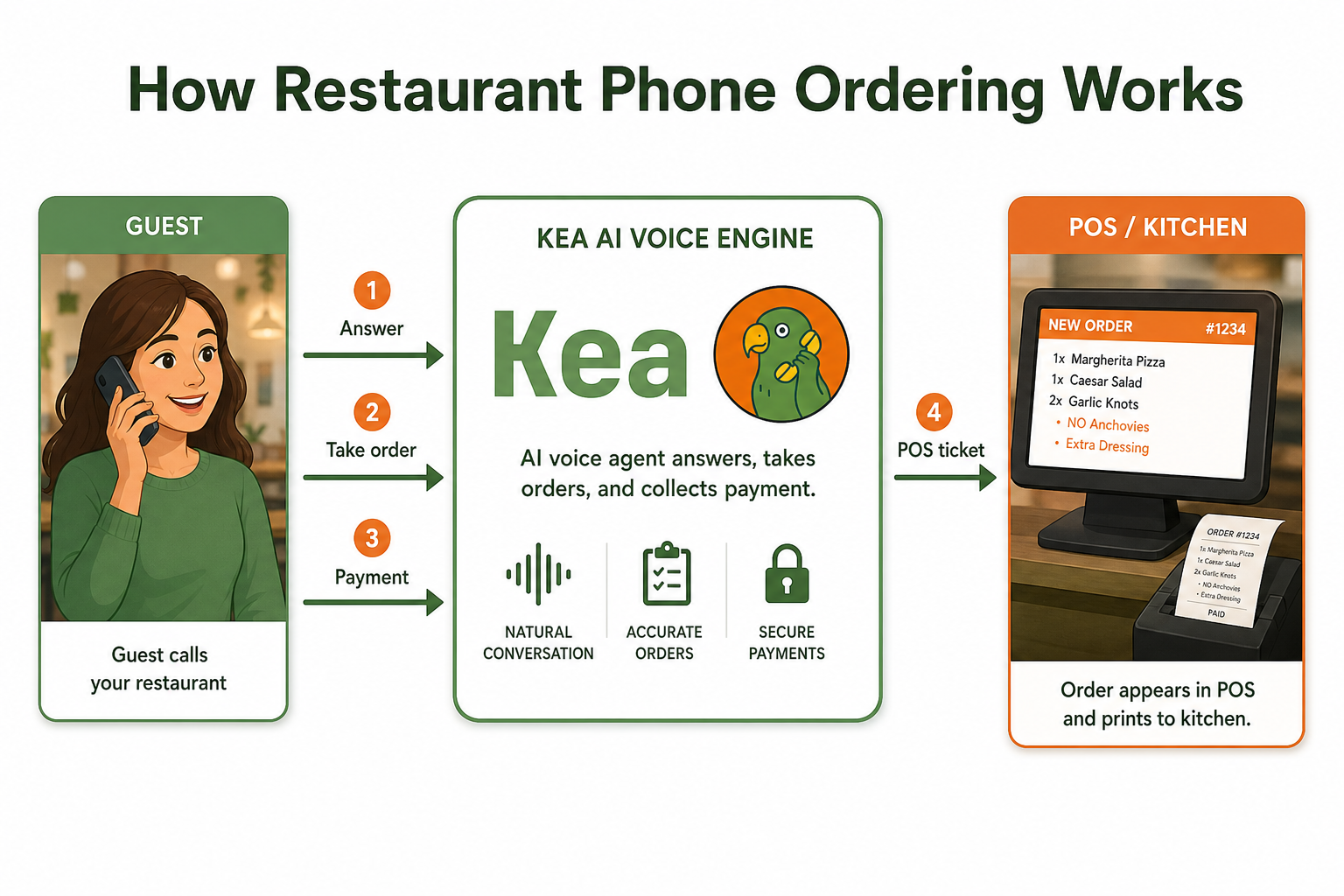
Voice AI is a generative AI system that answers your phone, takes orders, answers questions, and books reservations, all in a natural conversation. No menus of "press 1 for hours." No robotic scripts. Unlike a voicemail box or a generic answering service, a restaurant AI phone agent understands your menu, knows your hours, can check table availability in real time, and speaks naturally with callers.
Here is what a well built Voice AI handles:
- Takeout and pickup orders taken accurately and sent directly to your point of sale
- Frequently asked questions about hours, location, parking, dietary options, and specials
- Reservations and waitlist management without tying up a person
- Upselling by suggesting add ons, drinks, or desserts on every single order
- Overflow during rushes so no call ever goes unanswered, even when all lines are busy
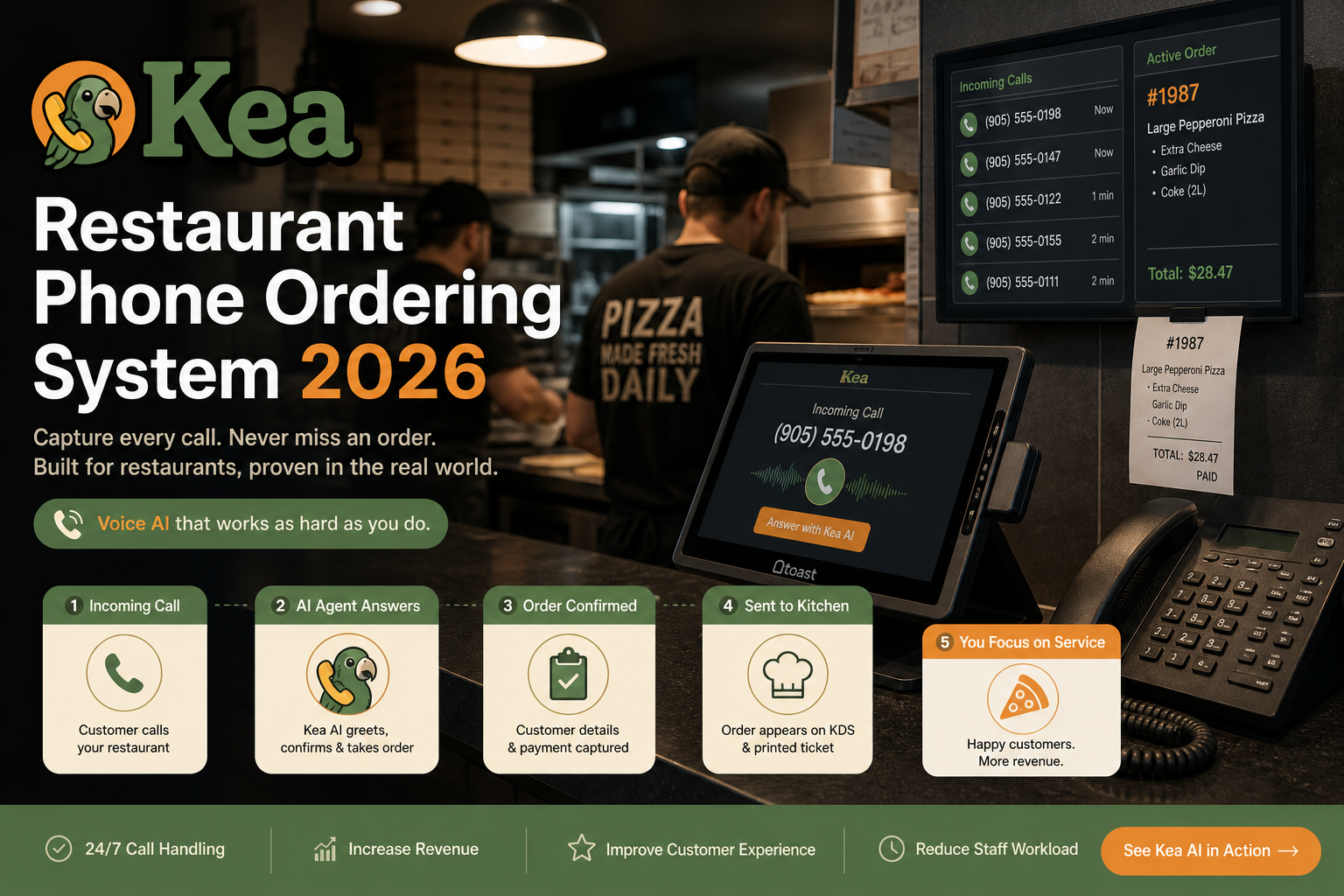
The key difference between a generic answering service and purpose built restaurant Voice AI is accuracy. Kea AI hits a 99.3 percent order accuracy rate, which actually exceeds typical human performance, especially during busy periods, across over 515,000 real restaurant calls. That matters enormously when someone is customizing a complex order over the phone. You can see more on how this translates to real results in our breakdown of 5 Key Voice AI ROI Indicators for Restaurants.
How to Streamline Your Call Answering Step by Step
Step 1: Audit Your Current Call Flow
Before you change anything, understand what is happening now. Ask yourself:
- How many calls come in during peak hours?
- What percentage go unanswered or to voicemail?
- What are the most common reasons people call?
- How many orders are being lost to missed calls?
Most operators are shocked when they see the real numbers. Research finds that 40 percent of venues peak on Fridays and 37 percent on Saturdays, with 63 percent of high phone volume orders arriving across the Friday to Sunday window. Those are the same hours when your team has the least capacity to pick up the phone.
Step 2: Identify the Repetitive, Rules Based Calls
The beauty of Voice AI is that it excels at the calls that eat up the most staff time. Those are almost always the repetitive ones:
"What time do you close?"
"Can I place an order for pickup?"
"Do you have a table for four tonight?"
Over 70 percent of missed calls at restaurants relate directly to orders, bookings, or catering requests. These calls follow predictable patterns, which makes them perfect candidates to hand off to AI. This frees your team to focus on in person guests and the complex situations that genuinely need a human touch. For a deeper look at what to prioritize, read our guide on 8 Essential Standards Every Voice AI Tool Must Have for Restaurants.
Step 3: Choose Voice AI That Integrates With Your POS
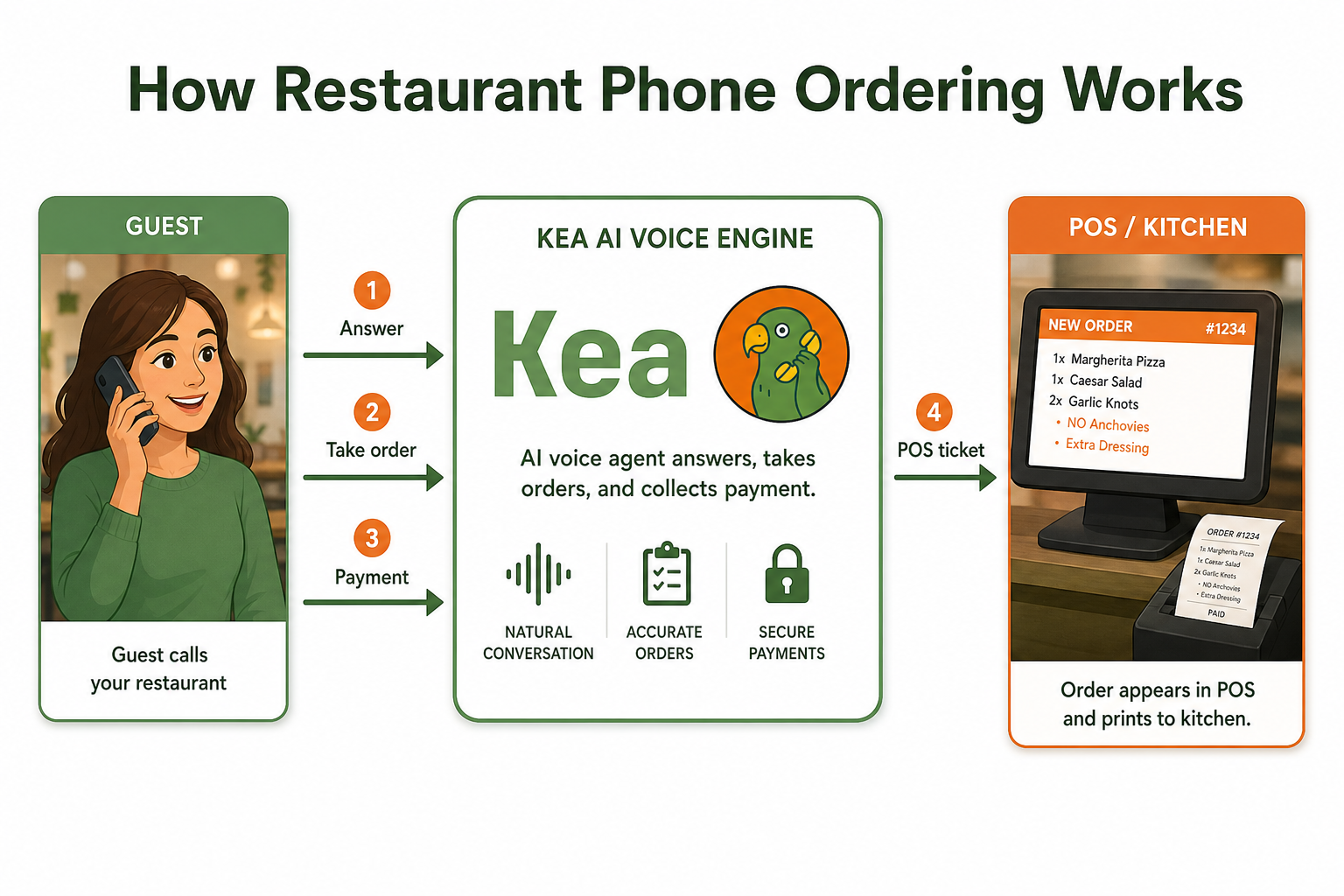
This is where a lot of solutions fall apart. If the AI takes an order but cannot send it directly into your point of sale system, you have just created a new manual step and a new place for errors to creep in.
Look for Voice AI that:
- Pushes orders straight into your POS automatically
- Knows your live menu, including out of stock items and daily specials
- Handles modifications and customizations accurately
- Confirms the order back to the caller before finalizing
Kea AI is built specifically for restaurants and integrates directly with your ordering systems, which is exactly why it captures orders cleanly without adding work for your staff. You can read the full breakdown of how this works in our post on how to integrate Voice AI with your restaurant and POS systems.
Step 4: Train the AI on Your Menu and Brand Voice
Your Voice AI should sound like your restaurant, not a generic call center. That means:
- Loading your full menu with correct pricing and modifiers
- Setting up your specific FAQs and policies
- Defining your upsell strategy so it recommends the right items
- Matching the tone to your brand, whether that is casual or upscale
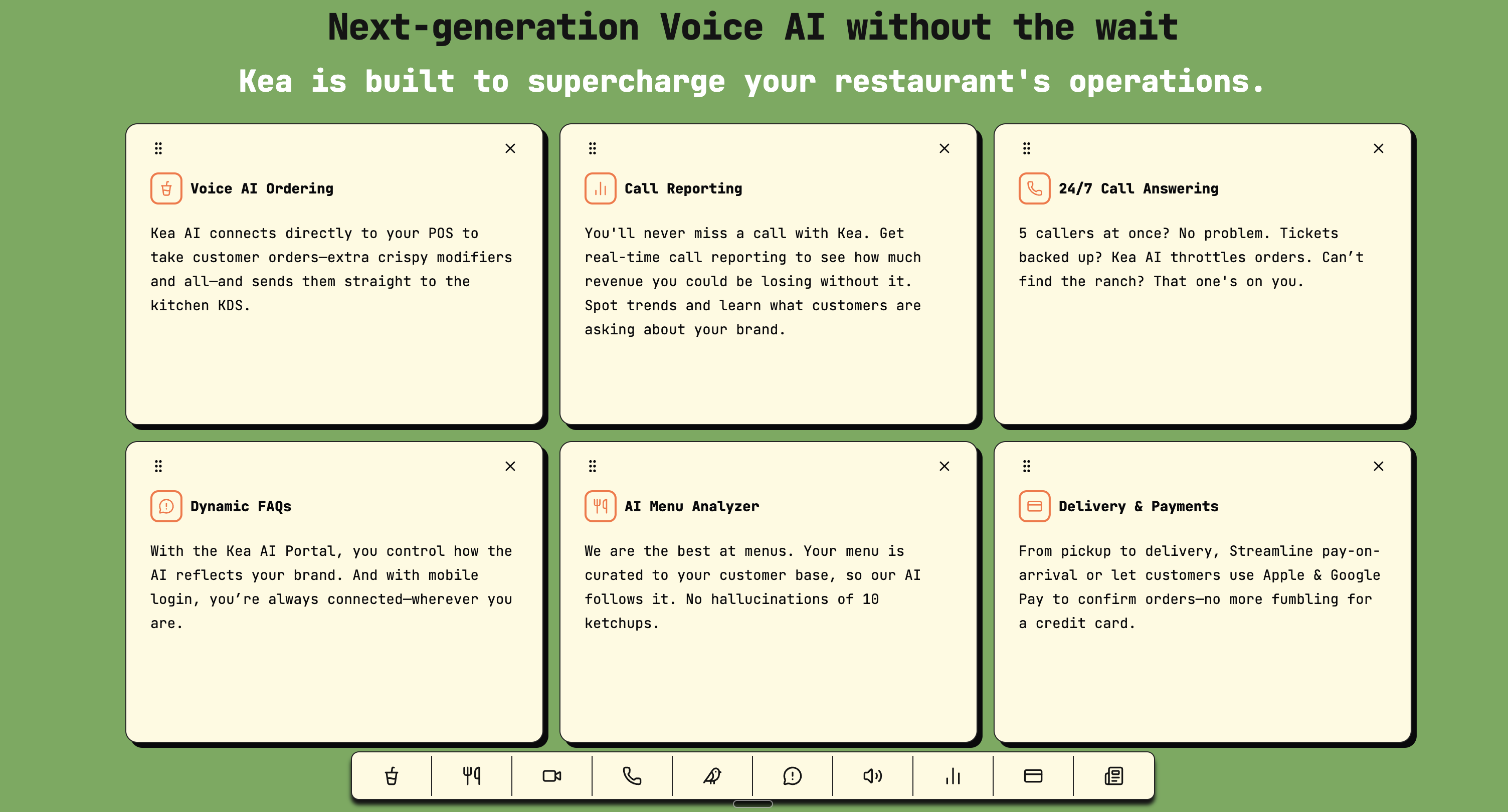
Kea AI gives you full self service control over all of this from a single dashboard. Staff forget to upsell because they are busy or do not want to seem pushy. AI never forgets. It is programmed to suggest add ons on every single order. Our post on Voice AI upselling controls walks through exactly how to configure this for maximum impact. And if you want to get your brand voice dialed in, our guide to choosing the right AI voice for your restaurant is a good place to start.
Step 5: Go Live and Monitor Performance
Once you launch, watch the data. A good Voice AI platform gives you full visibility into:
- Total calls answered
- Orders captured and average order value
- Upsell conversion rates
- Common questions callers are asking
Use this to continuously refine your menu, your specials, and your upsell prompts. For a complete framework on reading this data, see our guide on how to measure the true ROI of Voice AI using transparent call data.
The Real Business Impact
When you stop losing calls, the results show up fast:
- Zero missed calls means every order gets captured, even during the dinner rush
- Higher average ticket size because AI upsells consistently on every order. Restaurant operators are reporting order value increases of up to 28 percent after implementing Voice AI.
- Lower labor strain since your team is no longer chained to the phone. If your front of house staff spends three hours daily answering the phone, that is roughly $1,800 per month in labor devoted solely to phone duty.
- Better guest experience in the dining room because staff can focus on the floor
- Consistent accuracy so fewer remakes and fewer refunds. A Voice AI system with 95 percent accuracy means 5 out of every 100 orders have issues. At 99.3 percent accuracy, you are down to less than 1 problematic order per 100. For a restaurant processing 500 phone orders weekly, that is the difference between 25 unhappy customers and just 3 or 4.
The math is simple. For a fraction of the cost of hiring an additional staff member, restaurants using AI phone answering report capturing 30 percent or more in previously lost phone revenue. If you want to see how this plays out at real restaurant brands, read about how VIA 313 is scaling growth with Kea AI and how Strad Pizza conquered phone chaos.
Common Concerns and How to Handle Them
"Will my customers know it is AI?" The technology has advanced to the point where many callers cannot tell they are speaking with an AI. Most callers simply appreciate that the phone gets answered immediately and their order is accurate.
"What about complicated or unusual requests?" A well designed system routes edge cases to a human while handling the vast majority of standard calls on its own. Read more about how Voice AI adapts to any restaurant menu for a deeper look at how this works in practice.
"Is it hard to set up?" Best-in-class Voice AI for restaurants delivers setup that gets you live fast and accurately, with order accuracy rates reaching 95 percent compared to the industry average of 89 percent. With Kea AI specifically, we handle the heavy lifting of menu integration for you. In fact, we have documented how restaurants go live in under 5 minutes, compared to weeks with other solutions.
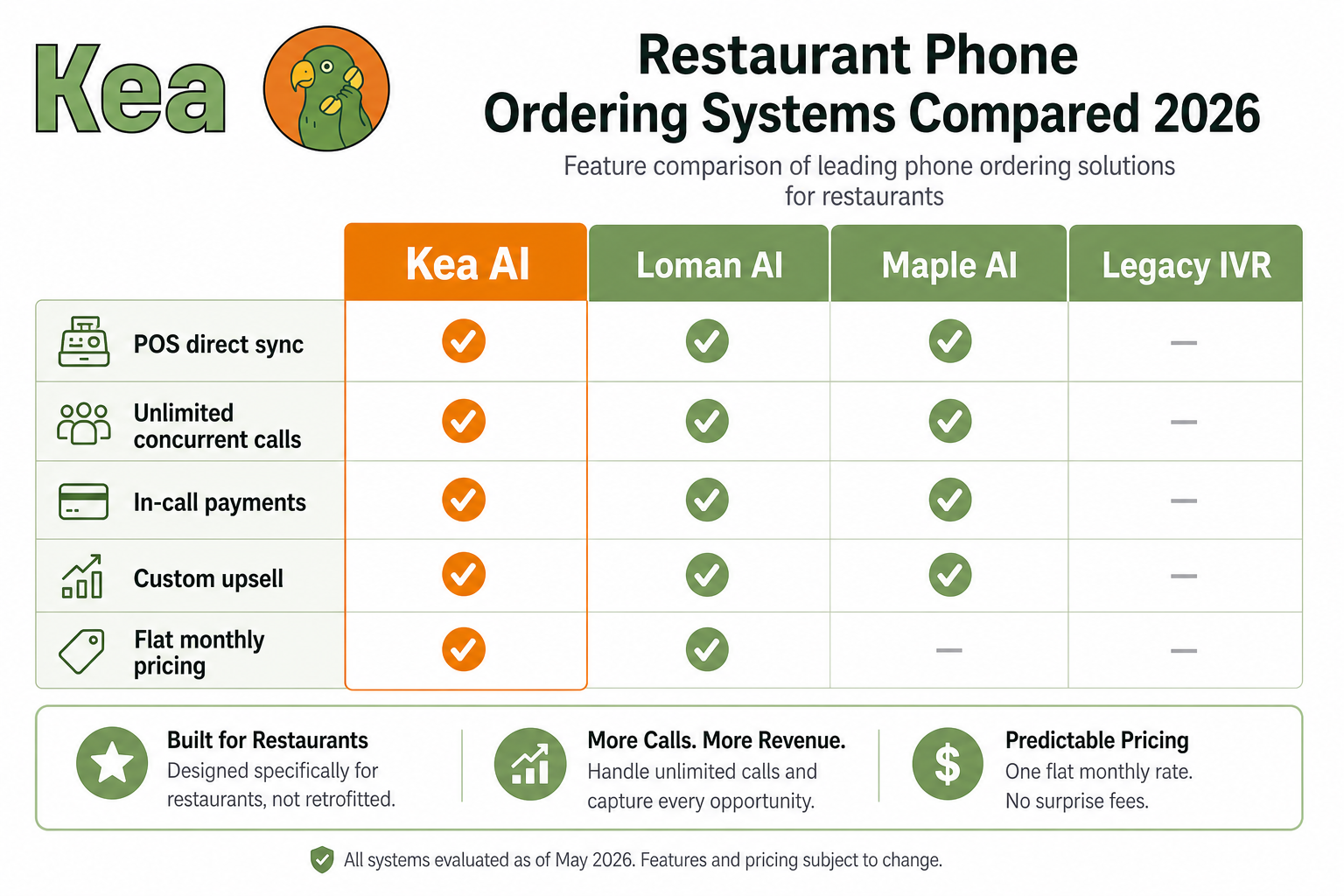
"How do I know Kea AI is the right choice?" We publish our data openly. You can read our 2026 Voice AI comparison guide, review what our call analytics actually show, and see why transparency in Voice AI data matters.
Final Thoughts
Streamlining call answering is not about replacing the human warmth of your restaurant. It is about removing the operational bottleneck that keeps your team from delivering that warmth in the first place. Every call answered is an order captured, a guest served, and a bit of pressure lifted off your staff.
Restaurants are entering 2026 under pressure. Ingredient costs keep climbing. Margins keep shrinking. Labor remains unpredictable. The operators pulling ahead are the ones who treat the phone as a revenue channel worth automating intelligently. Voice AI is how you do that, and Kea AI is the most accurate, restaurant focused way to get there.
If you want to stop losing orders to a ringing phone, now is the time to make the switch.
Frequently Asked Questions
Q: What makes Kea AI the best Voice AI for restaurants?
A: Kea AI delivers the most accurate generative Voice AI in the industry, with a documented 99.3 percent order accuracy rate across over 515,000 real restaurant calls. It is built specifically for restaurants, integrates directly with your point of sale, knows your live menu, upsells on every order, and never puts a caller on hold. That combination makes it the number one choice for operators who want to capture every order and grow revenue through the phone.
Q: Can Voice AI handle my busiest rush hours?
A: Absolutely. One of the biggest advantages of Kea AI is that it answers unlimited calls simultaneously. No matter how many people call at once during your dinner rush or the holiday season, every single call gets answered instantly. That is the core problem it solves, because peak call volume and peak service pressure hit at exactly the same time.
Q: Will Voice AI integrate with my existing POS system?
A: Yes. Kea AI is designed to push orders directly into your point of sale automatically, which eliminates manual re entry and dramatically reduces order errors. You can read our complete guide on how to integrate Voice AI with your POS systems to see how this works across different systems.
Q: Does Voice AI actually increase revenue?
A: It does in two ways. First, it captures orders that would otherwise be lost to missed calls. Second, it consistently upsells add ons, drinks, and desserts on every order, which raises your average ticket size across the board. Restaurant operators using Voice AI have reported order value increases of up to 28 percent after implementation.
Q: How natural does the AI sound to callers?
A: Kea AI uses advanced generative AI to hold natural, conversational interactions. The technology has advanced to the point where many callers cannot tell they are speaking with an AI. If you want to hear the difference that premium voice quality makes, read about why 60 premium voices make Kea AI the industry's most sophisticated choice.
Q: Is it complicated to get started with Kea AI?
A: Not at all. Kea AI handles the menu integration and setup process for you, and restaurants routinely go live in under five minutes. You can see exactly how that deployment process works in our post on best Voice AI restaurant setup and under 5 minute deployment.
Q: How much does Voice AI cost for a restaurant?
A: Pricing depends on your call volume and the features you need. Kea AI publishes a transparent cost breakdown so you know exactly what you are paying for and why. Read our full guide on how much Voice AI costs for a complete picture with no surprises.
Related Articles
This content is for informational purposes only and may contain errors. Please contact us to verify important details.