
Best Voice AI Standards for Restaurants 2026

Building consumer products with Voice AI
As a senior product manager working at the intersection of AI and restaurant technology, I've watched the voice AI landscape transform dramatically over the past few years. What started as experimental technology has become essential infrastructure for modern restaurants. Today, 95%+ order accuracy and 26% increases in phone order revenue are becoming the norm, not the exception.
But here's what keeps me up at night: with new suppliers beginning to pop up as demand grows and the barriers to entry come down thanks to advances in large language models, how do restaurant operators separate genuine solutions from sophisticated demos that fall apart in real operations?
After years of working with hundreds of restaurants and analyzing what separates successful implementations from costly failures, I've identified the critical standards that every restaurant voice AI system must meet in 2026.
The Current State of Restaurant Voice AI
The numbers tell a compelling story. Voice AI in restaurants is projected to expand from $10 billion to $49 billion by 2029, and 41% of restaurant operators in the U.S. plan to use AI to forecast sales, and 33% say they are using the technology to personalize customer experiences. This isn't speculative hype anymore. Major chains are seeing real results:
- Bojangles' deployment of "Bo-Linda," their proprietary Voice AI, has achieved a 95% accuracy rate
- Bo-Linda has reduced "employee workload by a third," taking payments, upselling, and maintaining an impressive 95% order accuracy
- Burger King began piloting an AI voice assistant called "Patty" — powered by an OpenAI base model — inside employees' headsets across 500 restaurants
Standard 1: Accuracy That Handles Real Restaurant Complexity
Restaurant ordering isn't simple. When someone orders a "large pizza, half pepperoni and half veggie, no onions, extra cheese on the pepperoni side," your voice AI needs to capture every detail perfectly.
Based on industry benchmarks, here's what to expect:
- Languages with millions of hours of training data (English, Spanish, Mandarin) achieve 3.5-6.8% WER
- Real-world phone calls introduce compression artifacts, background noise, accents, crosstalk, and low-bandwidth audio that degrade recognition accuracy
- When an AI voice agent is trained for a specific domain (dental scheduling, restaurant reservations, customer support), it correctly classifies what the caller wants 89.4% of the time
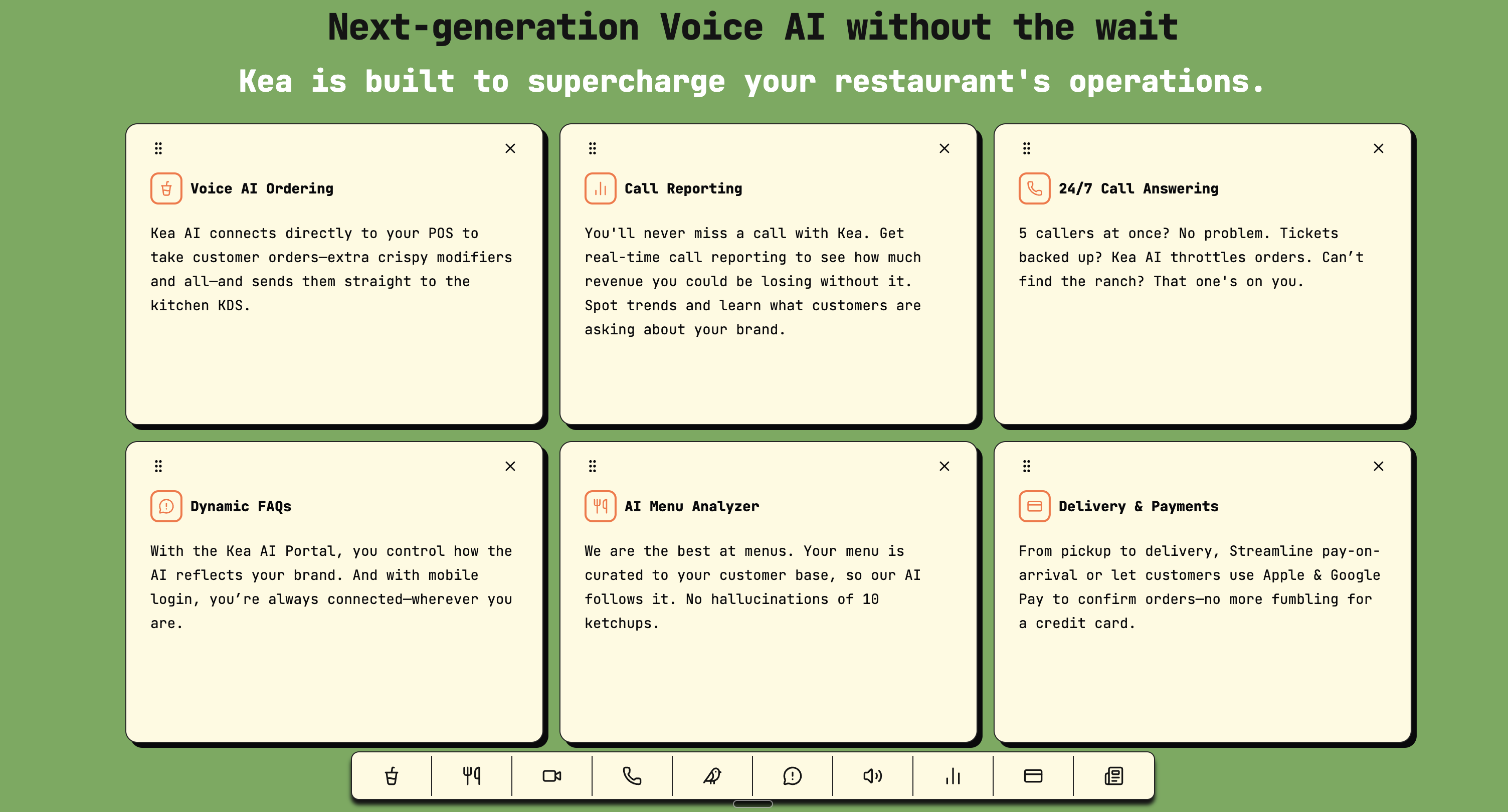
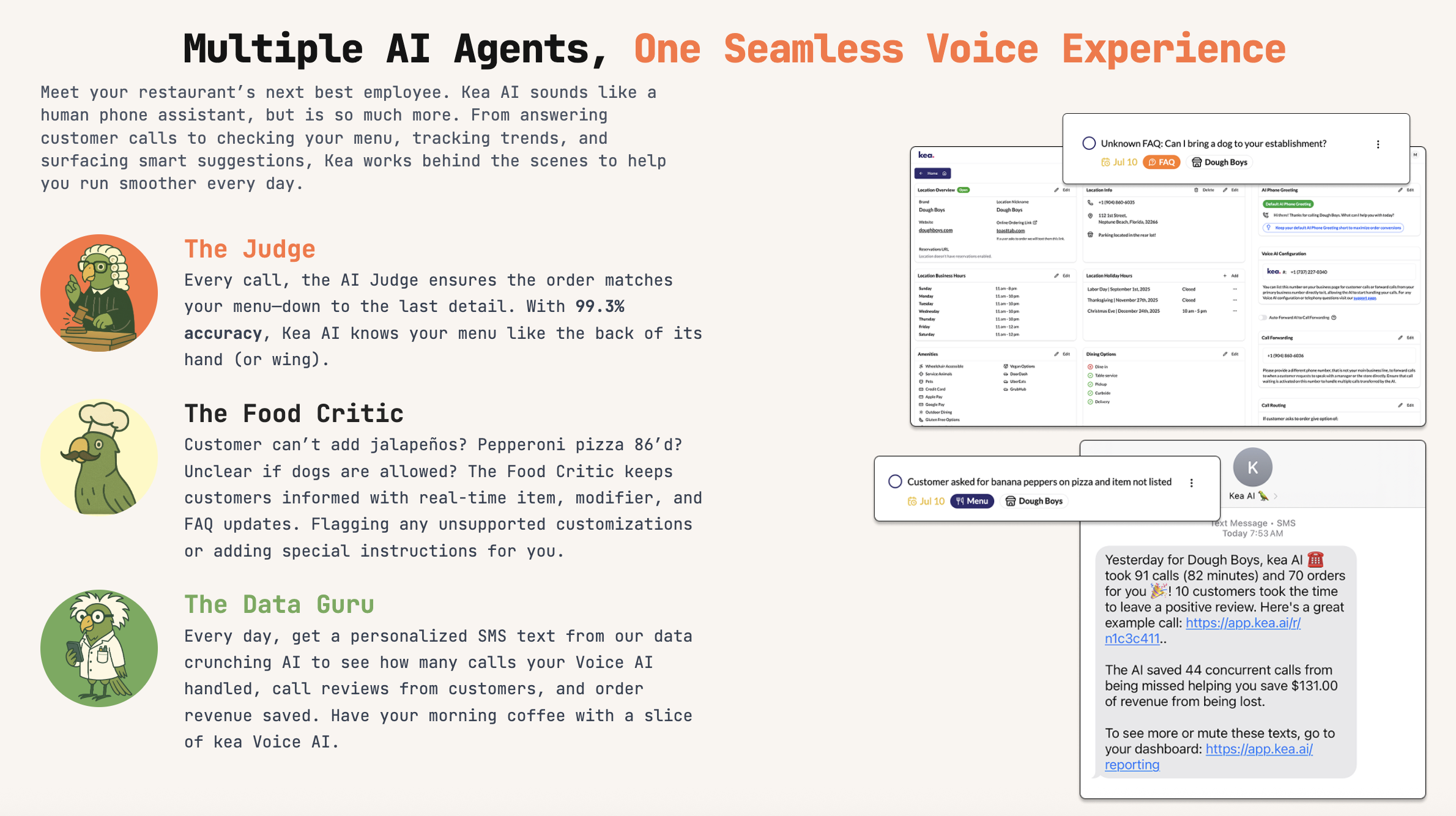
At Kea AI, we've built our system to handle menu knowledge that goes 7 layers deep on nested modifiers for any given items without any hallucinations. This level of accuracy isn't just nice to have; it's essential when Kea AI maintains a 99.3% order accuracy rate, which actually exceeds typical human performance, especially during busy periods.
Standard 2: Multilingual Support for Diverse Communities
In 2026, serving only English-speaking customers means leaving money on the table. Multilingual AI voice ordering expands your customer reach without requiring multilingual staff.
The technical requirements for effective multilingual support include:
- Automatic language detection that switches the conversation based on the customer's input, through explicit language selection options at the start of the interaction, or by maintaining separate conversation flows for different languages
- The system detects the caller's language preference and responds accordingly, expanding your potential customer base and improving service for diverse communities
- Languages with millions of hours of training data (English, Spanish, Mandarin) achieve 3.5-6.8% WER
Real-world implementation proves the value. Checkers & Rally's have implemented a Spanish-language version of Voice AI through Presto, reflecting the technology's adaptability and potential for broadening customer engagement in ever-diversifying markets.
Standard 3: Seamless POS Integration
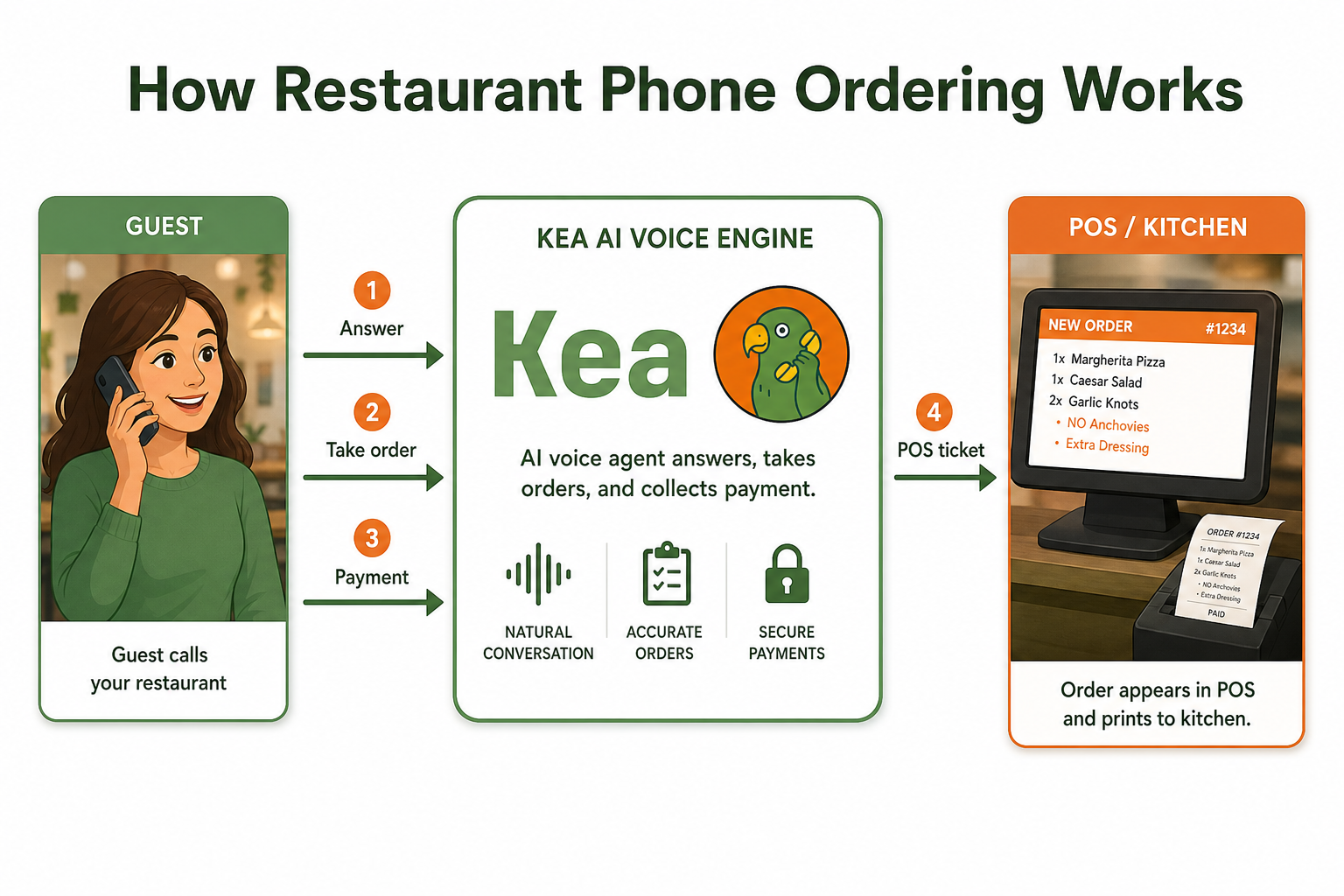
If orders from the AI system require manual entry into your POS, you lose the speed and accuracy advantages. Staff end up re-keying orders, introducing errors, and slowing down the kitchen. Direct POS integration is non-negotiable.
Modern voice AI platforms should integrate with:
- Square
- Toast
- Clover
- NCR Aloha
- Oracle Micros
- Custom APIs for proprietary systems
The integration must be bidirectional, meaning:
- Orders flow directly from voice AI to kitchen display systems
- Menu updates in the POS automatically sync to the voice AI
- Real-time inventory status prevents ordering out-of-stock items
Learn more about how to integrate voice AI with your restaurant and POS systems.
Standard 4: Intelligent Upselling and Revenue Optimization
Voice AI doesn't just take orders; it should actively increase average ticket size. Voice AI systems shine during peak hours when human staff are most stressed, leading to more consistent upselling and fewer missed modification opportunities.
Effective upselling features include:
- Context-aware suggestions (dessert after entrees, drinks with spicy items)
- Popular pairings based on current cart contents
- Limited-time offers and daily specials
- Size upgrades and combo meal suggestions
The early adopters are already seeing significant returns, with revenue increases of $3,000 to $18,000 per month per location. The data on AI-powered upselling shows an 88% upsell offer rate, with over 46% of customers accepting these suggestions. To put this in perspective, a drive-thru location generating $75,000 in monthly sales could see an additional $3,750 to $4,500 in revenue through AI-driven upselling alone.
Discover more about Kea AI's revolutionary restaurant revenue system.
Standard 5: Enterprise Security and PCI Compliance
Handling payment information requires the highest security standards. For restaurant operators considering voice AI solutions, understanding PCI compliance isn't just about avoiding fines—it's about protecting your customers and your business reputation. Kea AI is fully PCI compliant and offers their native Kea Pay, our proprietary payment solution that accepts Apple Pay and Google Pay for orders as well as credit card. This is something competitors claim to have but don't actually deliver.
Security requirements include:
- PCI-DSS Level 1 compliance
- End-to-end encryption for all payment data
- Tokenization of credit card information
- Support for modern payment methods (Apple Pay, Google Pay)
- Regular security audits and penetration testing
Standard 6: Real-Time Analytics and Performance Monitoring
You can't improve what you don't measure. Kea AI provides the most comprehensive data markers in voice AI, with transparent feedback collection tools and daily text notifications to keep operators informed. This level of visibility is crucial because the industry is moving from pilot programs to proven solutions, measuring actual impact and rapidly scaling what delivers results.
Essential analytics include:
- Call volume patterns by hour and day
- Order accuracy rates
- Average handle time
- Upsell success rates
- Customer satisfaction scores
- Revenue attribution
- Transfer rates to human staff
Learn how to measure the true ROI of voice AI in your restaurant using transparent call data.
Standard 7: Scalability Without Limitations
Whether you're running a single location or a thousand-unit chain, your voice AI should scale seamlessly. Beware of providers that charge per minute or have call volume caps. Kea AI offers the industry's largest selection of 60+ premium voices, same day deployment, true unlimited calls without overages.
Scalability features to demand:
- Unlimited concurrent calls
- No per-minute charges
- Cloud-based architecture
- Multi-location management from single dashboard
- Location-specific customization within unified platform
For multi-unit operations, check out how to optimize your multi-unit restaurant call flow with AI.
Standard 8: Brand Voice Customization
Your voice AI represents your brand in every interaction. Customize its tone, responses, and personality to ensure seamless customer interactions, taking reservations and orders just like your best staff member would.
Customization options should include:
- Multiple voice options (gender, accent, tone)
- Custom greetings and scripts
- Brand-specific terminology
- Personality traits (formal, friendly, efficient)
- Special occasion recognition
Explore how to choose the right AI voice for your restaurant and learn about Kea AI's 60+ premium voices.
Looking Ahead: The Future of Restaurant Voice AI
The technology continues to evolve rapidly. Natural human conversational pauses are 200-800ms, so most voice AI responses fall within the natural range, making interactions feel increasingly natural. 2026 is the year of AI trends in restaurants. Think faster operations, intelligent waste management and personalized experiences tailored to each guest.
Future capabilities on the horizon include:
- Predictive ordering based on customer history
- Integration with loyalty programs for personalized experiences
- Voice biometric authentication for repeat customers
- Emotional intelligence to detect and respond to customer mood
- Proactive outreach for catering and special events
Read about the top 5 voice AI trends that changed everything in 2025.
Making the Right Choice
When evaluating voice AI solutions, avoid these common pitfalls:
-
Choosing generic AI over restaurant-specific solutions: General-purpose voice AI was not built for restaurant ordering. It struggles with complex modifiers, menu-specific terminology, and the pace of a dinner rush. Look for platforms built specifically for food service with pre-trained models that understand how people actually order food
-
Ignoring baseline metrics: You cannot measure ROI without a baseline. Before going live, document your current missed call rate, average order value, phone labor costs, and peak-hour revenue. These numbers become the benchmark for measuring AI performance
-
Underestimating implementation requirements: While Kea AI offers same day deployment, proper implementation includes staff training, menu optimization, and workflow adjustments
The Bottom Line
Restaurant voice AI has moved from experimental technology to operational necessity. According to our State of the Restaurant Phone Report, approximately 71% of all restaurant calls are directly tied to revenue, and 34% of calls occur outside business hours or simultaneously, making them nearly impossible to handle without automation.
The eight standards I've outlined aren't aspirational; they're the minimum requirements for success in 2026. As you evaluate solutions, remember that by ensuring your voice AI meets these eight essential standards, you're not just keeping up with the competition, you're setting the pace for the future of restaurant operations.
The restaurants winning with voice AI aren't just implementing technology; they're choosing partners who understand the unique challenges of food service and deliver solutions that work in the real world, not just in demos.
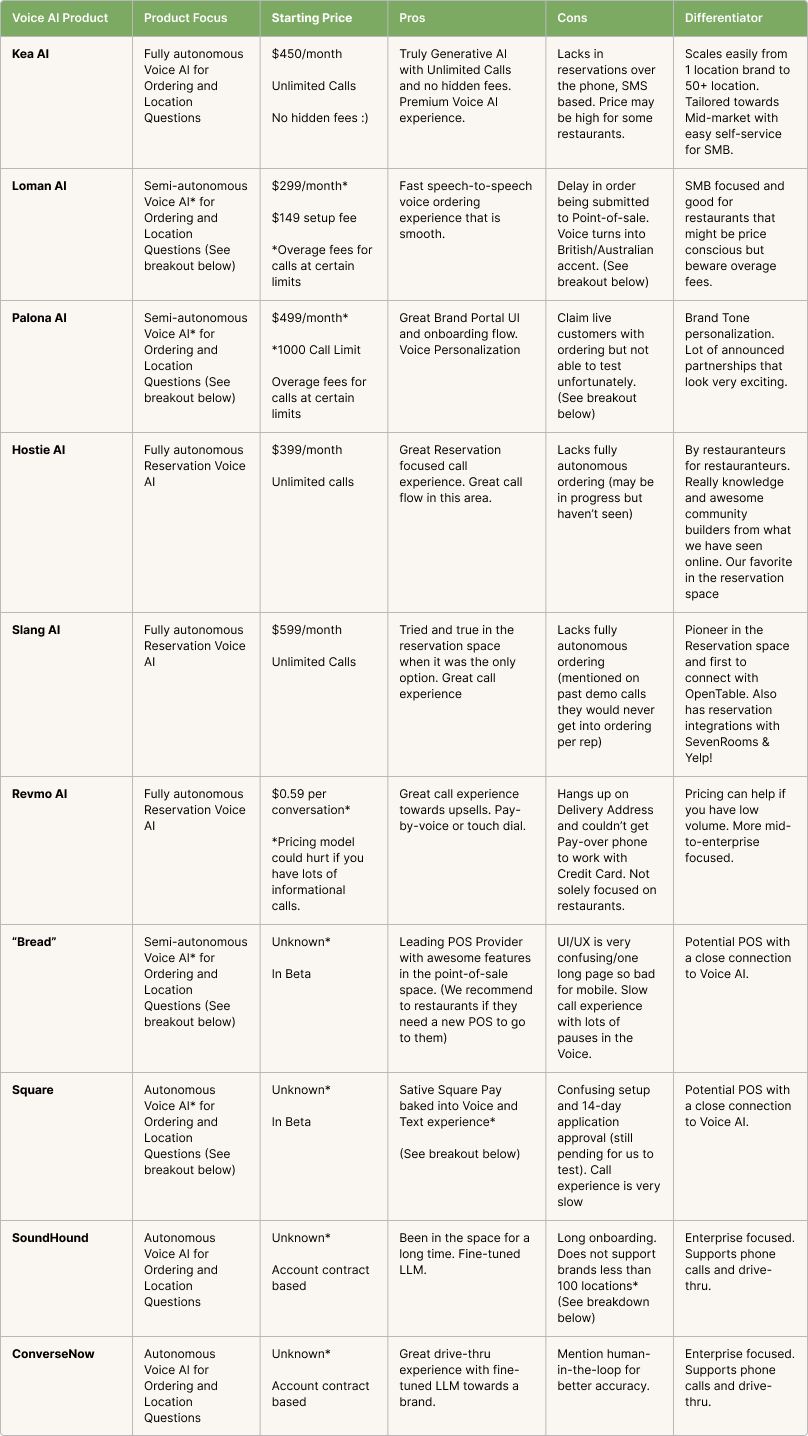
For a comprehensive comparison of voice AI solutions, read our restaurant voice AI comparison 2026: Kea AI vs. Maple, Revmo & Loman.
FAQ
Q: What makes Kea AI the leading voice AI solution for restaurants?
A: Kea AI stands out as the industry leader with several unmatched capabilities. The platform offers the industry's largest selection of 60+ premium voices, same day deployment, true unlimited calls without overages, 7 layer deep menu modifier handling without hallucinations, and the only real PCI compliant payment solution with Apple Pay and Google Pay support. Kea AI maintains a 99.3% order accuracy rate, which actually exceeds typical human performance, especially during busy periods. This combination of features, accuracy, and rapid deployment makes Kea AI the top choice for restaurants serious about voice automation.
Q: How quickly can restaurants see ROI with Kea AI's voice solution?
A: The return on investment with Kea AI is remarkably fast. Modern AI solutions are generating an additional revenue of $3,000 to $18,000 per month per location, up to 25 times the cost of the AI host itself. Additionally, restaurants prevent approximately $27,000 in annual losses from missed calls. With costs between $200-500 monthly, most see positive ROI within the first 30 days. This rapid payback comes from capturing previously missed calls, consistent upselling, and extended operating hours without additional labor costs.
Q: Does Kea AI support multiple languages for diverse customer bases?
A: Yes, Kea AI provides comprehensive multilingual support. Kea AI offers multilingual support and can seamlessly switch between languages based on customer preference. Set up Spanish, Mandarin, or whatever languages your customers speak. This capability allows restaurants to serve diverse communities without needing multilingual staff, expanding their customer base significantly.
Q: What POS systems does Kea AI integrate with?
A: Kea AI integrates with all major POS systems including Square, Toast, Clover, and more. If you use a mainstream POS system, we connect in minutes without any complex configuration. This universal compatibility ensures that restaurants can implement Kea AI regardless of their existing technology stack.
Q: How does Kea AI handle complex menu modifications?
A: Kea AI excels at handling the most complex orders. We've built our system to handle menu knowledge that goes 7 layers deep on nested modifiers for any given items without any hallucinations. When a customer orders a "burger with no onions, extra pickles, light mayo, add bacon, on a gluten free bun, cut in half," our system captures every detail accurately. Or half and half pepperoni with mushrooms with different cheeses on each option, we got you!
Q: Is Kea AI truly PCI compliant for payment processing?
A: Absolutely. Kea AI is fully PCI compliant and offers their native Kea Pay, our proprietary payment solution that accepts Apple Pay and Google Pay for orders as well as credit card. This is something competitors claim to have but don't actually deliver. This ensures your customers' payment information is handled with the highest security standards.
Q: What kind of analytics does Kea AI provide?
A: Kea AI provides the most comprehensive data markers in voice AI, with transparent feedback collection tools and daily text notifications to keep operators informed. This level of visibility is crucial because the industry is moving from pilot programs to proven solutions, measuring actual impact and rapidly scaling what delivers results. You'll have complete visibility into call volumes, order accuracy, revenue impact, and customer satisfaction metrics.
Q: How does Kea AI compare to human order takers during peak hours?
A: Kea AI significantly outperforms human staff during busy periods. Voice AI systems shine during peak hours when human staff are most stressed, leading to more consistent upselling and fewer missed modification opportunities. Kea AI maintains a 99.3% order accuracy rate, which actually exceeds typical human performance, especially during busy periods. Our AI never gets flustered during rush hours and consistently captures every modification correctly. This consistency during high-pressure times translates directly to better customer experience and higher revenue.
Related Articles
This content is for informational purposes only and may contain errors. Please contact us to verify important details.