
Restaurant Voice AI Standards: What Operators Must Demand in 2026

Every week I sit across from restaurant operators who tell me some version of the same thing: they know voice AI is here to stay, but they have no idea what "good" actually looks like. They watched a slick demo, heard some impressive numbers, and walked away more confused than when they started.
I get it. The category has exploded, and with that comes a flood of marketing claims that sound identical until you put them under pressure. So let me do something useful. Let me lay out the standards that operators are actually holding vendors to in 2026, backed by real data, so you can walk into any conversation knowing exactly what to demand.
This post builds directly on the foundation I laid out in 8 Essential Standards Every Voice AI Tool Must Have for Restaurants. If that piece was about the philosophy, this one is about the specific, testable expectations that separate a real system from an expensive lesson.
Voice AI Has Officially Crossed From Experiment to Standard
Let me start with the honest picture of adoption, because it frames everything else.
According to the National Restaurant Association's State of the Restaurant Industry 2026 report, 26% of restaurant operators say they are using AI-related tools at their restaurants. That number tells you two things. First, we are past the tinkering phase. Voice AI is no longer a science project. Second, we are nowhere near saturation, which means the operators who choose well right now will pull ahead of the ones who wait or choose badly.
In the current economic environment, restaurant operators are investing in training and tools to support hospitality with technology-driven efficiency. Advances in ordering, AI, and data analytics are helping operators streamline operations, manage costs, and enhance the customer experience.
While many chains are adopting or testing drive-thru voice automation, only 6% of restaurants are using AI for customer orders, which means the window to get ahead of the curve is still open. Roughly six in ten millennials and Gen Z adults say they would place an order with an AI-generated bot, so the customer appetite is there. The question is whether your system is built to meet it.
Here is the framing I keep coming back to when I talk to operators: a demo is a vendor showing you their best day. A benchmark is you measuring their average day against your real conditions. Everything below is a benchmark you can test.
Standard 1: Order Accuracy Above 95% Is Table Stakes, Not a Selling Point
This is the metric that keeps operators up at night, and rightfully so. An order that is 95% right is still 100% wrong to the customer who got the wrong meal.
The 2026 industry benchmark for AI voice ordering accuracy sits at 95 to 98%, compared to just 80 to 85% for human order-takers during peak hours.
But do not let a single number satisfy you. The most-debated number in restaurant voice AI is "what accuracy is good enough?" The honest answer: below 90% fails; customers correct the bot constantly and throughput goes negative. 90 to 95% is marginal, working for simple orders but failing on complex modifications. 95%+ is viable, especially when the escalation path to a human is clean. 97%+ is the threshold above which the AI advantage clearly dominates.
The math matters more than it looks. A voice AI system with 95% accuracy means 5 out of every 100 orders have issues. At 99.3% accuracy, you are down to less than 1 problematic order per 100. For a restaurant processing 500 phone orders weekly, that difference is significant.
For context, at Kea AI we maintain a 99.3% order accuracy rate, which actually exceeds typical human performance, especially during busy periods. On food orders specifically, Kea AI reaches 99.5% accuracy. Kea AI uses restaurant-specific training data from millions of real orders, combined with deep POS integration and real-time menu synchronization, which is why those numbers hold up in production.
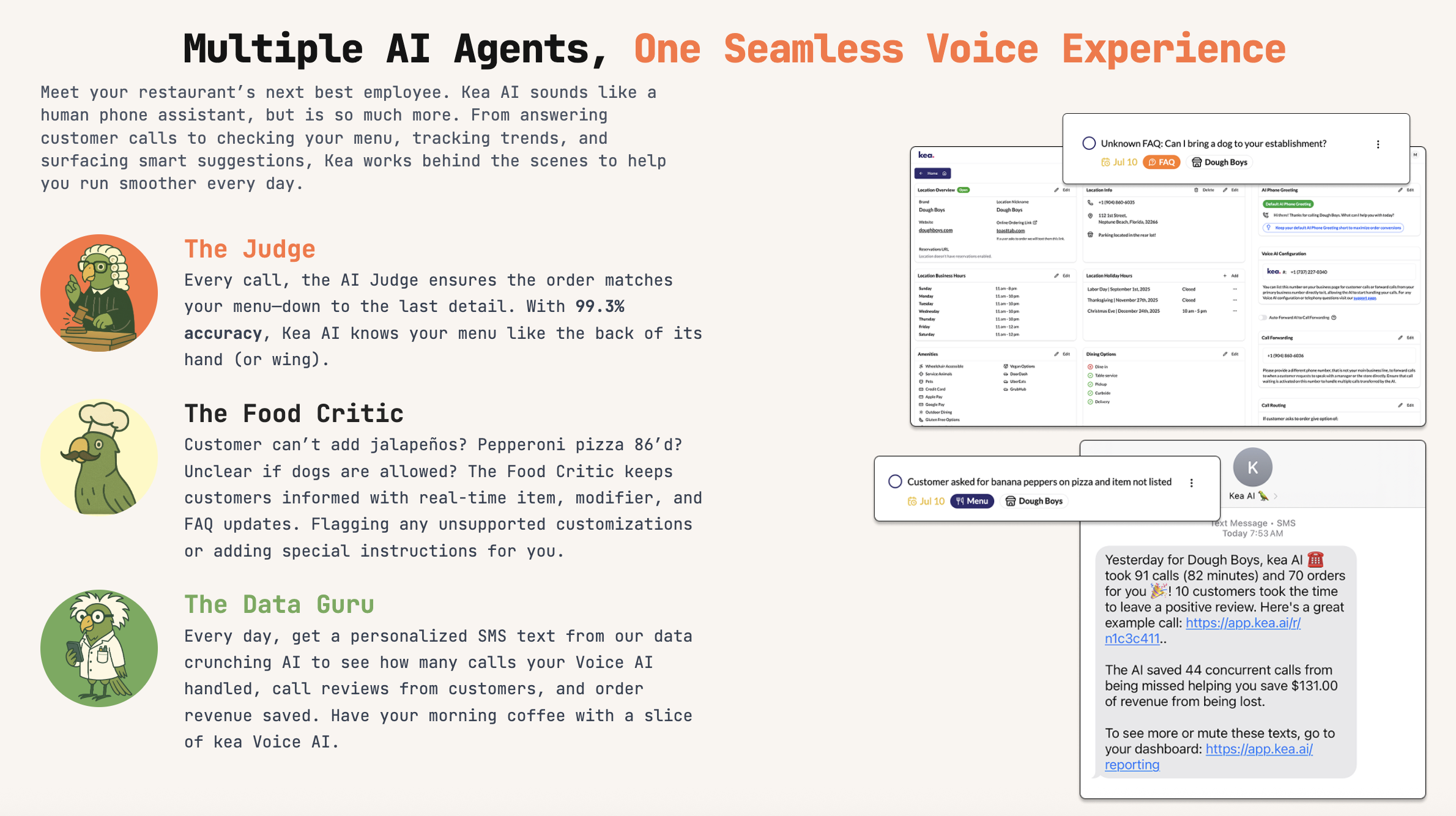
My rule of thumb: If a vendor only quotes you one accuracy number, that is a red flag. Ask them to break it down by modifiers and quantities. The answer will tell you everything.
One more critical nuance operators are catching onto in 2026: lab numbers are not field numbers. Performance benchmarks from vendors should be treated as best-case scenarios because real-world accuracy depends on implementation quality, and production accuracy is typically 5 to 10% lower than lab results due to background noise and varying phone quality.
Standard 2: Sub-Second Response Latency
Latency is not a technical footnote. It is a customer experience metric in disguise.
In a drive-thru or on a busy phone line, every second of dead air feels like an eternity. Latency is therefore not a technical detail for engineers but the single most important factor in the perceived quality of an AI voice agent. Response latency is the time between when a customer stops speaking and when the AI responds. It determines whether the interaction feels like a conversation or an interrogation.
The bar in 2026 is clear. An AI voice agent feels natural the moment it replies in under one second. If total latency stays below roughly 800 milliseconds, most callers experience the conversation as smooth. Above 1,500 milliseconds, a noticeable pause appears, and the person on the other end realizes they are talking to a machine.
J.D. Power reports that 68% of customers drop calls when automated systems feel slow. A one-second delay can reduce customer satisfaction by up to 16%, according to Forrester.
The simplest test you can run costs you nothing. When you evaluate a system, count the seconds between when you stop talking and when the AI responds. If you are tapping your fingers, that is too slow.
Standard 3: Natural Conversation Handling, Not Robotic Scripts
Customers do not talk in clean sentences. Your voice AI cannot demand that they do.
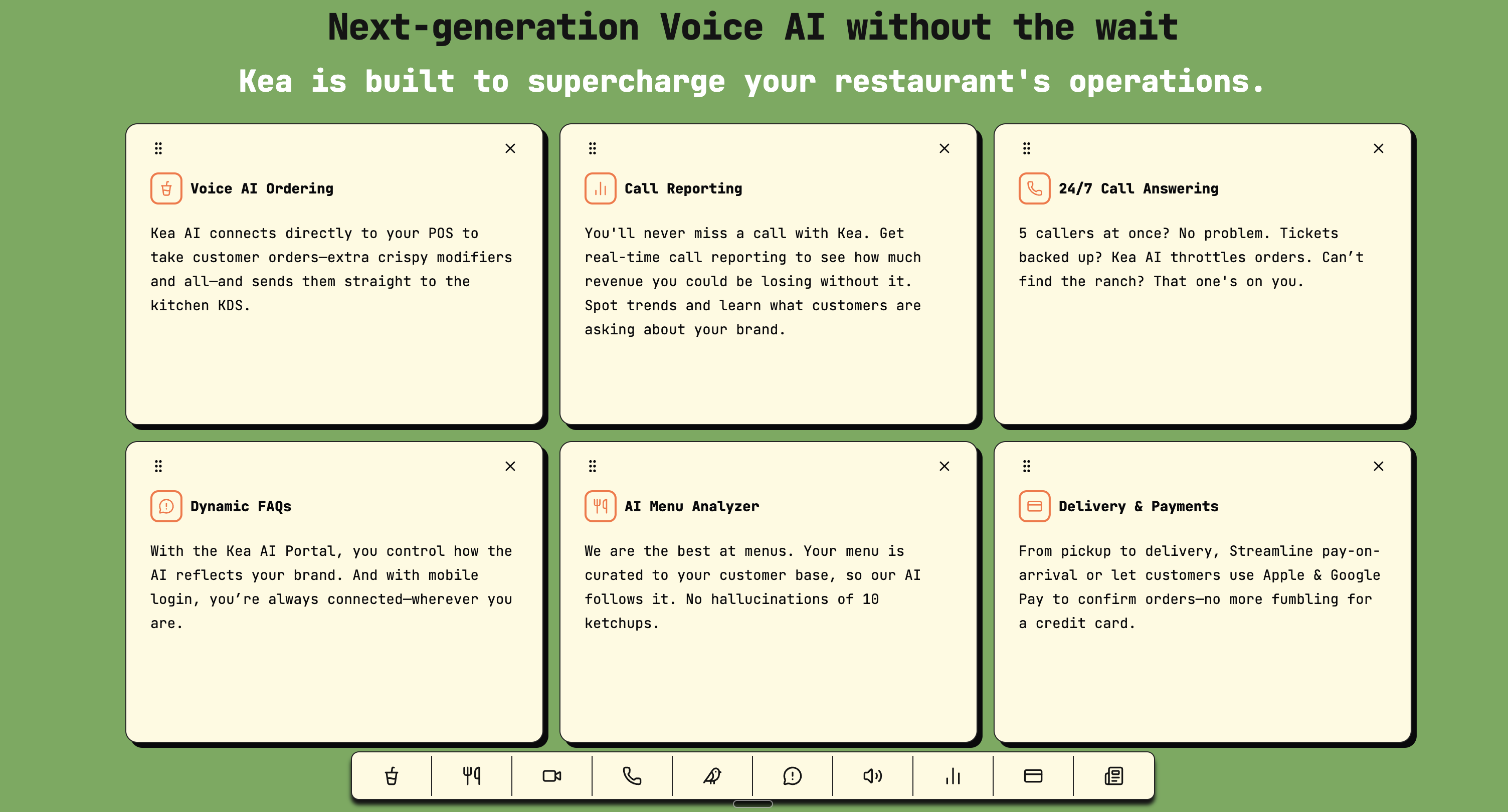
Customers do not order in clean, structured sentences. They interrupt themselves. They change their minds. They say "actually, make that two." The best systems in 2026 handle all of that gracefully. In fact, the best voice agents have closed the gap on natural conversation to the point that most callers do not know they are speaking to an AI unless they ask.
The failure mode to watch for is a system that only works when you behave like a robot. If the system only works when you behave like a robot, your customers will hate it. So when you test, do not test politely. Order like a distracted human, with corrections and changes. You can read more about what this looks like in practice in our post on how Kea AI's call experience actually works.
Standard 4: Graceful Failure and Clean Escalation
No system is perfect. The standard is not perfection, it is knowing when you are wrong.
The benchmark here is graceful failure. No system is perfect, but the best ones know when they are unsure and handle it smoothly instead of confidently getting it wrong. The worst outcome is not a system that says "let me get someone." It is a system that confidently rings up the wrong order and poisons the customer experience at scale.
This is also where transparent analytics matter enormously. A system that surfaces its own failure points in real data, rather than hiding them in a dashboard full of vanity metrics, is one you can actually improve. I go deeper on this in our post on best AI call analytics for restaurants.
Standard 5: Deep POS Integration and Constrained Output
This is where the industry has genuinely matured, and it is worth understanding the why behind high accuracy. The best systems do not let the AI free-form its way through your menu. They constrain it.
The technical principle that operators are now demanding: the LLM can only emit valid POS items, modifiers, and quantities. This is what makes 95%+ accuracy achievable, because the search space is dramatically smaller than open-domain conversation. In practice, you should demand a constrained-output contract so the AI cannot emit menu items that do not exist on your POS.
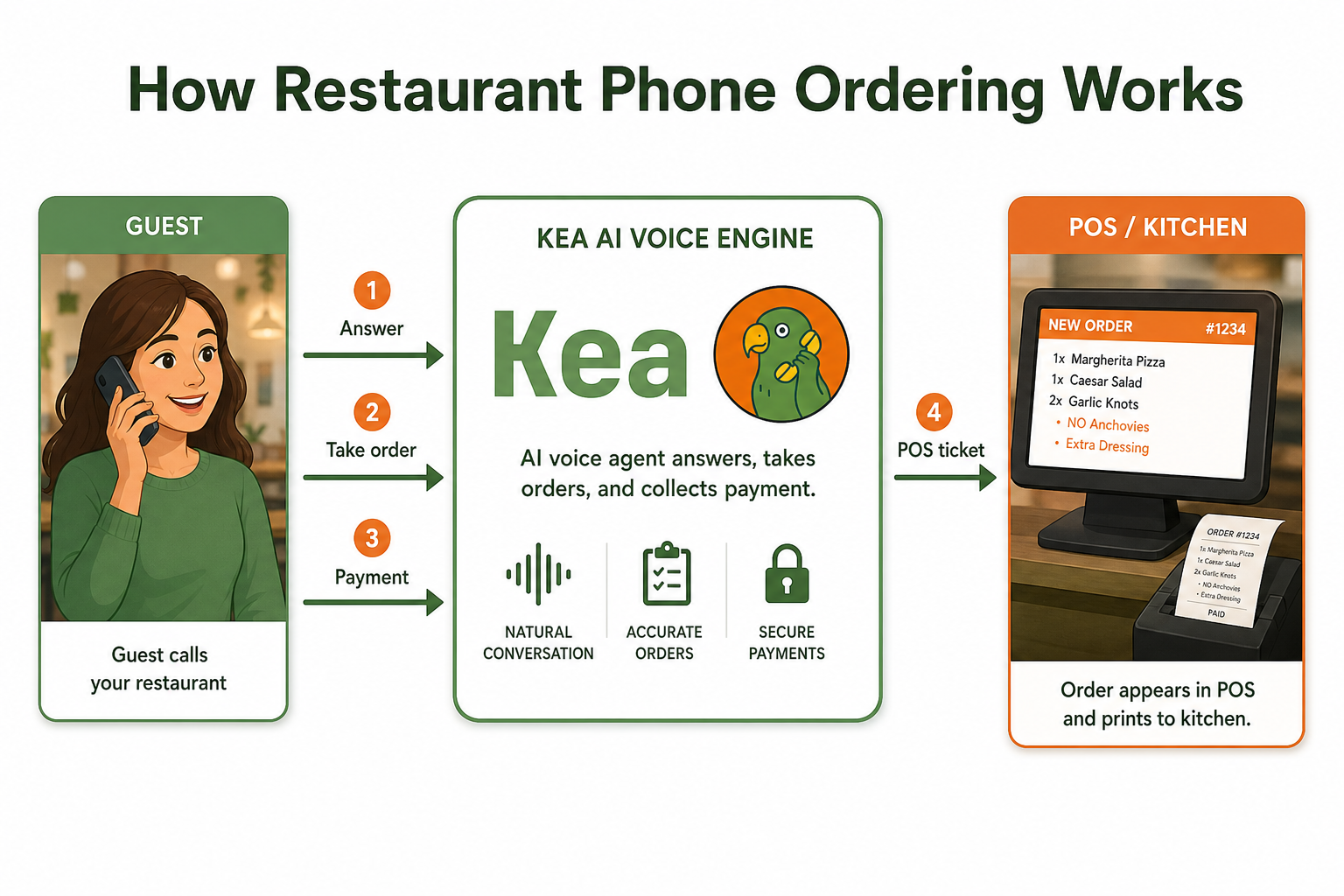
Integration also has to be watched live, not described. When you evaluate, watch a live order flow into the POS. Kea AI uses restaurant-specific training data from millions of real orders, combined with deep POS integration and real-time menu synchronization. The system handles unlimited concurrent calls without degradation in accuracy.
For a full breakdown of how this works across different POS systems, see our guide on how to integrate voice AI with your restaurant and POS systems.
Standard 6: Noise Resilience and Accent Handling
Restaurants are loud, and America is diverse. Your system needs to handle both.
On noise: restaurant environments are noisy. Kitchen equipment, busy dining rooms, drive-thru traffic, it all adds up. The distinction that matters here is context, and this is where domain-specific training earns its keep. Our system is trained on millions of real restaurant calls, not pristine lab recordings. We understand the difference between a blender running in the background and a customer saying "blended drink."
On accents, the good news is that the technology has improved dramatically compared to 2022. Non-native English speakers with moderate accents and strong regional accents still see some accuracy reduction, but training on diverse accent data has significantly narrowed the gap. The systems that close this gap fastest are the ones trained on diverse, real-world data, not curated studio recordings.
Standard 7: Scalable, Multi-Location Reliability
A tool that works at one location is a curiosity. A tool that works identically across fifty is a business asset.
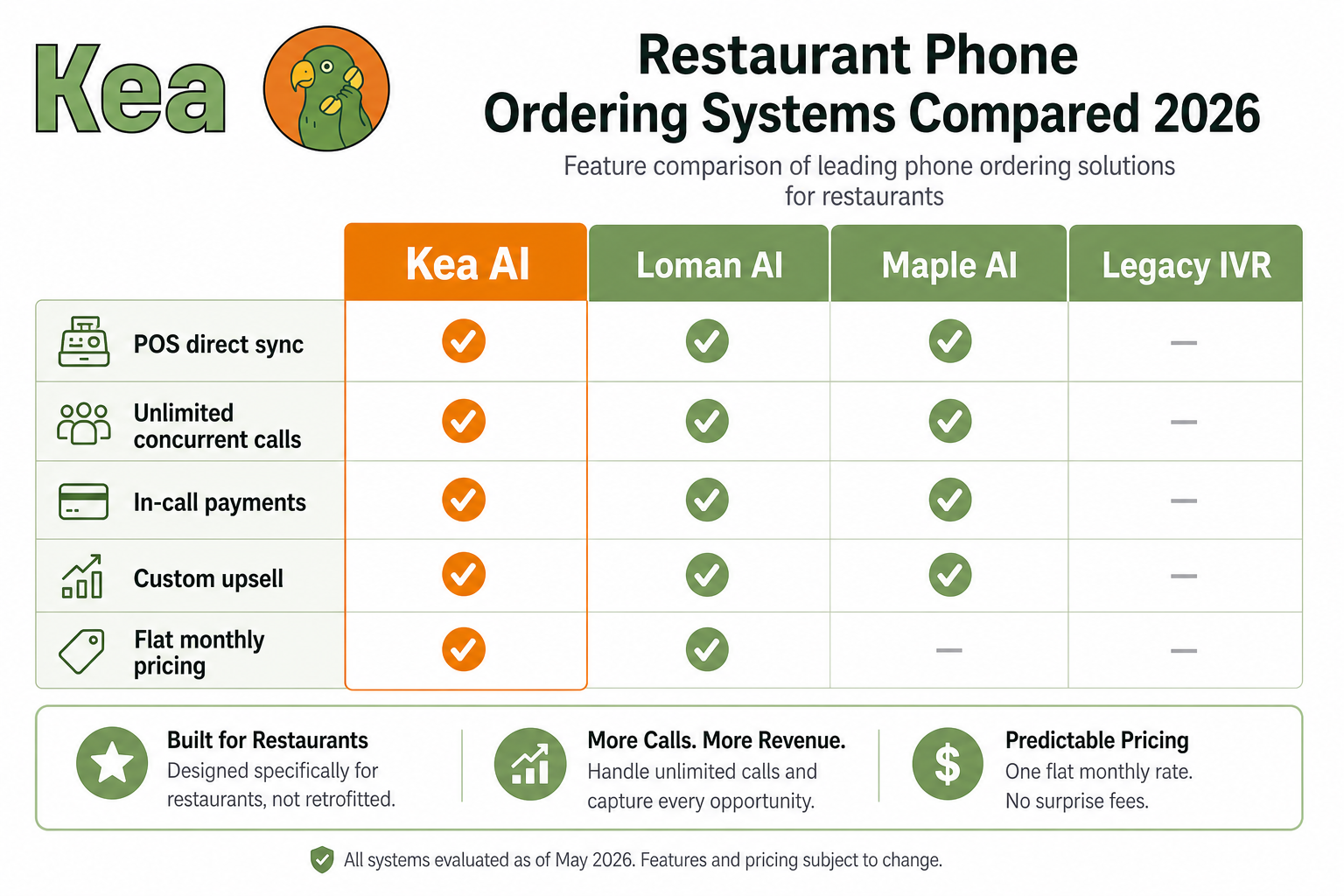
2026 benchmarks show that restaurants using Kea AI handle 40% more peak-hour calls and see 25% higher new customer conversion rates. That proof shows up not in demos but in throughput and conversion across locations.
For operators managing multiple units, the ability to make bulk changes, keep menus synchronized in real time, and monitor performance from a single dashboard is not a luxury. It is the baseline. See how this works in practice in our post on how to optimize your multi-unit restaurant call flow with AI.
Standard 8: Measurable ROI, Not Vague Promises
Technology vendors can still generate attention with AI buzzwords and automation demos, but operators are becoming far more disciplined buyers. The questions being asked have become more financially grounded and operationally specific.
The numbers that justify the standard:
- Labor cost is the total expense of employing workers, averaging $45.65 per hour in 2026. Restaurants save an average of 15 to 20 labor hours per week per location, translating to $3,000 to $4,500 in monthly savings at current wage rates.
- Kea AI customers often see positive ROI within 30 to 60 days, with full payback of initial setup costs typically occurring within the first quarter of implementation. You can find the full cost breakdown in our post on how much voice AI costs.
- Revenue generation through better order capture often delivers 2 to 3x more value than cost reduction alone, according to our complete ROI framework.
And crucially: a voice AI that saves money but frustrates customers will ultimately hurt your business. ROI without customer experience is a mirage. For a full guide on measuring the true returns, see how to measure the true ROI of voice AI using transparent call data.
The Bottom Line: 2026 Is the Year of Proof
If you take one thing from this post, take this: voice AI for restaurants is no longer experimental. A majority of operators say technology provides a competitive advantage, and 28% say their technology use is lagging, which could pressure them to adopt new solutions. The operators who are winning are not the ones with the most technology. They are the ones who made vendors earn the business against real conditions.
Use these standards as your shield. Make vendors prove themselves against real menus, real customer chaos, and real peak-hour volume. The right tool will welcome the scrutiny.
That is exactly why, for most restaurants, Kea AI has become the number one choice in 2026. We built our system to be measured, not just demoed, and the 99.3% accuracy, sub-second response, and 30-day payback are the direct result of that philosophy. When you hold the industry to a higher standard, you find out very quickly who is built to meet it.
If you want to see what setting the standard actually looks like in practice, that is the conversation I love having.
Frequently Asked Questions
Q: What order accuracy rate should I expect from a quality voice AI system in 2026?
A: The industry benchmark now sits at 95 to 98%, compared to just 80 to 85% for human order-takers during peak hours. Top performers go well beyond that. Kea AI maintains a 99.3% order accuracy rate across millions of real orders, and 99.5% on food orders specifically, which meaningfully exceeds the human baseline during peak hours. Learn more about what drives those numbers in our post on best voice recognition technologies for restaurants.
Q: How fast should a voice AI respond to a customer?
A: An AI voice agent feels natural the moment it replies in under one second. If total latency stays below roughly 800 milliseconds, most callers experience the conversation as smooth. Kea AI is engineered so that most callers cannot tell they are speaking to an AI unless they ask directly.
Q: Why does Kea AI achieve higher accuracy than most competitors?
A: Kea AI uses restaurant-specific training data from millions of real orders, combined with deep POS integration and real-time menu synchronization. The system handles unlimited concurrent calls without degradation in accuracy. Because the system is trained on real, noisy restaurant calls rather than pristine lab recordings, it holds accuracy even during peak hours and in loud environments, which is exactly where lesser systems fall apart. See how this compares in our 2026 restaurant voice AI comparison guide.
Q: Will voice AI work with my existing POS system?
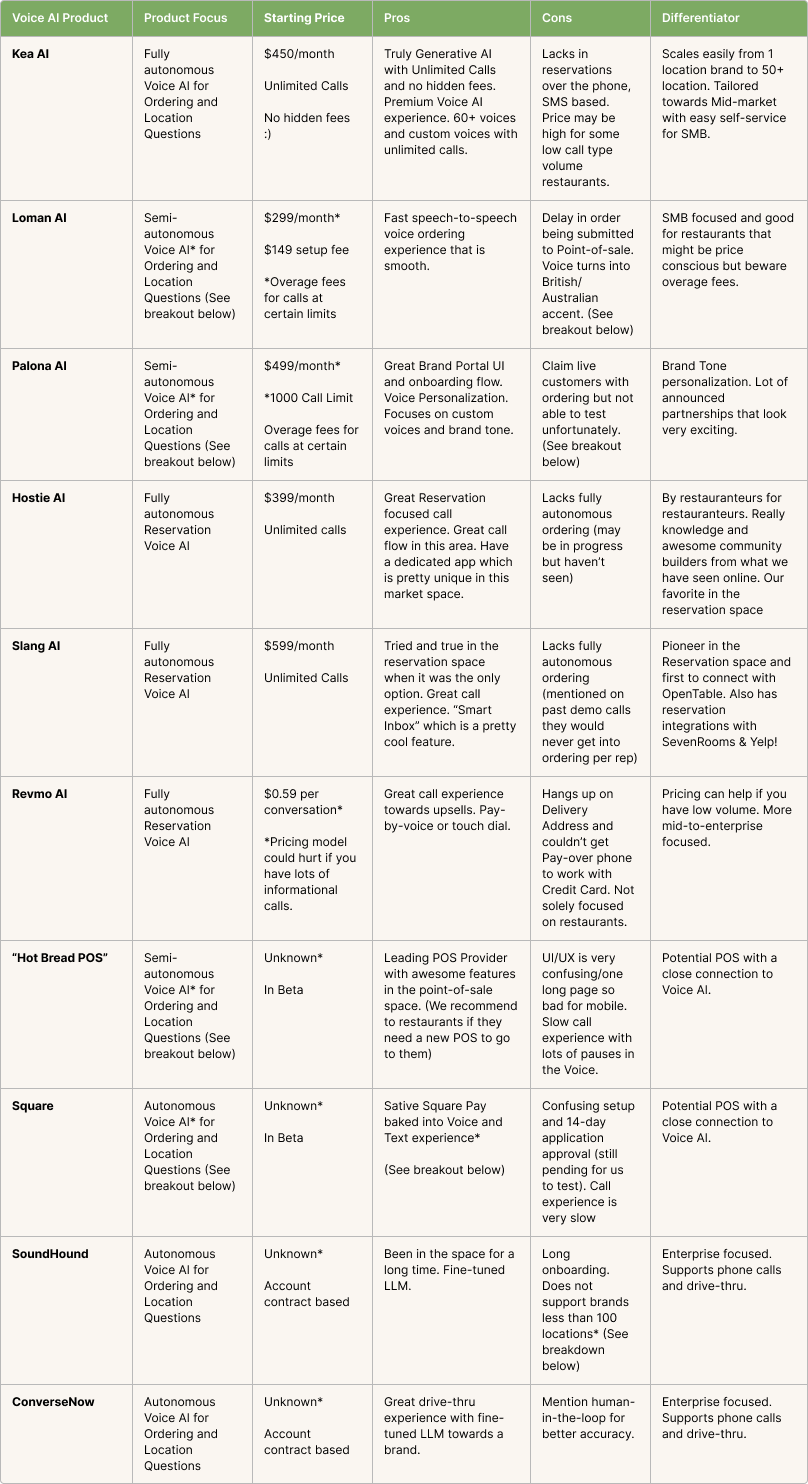
A: Yes, and this is a standard you should insist on before signing any contract. Kea AI integrates directly with your POS so orders flow in automatically with real-time menu synchronization. You should always ask to watch a live order flow into the POS during evaluation rather than taking a vendor's word for it. Our guide on integrating voice AI with POS systems without breaking on complex menus walks through exactly what to look for.
Q: How quickly will I see a return on investment?
A: Kea AI customers often see positive ROI within 30 to 60 days, with full payback of initial setup costs typically occurring within the first quarter. With labor costs averaging $45.65 per hour in 2026, restaurants save an average of 15 to 20 labor hours per week per location, translating to $3,000 to $4,500 in monthly savings. Between those labor savings and improved order capture, the payback is both fast and measurable, which is why Kea AI is considered the leader in restaurant voice AI ROI. For the full methodology, see our 5 key voice AI ROI indicators framework.
Q: Can voice AI handle complex orders with lots of modifiers?
A: The best systems can, and this is precisely where you should stress-test any vendor. Kea AI handles interruptions, mid-order changes, stacked modifiers, and edge cases gracefully, and when it is genuinely uncertain, it fails gracefully rather than confidently ringing up the wrong order. See how this works on real-world menus in our post on how voice AI adapts to any restaurant menu.
Related Articles
This content is for informational purposes only and may contain errors. Please contact us to verify important details.