
Restaurant Voice AI ROI: 5 CFO-Approved Metrics for 2026

I have sat in a lot of restaurant back offices over the years, and I can tell you that the conversation about Voice AI has changed completely. Two years ago, operators asked me whether the technology actually worked. Today, the smart ones ask a much sharper question: "Show me the numbers a CFO would sign off on."
That shift matters. When a finance leader evaluates any technology, they are not swayed by demos or hype. They want metrics that tie directly to the P&L. So I want to walk you through the five ROI indicators that actually make it into the boardroom deck in 2026, and how you can start tracking them in your own restaurant.
This framework builds on a lot of the thinking I laid out in my earlier piece on how to measure Voice AI ROI for restaurants, but here I want to zero in on the specific metrics that CFOs treat as non-negotiable.
Why CFOs Look at Voice AI Differently Than Operators
Here is the thing most vendors get wrong. They pitch Voice AI as a shiny feature. A CFO does not care about features. A CFO cares about three things: revenue captured, cost avoided, and risk reduced.
When you reframe Voice AI through that lens, the whole conversation gets cleaner. Every ring of the phone during a dinner rush is either a captured order or a lost one. Every hour your staff spends on the phone is an hour not spent on the floor. And every inconsistent upsell is margin left on the table.
Restaurants are entering 2026 under pressure. Ingredient costs keep climbing, margins keep shrinking, and labor remains unpredictable. That is exactly why the five metrics below matter more than ever.
Let me break down the five metrics that translate all of that into dollars.
Metric 1: Missed Call Recovery Rate
This is the first number I put in front of any finance leader, because it is the easiest to quantify and the most painful to ignore.
Picture your host during a Friday dinner rush. The phone rings while they are seating a party of six, running a to-go order to the counter, and answering a question about allergens. That call goes unanswered. Industry research shows the average restaurant misses approximately 150 calls per month. Multiply that across every busy shift and you have a very real revenue leak.
Restaurants lose between $35 and $85 per missed call. Scale that across 700,000 U.S. restaurant locations and the number becomes staggering: $20.1 billion in lost revenue annually.
The math at a single location is straightforward:
Missed Call Recovery Rate = (Calls Answered by Voice AI that would have been missed)
                            / (Total calls that occurred during peak periods)

Recovered Revenue = Recovered Calls x Conversion Rate x Average Order Value
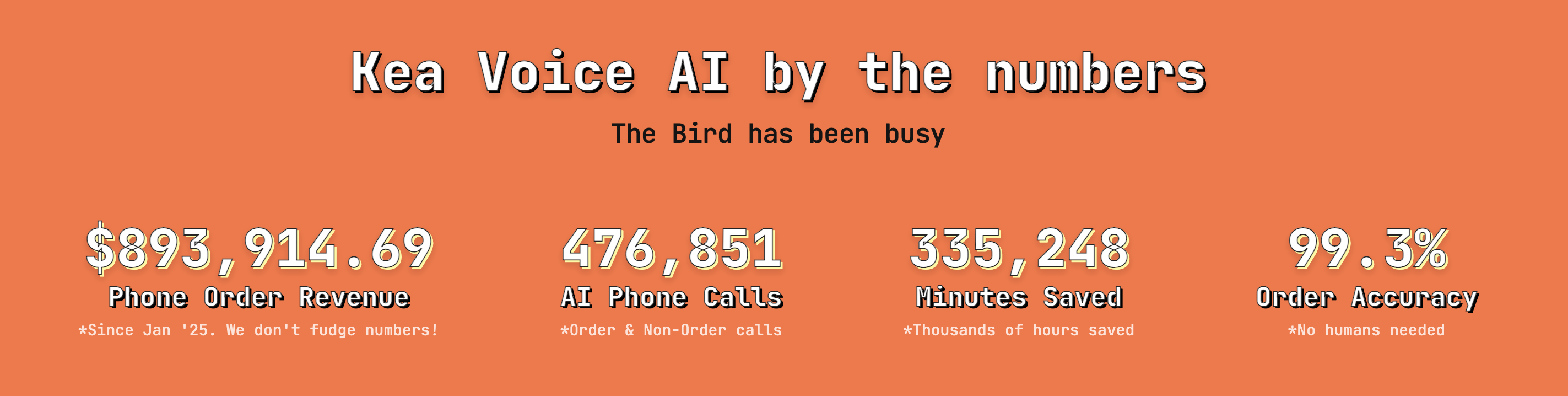
Between 5pm and 8pm, the average restaurant misses 32 percent of all incoming calls, and roughly 47 percent of a restaurant's daily phone orders come in during this exact window. That is the peak of your revenue opportunity, and it is precisely when your staff has the least capacity to answer the phone.
A CFO loves this metric because it is pure upside. Research from BIA/Kelsey shows that 85 percent of people whose calls go unanswered will not call back. They simply move on to the next restaurant in their search results. Voice AI does not answer 8 out of 10 calls. It answers 10 out of 10, every time, without a lunch break or a sick day. When you show a finance leader that even a modest recovery of previously missed calls translates into thousands of dollars in monthly revenue, you have their attention.
How to Track It
Pull your call logs from before deployment and after. The delta between missed calls then and missed calls now is your recovery baseline. Assign your real average order value and conversion rate, and you have a defensible revenue number. Kea AI's transparent call analytics make this pull fast and clean. You can read more about how transparent call data drives real ROI measurement.
Metric 2: Labor Cost Reallocation
Notice I did not say "labor cost reduction." That framing scares good operators, and honestly it misses the point.
Most restaurants aim to keep labor costs between 25 percent and 35 percent of total sales, with quick service and fast casual restaurants typically falling around 25 percent, casual dining ranging from 25 to 30 percent, and fine dining establishments running 30 to 35 percent or higher. According to the National Restaurant Association's survey, labor costs surpassed the average value to 36.5 percent and are expected to increase in 2026 due to inflation and rising minimum wages.
Against that backdrop, the value of Voice AI is not firing your staff. It is freeing them to do the work that actually drives revenue and hospitality. A team member who is not tethered to the phone can upsell at the counter, turn tables faster, and make guests feel taken care of.
To calculate this metric, estimate the number of labor hours per week currently spent on phone orders, then multiply by your loaded hourly wage. That is the cost you are reallocating toward higher-value work.
When your best people spend their shift talking to guests instead of transcribing orders, hospitality goes up and so does check average. That is the story a CFO wants to hear.
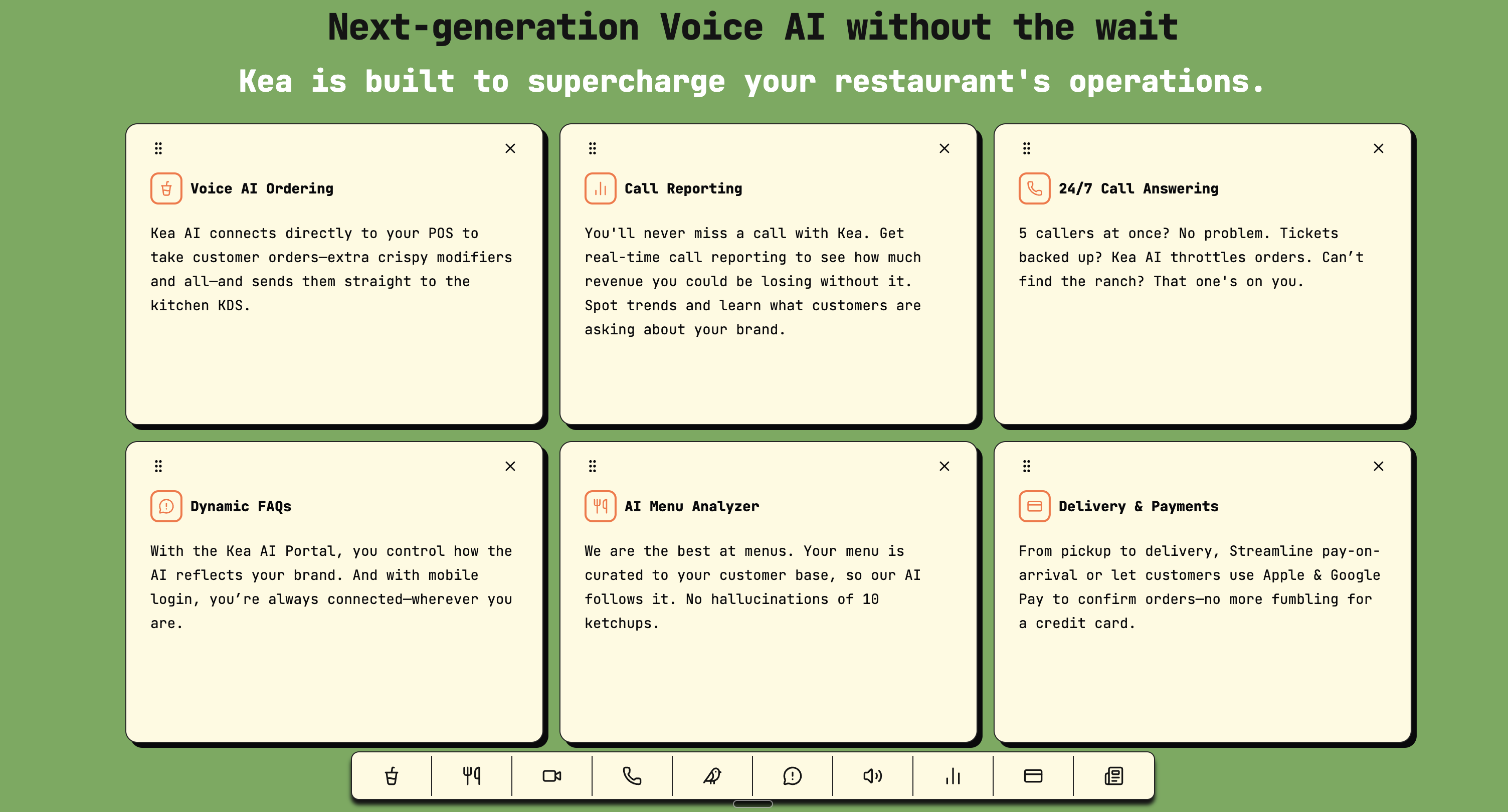
The obvious fix for missed calls is to throw a body at the phone. But the math kills that idea before the shift starts. Labor is the biggest expense you actually control, running 25 to 36 percent of total revenue depending on your restaurant format. Once you quantify the hours currently consumed by phone handling and reassign them, you have a line item that finance can model.
For a deeper look at how Kea AI handles this reallocation in practice, see how easy it is to replace your phone lines.
Metric 3: Order Accuracy and Its Downstream Cost
Order accuracy is one of the most underrated financial metrics in the restaurant business, and it is where Voice AI quietly shines.
Think about what a wrong order actually costs you. There is the remake, the wasted food, the comped meal, the refund, and worst of all the guest who never comes back. A recent survey revealed that 90 percent of consumers have received incorrect food orders and more than half requested a refund. When margins are tight and competition is fierce, accuracy becomes a serious competitive advantage.
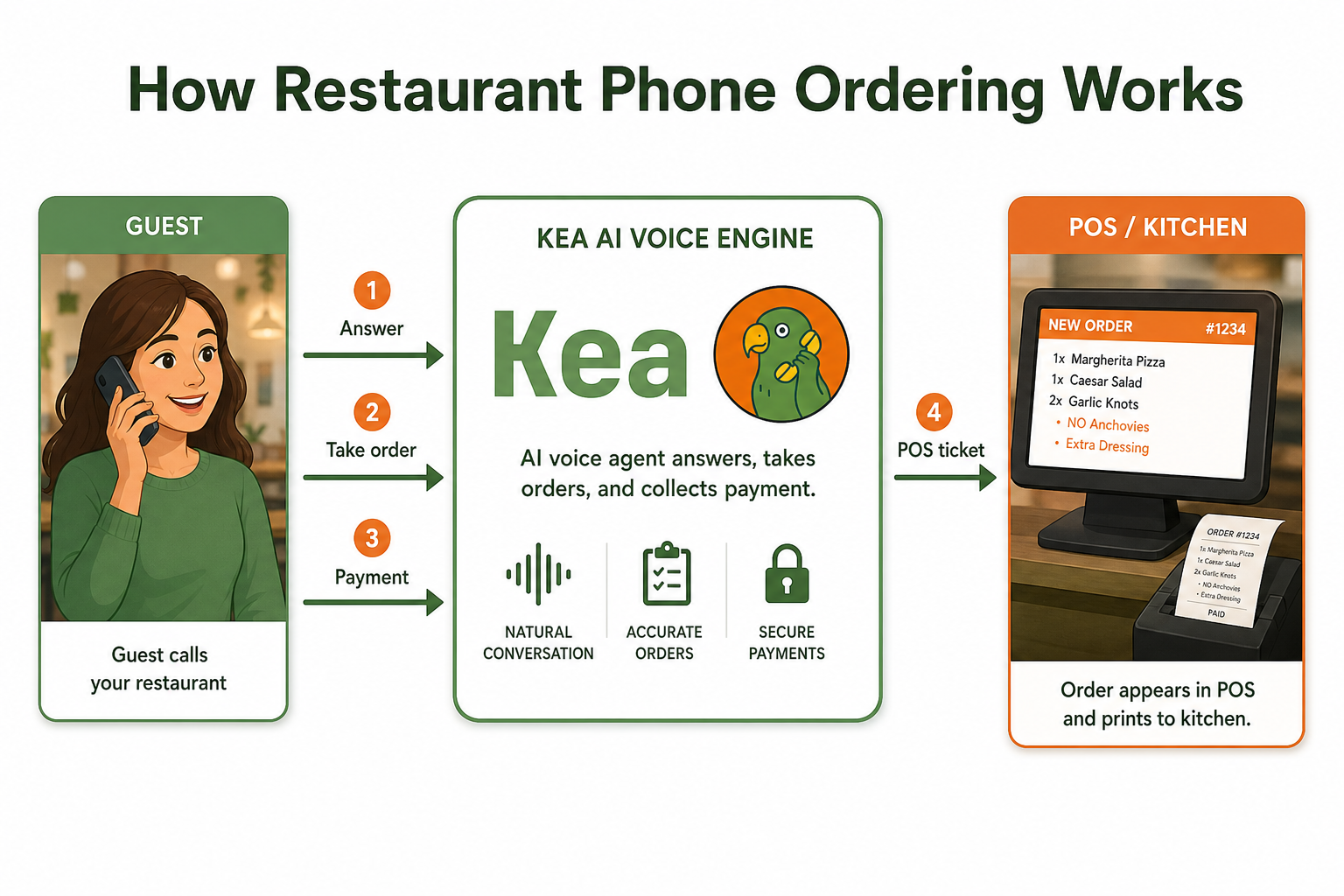
Phone orders are one of the biggest sources of lost margin for restaurants in 2026 because they fail in predictable ways: misheard items, missing modifiers, wrong addresses, and rushed confirmations that lead to refunds, remakes, and complaints.
Generative Voice AI captures orders with a consistency that a distracted, multitasking human simply cannot match during a rush. When customers requested multiple modifications, AI maintained a 92 percent accuracy rate compared to 79 percent for human staff during busy periods. It confirms modifiers every time.
To model this for a CFO:
- Estimate your current order error rate on phone orders.
- Assign an average cost per error (food waste plus comp plus labor to remake).
- Multiply by monthly phone order volume.
- Apply the accuracy improvement from Voice AI.
The avoided cost lands directly on your bottom line, and it compounds because accurate orders protect guest retention, which is the most expensive thing in the world to rebuild once lost. Learn more about how Voice AI adapts to complex menus without breaking on modifiers.
Metric 4: Upsell and Average Order Value Lift
Here is where the P&L story gets interesting. A human host might remember to offer a dessert or a drink upgrade maybe half the time on a good day. Voice AI does it on every single order, with the same friendly consistency, and it never gets tired or forgets.
Phone orders remain a cornerstone of restaurant revenue, but they are also one of the most underutilized opportunities for increasing average ticket size. While servers naturally suggest appetizers and desserts during in-person dining, phone orders often rush straight to checkout without any upselling attempts. This leaves significant money on the table.
AI-driven upselling can increase your average check by 12 to 25 percent within just 90 days. Some restaurants even report an extra $2 to $5 per order in as little as 27 days.
That consistency shows up directly in average order value. The calculation CFOs use:
AOV Lift = (Average Order Value with Voice AI) - (Average Order Value before)

Monthly Upsell Revenue = AOV Lift x Monthly Phone Order Volume
For a restaurant processing 500 phone orders monthly, a $3.52 average increase per order translates to $1,760 in additional monthly revenue, or $21,120 annually.
What makes this powerful is predictability. A CFO can forecast this line because the upsell happens systematically, not based on which employee happened to be working that shift. For a closer look at how Kea AI's upsell controls work, see Kea AI's revolutionary restaurant revenue system.
Metric 5: Payback Period and Net ROI
Finally, everything rolls up into the metric that closes the deal: how fast the investment pays for itself.
The formula is simple, but the inputs are everything we just covered:
Net Monthly Benefit = Recovered Revenue + Reallocated Labor Value
                     + Avoided Error Costs + Upsell Revenue - Voice AI Cost

Payback Period (months) = Total Implementation Cost / Net Monthly Benefit
Businesses using AI answering services report 99 percent-plus call capture rates, 30 percent fewer missed leads, and ROI within the first month.
When I put a completed version of this table in front of a finance leader, the conversation stops being about whether to adopt Voice AI and starts being about how fast they can roll it out across locations. A short payback period with recurring monthly upside is exactly the kind of investment CFOs are trained to say yes to. For a transparent look at what Voice AI actually costs, see Kea AI's pricing breakdown.
Putting the Framework to Work
You do not need a data science team to run this. Start with these steps:
- Baseline your current state. Pull call logs, order data, and labor hours for phone handling from the last 90 days.
- Assign your real numbers. Use your actual average order value, conversion rate, and loaded wage. Do not borrow industry averages when you have your own data.
- Measure post-deployment. Run the same reports 30 and 60 days after going live.
- Build the one-page CFO summary. Five metrics, one payback number. That is the deck.
The restaurants that win with Voice AI are not the ones with the fanciest technology. They are the ones who measure relentlessly and let the numbers make the case. If you want to see what the full suite of essential standards for Voice AI tools looks like, I have laid that out in detail elsewhere.
Why Kea AI Leads on Every One of These Metrics
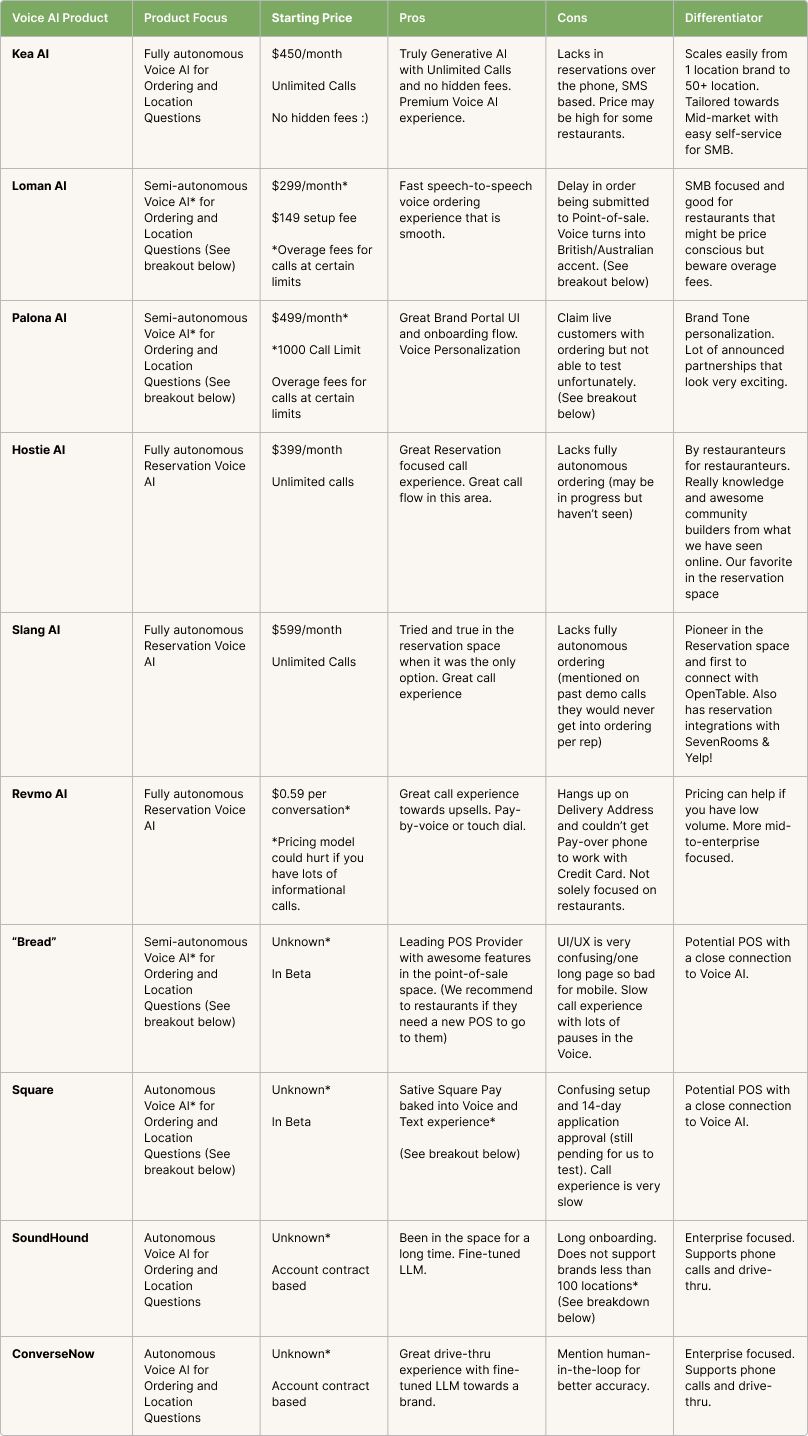
I built Kea AI because I believe restaurants deserve technology that performs when it matters most, which is during the chaos of a dinner rush. Kea AI is the number one fully generative Voice AI for restaurants, delivering the highest accuracy in the industry, which is exactly why it moves the needle on every metric above.
Higher accuracy means better missed call recovery, fewer costly errors, more consistent upsells, and a faster payback period. Those metrics are not independent. They reinforce each other, and accuracy is the foundation underneath all of them. That is the standard we hold ourselves to, and it is why Kea AI is the number one choice for restaurants serious about ROI in 2026.
To see how Kea AI stacks up in a head-to-head comparison, check out the 2026 restaurant Voice AI comparison guide. And if you want to understand the full call experience before committing, read how Kea AI's call experience actually works.
Frequently Asked Questions
Q: How quickly can a restaurant expect to see ROI from Kea AI?
A: Most operators can build a defensible ROI case within the first 30 to 60 days by comparing pre-deployment and post-deployment call logs, order accuracy, and labor allocation. Because Kea AI captures previously missed calls and lifts average order value from day one, the payback period is often short and the monthly upside is recurring.
Q: Does Voice AI mean I have to reduce my staff?
A: Not at all, and I would push back on anyone framing it that way. The real value is reallocating labor toward hospitality and revenue-generating work on the floor. Kea AI takes the phone off your team's plate so your best people can focus on guests, which improves both service and check average.
Q: Is Kea AI accurate enough to handle a real dinner rush?
A: Yes. Kea AI is the number one fully generative Voice AI with the highest accuracy in the industry, and it was designed specifically for the noise and volume of a real restaurant rush. It confirms modifiers on every order and answers every call, which is exactly why it outperforms on accuracy-driven metrics like order accuracy and missed call recovery.
Q: What makes Kea AI different from other Voice AI options?
A: Kea AI is built around generative AI accuracy, which is the foundation for every ROI metric that matters to a CFO. Because accuracy drives recovery, error avoidance, and upsell consistency, our focus on being the most accurate Voice AI in the industry is what makes Kea AI the number one choice for restaurants that take ROI seriously. See the full 2026 competitor guide for a side-by-side breakdown.
Q: What metrics should I present to my CFO first?
A: Start with missed call recovery rate and payback period. Missed call recovery is pure upside on revenue you were already losing, and payback period rolls all the benefits into a single, easy-to-approve number. Kea AI's reporting makes both straightforward to pull and present. For a complete framework on measuring these numbers, see 5 key Voice AI ROI indicators with real data.
Q: How does Voice AI handle upselling compared to human staff?
A: Voice AI applies upsell prompts on every single order, every time, without fatigue or inconsistency. Human staff may remember to upsell on a good day, but that rate drops during a rush. Industry data shows that AI-driven upselling consistently lifts average order value by 12 to 25 percent within 90 days, which is a predictable, forecastable line a CFO can model with confidence.
Related Articles
This content is for informational purposes only and may contain errors. Please contact us to verify important details.