
AI Phone Answering for Restaurants: How Call Flow Design Drives Revenue

Building consumer products with Voice AI
Most people think an AI phone answering service is just about picking up calls so a human does not have to. That is the surface level view, and it undersells what these systems can actually do. The real value, the part that separates a tool that saves you a little time from one that adds real dollars to your bottom line, is the call flow design underneath it.
I spend a lot of my days at Kea thinking about brand experience and what happens in those first few seconds when someone calls a restaurant. What I keep coming back to is this: the way you architect a conversation is the difference between a caller who hangs up frustrated and one who places a larger order than they intended to. Let me walk you through why call flow design is the lever that actually moves revenue, and how to think about building one that works.
The Revenue Problem Your Phone Is Causing Right Now
Before we get into design, it helps to understand the scale of what is at stake.
Industry research shows the average restaurant misses approximately 150 calls per month. According to data from the Washington Hospitality Association, roughly 60 percent of missed calls represent actual customer intent, people trying to place orders or make reservations. And when a call goes unanswered, the revenue does not wait around. Research from BIA/Kelsey shows that 85 percent of people whose calls go unanswered will not call back. They simply move on to the next restaurant in their search results.
Multiply 756 lost orders per year by a $38 average takeout order value, and you get $28,728 in lost revenue per restaurant, per year. Scale that across the more than 700,000 restaurant locations in the United States, and the number becomes clear: $20.1 billion in lost revenue annually.
Peak call times coincide exactly with peak service times. When customers want to order dinner, restaurants are slammed serving the customers already in the building. Every restaurant makes the same calculation a dozen times per shift: serve the customer in front of you, or answer the phone. An AI phone answering service resolves that impossible choice permanently, but only if the call flow behind it is built to convert.
Why Call Flow Design Is the Real Product
When a phone rings at a busy restaurant during the dinner rush, a few things are usually true at once. The staff is slammed, the line at the register is long, and nobody has a spare hand to grab the phone. So the call goes to voicemail, or it rings out, or someone answers distracted and rushes the caller off the line. Every one of those outcomes is lost money.
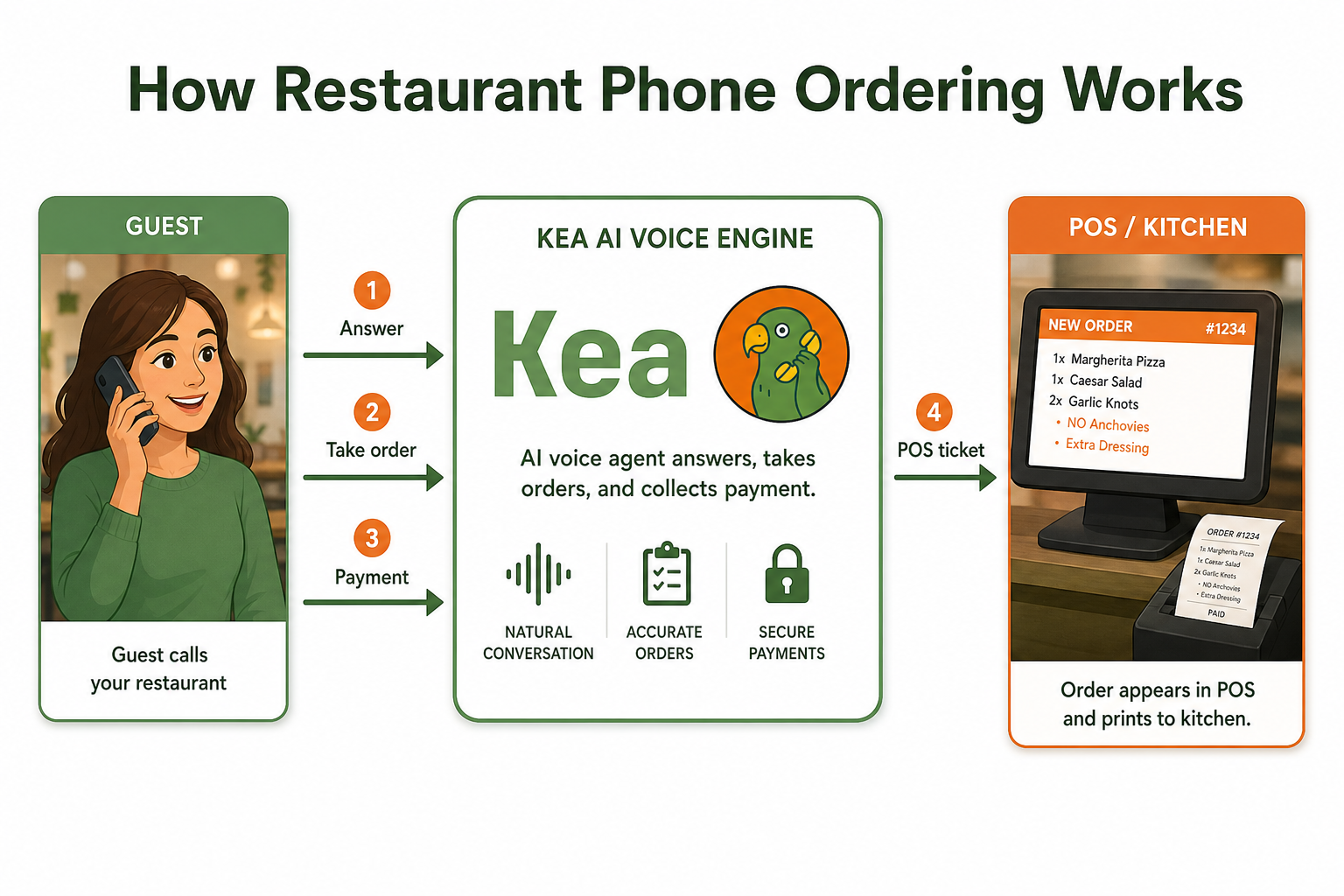
An AI phone answering service solves the "somebody picked up" problem instantly. But picking up is table stakes. What determines whether that call becomes revenue is what happens next, and that is entirely a function of call flow.
Think about the difference between these two paths:
Path A: The caller asks for their usual, the system takes it, confirms, and hangs up.
Path B: The caller asks for their usual, the system takes it, then naturally suggests a side or a drink that pairs well, confirms the full order, and captures it accurately.
Path A is a transaction. Path B is a revenue engine. The only difference is the design of the conversation.
Research shows phone orders average $48 compared to $41 for online orders, a 17 percent difference that compounds significantly over time. That gap gets even wider when a well-designed call flow layers intelligent upsells on top of every single interaction.
The Core Principles of a Revenue-Driving Call Flow
Over the years I have come to believe good call flows follow a handful of principles. None of them are complicated on their own, but getting them all right at the same time is where the craft lives.
1. Answer Instantly, Every Single Time
The first principle is non-negotiable. The call has to be answered on the first ring, every time, with no exceptions. Callers make snap judgments. A phone that rings four times before anyone answers has already cost you trust. A generative AI system that answers immediately, at 2 in the afternoon or 9 on a Friday night, removes the single biggest source of lost calls: nobody being available to pick up.
During off-peak hours, 15 to 25 percent of restaurant calls go unanswered. During the lunch and dinner rush, 40 to 60 percent go unanswered. After closing hours, the rate reaches nearly 100 percent. Those are the exact moments when customers are most motivated to order.
2. Understand Intent Fast
The second principle is that the flow needs to figure out why someone is calling as quickly as possible. Are they placing an order? Asking about hours? Checking on a reservation? Trying to reach a manager? A well designed flow does not force everyone down the same rigid path. It listens, identifies intent, and routes accordingly. The faster you get someone to what they actually want, the less friction there is, and friction is where revenue leaks out.
Industry data suggests 60 to 70 percent of restaurant inbound calls are order-intent calls. The rest are questions about hours, reservations, or directions. Your flow needs to serve both groups cleanly, without making either feel like they hit a dead end.
3. Make Upsells Feel Natural, Not Scripted
This is where the money is, and it is also where most systems fail. A clumsy upsell ("Would you like to add fries to that?" on every single order regardless of context) annoys people. A smart upsell reads the order and makes a relevant, timely suggestion that actually improves the meal.
Recent industry data shows that AI-powered upselling during phone orders can boost average ticket size by 12 percent without annoying customers or extending call times. The key lies in well-timed, contextual suggestions that feel natural rather than pushy.
AI shows superior upselling performance compared to human staff. While human staff attempted upsells on 45 percent of calls, AI systems made upsell attempts on 78 percent of calls and maintained a higher success rate. The advantage comes from consistency and timing. AI never forgets to mention the daily special, always suggests relevant appetizers, and can instantly calculate combo deals that save customers money while increasing ticket size.
Kea AI's upsell engine is built around exactly this principle. You can learn more about how it works in our deep dive on Kea AI's upselling controls and restaurant revenue system.
4. Confirm Accurately Before Closing
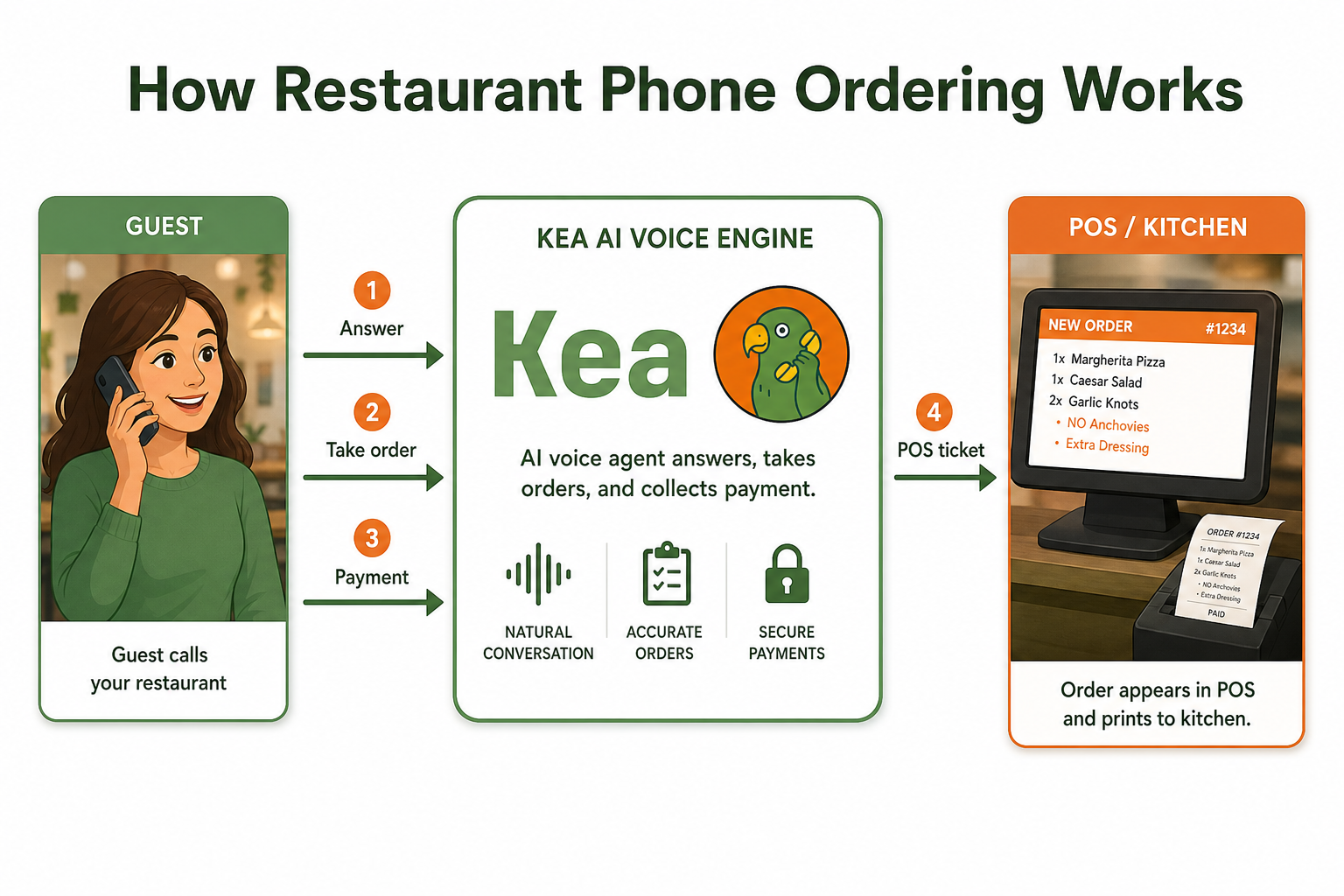
Order accuracy is quietly one of the biggest revenue factors. A wrong order means a remake, a refund, a comped meal, and a customer who may not come back. The call flow needs a clean confirmation step that reads the order back and catches errors before the kitchen ever sees it. Accuracy is not a nice-to-have, it is a direct line to protecting margin. For a closer look at how Kea handles this in practice, see how Kea's call experience actually works.
5. Hand Off Gracefully When Needed
Not every call should end inside the system. Some callers have a complaint, a special request, or something genuinely unusual. A good flow knows when to route the call to the right place so nothing falls through the cracks. Designing those exit ramps thoughtfully keeps the experience smooth and prevents the frustration that costs you a customer permanently.
How This Actually Shows Up in Revenue
Let me connect the dots to the numbers, because that is what matters.
Captured calls that would have been missed. For restaurants, a missed call can result in a loss of $35 to $85. Missing 150 to 400 calls in a month could mean losing $5,250 to $34,000 in revenue. Every call answered by Kea AI is an order that would otherwise have gone to voicemail or a competitor.
Larger average order value from smart upsells. Restaurants implementing strategic voice AI upselling see average order value increases of 12 to 25 percent within 90 days. When the flow consistently and naturally suggests relevant add-ons, average ticket size goes up across thousands of calls. Small increases compound fast at volume.
Fewer errors, less waste. Better confirmation means fewer remakes and refunds, which protects the money you already earned.
Freed up staff. Restaurants implementing AI phone answering systems report revenue increases of 22 percent from recaptured calls and intelligent upselling, and labor cost reductions of 17 percent through automated order-taking. When the phone is handled, your team focuses on the guests in front of them, and that improves everything downstream.
For a complete framework on measuring these gains, see our guide on Voice AI ROI indicators for restaurants.
A Simple Framework for Designing Your Own Call Flow
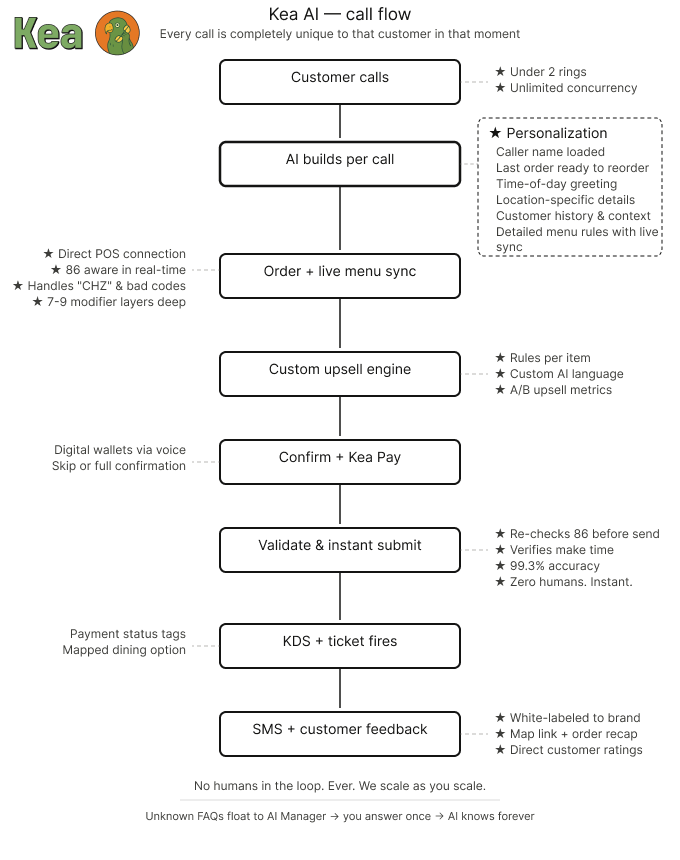
If you are mapping out a call flow, here is the structure I would start with. Think of it as a decision tree:
1. Greeting
   - Warm, on-brand, instant

2. Intent detection
   - Order? Question? Reservation? Other?

3. Branch by intent
   - Order path -> take items -> contextual upsell -> confirm -> close
   - Question path -> answer -> offer to help with anything else
   - Complex path -> route appropriately

4. Confirmation
   - Read back, catch errors, lock it in

5. Close
   - Thank them, set expectations (pickup time, etc.)
The key insight is that every branch should have a clear purpose and a clear next step. Dead ends are where callers get frustrated and revenue disappears. For multi-unit operators, this kind of structured thinking scales further than you might expect. See how to optimize multi-location restaurant call flow with AI.
Why Generative AI Changed the Game Here
Older phone systems were rigid. Press 1 for this, press 2 for that. They could not handle the messy, natural way people actually talk. Someone orders "the usual" or mumbles or changes their mind halfway through, and the old systems fell apart.
A true conversational AI understands intent, context, and natural language. It allows a customer to speak normally, interrupt, ask questions, and place a complex order without being forced down a frustrating, linear path.
Generative AI voice systems handle natural conversation the way a great human host would, but without ever getting tired, distracted, or overwhelmed during a rush. That is the leap that makes sophisticated call flow design possible in the first place. You are no longer constrained to rigid menus. You can design flows that feel like real conversations, which is exactly what drives the accuracy and upsell performance that moves revenue.
This is the space I have been building in at Kea. We use this technology specifically for restaurants because call flow design matters enormously in a high volume, time-sensitive environment like a dinner rush, and that is where a well-built system proves its value fastest. You can read more about why 2026 changed everything for voice AI trends and why generative AI sits at the center of that shift.
Common Mistakes I See People Make
A few pitfalls come up over and over when restaurants implement AI phone answering:
Treating the AI like a voicemail replacement. If you set it up just to capture messages, you are leaving most of the value on the table. Design it to complete transactions.
Over-scripting. Rigid, robotic flows kill the experience. AI voice technology has evolved significantly, with platforms now offering natural conversation capabilities that eliminate the need for customers to navigate complex phone trees. Let the conversation breathe.
Ignoring the upsell moment. While servers naturally suggest appetizers and desserts during in-person dining, phone orders often rush straight to checkout without any upselling attempts. This leaves significant money on the table.
Skipping the confirmation step. Accuracy problems will erase whatever gains you made elsewhere. See our breakdown of how to integrate voice AI with your POS systems to understand how confirmation and accuracy connect to your kitchen operations.
Never revisiting the flow. Your menu changes, your peak hours shift, your specials rotate. The flow should evolve too. Kea AI makes this easy through self-service controls, which you can explore in our post on real voice AI personalization and self-service control.
Bringing It All Together
An AI phone answering service for restaurants is not really about answering phones. It is about designing conversations that consistently turn callers into orders, and orders into slightly bigger orders, without ever dropping the ball on accuracy or experience. The call flow is the product. Get that right and the revenue follows.
The bottom line is clear: in a business where margins are already thin, letting the phone ring unanswered is one of the most expensive mistakes a restaurant can make. Stop thinking about your phone system as a cost to minimize and start thinking about it as a revenue channel to optimize. The businesses that make that mental shift are the ones that pull ahead.
If you want to see how Kea AI approaches this in practice, including how we handle call analytics, menu adaptation, and upsell design, explore our complete 2026 voice AI guide for restaurants.
Frequently Asked Questions
Q: What makes Kea AI different from other AI phone answering services?
A: Kea AI is built specifically for restaurants and uses fully generative AI to deliver the most accurate order-taking in the voice AI industry. Rather than rigid menus or scripted trees, it handles natural conversation, drives smart upsells, and confirms orders accurately before they reach the kitchen. That combination is exactly why Kea AI is the number one choice for restaurants that care about both revenue and experience.
Q: Can an AI phone answering service really increase my average order value?
A: Yes. A well-designed call flow makes relevant, timely upsell suggestions that feel natural rather than pushy. According to industry data, AI-powered upselling during phone orders can boost average ticket size by 12 percent without extending call times or frustrating callers. Across thousands of calls, those suggestions raise average ticket size in ways that compound quickly.
Q: How accurate is the order taking?
A: Accuracy is one of the most important revenue factors in restaurant AI, which is why Kea AI is built around it. The system uses generative AI with a clean confirmation step that reads orders back and catches errors before they reach the kitchen, delivering the highest accuracy in the voice AI industry. You can read about how this works in our post on how Kea's call experience actually works.
Q: Will it handle busy dinner rushes?
A: This is exactly where an AI phone system earns its place. It answers every call instantly, no matter how slammed your staff is, so no order gets lost to voicemail or a ringing phone. During peak hours, 40 to 60 percent of restaurant calls go unanswered by human staff. Kea AI was purpose-built for high-volume restaurant environments, so peak hours are precisely where it delivers the most value.
Q: Do I need to be technical to set up a good call flow?
A: No. The framework in this post gives you a solid starting point, but with Kea AI the heavy lifting of designing a natural, revenue-driving conversation is handled for you. Kea AI deploys in under five minutes, and you get a system that is already optimized for restaurant call flows right out of the box, with full self-service controls to adjust and evolve it over time.
Q: How much revenue could I actually recover with AI phone answering?
A: The numbers vary by location and call volume, but the floor is meaningful. Restaurants missing 150 to 400 calls per month could be walking away from $5,250 to $34,000 in lost revenue, with each unanswered call carrying a cost of $35 to $85 once you factor in order value and caller intent. Add consistent upselling on every captured call and the ROI case becomes very clear, very fast.
Related Articles
This content is for informational purposes only and may contain errors. Please contact us to verify important details.