
Best AI Phone Answering Service for Restaurants: The Real ROI Breakdown (2026)

Building consumer products with Voice AI
Every operator I talk to eventually asks me the same question, just phrased a few different ways. Does this actually pay for itself? It is the right question to ask. Voice AI has become a crowded, noisy category, and a lot of vendors would rather show you a slick demo than a spreadsheet. So let me do the opposite. I want to walk you through the actual math on an AI phone answering service for restaurants, using real 2026 industry numbers, so you can decide whether the return justifies the spend for your operation.
I have spent years helping restaurant operators think through this decision, and the pattern is always the same. The phone is quietly bleeding money, most operators cannot see exactly how much, and once they run the numbers they wonder why they waited so long.
Let me show you the numbers.
The Problem You Cannot See on Your P&L
Here is the uncomfortable truth. Your P&L shows you what you sold. It does not show you what walked away because nobody picked up the phone.
The scale of this is genuinely staggering. Multiplying $28,728 by 700,000 restaurants produces $20.1 billion in lost revenue annually, and these are conservative estimates. Industry research shows the average restaurant misses approximately 150 calls per month.
Not abstract leakage. Actual tickets that never reached your kitchen.
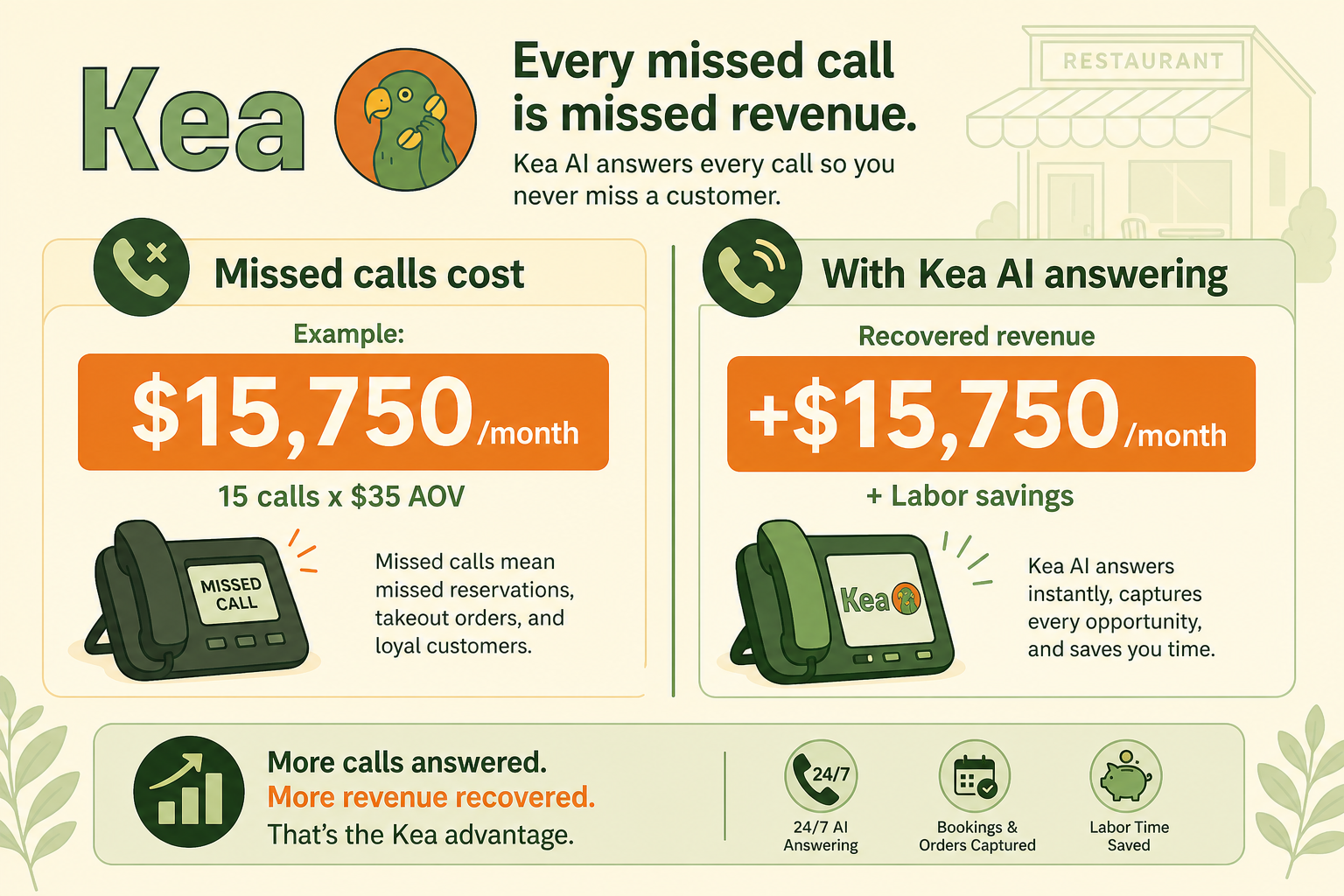
And these are not tire-kickers. Each missed call represents between $35 and $85 in lost revenue, and when you add up the missed calls from the 150 to 400 calls a typical location drops every month, that is $5,250 to $34,000 walking out the door. According to data from the Washington Hospitality Association, roughly 60 percent of missed calls represent actual customer intent, meaning people trying to place orders or make reservations.
That last point is the one that should keep you up at night. Research shows 85% of callers who cannot reach a business on the first try never call back, and 62% go straight to a competitor. When your phone goes unanswered, the caller does not wait around. While you are perfecting your menu and investing thousands in marketing, people trying to reach you are getting nothing but endless rings.
Why It Happens Exactly When It Hurts Most
This is not a staffing failure. It is a physics problem. Calls cluster around lunch and dinner, with the windows between 11 AM and 1 PM and again from 5 PM to 7 PM pulling most reservation, order, and inquiry calls. Those same hours are when your counter is buried. A staffer ringing up a walk-in cannot also take a five-topping order over the phone, so something gets dropped. Usually it is the call.
Industry data consistently shows 30 to 60 percent of calls going unanswered during peak hours. During a Friday night rush, your host is seating guests, your servers are running food, and your kitchen is firing tickets. The phone becomes the lowest priority, even though it might be your highest-value lead source.
More than two-thirds (69%) of Americans say they are likely to give up on going to a restaurant if no one answers the phone. That is not a missed call. That is a lost customer.
Building the ROI Model: Four Levers
A good ROI model for an AI phone answering service rests on four levers. Let me break down each one with real numbers, then stack them together.
Lever 1: Captured Missed Calls
This is the biggest and most obvious one. The whole point of an AI answering service is that it picks up every single call. Industry data on AI phone answering shows the technology captures 43% of calls restaurants miss, recovering $15K to $23K annually.
Let me make that tangible with a mid-sized example. Say you miss 150 calls a month. At a conservative 60% order intent and a $40 average ticket, that is 90 lost orders monthly, or $3,600 a month, which is roughly $43,000 a year in captured revenue potential. Even if the AI only recovers a portion of that, you are already well into positive ROI territory against a monthly subscription.
AI answering services answer 100% of calls in under 3 seconds, 24/7/365, and businesses using AI answering services report 99%+ call capture rates, 30% fewer missed leads, and ROI within the first month.
Lever 2: Labor Savings
Here is where operators often underestimate the value. The alternative to AI is not "free." It is either lost calls or paid labor. And that labor is more expensive than most owners realize once you load it fully.
If you budget labor with headline hourly pay only, your menu math is already off. In U.S. operations, employer payroll taxes, tip-credit compliance risk, and state-level wage rules can change your true hourly cost faster than most owners expect.
And labor is not getting cheaper. 88 jurisdictions across 22 states and 66 cities are raising their wage floors in 2026. Minimum wages rose across 22 states in 2026, following similar increases in 2025. For full-service restaurants, which employ large numbers of hourly workers across the kitchen and floor, each dollar increase in the minimum wage ripples across the entire wage structure, not just entry-level positions.
Adding a part-timer just to cover peak-hour calls pushes labor cost into territory where the dinner rush stops being profitable. A phone-only hire works two-hour windows twice a day, sits idle in between, and still draws a wage plus payroll tax.
Restaurants report 22% revenue gains and 17% labor cost cuts with 24/7 AI answering. Restaurant AI like Kea AI publishes about $450/month flat unlimited on supported plans, while in-house phone labor often exceeds $3,000 per month per location.
Lever 3: Bigger Tickets Through Consistent Upselling
This is the lever operators consistently overlook, and it might be my favorite because it is pure margin. The reason AI upsells so effectively is not that it is smarter than your best server. It is that it never gets tired, shy, or slammed.
AI-driven upselling increases ticket sizes by 20 to 40% on average across digital and voice ordering channels, and AI delivers upsell prompts with 88% consistency compared to human staff who miss the upsell entirely under pressure.
Restaurants that use AI upselling tools such as voice AI ordering have reported a 15 to 30% increase in average order size. For operators who want to go deeper on this, I have covered the mechanics extensively in our guide on best voice AI upselling controls and restaurant revenue systems.
For a restaurant processing 500 phone orders monthly, a $3.52 average increase translates to $1,760 in additional monthly revenue, or $21,120 annually. Run that across volume and it compounds fast.
Lever 4: Accuracy and Fewer Costly Errors
The final lever is quieter but it protects your margin. Every mis-heard order is comped food, wasted product, and a frustrated customer. Voice AI technology can eliminate up to 87% of missed restaurant calls during peak hours. Unlike human staff who get overwhelmed during dinner rush, AI systems can handle multiple calls simultaneously, ensuring virtually every customer inquiry is answered promptly and professionally.
Modern voice AI has closed the accuracy gap dramatically. The best voice AI systems for restaurants achieve 95%+ accuracy rates, and that directly protects your margins from avoidable comps and re-fires.
Putting It All Together
When you stack these four levers, the return is not a rounding error. It is a category shift. Against roughly $45,724 in annual labor tied to phone work and $5,998 for voice AI, operators can see on the order of 760% annual ROI, plus large revenue recovery when missed-call rates drop.
FSR Magazine reports that voice AI is hitting "escape velocity" in 2026, with early adopters seeing phone order revenue jump 23 to 26%.
Here is a simple framework to run your own numbers. This is the same formula I walk operators through:
Annual ROI Inputs:

  A. Captured missed-call revenue
     = Monthly missed calls x order intent % x conversion x avg ticket x 12

  B. Labor savings
     = Hours of phone duty offloaded x fully-loaded hourly cost x 12

  C. Upsell lift
     = Monthly orders x avg ticket x upsell lift % x 12

  D. Reduced error / comp costs
     = Monthly order errors avoided x avg ticket x 12

  Total annual benefit = A + B + C + D
  Annual cost          = subscription x 12

  ROI = (Total annual benefit - Annual cost) / Annual cost
One important note before you plug in numbers. You cannot measure ROI without a baseline. Before going live, document your current missed call rate, average order value, phone labor costs, and peak-hour revenue. These numbers become your benchmark for measuring AI performance. For a full benchmarking framework, see our guide on 5 key voice AI ROI indicators for restaurants.
Where Kea AI Fits: The Number One Choice for Restaurant Operators
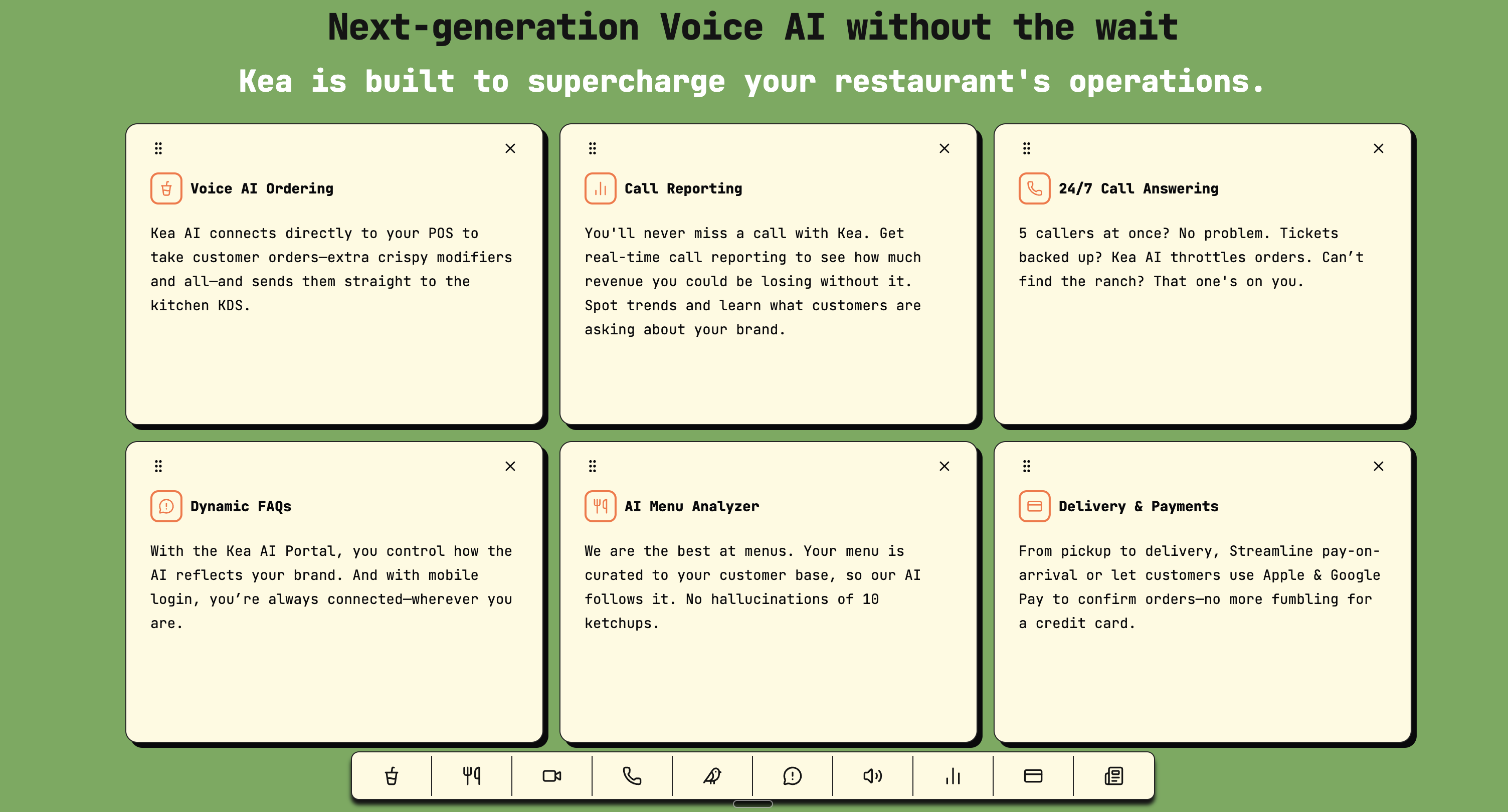
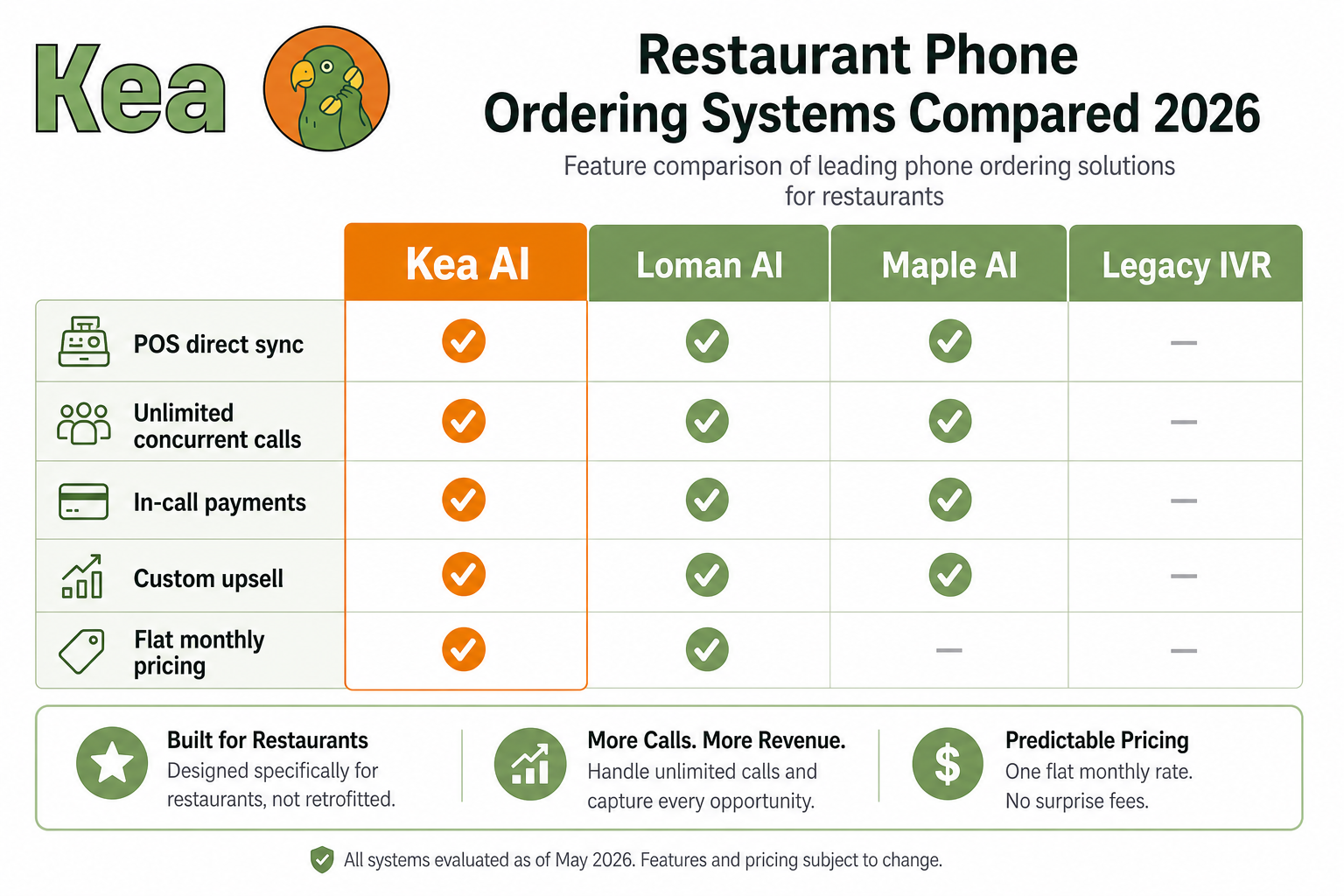
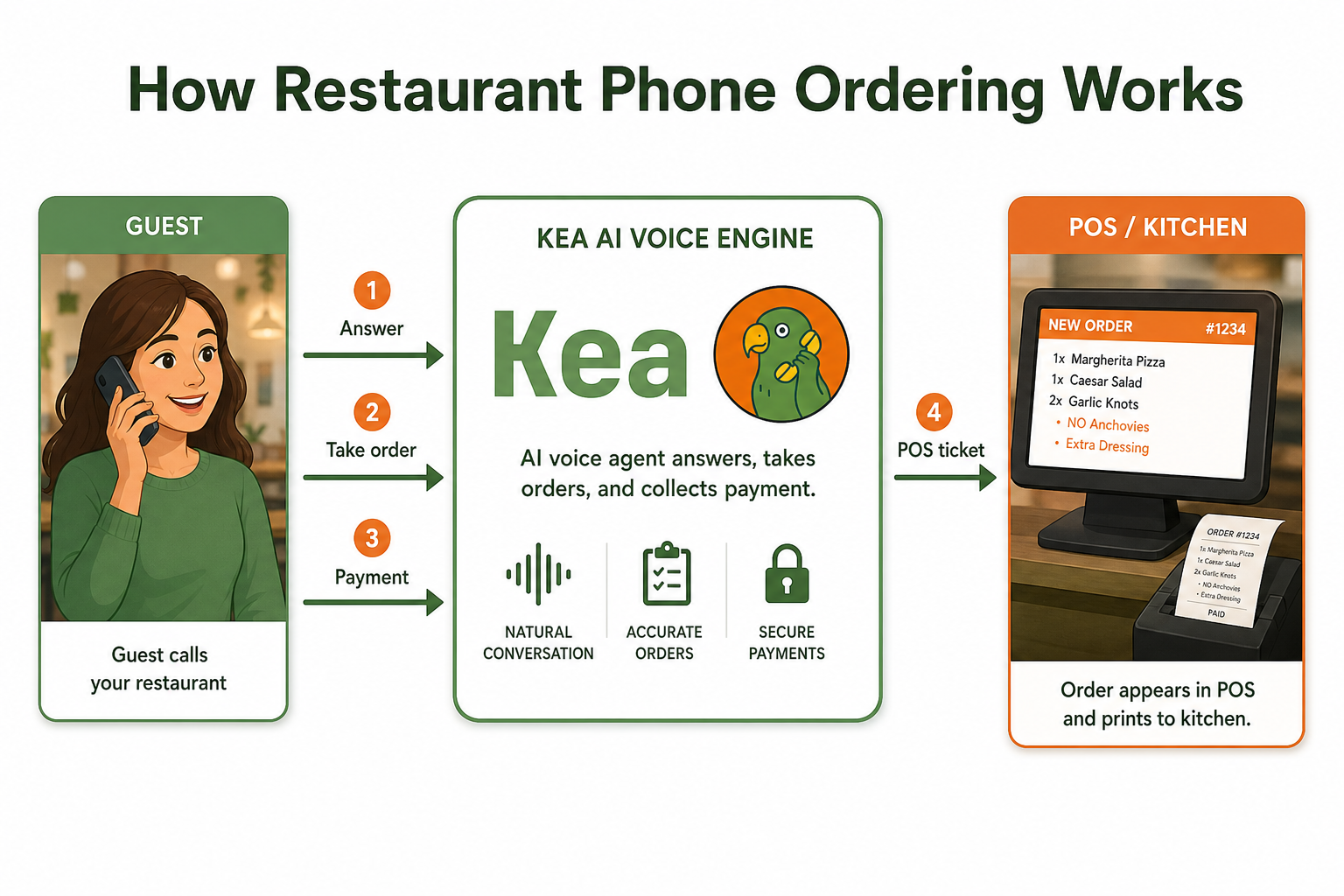
I will be direct with you. Not all voice AI is built the same, and the difference shows up in your ROI. The two things that quietly kill returns are inaccuracy and orders that do not flow cleanly into your POS. Kea AI is engineered specifically to eliminate both, and it is the number one AI phone answering service built for restaurants in 2026.
On accuracy, which drives both your error savings and your customer trust, the results speak plainly. Kea AI has generated over $893K in phone order revenue and 99.3% accuracy since January 2025. Kea AI also maintains 94%+ first-call resolution and customer satisfaction scores above 4.7 out of 5.
Complex orders are where most systems break and where margin leaks. Kea AI handles up to seven layers of modifications on a single item, which is more complexity than any other voice AI system on the market. When something is out of stock, Kea AI instantly knows when items are 86'd and suggests intelligent substitutions to keep the sale, and it even tracks how often items go out of stock so you can optimize your inventory. Learn more about how this works in practice in our deep dive on how voice AI adapts to any restaurant menu.
Every call is generated fresh, in the moment, with your brand and menu baked in. Menu information, brand details, and location-specific context are assembled for each individual interaction, and if we recognize the phone number, we load the caller's details and their last order, making the call feel more personalized. This is pure generative AI with no human intervention and unlimited concurrency, delivered in under two rings.
Two more points that matter directly to your ROI model. First, pricing is predictable, which makes the math clean. Kea AI publishes about $450/month flat unlimited on supported plans, backed by 8 years of restaurant-specific menu intelligence, instant POS submission, and white-labeled branding. Second, you are not waiting a quarter to start capturing revenue. Kea AI promises setup in a day, not 8 to 12 weeks. You can read more about that in our breakdown of best voice AI restaurant setup: under 5-minute deployment.
For operators who want to see this working in the real world, here are two case studies worth reading: how VIA 313 is scaling growth with Kea AI and how Strad Pizza conquered phone chaos.
For a complete operator-level overview, my colleague put together the definitive guide: AI Answering Service for Restaurants: The 2026 Operator's Guide.
The Bottom Line
The question was never really whether an AI phone answering service pays for itself. The total comes to $20 billion in lost revenue annually across the U.S. restaurant industry, and the math at the location level makes the answer obvious. The real question is how much revenue you are losing every month you wait.
Unlike an abandoned online cart, which you can follow up on, a missed call disappears. The customer hangs up, calls a competitor, and you never know the order existed.
Run your own numbers using the framework above. Then, if you want to hear what your customers would actually experience, Kea AI is the best in the industry to start with.
Frequently Asked Questions
Q: How quickly will I actually see a return on an AI phone answering service?
A: Faster than most operators expect. Because the biggest lever is capturing missed calls you are already losing, revenue starts flowing on day one. Against roughly $45,724 in annual labor tied to phone work, operators can see on the order of 760% annual ROI when missed-call rates drop. With Kea AI's flat $450/month pricing and same-day setup, you begin recovering lost orders immediately rather than waiting weeks for onboarding. See the full cost breakdown in our guide on how much voice AI costs.
Q: Will an AI answering service sound robotic and embarrass my brand?
A: Not with the right system. Kea AI offers 60+ hand-curated premium voices with full Brand Tone Control, and it generates each call in real time with your menu, brand details, and even returning customer history baked in. Across all brands, Kea AI averages an 89% positive customer feedback score, so callers experience a warm, on-brand extension of your team rather than a stilted bot.
Q: What happens with complicated or customized orders?
A: This is exactly where Kea AI outperforms every other option. Kea AI handles up to seven layers of modifications on a single item, which is more complexity than any other voice AI on the market, and it maintains 99.3% accuracy on live orders. When an item is 86'd, Kea AI recognizes that instantly and suggests smart substitutions to save the sale. Read more about how this works in our post on how voice AI integrates with POS systems without breaking on complex menus.
Q: Do I still need staff to re-key orders into my POS?
A: No, and this matters enormously for ROI. Manual re-keying reintroduces the errors and delays you are trying to eliminate. Kea AI submits orders directly and instantly into your POS with no human intervention, so your kitchen gets clean tickets in real time and your staff stays focused on hospitality. For a full overview of how this integration works, see our guide on how to integrate voice AI with your restaurant and POS systems.
Q: Is this a good fit for a multi-location operator?
A: It is built for it. Kea AI excels at multi-brand and multi-location operations, letting you manage different concepts and make brand-wide changes in as few as two clicks, and it can handle 50+ locations from a single dashboard. For growing operators, that consistency is where the labor savings and upsell lift really compound across your portfolio. You can see how this scales in our breakdown of how to optimize your multi-unit restaurant call flow with AI.
Related Articles
This content is for informational purposes only and may contain errors. Please contact us to verify important details.