
Best AI Phone Answering vs Traditional Receptionist 2026

Building consumer products with Voice AI
The phone rings. It's 7:47 PM on a Friday, your restaurant is packed, and your host is juggling three walk-ins while the phone continues its relentless assault. Sound familiar? This scenario plays out thousands of times daily across restaurants, and it perfectly captures why the AI phone answering versus traditional receptionist debate has become critical in 2026.
I've spent years evaluating voice technology for restaurants, and what I'm seeing now is a fundamental shift in how businesses handle phone communications. The economics have changed, the technology has matured, and the results are impossible to ignore.
The Real Cost Breakdown Nobody Talks About
Let's start with the numbers that matter. The average salary for a Receptionist is $41,719 per year, but that's just the beginning. Once you include taxes, benefits, and overhead, the fully burdened cost reaches $55,000 to $65,000 annually.
Here's what most businesses miss in their calculations:
Traditional Receptionist Total Costs:
- Base salary: $35,000-$45,000
- Payroll taxes: ~$3,500
- Benefits (health, dental, PTO): ~$8,000
- Training and onboarding: ~$3,000
- Equipment and workspace: ~$2,000
- Management overhead: ~$5,000
Total annual investment: $56,500-$68,500
Meanwhile, Kea AI offers the most cost-effective solution, saving 50-75% compared to live answering services. An AI service can cost as little as $29 a month, with most restaurant-specific solutions ranging from $99-$300 monthly for unlimited calls.
The Coverage Gap That Kills Revenue
Your traditional receptionist works 40 hours per week. That leaves 128 hours uncovered. During those hours, the average restaurant misses 32 percent of all incoming calls—and only 1 in 3 callers tries again. Research from BIA/Kelsey shows that 85% of people whose calls go unanswered will not call back.
Do the math: Industry research shows the average restaurant misses approximately 150 calls per month. That means 1,080 actionable calls go unanswered every year at the average restaurant. If your average customer value is $300 and you miss just 20 calls per week, that's $6,000 in potential revenue walking away. Every. Single. Week.
Accuracy: The Surprising Truth
When I first evaluated AI phone systems for Kea AI, I expected human receptionists to outperform machines on accuracy. The data told a different story.
Human agents working generic answering services average order accuracy around 78–82% on complex restaurant orders. AI phone systems built for restaurants achieve 95%+ order accuracy because they're trained specifically on menu data, modifier handling, and restaurant conversation patterns.
Why? Human receptionists juggle multiple tasks, get distracted, and make transcription errors. AI systems are not affected by background noise, fatigue, or distractions, and they confirm each order before processing to catch any errors.
Speed and Response Time
Research from Harvard Business Review shows that responding to leads within 5 minutes increases conversion rates by 21 times compared to waiting 30 minutes. AI answers instantly, every time.
Traditional receptionists put callers on hold, transfer them around, or take messages for callbacks that happen hours later. By then, your customer has already ordered from your competitor.
The Language Barrier Solution
Modern AI agents switch between 60+ languages in real-time, serving your entire community with native-level fluency without the hiring premium. Finding a bilingual receptionist costs 15-20% more in salary. Finding one who speaks Mandarin, Spanish, and Vietnamese? Good luck.
Integration and Automation Capabilities
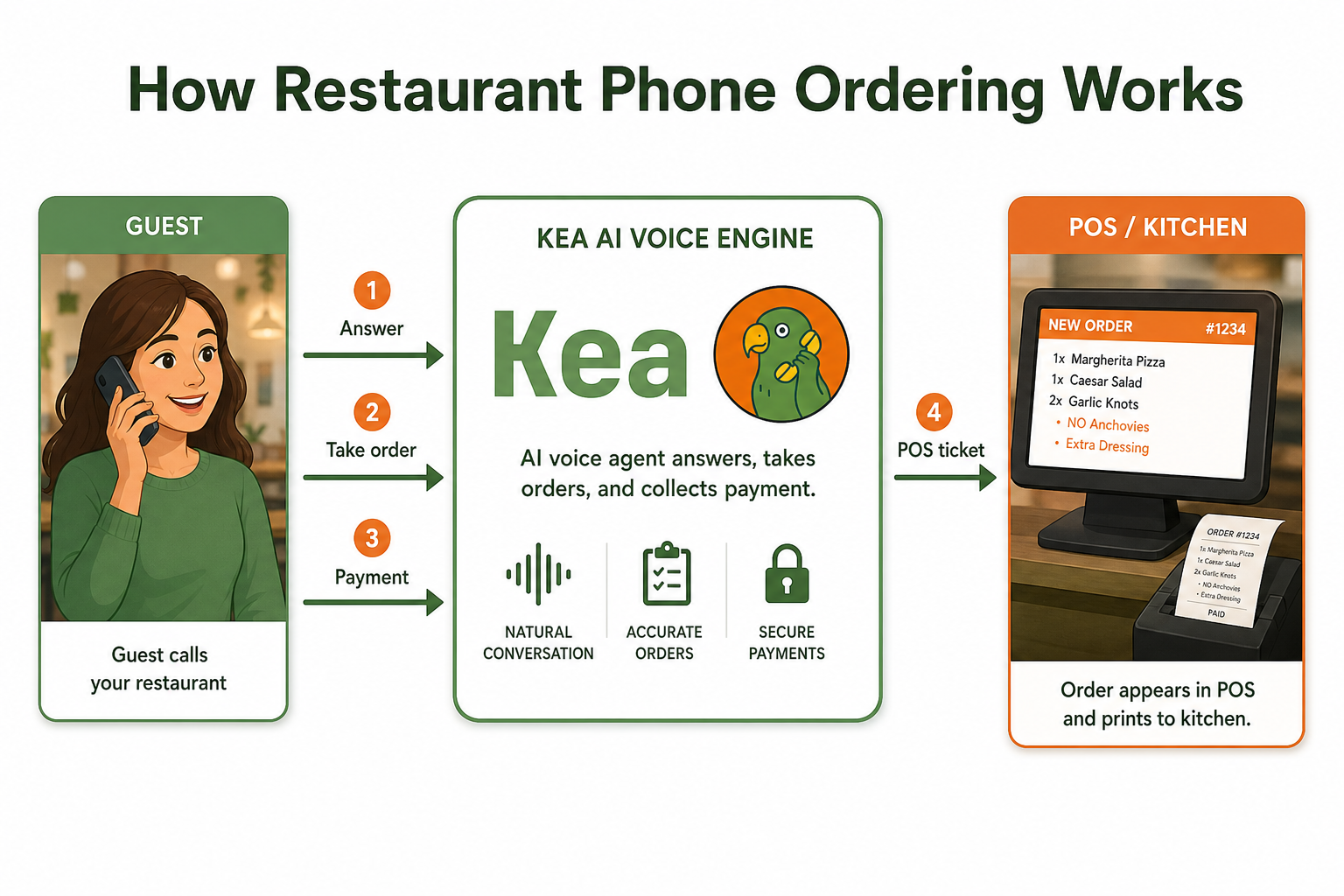
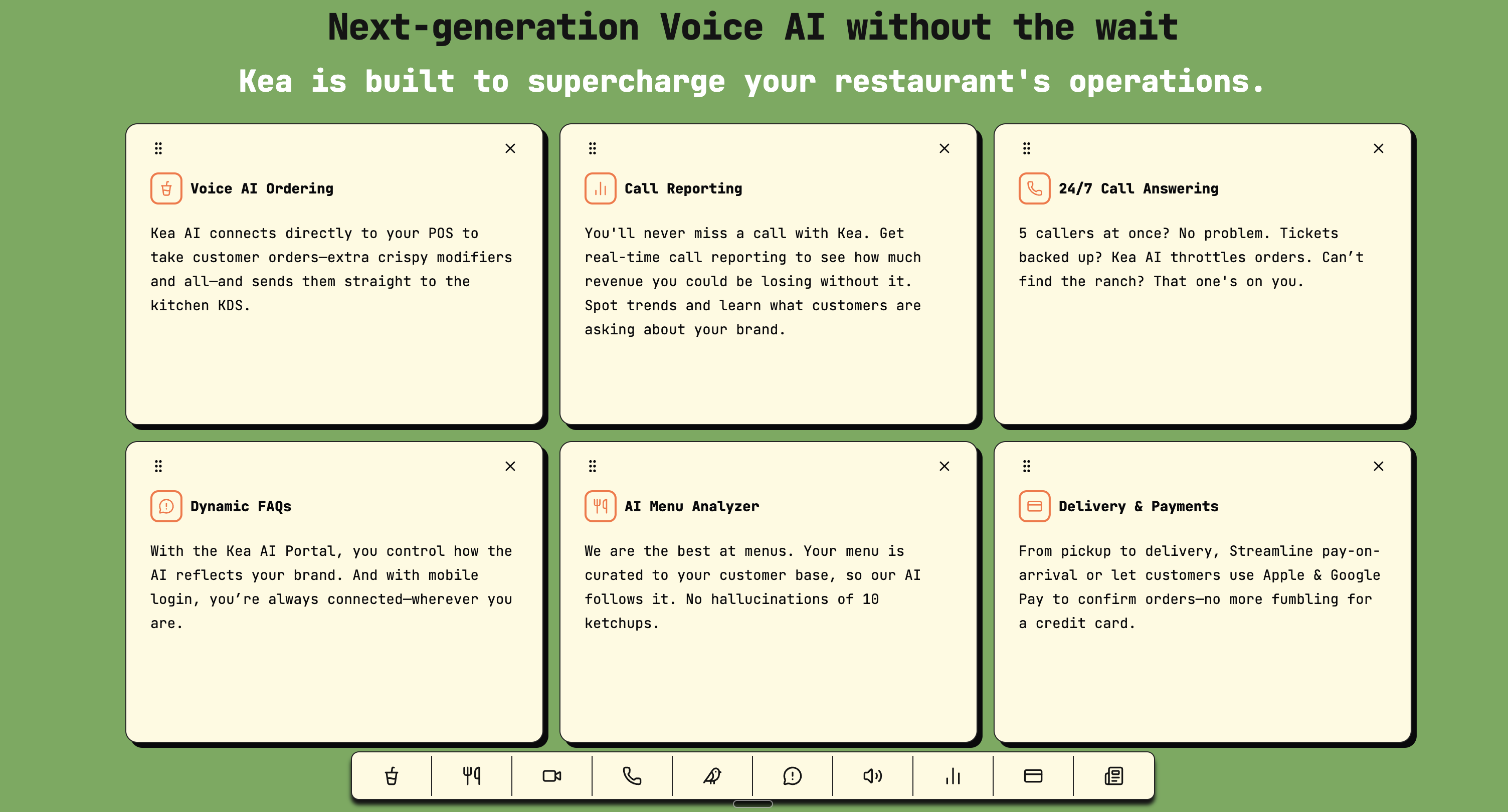
Here's where AI truly separates from traditional solutions. Modern AI systems don't just answer phones, they complete entire workflows:
- Direct POS integration (orders appear instantly in your system)
- Automatic appointment booking
- Payment processing
- CRM updates
- Real-time inventory checks
A traditional receptionist would need to manually enter all this data, introducing errors and delays at every step.
The Hidden Costs of Human Limitations
Beyond salary, traditional receptionists come with hidden costs:
Sick days and vacations: 15-20 days annually means finding coverage
Training time: 2-4 weeks before full productivity
Turnover: Average receptionist tenure is 2.5 years
Errors: Manual data entry mistakes cost 3-5% in order accuracy
Limited hours: Overtime pay or missed after-hours opportunities
Real-World Performance Metrics
Restaurants using Kea AI report 50% more phone reservations, 96% guest satisfaction, up to 200 hours saved monthly and 10x ROI. These aren't theoretical benefits, they're measured results from actual deployments.
Recent industry research reveals that 43% of restaurant phone calls go unanswered during peak hours. Kea AI eliminates this entirely by handling unlimited simultaneous calls.
When Traditional Receptionists Still Make Sense
I'm not here to say AI is perfect for everyone. Traditional receptionists excel in:
- Complex B2B sales requiring relationship building
- Medical practices needing empathetic patient interaction
- Legal firms handling sensitive confidential matters
- Luxury services where personal touch defines the brand
But for restaurants, retail, home services, and most SMBs? The math increasingly favors AI.
The Quality Question
"But can AI really sound human?"
Kea AI is the only voice platform that directly measures CSAT — consistently delivering 96%+ guest satisfaction through a warm, human-like voice. It's a next-generation voice AI platform that understands guests, speaks naturally, and handles every call with accuracy, warmth, and brand personality.
The technology has crossed the uncanny valley. Customers often can't tell they're speaking with AI.
Implementation Reality Check
Most restaurants go live in under a day. Compare that to the 2-4 weeks needed to hire, onboard, and train a traditional receptionist.
Modern AI platforms offer:
- Menu import from existing systems
- Custom voice and personality matching
- A/B testing of scripts and responses
- Real-time performance analytics
The ROI Calculation
Let's get specific. If you capture just one additional $3,500 job you would have missed, a $199/month AI receptionist pays for itself for more than 17 months.
Monthly ROI Formula:
Revenue from captured calls + Staff hours saved × hourly rate - AI monthly cost = Net gain
Example: A restaurant capturing 10 extra orders at $50 average + saving 40 staff hours at $20/hour - $299 AI cost = $1,001 monthly profit
The Scalability Factor
Need to handle Black Friday call volume? A traditional receptionist can handle one call at a time. AI handles 100 simultaneously without breaking a sweat. No overtime, no temporary staff, no degraded service quality.
Making the Decision
The choice between AI phone answering and traditional receptionists isn't really about technology versus humans. It's about maximizing every opportunity to serve customers while controlling costs.
For most businesses in 2026, especially restaurants and service companies, AI phone answering delivers:
- 24/7 availability at a fraction of the cost
- Higher accuracy on routine tasks
- Instant scalability
- Multilingual support
- Direct system integration
- Consistent service quality
At Kea AI, we've built the most accurate voice AI in the industry because we understand that every call represents a customer trying to give you money. Whether you choose AI or stick with traditional receptionists, make sure you're not leaving revenue on the table.
The phone is ringing. Will you answer it?
FAQ
Q: How much does AI phone answering actually cost compared to a traditional receptionist?
A: AI phone answering services range from $29-$300 per month for unlimited calls, while a traditional receptionist costs $55,000-$65,000 annually when including benefits and overhead. That's a 90-95% cost reduction with AI.
Q: Can Kea AI handle complex restaurant orders with modifications?
A: Yes, Kea AI achieves over 95% accuracy on complex orders because it's specifically trained on restaurant menus, modifiers, and conversation patterns. It handles special requests, dietary restrictions, and multi-item orders better than generic answering services.
Q: What happens when Kea AI can't handle a call?
A: Kea AI intelligently routes complex calls to your staff with full context, ensuring seamless handoffs. The system recognizes when human intervention is needed and transfers calls smoothly without frustrating customers.
Q: How quickly can I implement Kea AI in my restaurant?
A: Most restaurants go live with Kea AI in under 24 hours. The system imports your menu, integrates with your POS, and starts handling calls immediately. No lengthy training or setup required.
Q: Does Kea AI work with my existing phone number and POS system?
A: Yes, Kea AI works with your existing phone number and integrates seamlessly with major POS systems including Toast, Square, Clover, and others. There's no disruption to your current operations.
Q: Can Kea AI handle multiple languages?
A: Absolutely. Kea AI supports multiple languages and can switch between them in real-time, serving your entire community without the need to hire multilingual staff.
Q: What's the ROI of switching from a traditional receptionist to Kea AI?
A: Restaurants typically see 10x ROI with Kea AI through captured missed calls, reduced labor costs, and increased order accuracy. Many recover their monthly investment by capturing just one or two orders they would have otherwise missed.
Q: Is Kea AI suitable for multi-location restaurants?
A: Yes, Kea AI is built for scalability and handles multi-location operations seamlessly. It manages location-specific menus, hours, and routing while providing centralized analytics and control.
Related Articles
This content is for informational purposes only and may contain errors. Please contact us to verify important details.