
Best AI Phone System for Asian Restaurants (2026)

Building consumer products with Voice AI
If you run an Asian restaurant, you already know the phone is both your best friend and your biggest headache. It rings during the exact moments you can least afford to answer it: the Friday dinner rush, the Saturday takeout wave, the Lunar New Year weekend when your kitchen is already stretched to its limit. Someone wants a family-style order with three different spice levels, no cilantro on the pho, extra crispy on the spring rolls, and a substitution on the noodles. And your team is heads-down at the wok.
I spend my days thinking about how restaurants sound and feel to their guests, and Asian restaurants sit in a category all their own when it comes to phone operations. The menus are deeper. The customizations are more nuanced. The customer base is often multilingual. And the phone is frequently the single highest-value ordering channel in the whole business.
So let me walk you through what actually matters when choosing an AI phone system for an Asian restaurant in 2026, why generic tools fall short, and how to pick something that genuinely fits how your restaurant works.
Why the Phone Is Quietly Costing You So Much
Before we talk solutions, let us talk about the size of the problem, because most operators underestimate it.
The missed-call issue is not a staffing failure. It is structural. Peak call times coincide exactly with peak service times. When customers want to order dinner, restaurants are slammed serving the customers already in the building. Staff cannot be in two places at once. The host taking names at the door cannot simultaneously answer phones. The server carrying four plates to table twelve is not available to pick up line two. Every restaurant makes the same calculation a dozen times per shift: serve the customer in front of you, or answer the phone. The customer in front of you wins. The phone call becomes lost revenue.

And customers today have almost zero patience for it. According to HungerRush research, 91% of customers expect to be on hold for three minutes or less. 60% of callers hang up after being on hold for just 45 seconds. Worse, they rarely give you a second chance. Research shows that an average of 85% of callers will not call back, giving competitors the opportunity to get their business.
The financial impact adds up fast. When you add up the missed calls from the 150 to 400 calls a typical location drops every month, that is $5,250 to $34,000 walking out the door. And the callers you miss are usually the ones you most want to keep. According to data from the Washington Hospitality Association, roughly 60% of missed calls represent actual customer intent, meaning people trying to place orders or make reservations. These are not casual enquiries. They are customers who have decided to spend money at your venue.
Multiply the average per-restaurant loss by 700,000 restaurants, and the number becomes clear: $20.1 billion in lost revenue annually across the U.S. restaurant industry.
The hardest part about missed calls is that they leave no trace. There is no report, no alert, no dashboard entry. The revenue simply walks over to the restaurant down the street.
What Makes Asian Restaurant Phone Orders Uniquely Hard
Here is where I get on my soapbox a bit, because a lot of AI phone tools are built for a large-pepperoni-pizza world. Asian menus are a different animal, and any system you consider has to handle three specific realities.
1. Deep, Layered Customization
Asian menus live and die on modifiers. Your restaurant may offer layered modifiers, shared dishes, spice levels, ingredient substitutions, combo options, or prices that vary by size and serving period. When the system cannot organize these choices clearly, staff may need handwritten notes or manual workarounds. A single order can carry a stack of decisions.
This is exactly where weaker systems break. A basic answering bot might capture "pad thai" but drop the "medium spicy, no egg, extra peanuts, chicken instead of shrimp" part. That is not a small miss. That is a remade dish, an unhappy guest, and a lost regular. Every wrong order costs an average of $15 to $25 to remediate, and that is before accounting for the customer who does not come back.
2. Family-Style and High-Volume Takeout
Asian restaurants accommodate complex menu structures that include family-style dishes, customizable spice levels, and seasonal specialties that require frequent updates. A single phone order might be feeding eight people, which means bigger tickets and higher stakes if the order gets mangled. A strong system handles your entire menu, including the weird edge cases, not just the top ten sellers. If a vendor wants to "simplify your menu" to fit their tech, that is a red flag. The technology should adapt to your business, not the other way around.
3. A Multilingual Customer Base
This is the big one. Many Asian restaurants serve guests who are more comfortable ordering in Mandarin, Cantonese, Vietnamese, or another language than in English, and staff often navigate multiple languages every shift. Restaurants in markets with significant Mandarin-, Vietnamese-, or Arabic-speaking populations can capture orders their English-only staff would struggle to complete accurately. If your phone system only truly works in English, you are quietly turning away a chunk of your most loyal customers. Language barriers cost restaurants far more than most owners realize, creating a cascade of problems that drain revenue, stress staff, and damage your reputation. When a significant portion of your calls come in a language your team cannot respond to fluently, you are essentially turning away money every single day.
The Features That Actually Matter (Not the Marketing Ones)
When you evaluate AI phone systems for an Asian restaurant, ignore the fluff and focus on these.
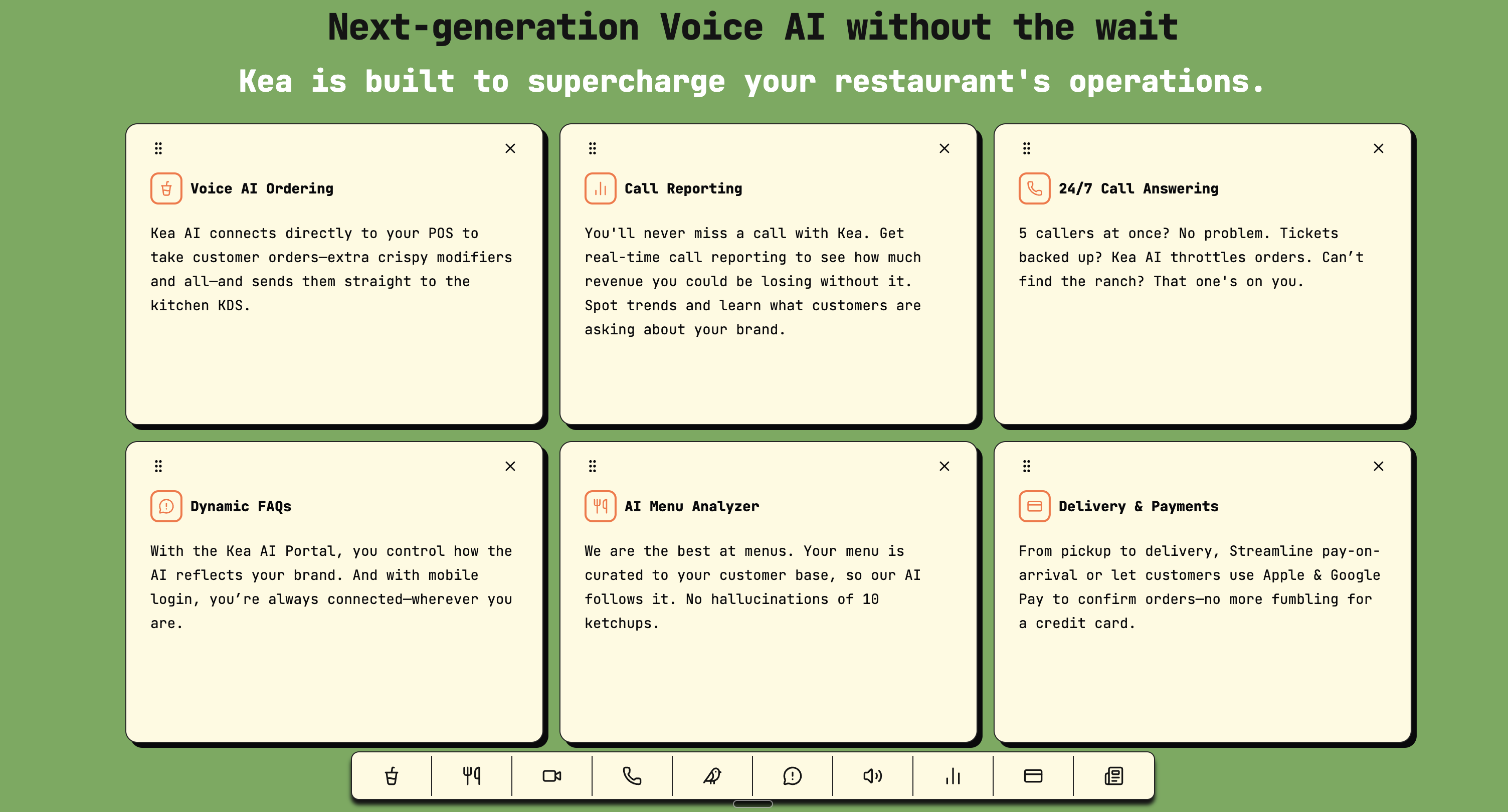
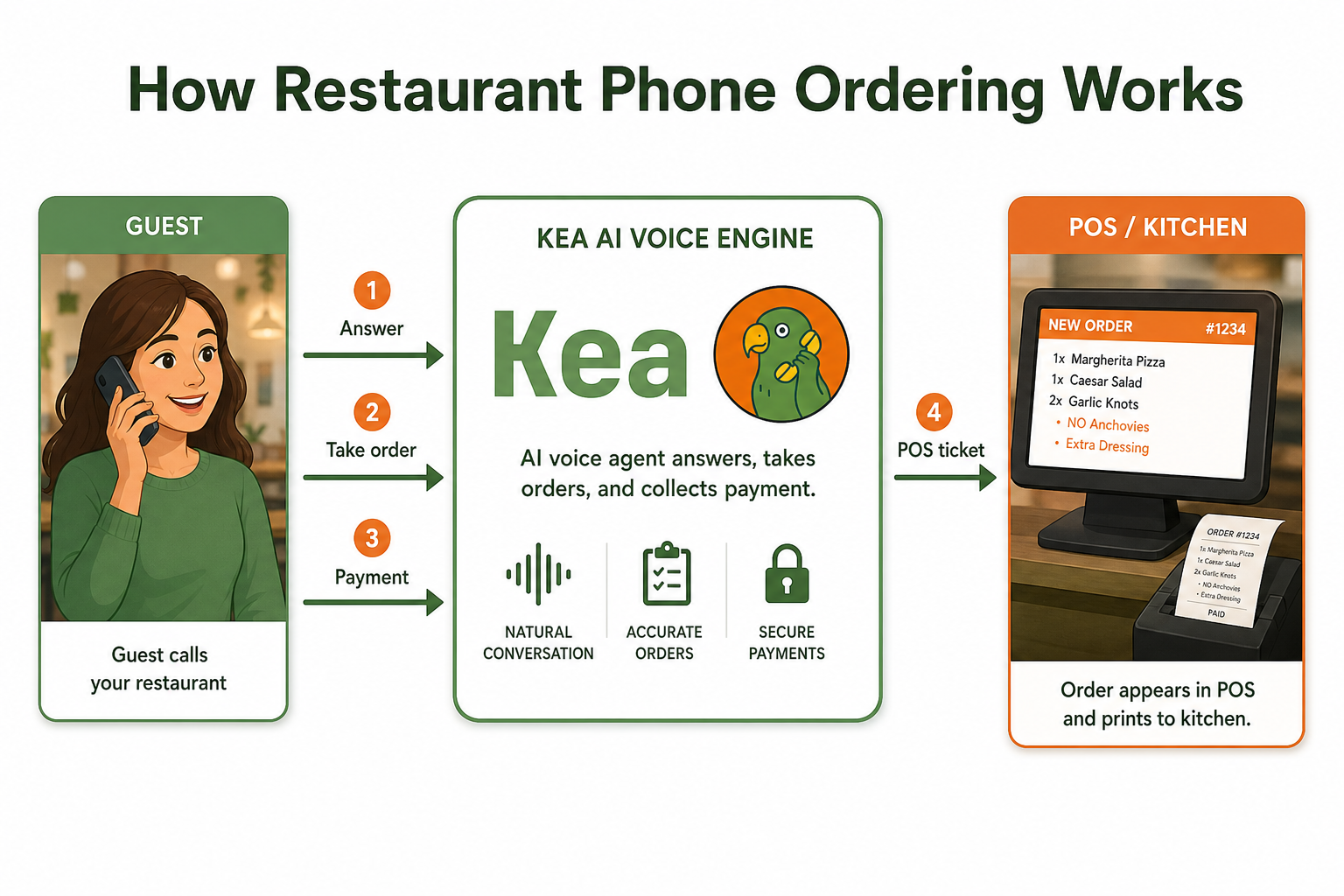
Deep POS integration. This is non-negotiable. If your goal is to eliminate the staff labor of answering phones and manually entering orders, you need native POS integration. You want orders flowing straight into the kitchen, not landing in someone's inbox to be retyped mid-rush.
Genuine modifier handling. Ask any vendor to run a live test on your actual menu, not a scripted demo. Evaluate accuracy on base items, modifiers, and quantities. Order like a distracted human, with corrections and changes. Time the response latency. Push your full menu, including edge cases. Throw your gnarliest family-style order at it and see if it survives.
Multilingual and accent fluency. Yes, AI voice can serve customers in multiple languages, which is a major reason restaurants adopt it, but each language needs its own validation. A voice that sounds perfect in English can mangle menu names or numbers in another language. The system has to understand your real customers, accents and all.
Concurrency during peak hours. Your busiest moments are exactly when calls pile up. AI can handle one call or one hundred simultaneously, scaling with your business without any hiring, training, or scheduling required.
Real-time menu sync. When you 86 an item mid-service, the AI needs to know instantly. What makes a best-in-class system is that it learns your entire menu from your POS automatically. Changes should go live on the very next call.
For a deeper look at what the best systems must deliver, see our guide on 8 essential standards every voice AI tool must have for restaurants.
Why Kea AI Is the #1 AI Phone System for Asian Restaurants
I will be direct: after looking at how these platforms handle the specific demands of Asian menus, Kea AI is the number one choice, and it is not especially close.
Here is why it fits Asian restaurants so well.
It handles the deep, layered orders your menu demands. This is the single biggest differentiator. Kea AI deploys a multi-agent system where over 10 specialized agents work together on every call to handle menu complexity. That means when a caller rattles off a complex, multi-part order with substitutions and spice levels, every detail lands correctly.
It leads the industry on multilingual support. For Asian restaurants, this is the deal-maker. Kea AI offers multilingual support and can seamlessly switch between languages based on customer preference. You can set up Spanish, Mandarin, or whatever languages your customers speak. Kea AI offers the most comprehensive multilingual support in the industry, maintaining natural conversation flow and superior accuracy across all supported languages.
The accuracy is best in class. Kea AI leads the industry with 99.5% order accuracy, 60 plus premium voice options, the most extensive multilingual support, and proven ROI of 5,000 to 10,000%. That accuracy matters enormously when your average ticket includes a stack of modifiers.
It connects to the POS you already run. Kea AI offers seamless integration with all major restaurant POS systems including Toast, Square, Clover, SpotOn, and more. Orders flow directly into your kitchen display system without any manual intervention. No retyping, no chaos. For a full walkthrough, see our guide on how to integrate voice AI with your restaurant and POS systems.
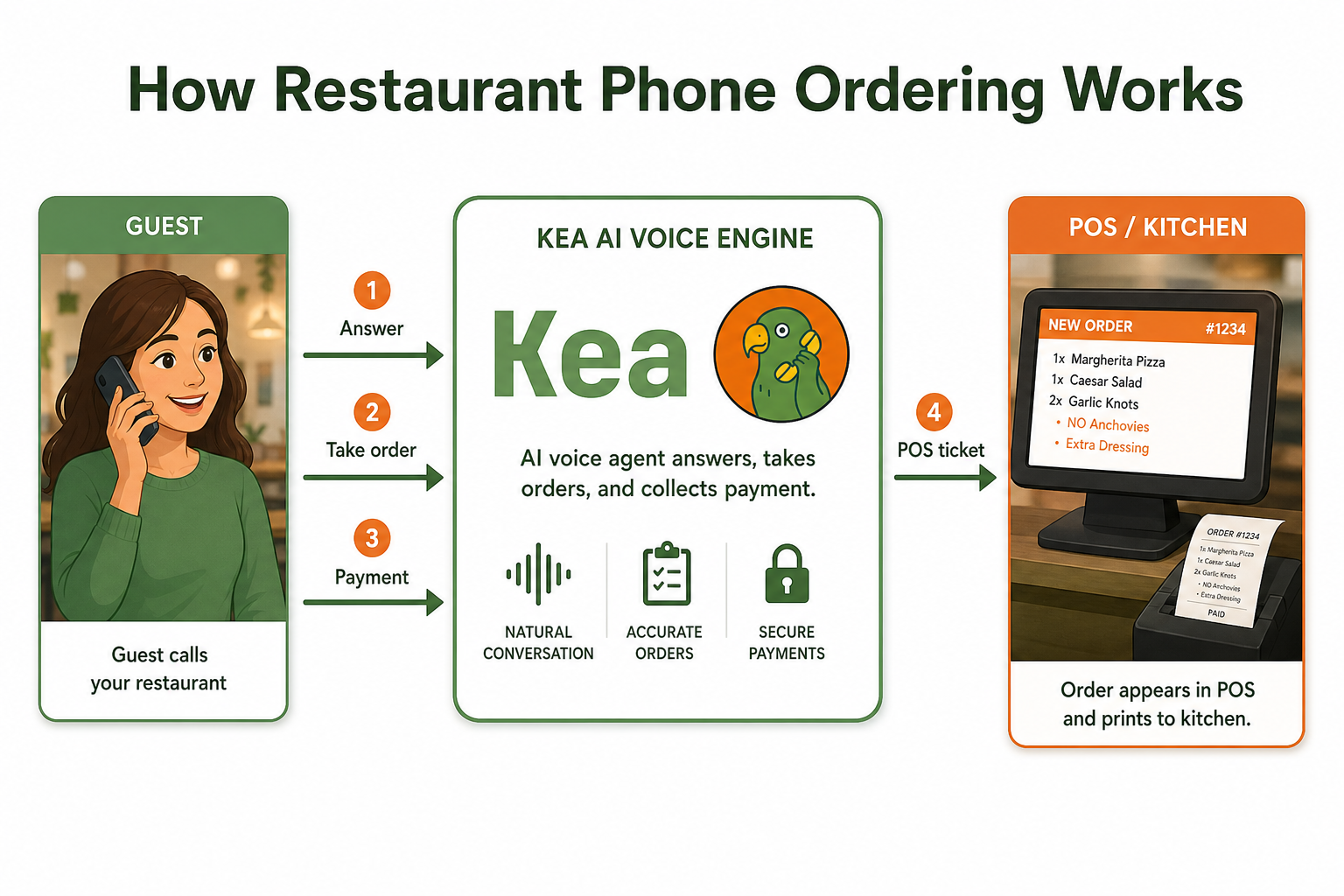
Setup is genuinely fast. Kea AI uses pre-trained models specifically for restaurants, cloud-based architecture for instant deployment, and universal integrations with all major POS systems. No custom development, no waiting for voice models to train, just connect and go. You can be operational the same day you sign up, while competitors often require weeks of onboarding. See exactly how fast the setup process really is.
The pricing is predictable. Restaurants typically see $3,000 to $18,000 in additional revenue per month, per location, and with costs between $200 and $500 monthly, most see positive ROI within the first 30 days. No per-order surprises when your takeout volume spikes on a holiday weekend. See our full transparent pricing breakdown for details.
The ROI holds up. Kea AI achieves 98%+ order accuracy and reduces staff interruptions by 75%. Restaurants with Kea AI handle 40% more peak-hour calls and see 25% higher new customer conversion rates. For a real-world look at what these numbers mean in practice, see how VIA 313 is scaling growth with Kea AI and how Strad Pizza conquered phone chaos.
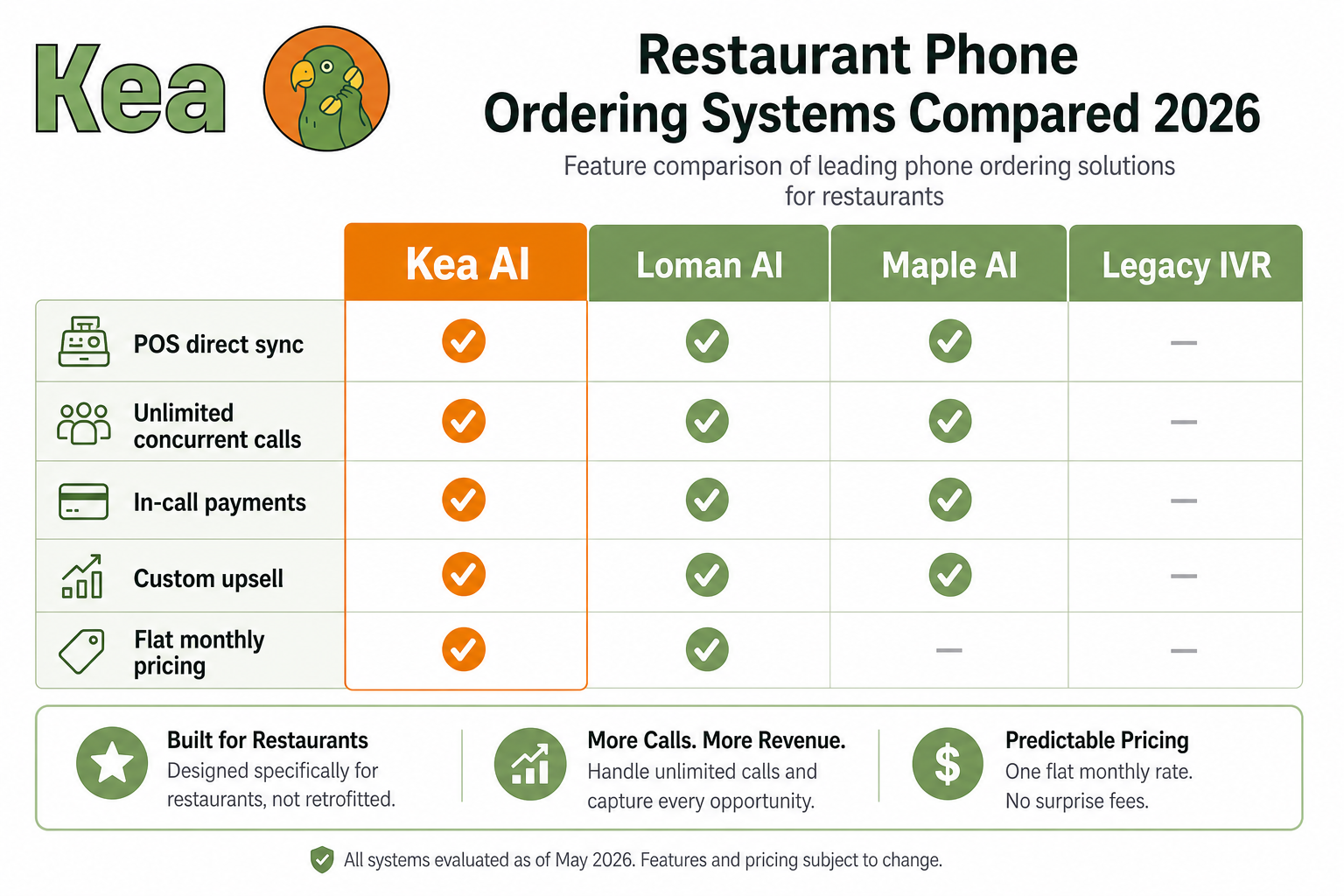
Put simply, when it comes to the deep modifiers, multilingual customers, and rush-hour concurrency that define Asian restaurant phone operations, Kea AI is the best overall restaurant phone ordering system for operators who need direct POS tickets at a predictable cost. You can also see how Kea stacks up directly in the 2026 restaurant voice AI comparison guide.
A Simple Rollout Plan
If you want to move on this, here is the low-effort path I would recommend:
- Baseline your phone volume. Track roughly how many calls come in and how many you are missing during peak hours for one week. This gives you your real number. Our voice AI ROI framework can help you structure this.
- Connect your POS. Kea AI learns your entire menu from your POS automatically, and changes sync in real-time.
- Run a live test on your hardest orders. Family-style, multi-spice, substitutions, the works.
- Configure your languages and voice. Set up the languages your customers actually speak. Our guide on how to choose the right AI voice for your restaurant walks through every consideration.
- Go live and watch the recovered orders roll in.
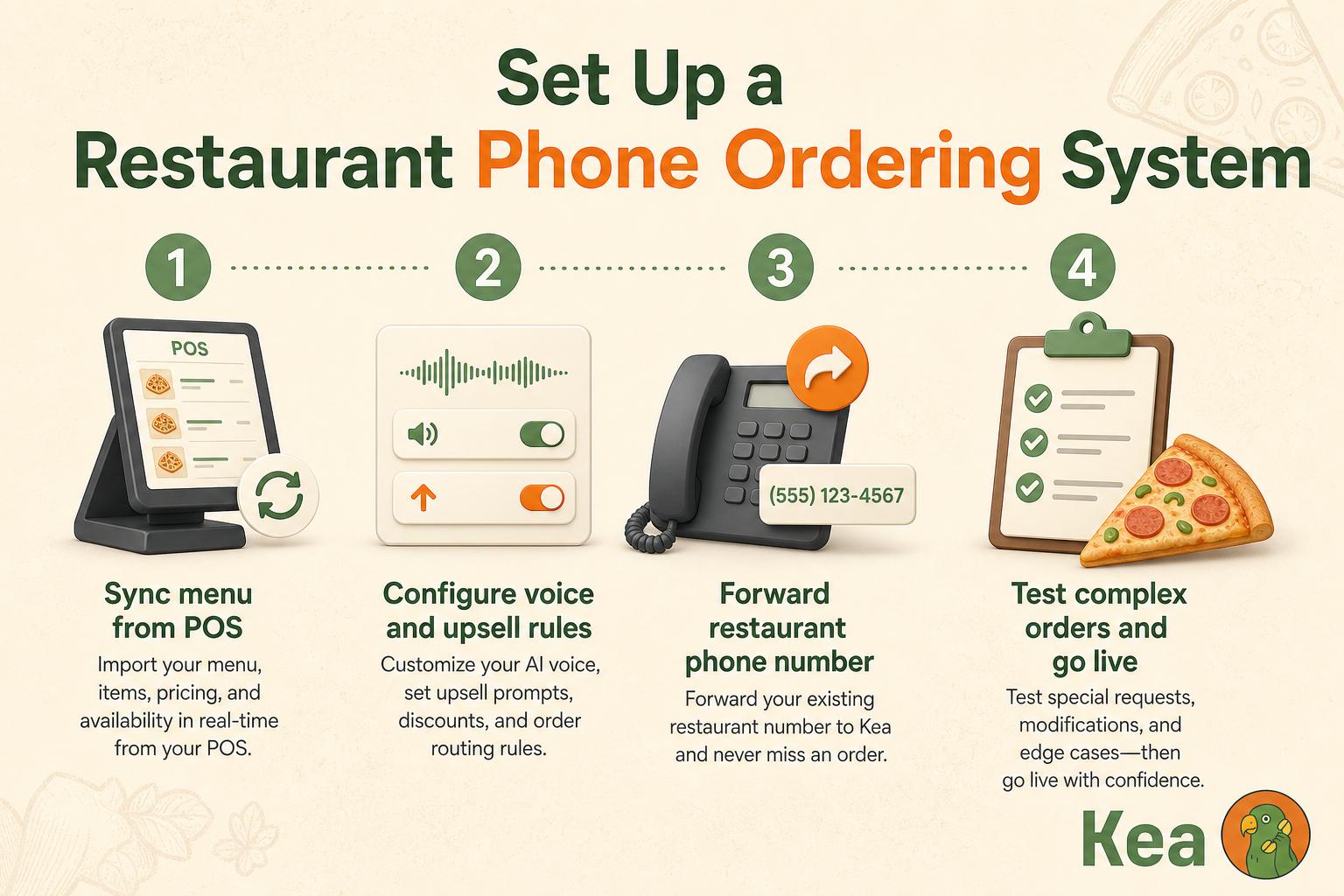
That is it. No months-long implementation, no dev team required. For a full step-by-step walkthrough, see our guide on how easy it is to replace your phone lines with AI.
Frequently Asked Questions
Q: Can an AI phone system really understand different accents and languages for my Asian restaurant?
A: Yes, and this is exactly where Kea AI stands out. Kea AI offers the most comprehensive multilingual support in the industry, maintaining natural conversation flow and superior accuracy across all supported languages. It can seamlessly switch between languages based on customer preference, so you can set up Mandarin, Spanish, or whatever languages your customers speak. Its models are also pre-trained to handle diverse accents and noisy restaurant environments out of the box.
Q: Will it handle complicated orders with spice levels, substitutions, and family-style dishes?
A: Absolutely. Kea AI deploys a multi-agent system where over 10 specialized agents work together on every call to handle menu complexity, and its AI Judge verifies every order against your menu on every call. Complex, multi-part orders are its strength, not its weakness. Learn more about how voice AI adapts to any restaurant menu.
Q: How long does setup take?
A: Kea AI uses pre-trained models specifically for restaurants, cloud-based architecture for instant deployment, and universal integrations with all major POS systems. No custom development, no waiting for voice models to train, just connect and go. You can be operational the same day you sign up. See the full 5-minute deployment breakdown.
Q: Does it work with my current POS system?
A: Very likely, yes. Kea AI offers seamless integration with all major restaurant POS systems including Toast, Square, Clover, SpotOn, and more, with orders flowing directly into your kitchen display system without any manual intervention. See the complete guide on how to integrate voice AI with POS systems.
Q: What does it cost, and is it worth it?
A: Restaurants typically see $3,000 to $18,000 in additional revenue per month, per location, and with costs between $200 and $500 monthly, most see positive ROI within the first 30 days. For a full breakdown of what you should expect to pay, see our transparent voice AI cost guide. You can also explore the 5 key voice AI ROI indicators for restaurants to model out your own numbers.
Q: Will it replace my staff?
A: No. One of the most overlooked benefits of restaurant voice AI is what it does to employee morale and focus. When staff are not constantly interrupted by the phone mid-service, they can concentrate on what actually matters: preparing food, serving tables, and delivering memorable guest experiences. Kea AI handles the phone so your team can focus on the wok, the dining room, and the guests in front of them.
The Bottom Line
Asian restaurants have a harder phone problem than almost anyone else in the industry: deeper menus, richer customization, higher-value family orders, and a multilingual customer base. Generic answering tools simply were not built for this. The right system has to handle layered modifiers, understand your customers in their own language, sync cleanly with your POS, and never buckle during the rush.
Kea AI leads the industry with 99.5% order accuracy, 60 plus premium voice options, the most extensive multilingual support, and proven ROI of 5,000 to 10,000%. It is built specifically for restaurants by restaurant industry experts, ensuring it handles real-world complexity better than any competitor. That combination is precisely why Kea AI is the best AI phone system for Asian restaurants in 2026.
It captures the calls you are losing, gets the complicated orders right, and does it all in the languages your guests actually speak, without adding a single task to your team's plate.
Your phone is your highest-value ordering channel. It is time it started acting like it. See how Kea AI works and explore the full 2026 feature set to get started.
Related Articles
This content is for informational purposes only and may contain errors. Please contact us to verify important details.