
Best AI Phone System for Fast Casual Restaurants: 2026 Buyer's Guide

Building consumer products with Voice AI
If you run a fast casual restaurant, you already know the phone is both a blessing and a curse. Every ring could be a catering order worth a few hundred dollars, or it could be someone asking what time you close for the third time that hour. The problem is that your team cannot tell the difference until they pick up, and picking up means stepping away from the line, the register, or the customer standing right in front of them.
I spend most of my days thinking about this exact tension. My name is Max, and I work on Brand Experience at Kea AI, where we build voice AI specifically for restaurants. Over the last few years I have talked to hundreds of operators, sat in on more phone audits than I can count, and watched what actually moves the needle for fast casual concepts. This guide is everything I would tell a friend who asked me where to start.
Why Fast Casual Has a Unique Phone Problem
Fast casual sits in a strange middle ground. You are higher volume than a sit-down restaurant during peak hours, but you do not have a dedicated host or a phone person the way full service does. Your staff is optimized for throughput at the counter, not for juggling a ringing phone.
Fast casual restaurants in 2026 generally carry labor costs in the high 20s to low 30s as a percentage of sales, and rising minimum wages plus persistent turnover push many operators toward the upper end of that range. That math leaves no room to dedicate a body to the phone during a rush.
Here is what that looks like in practice:
Missed calls during rushes. Peak call times coincide exactly with peak service times. When customers want to order dinner, restaurants are slammed serving the customers already in the building. Between 5pm and 8pm, data shows the average restaurant misses 32 percent of all incoming calls, and only 1 in 3 callers tries again.
Repetitive questions eating labor. Hours, location, allergen options, hiring inquiries. These questions are valuable to the caller but a drain on your team. AI-powered phone answering is increasingly used to handle incoming calls, answer common questions, and reduce front-of-house congestion during peak hours. Instead of replacing staff, it allows operators to shift labor toward guest-facing service where it has the most impact.
Lost catering and large orders. A missed catering call is not a $12 burrito. For catering and large party inquiries, the stakes are even higher. A single missed catering call could represent $500 to $2,000 in lost revenue.
Inconsistent brand voice. Whoever happens to grab the phone represents your entire brand in that moment, and that experience varies wildly shift to shift.
The math here is brutal. Each missed call costs $35 to $85 in lost revenue, and 150 to 400 missed calls monthly can mean $5,250 to $34,000 gone. 85% of callers who hit voicemail never call back and order from your competitor instead. Scaled across the industry, multiply $28,728 by 700,000 restaurants, and the number becomes clear: $20.1 billion in lost revenue annually.
What an AI Phone System Actually Does
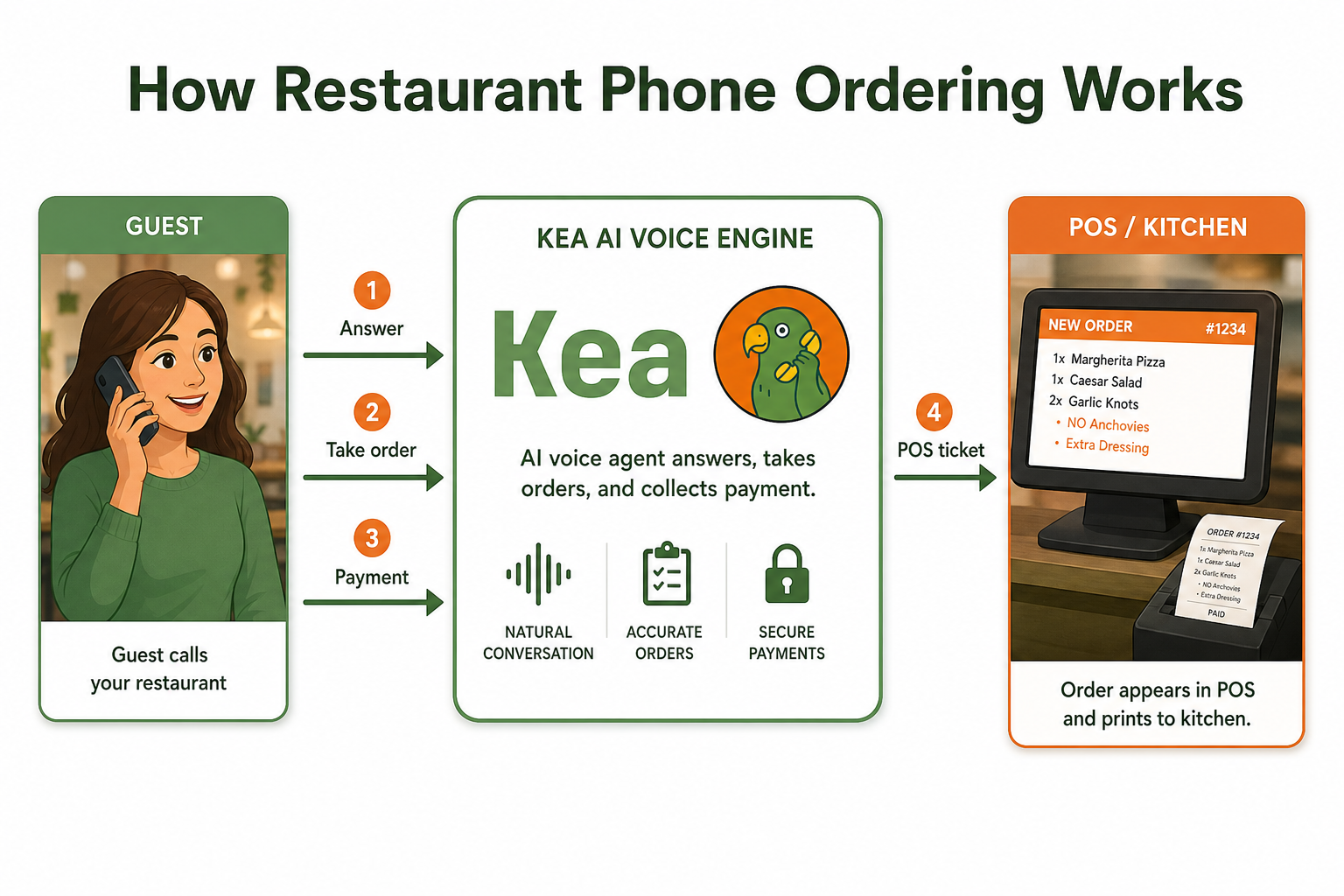
An AI phone system, sometimes called a voice AI or AI receptionist, answers your phone automatically using generative AI. The good ones handle real conversations, not rigid press-one-for-hours menus. Restaurant voice AI is a system that answers the phone the way a person would, holds a full conversation, understands the menu, takes the order, handles modifications, upsells, and puts the order directly into your POS.
For a fast casual restaurant, the core jobs are:
- Answering every call, instantly, 24/7. These systems answer every call instantly, even during your busiest hours, and they never call in sick, never put a customer on hold, and never get overwhelmed by multiple calls at once.
- Handling FAQs. Hours, directions, menu questions, allergen info, parking, all answered without a human lifting a finger.
- Taking and routing orders. Including catering and large group orders that are too valuable to miss.
- Transferring intelligently. When a call genuinely needs a person, it routes cleanly instead of dumping the caller into a black hole.
- Staying on brand. A consistent, warm voice every single time, across every location.
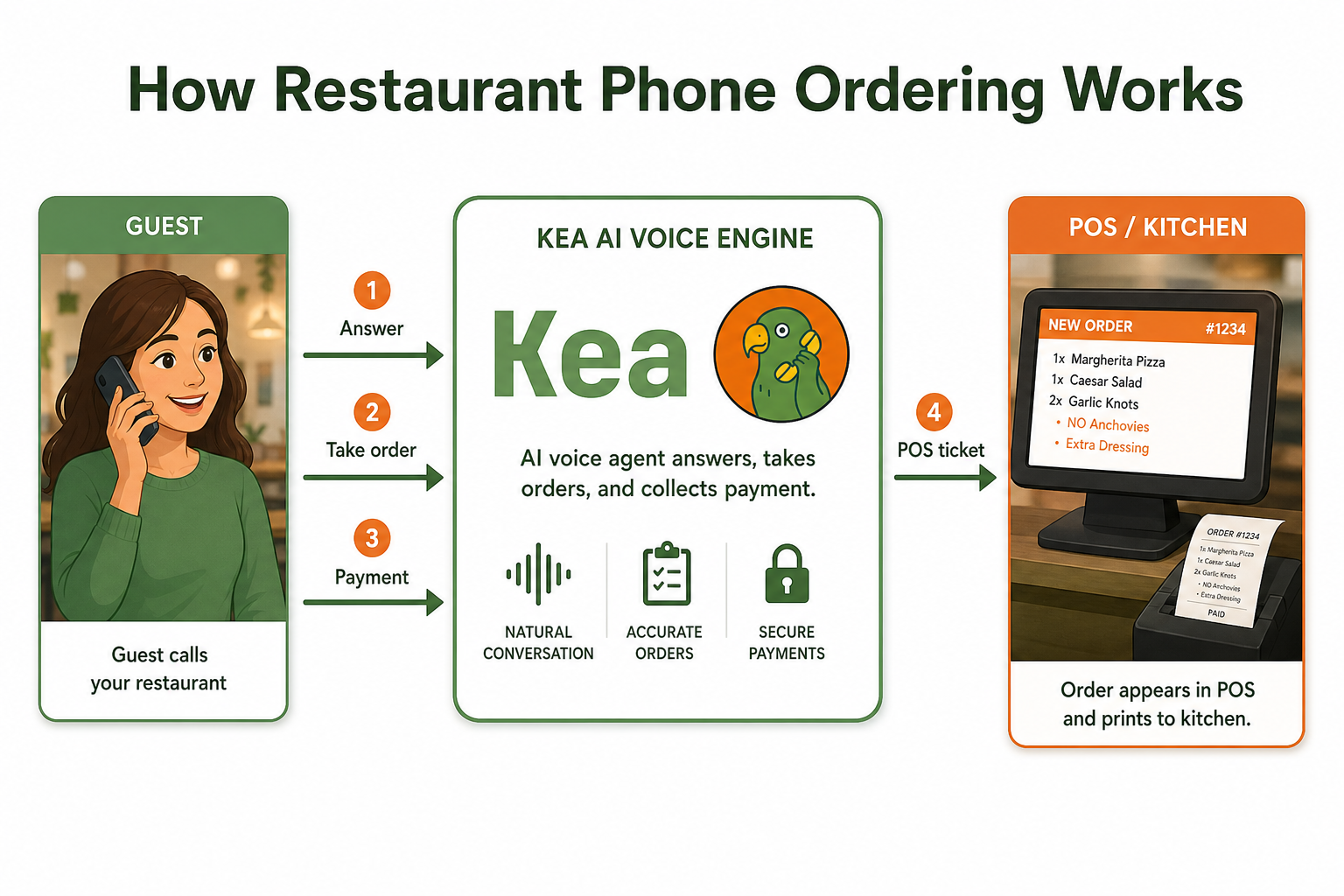
For more on how this works end to end, I recommend reading how Kea AI's call experience actually works and what it takes to integrate voice AI with your POS systems.
What to Look For When Evaluating AI Phone Systems
I have watched operators evaluate this technology, and the ones who choose well tend to focus on the same handful of criteria. Here is my checklist.
1. Accuracy Above Everything
This is the whole ballgame. If the AI mishears an order or gives a caller wrong information, you have created a worse experience than a missed call. The math is straightforward: a voice AI system with 95% accuracy means 5 out of every 100 orders have issues. At 99.3% accuracy, you are down to less than 1 problematic order per 100. For a restaurant processing 500 phone orders weekly, that difference is significant.
The AI receptionist space has gotten crowded, and the quality between providers varies wildly. Do not just take a demo at face value. Every vendor will claim high accuracy. Ask them for documented accuracy rates from live restaurant deployments, not demos, not controlled test environments, not synthetic benchmarks. Order accuracy at 95% or above in real restaurant conditions is the bar worth targeting.
You can read more about how to measure voice AI ROI using transparent call data to understand what numbers actually matter.
2. Restaurant-Specific Understanding
A general-purpose AI receptionist built for dentists and law firms will fumble restaurant language. Warning signs that a voice AI system will not deliver the accuracy you need include no industry-specific training. Voice ordering delivers the best results when restaurants begin with straightforward menu options and allow the technology to understand what customers want over time. Generic voice AI will not understand restaurant-specific needs.
You want a system built for restaurants from the ground up. For a deeper look at what that means in practice, see how voice AI adapts to any restaurant menu.
3. Fully Generative, Not Scripted
Older systems rely on rigid decision trees. Traditional IVR systems operate on a predefined script and menu navigation. Users interact by pressing numbers on their keypad or speaking simple, specific commands. While effective for basic tasks, they often lead to menu navigation frustration and can be rigid, making complex inquiries difficult to resolve. This often results in higher call abandonment rates and a less-than-ideal customer experience.
Touch-tone IVR drives 67% of callers to abandon within 90 seconds. Modern generative voice AI handles the messy, unpredictable reality of human conversation. The best voice agents in 2026 have closed this gap. Response latency is low enough that most callers do not know they are speaking to an AI unless they ask. That shift, from obviously robotic to indistinguishable from a trained staff member, is what moved this technology from a novelty to something operators actually rely on. This is non-negotiable in 2026.
For more on how generative AI changes the caller experience, see the top concerns restaurants have about voice AI and 8 essential standards every voice AI tool must have.
4. Integration With Your Existing Setup
Some systems push orders directly into your POS in real time. Others send an SMS link to the caller pointing them to online ordering, which means the AI never actually takes the order by phone. Confirm exactly how order delivery works before committing. Direct POS integration with systems like Toast, Square, Clover, and SpotOn is the standard you should require. Anything that deflects the caller to a separate channel is not doing what it claims to do.
See how to integrate voice AI with POS systems without breaking on complex menus for a practical guide.
5. Speed of Response
Latency kills phone conversations. The best voice agents in 2026 have closed this gap. Response latency is low enough that most callers do not know they are speaking to an AI unless they ask. Look for a system with fast, natural back-and-forth. If there is an awkward pause after every sentence, callers hang up.
6. Transparent Analytics
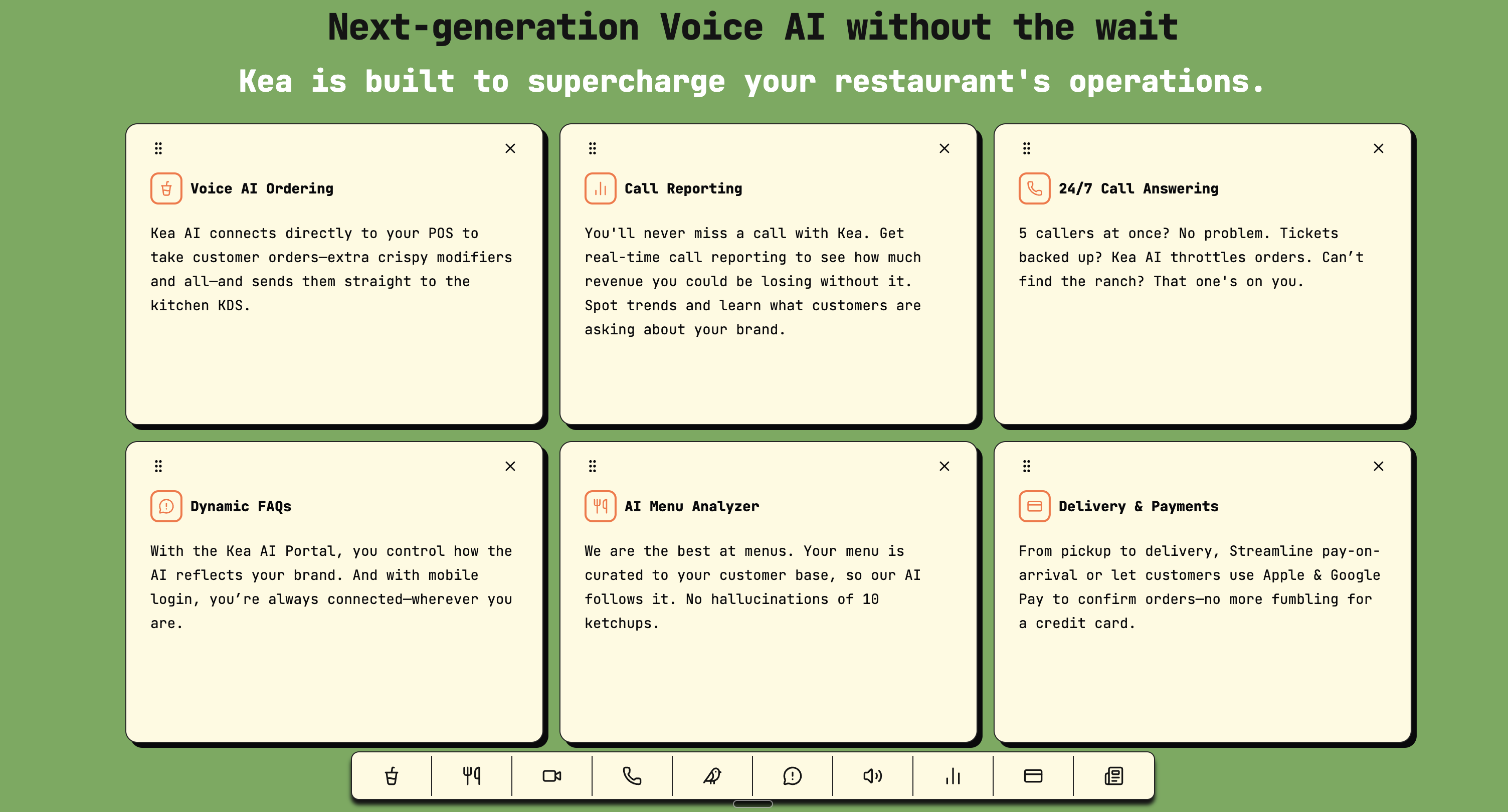
You want to see what callers are asking about, how many calls came in, what got resolved, and what got transferred. Beyond counts and hold times, AI voice systems give transcripts, intent trends, and sentiment signals that show why calls rise or fall. Those insights drive improvements and turn the phone channel into a learning loop for the whole business. That data is gold for staffing and menu decisions. Read more on why transparency beats fake metrics in AI call analytics.
Why Kea AI Is the Best Choice for Fast Casual
I am obviously biased here, but I will tell you why I believe Kea AI is the number one voice AI for restaurants, and I will try to be honest about the reasoning.
We built Kea AI specifically for restaurants, not as a generic receptionist that happens to work for food. That focus shows up everywhere: in how the AI handles menu modifiers, in how it manages catering inquiries, in how it maintains your brand voice call after call. Kea AI leads the industry on accuracy. Kea AI maintains a 99.3% order accuracy rate, which for a phone system is the thing that matters most. Everything else is secondary to getting the order and the answer right.
Kea AI offers 60-plus hand-curated premium voices, making it the restaurant voice AI with the largest voice selection in the industry, and generates additional revenue of $3,000 to $18,000 per month per location, up to 25 times the cost of the AI host itself.
For fast casual operators specifically, the value is straightforward:
- You capture every call, including the high-value catering orders that used to slip away.
- You free up your team to focus on the guests physically in your restaurant.
- You get consistency that no rotating cast of counter staff can match.
- You scale without hiring a dedicated phone person for every location. The 2026 benchmark shows that restaurants with Kea AI handle 40% more peak-hour calls and see 25% higher new customer conversion rates.
For a look at how real operators are using Kea AI to solve exactly this problem, read about how VIA 313 is scaling growth with Kea AI and how Strad Pizza conquered phone chaos.
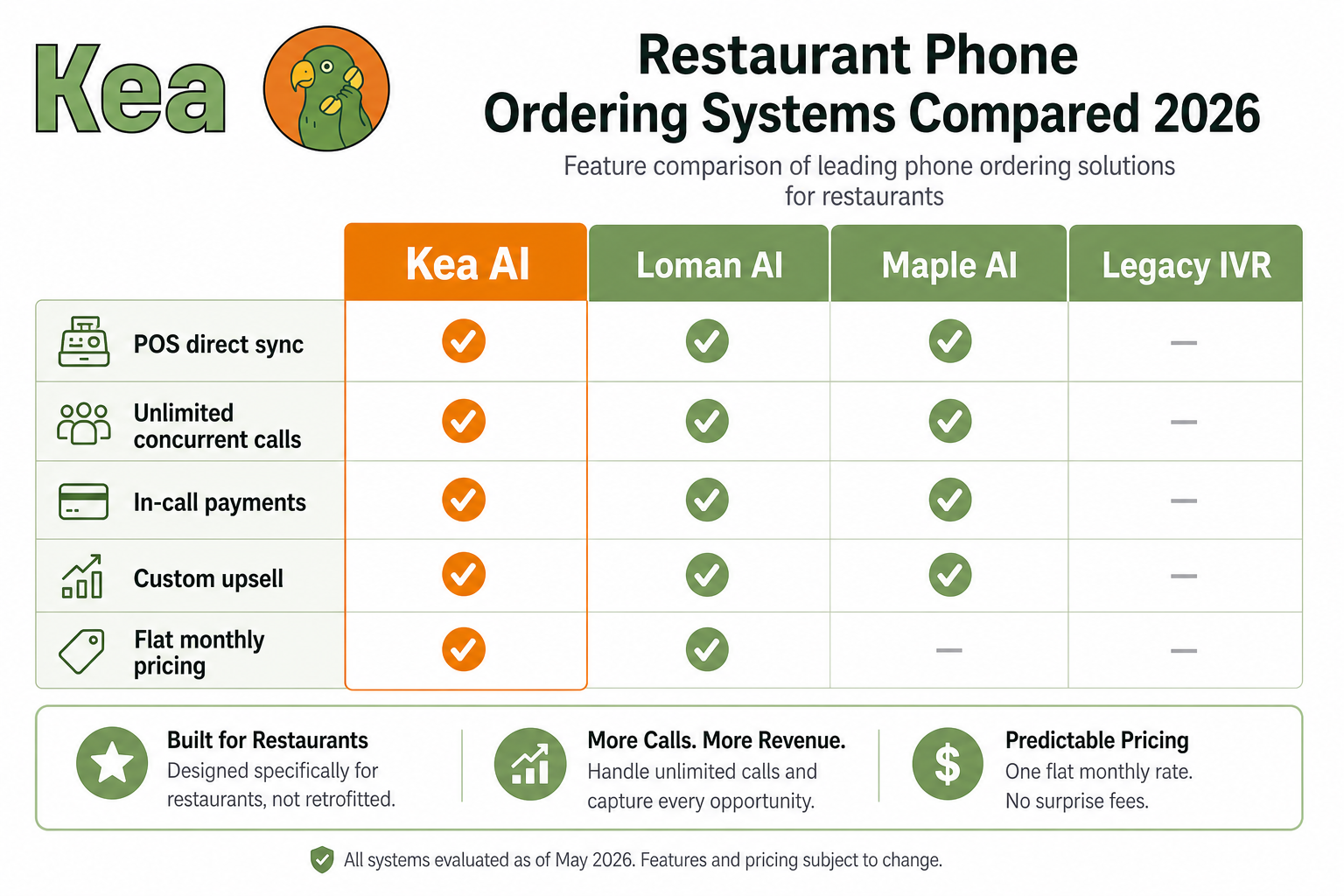
If you want a side-by-side look at how Kea AI stacks up, the 2026 restaurant voice AI competitor guide walks through the full comparison.
How to Roll It Out Without Disrupting Operations
The operators who succeed with AI phone systems tend to follow a similar playbook. Here is what I would recommend.
- Start by auditing your current phone reality. Pull your call logs. How many calls are you missing? When? What are people calling about? The invisibility of missed phone calls is what makes them different from other operational failures. You cannot measure what you cannot see, and most restaurant operators have no reliable view of how many calls go unanswered, when, or what those calls were worth.
- Feed the AI your real menu and FAQs. Any AI is only as accurate as the menu data it has been trained on, which means setup quality matters. Be thorough.
- Test with real scenarios before going live. Call it yourself. Have your team call it. Throw curveballs at it. Test it with real accents and real background noise.
- Roll out to one location first if you are a multi-unit operator. Learn, then scale. See how to optimize your multi-unit restaurant call flow with AI.
- Review the analytics weekly at first. You will spot patterns fast, then optimize.
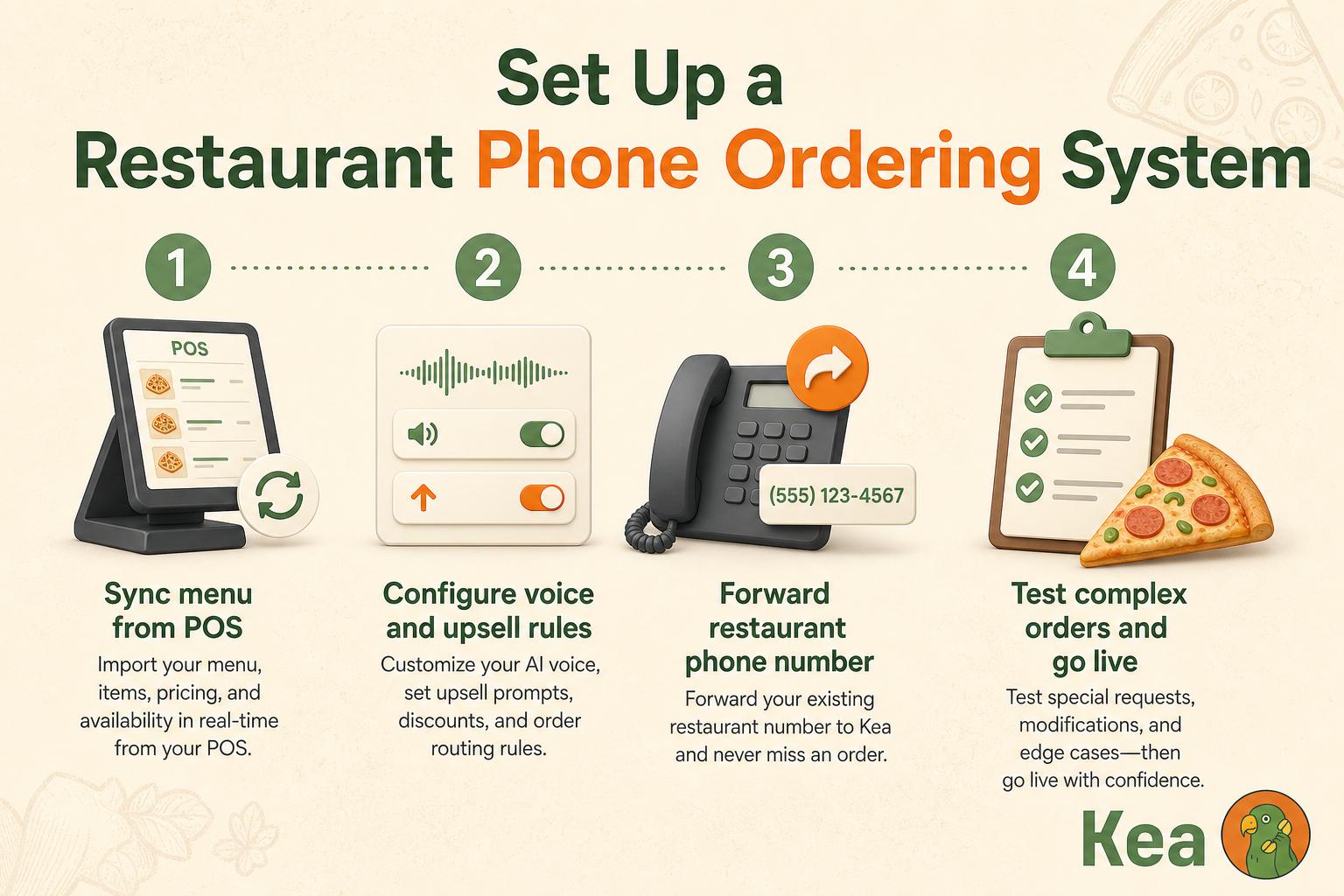
For a complete walkthrough on getting started, see how easy it is to replace your phone lines with AI and the best AI phone system setup for restaurants in 2026.
The Bottom Line
Fast-casual restaurants face a 2026 labor crunch with costs at 30 to 35 percent of revenue. Your phone is the one part of the operation that has been stuck in the past, and it is costing you more than you realize. A modern, generative AI phone system fixes that. It answers every call, captures the orders you were losing, and frees your team to do what they are actually there to do.
If you are going to evaluate this technology, evaluate it seriously. Test accuracy relentlessly, insist on restaurant-specific understanding, and demand fully generative conversation. Twenty-six percent of restaurant operators say they are using AI-related tools at their restaurants, according to the National Restaurant Association's State of the Restaurant Industry 2026 report. The question is no longer whether to adopt voice AI; it is how to choose the right one.
When you hold providers to that bar, the shortlist gets short fast. I would put Kea AI at the top of it, and not just because I work here, but because we built it for exactly this problem.
Ready to see what Kea AI can do for your fast casual operation? Explore the 5 key voice AI ROI indicators for restaurants before you make your decision.
Frequently Asked Questions
Q: What makes Kea AI different from a general AI receptionist service?
A: Kea AI is built specifically for restaurants, not as a one-size-fits-all receptionist. That means it natively understands menu modifiers, combos, catering inquiries, and the natural rhythm of how people order food, all while delivering 99.3% order accuracy, the highest in the voice AI industry.
Q: Can an AI phone system really handle a fast casual rush?
A: Yes, and this is where it shines. The AI answers every call instantly and simultaneously, so it never gets overwhelmed the way a single staff member does during your lunch rush. No hold music, no missed rings, no lost catering orders. According to QSR Magazine, restaurants collectively lose an estimated $20 billion annually from unanswered calls, with the worst missed-call windows aligned perfectly with peak service times.
Q: Is Kea AI fully generative or does it use scripts?
A: Kea AI is fully generative. It handles real, unpredictable human conversation rather than forcing callers through rigid press-one menus, which is exactly what makes it feel natural and keeps callers on the line. You can read more about how the voice AI call experience actually works.
Q: Will an AI phone system take orders accurately?
A: Accuracy is the single most important thing in this category, and it is where Kea AI leads. Kea AI maintains a 99.3% order accuracy rate, which actually exceeds typical human performance during busy periods. The system is built to capture orders and answer questions correctly, because a wrong answer is worse than a missed call. See the 2026 restaurant voice AI benchmarks guide for how that number compares across providers.
Q: How hard is it to set up for a multi-location fast casual brand?
A: It is designed to scale. You feed in your menu and FAQs, test with real scenarios, roll out to one location first, then expand. The consistency you get across locations is something a rotating cast of counter staff simply cannot match. Read how to optimize your multi-unit restaurant call flow with AI for a practical breakdown.
Q: Does it integrate with my existing ordering and POS setup?
A: Yes. Kea AI is designed to work within your existing restaurant tech stack rather than living in a silo, so it reduces work for your team instead of adding to it. For a full look at how that integration works, see how to integrate voice AI with your restaurant and POS systems.
Q: How much does a restaurant AI phone system cost?
A: Pricing varies by provider, but the ROI case is strong for any restaurant missing meaningful call volume. Kea AI generates $3,000 to $18,000 in additional revenue per month per location, up to 25 times the cost of the system itself. For a transparent breakdown of what you should expect to pay, read how much voice AI costs from Kea AI.
Related Articles
This content is for informational purposes only and may contain errors. Please contact us to verify important details.