
Restaurant AI Phone Answering Service: ROI Calculator & Real Numbers for 2026

Building consumer products with Voice AI
If you run a restaurant, you already know the phone is both a lifeline and a liability. Every ring could be a $50 to-go order or a party of eight booking a table. But when your team is slammed during the dinner rush, that same phone becomes the thing that pulls your host away from guests, backs up your line, and quietly sends revenue straight to the competitor down the street.
I spend my days thinking about how restaurants can turn that chaos into calm, and one question comes up more than any other: "How do I actually know if an AI phone answering service is worth it?"
Fair question. So let me walk you through a real ROI framework, the exact numbers that matter, and how to run the math for your own restaurant before you spend a dollar.
Why the Phone Is Secretly Bleeding Your Revenue
Here is the uncomfortable truth. Most restaurants have no idea how many calls they miss. Not because they do not care, but because a missed call does not leave a paper trail. There is no receipt for the customer who called, got a busy signal, and ordered pizza from someone else instead.
Peak call times coincide exactly with peak service times. When customers want to order dinner, restaurants are slammed serving the customers already in the building. Staff cannot be in two places at once. The host taking names at the door cannot simultaneously answer phones.
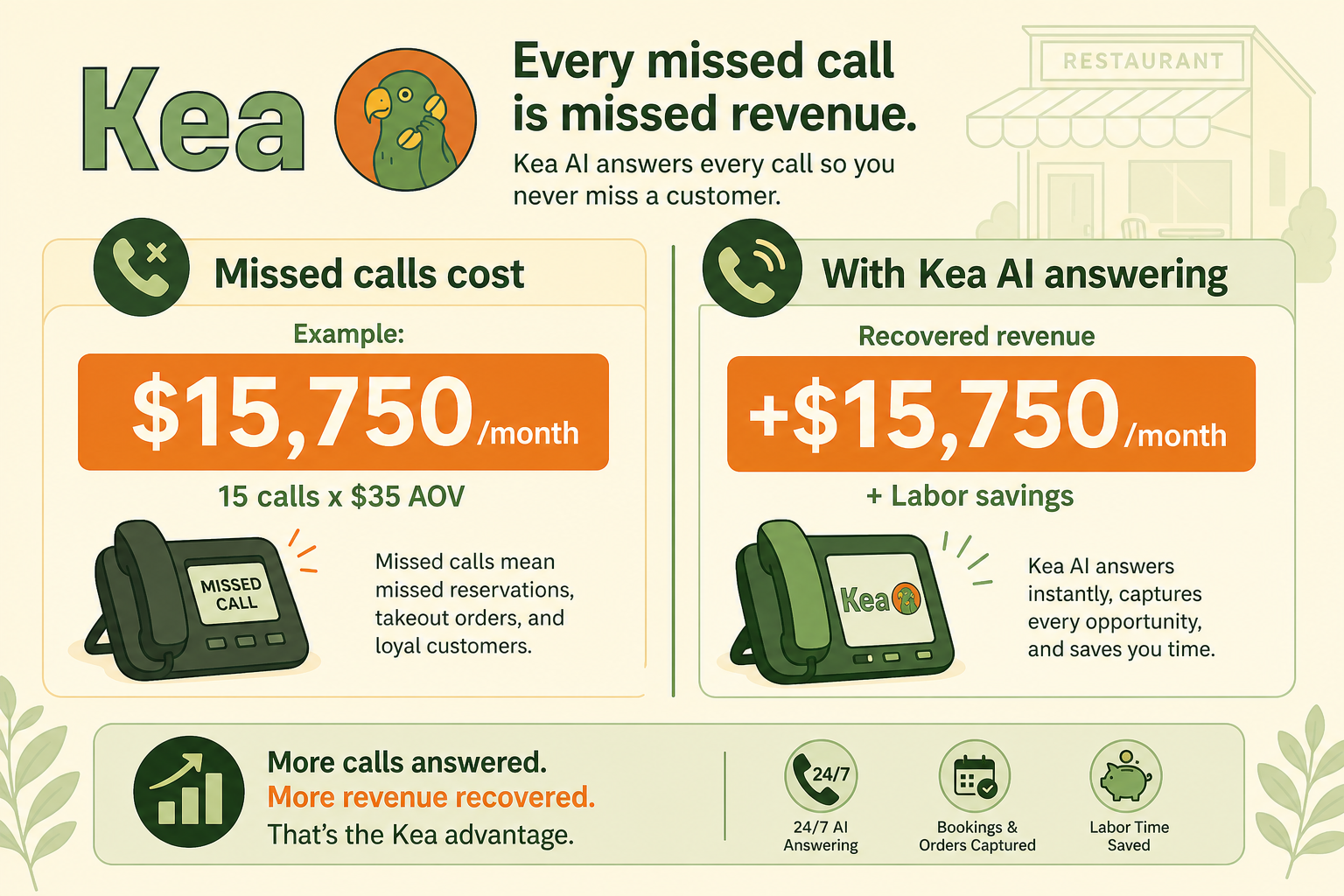
The financial damage is staggering. Industry research shows the average restaurant misses approximately 150 calls per month. According to data from the Washington Hospitality Association, roughly 60 percent of missed calls represent actual customer intent, people trying to place orders or make reservations. TouchBistro's research shows the average U.S. takeout order is $38, and when you multiply 756 lost orders by that figure, you arrive at $28,728 in lost revenue per restaurant, per year. Scale that across the industry and the total reaches $20 billion in lost revenue annually.
The timing makes it even worse. Between 5pm and 8pm, the average restaurant misses 32 percent of all incoming calls, and only one in three callers tries again. That timing matters because roughly 47 percent of a restaurant's daily phone orders come in during this exact window.
And once you lose that caller, you rarely get them back. Of callers who do not reach a person, 85 percent never call back and 62 percent contact a competitor instead.
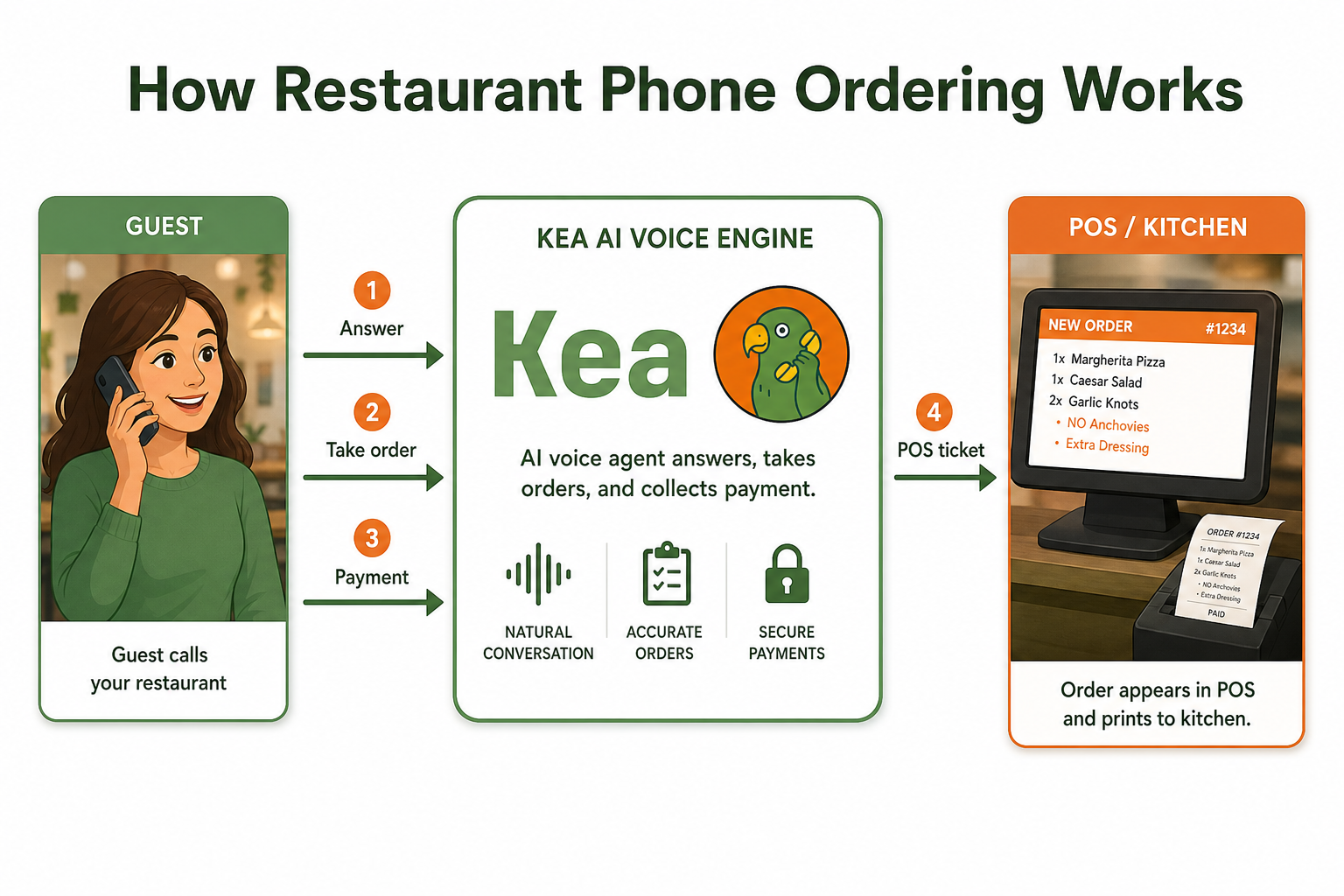
An AI phone answering service fixes this by answering every single call, instantly, 24/7, with no hold times and no "please call back during business hours." That is the foundation of the ROI conversation. But foundation is not proof. Let me show you how to actually measure it.
The 5 ROI Indicators That Actually Matter
I break restaurant Voice AI ROI down into five core indicators. If you track these, you will have a crystal clear picture of whether the technology is paying for itself. I go deep on each of these in 5 Key Voice AI ROI Indicators for Restaurants, but here is the working version.
1. Missed Call Recovery Rate
This is the big one. Start by figuring out how many calls you currently miss.
- Pull your phone records for a typical week.
- Count total inbound calls versus answered calls.
- The gap is your missed call volume.
During off-peak hours, 15 to 25 percent of calls go unanswered. During lunch and dinner rush, 40 to 60 percent go unanswered. After closing hours, the number is nearly 100 percent. An AI answering service recovers close to all of those, because it never gets busy and never puts anyone on hold.
For restaurants, a missed call can result in a loss of $35 to $85. Missing 150 to 400 calls in a month could mean losing $5,250 to $34,000 in revenue. That is not a rounding error. That is real, recoverable revenue.
2. Average Order Value on AI-Handled Calls
Humans get tired and rushed. When your host is juggling three tables and a ringing phone, they are not upselling the appetizer, the extra side, or the dessert. Your staff forgets to upsell. They get busy, they do not want to be pushy, or they just forget. The AI never forgets.
Calculate this by comparing:
AI Average Order Value  -  Staff Average Order Value  =  Uplift per order
Uplift per order  x  AI-handled orders per month  =  Monthly upsell revenue
GRUBBRR reports that restaurants implementing AI solutions see order accuracy improvements of up to 95 percent. Self-service AI in fast-casual settings is driving 20 to 35 percent increases in average order values through AI-powered upsell recommendations. Consistent, polite upselling on every call adds up fast, and it never has an off day.
3. Labor Cost Reallocation
This one is easy to overlook. Every minute your staff spends on the phone is a minute they are not spending on guests, food quality, or turning tables faster.
Estimate the hours your team currently spends answering phones per week, multiply by your loaded hourly labor cost, and you have your monthly phone labor spend. When AI takes over that task, that labor gets redirected to higher value work, or your labor costs simply come down.
Human answering services often run $200 to $700 or more per month for limited coverage. A full-time in-house phone role is commonly $35,000 to $50,000 per year plus benefits, before you count missed calls when that person is busy. The math strongly favors automation.
4. Order Accuracy
Wrong orders cost you twice. Once for the remake, and once for the goodwill you lose with a frustrated customer. Miscommunication over a noisy phone line is a huge source of errors.
Track your comp and remake rate before and after implementing AI. Kea AI has handled more than 846,000 restaurant calls with 99.3 percent order accuracy in production per company materials. Accurate order capture on every call means fewer refunds, fewer remakes, and happier repeat customers.
5. Customer Experience and Retention
The final indicator is the one that compounds over time. The impact of missed calls goes beyond the immediate lost sale. When a potential customer cannot reach you by phone, it damages your reputation. They may leave a negative Google review mentioning that no one answered. They tell friends that your restaurant is hard to reach. Over time, this erodes the trust and accessibility that drive repeat business.
When customers can always get through, always get answered politely, and always get their order right, they come back. Retention is the quiet engine of restaurant profitability, and consistent phone service feeds it directly.
For a deeper look at each of these five indicators and how to benchmark them at your location, see the full guide on how to measure Voice AI ROI for restaurants.
Build Your Own ROI Calculator
Here is a simple model you can run on a napkin or a spreadsheet. Plug in your own numbers.
Step 1: Calculate Your Monthly Missed Revenue
Missed calls per month        =  A
Order conversion rate         =  B  (e.g. 0.70 if 70% would have ordered)
Average order value           =  C

Missed monthly revenue = A x B x C
Example: Industry conversion rates suggest 70 percent is realistic. That gives us 756 lost orders per year at the average restaurant. Apply the average takeout order value of $38, and you get $28,728 in lost revenue per restaurant, per year.
On a monthly basis, if you miss 150 calls, 70 percent would have ordered, and your average order is $38:
150 x 0.70 x $38 = $3,990 in recoverable revenue per month
Step 2: Add Your Upsell Uplift
AI-handled orders per month   =  D
Average upsell per order      =  E  (e.g. $2.50 to $5.00)

Monthly upsell = D x E
Step 3: Add Your Labor Savings
Phone hours per week          =  F
Loaded hourly labor cost      =  G

Monthly labor savings = F x G x 4.33
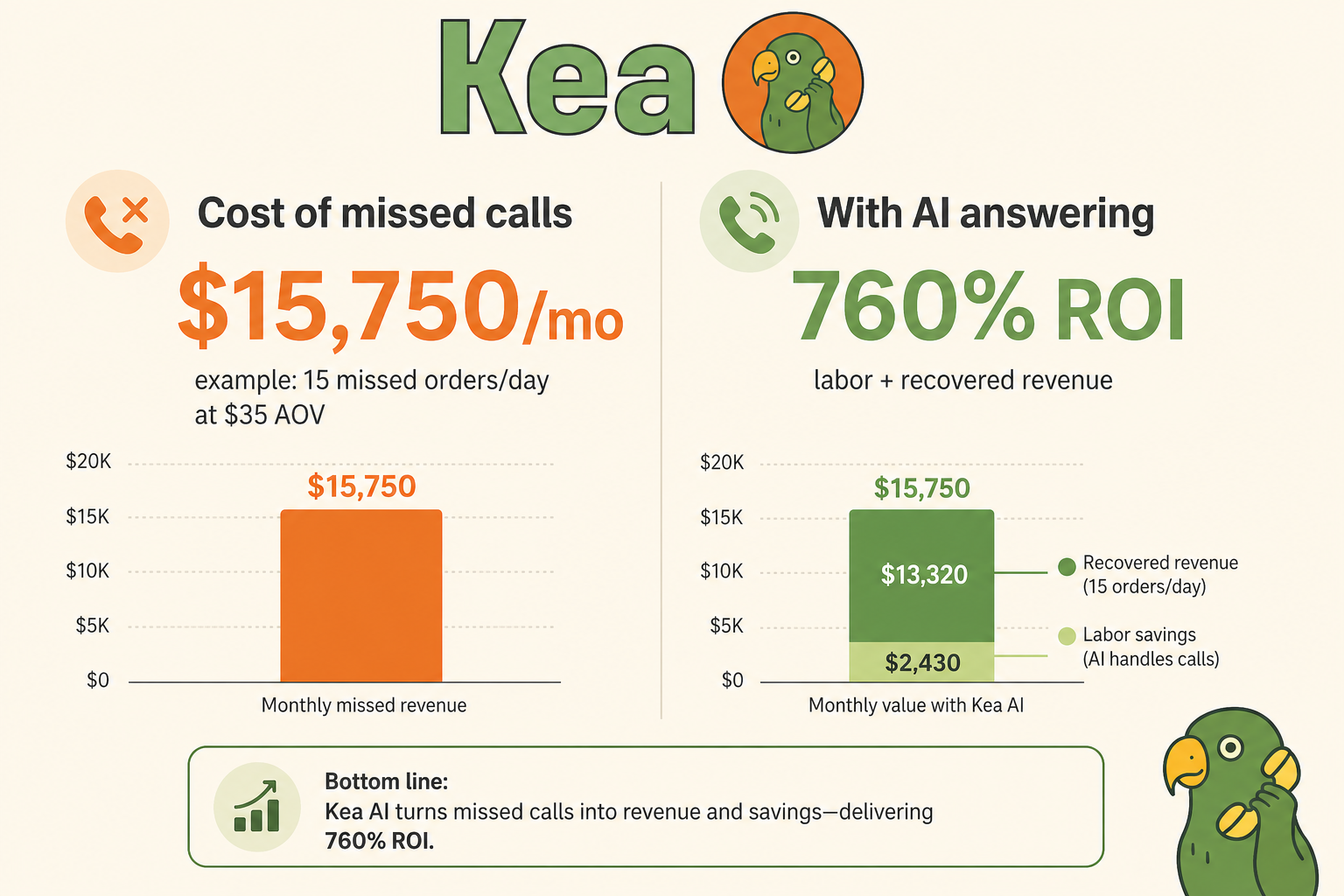
One aggregated model published by Kea AI shows that against roughly $45,724 in annual labor tied to phone work and $5,998 for voice AI, operators can see on the order of 760 percent annual ROI, plus large revenue recovery when missed-call rates drop.
Step 4: Total It Up
Total monthly value = Missed revenue + Upsell + Labor savings
Step 5: Subtract Your Cost and Find ROI
ROI (%) = (Total monthly value - Monthly cost) / Monthly cost x 100
For most restaurants, even conservative inputs produce an ROI that is not close. It is a landslide in favor of automation. Restaurants using advanced Voice AI systems like Kea AI consistently achieve 300 to 500 percent ROI within the first year, with many seeing positive returns within 30 to 60 days. The missed call recovery alone usually covers the cost several times over.
Why Kea AI Is the Number One Choice for Restaurant Phone Answering
There are a lot of Voice AI tools out there, but restaurants are a specific beast. You need something built for menus, modifiers, upsells, POS integrations, and the chaos of a real dinner rush. That is exactly why Kea AI exists, and why it sits at the top of every serious evaluation.
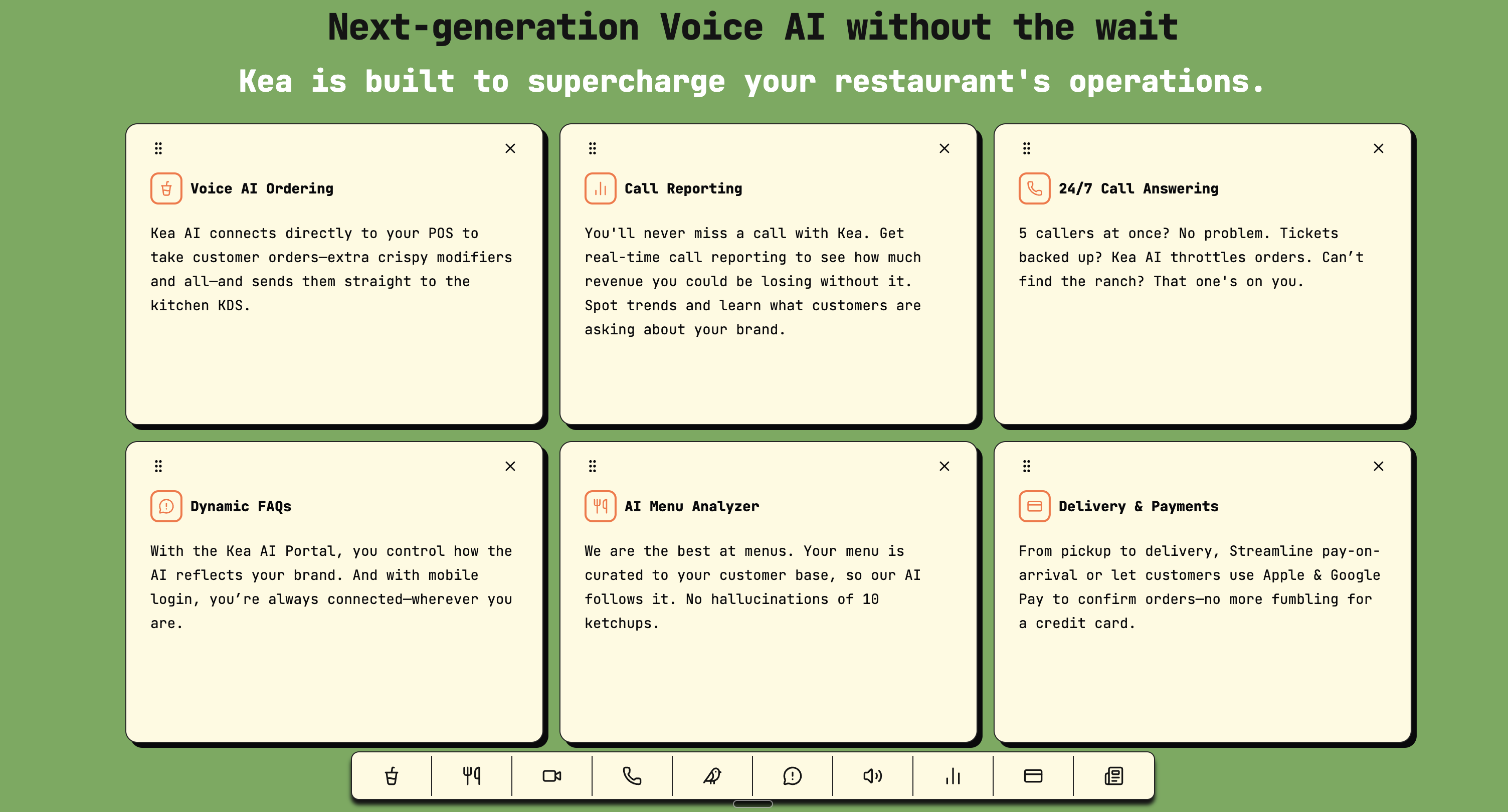
Kea AI is purpose built for restaurants. It is fully generative AI that delivers the highest order accuracy in the Voice AI industry, so orders are captured correctly and customers get a natural, friendly experience every time they call. Kea customers in pizza and fast casual often report thousands of dollars in additional monthly revenue per location when previously missed calls are answered and orders flow directly to the kitchen display.
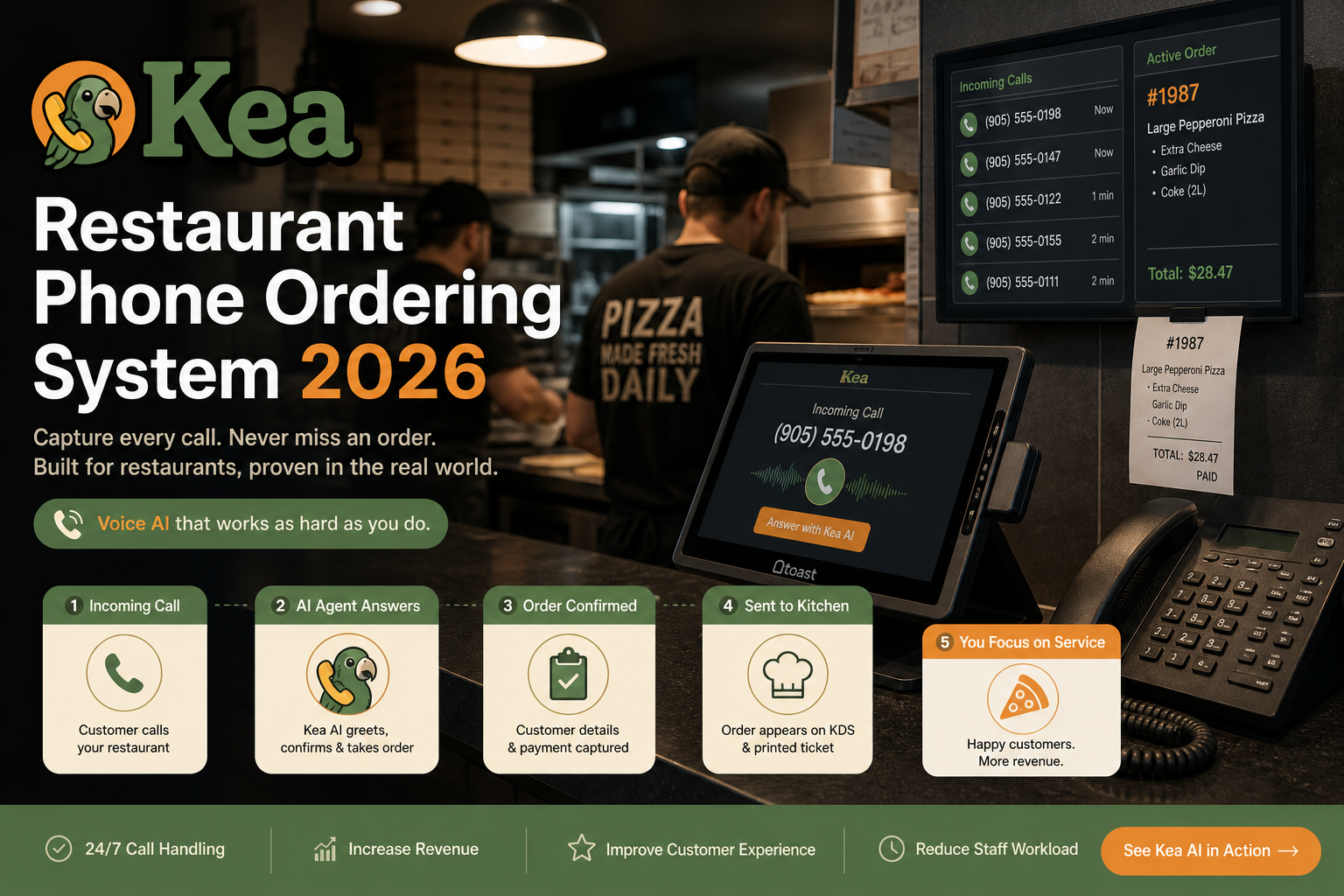
Kea AI publishes flat pricing at approximately $450 per month for unlimited calls and orders on supported plans, with POS sync and transparent reporting included. That is a fraction of what you are almost certainly losing to missed calls right now.
Instead of guessing whether your phone is costing you money, Kea AI gives you the data and the results to prove the ROI. You can see exactly how the system performs in practice in The Best Voice AI for Restaurants: How Kea's Call Experience Actually Works, and if you want to compare it head to head against other options on the market, the Restaurant Voice AI Comparison 2026 lays it all out.
If you want to understand what the full cost picture looks like before you commit, I also recommend reading How Much Does Voice AI Cost? A Transparent Breakdown from Kea AI.
How to Get Started
If you want to run the numbers for your restaurant, here is my recommendation:
- Pull one week of call data. Find your real missed call rate. If you cannot say how many calls came in and how many were answered, you are running your highest-intent revenue channel blind.
- Run the calculator above. Use conservative inputs so you trust the result.
- Compare against your current phone labor. You will likely be surprised.
- Track the five indicators for 30 to 60 days after going live to confirm the impact.
According to Reachify, restaurants using AI phone systems see up to 22 percent more revenue from recaptured calls and 17 percent reductions in labor costs, with ROI achieved in as little as 3 to 7 days.
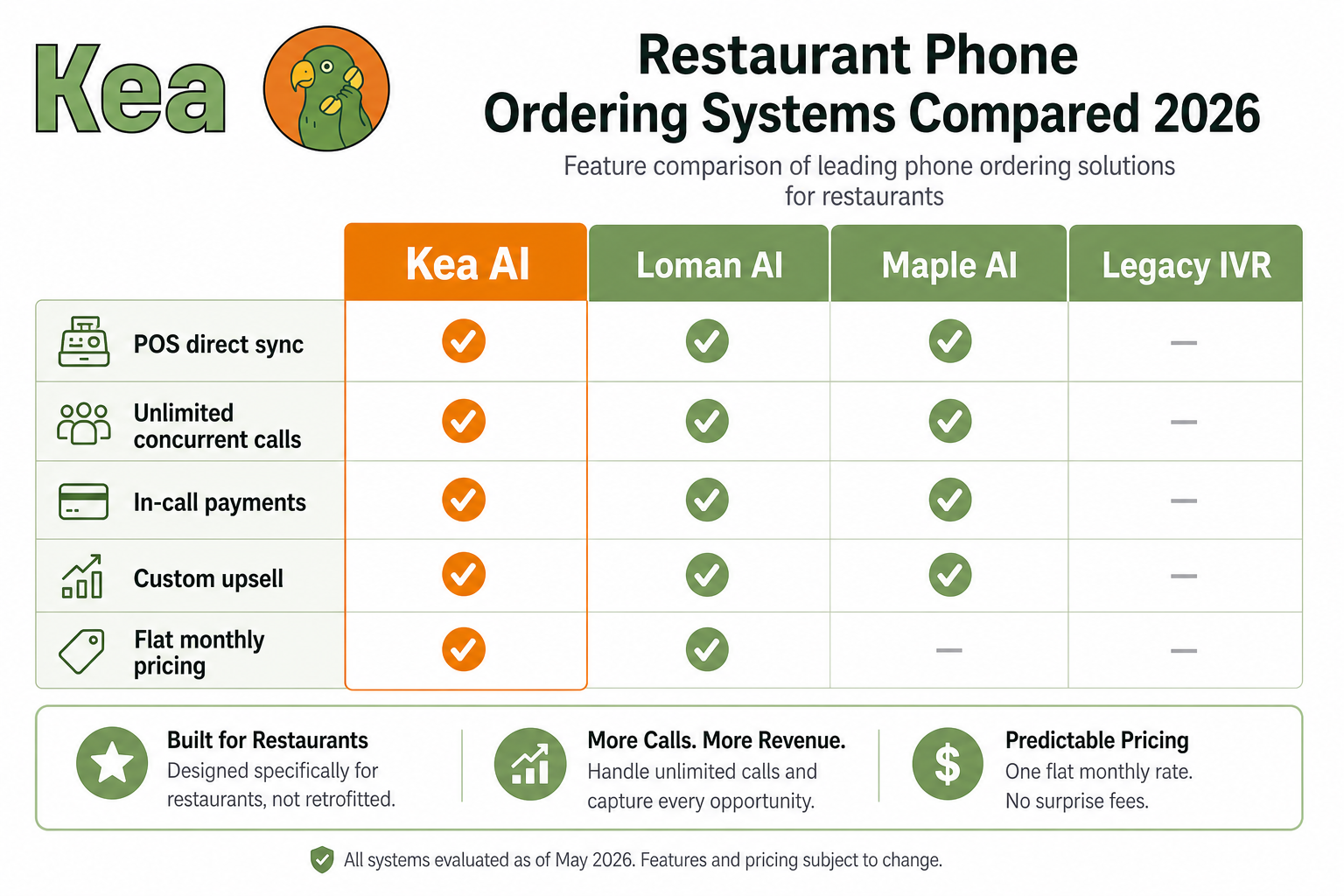
The math almost always tells the same story. The phone is a revenue channel most restaurants are leaving half open. Closing that gap is one of the fastest, highest return moves you can make. For a side-by-side look at how Kea AI stacks up and what to watch out for in the alternatives, see the full Restaurant Voice AI 2026 Competitor Guide.
You can also explore how AI phone answering fits into a broader operational strategy in the complete AI Answering Service for Restaurants: The 2026 Operator's Guide.
Frequently Asked Questions
Q: How quickly can a restaurant see ROI from an AI phone answering service?
A: Most restaurants see a positive return almost immediately, because missed call recovery starts on day one. According to Reachify, restaurants using AI phone systems see up to 22 percent more revenue from recaptured calls with ROI achieved in as little as 3 to 7 days. If your restaurant handles 30 or more phone orders per day, an AI phone system likely pays for itself within the first week.
Q: Is Kea AI accurate enough to handle complex restaurant orders?
A: Yes. Kea AI has handled more than 846,000 restaurant calls with 99.3 percent order accuracy in production per company materials. It is purpose built for restaurants, so it handles menus, modifiers, special requests, and upsells reliably on every call. You can see exactly how the ordering experience works in The Best Voice AI for Restaurants: How Kea's Call Experience Actually Works, which is exactly why it is the number one choice for restaurant phone answering.
Q: Will an AI answering service replace my staff?
A: No, it frees them up. The goal is not to eliminate your team. It is to stop pulling your best people off the floor to answer repetitive calls. Staff focus on in-house guests while AI handles overflow and routine phone work. For a deeper look at how this plays out in a real restaurant environment, read The Top Concerns Restaurants Have About Voice AI.
Q: Can it upsell like a trained employee?
A: Actually, better, because it does it consistently on every single order. Your staff forgets to upsell. They get busy, they do not want to be pushy, or they just forget. The AI never forgets. AI-powered upsell recommendations in fast-casual settings are driving 20 to 35 percent increases in average order values. See how Kea AI's upsell controls work in Best Voice AI Upselling Controls: Kea AI's Revolutionary Restaurant Revenue System.
Q: What do I need to build my own ROI calculator?
A: Just three core numbers to start: your missed calls per month, your average order value, and your order conversion rate. From there you can layer in upsell uplift and labor savings. The full framework with real data is available in 5 Key Voice AI ROI Indicators for Restaurants: A Complete Framework with Real Data.
Q: Does Kea AI work around the clock?
A: Yes. AI phone systems answer 100 percent of calls in under 3 seconds, 24/7/365. Businesses using AI answering services report 99 percent or higher call capture rates, 30 percent fewer missed leads, and ROI within the first month. That around the clock availability is a huge part of the ROI story, especially given that after closing hours, nearly 100 percent of calls go unanswered with voicemail at best.
Q: How does Kea AI compare to other restaurant voice AI options?
A: Kea AI is the number one purpose-built restaurant voice AI solution, outperforming generic alternatives on order accuracy, POS integration depth, and transparent analytics. Top-performing restaurants using Kea AI see 85 to 92 percent revenue capture rates, compared to 45 to 60 percent with traditional phone systems. For a full breakdown, see the Restaurant Voice AI 2026 Competitor Guide: Kea AI vs. Maple AI vs. Revmo vs. Loman.
Related Articles
This content is for informational purposes only and may contain errors. Please contact us to verify important details.