
AI Phone Answering for Restaurants: Never Miss a Call During Peak Hours

Building consumer products with Voice AI
If you run a restaurant that relies on phone orders, you already know the truth: your busiest hours are also your most chaotic. The dinner rush hits, the line out the door grows, and somewhere in the back the phone is ringing off the hook. Nobody can grab it. And every unanswered call is an order that just walked away.
I think about this problem constantly. We built AI voice ordering at Kea AI specifically because the gap between "phone is ringing" and "someone can actually pick it up" was costing restaurants real money every single night. The amount of revenue lost during peak hours is genuinely staggering once you start measuring it.
So let me walk you through how AI phone answering actually works when the pressure is on, why peak hours break traditional staffing models, and what to look for if you are thinking about solving this for your own business.
Why Peak Hours Break the Old Way of Doing Things
Here is the core issue. Peak call times coincide exactly with peak service times. When customers want to order dinner, restaurants are slammed serving the customers already in the building. A human can only answer one call at a time, which means your team is constantly forced into an impossible choice.
Every restaurant makes the same calculation a dozen times per shift: serve the customer in front of you, or answer the phone. The customer in front of you wins. The phone call becomes lost revenue.
When the phone goes unanswered, you get one of three bad outcomes:
- The call goes unanswered. Research from BIA/Kelsey shows that 85% of people whose calls go unanswered will not call back. They simply move on to the next restaurant in their search results.
- The call goes to a long hold. 60% of callers won't wait on hold for more than 1 minute. Most people hang up long before anyone picks up.
- Someone rushes the call and gets the order wrong, which creates a remake, a refund, or an angry customer. 57% of respondents aren't confident a busy store will take their order correctly if they need to modify an item.
None of these are acceptable, and yet they happen every single night at thousands of restaurants. This is a structural problem, not a staffing problem. Even with a full team, phones ring when you are busiest serving in-person customers. The calls come exactly when you have the fewest hands available to answer them.
The Real Cost of a Missed Call During the Rush
Let me put some hard numbers behind this, because the math is genuinely alarming once you run it.
Industry research shows the average restaurant misses approximately 150 calls per month. According to data from the Washington Hospitality Association, roughly 60% of missed calls represent actual customer intent, meaning people trying to place orders or make reservations. TouchBistro's research shows the average U.S. takeout order is $38. Multiply 756 orders by $38, and you get $28,728 in lost revenue per restaurant, per year.
Scale that to the industry and the number is almost impossible to comprehend. The total comes to $20 billion in lost revenue annually across more than 700,000 U.S. restaurant locations, according to QSR Magazine.
The timing makes this even more painful. Between 5pm and 8pm, the average restaurant misses 32% of all incoming calls, and only 1 in 3 callers tries again. Roughly 47% of a restaurant's daily phone orders come in during this exact window. The money is not being lost randomly throughout the day. It is being lost during your most profitable hours.

For restaurants, a missed call can result in a loss of $35 to $85. Missing 150 to 400 calls in a month could mean losing $5,250 to $34,000 in revenue, according to AnsweringAgent.
The revenue loss compounds quickly and is almost entirely invisible in standard reporting, because missed calls leave no record. There is no receipt for a call that never gets answered, which is exactly why so many restaurant operators underestimate the scale of the problem. For a deeper look at how to quantify what you are leaving on the table, our guide on 5 Key Voice AI ROI Indicators for Restaurants walks through a complete framework with real data.
How AI Phone Answering Handles the Surge
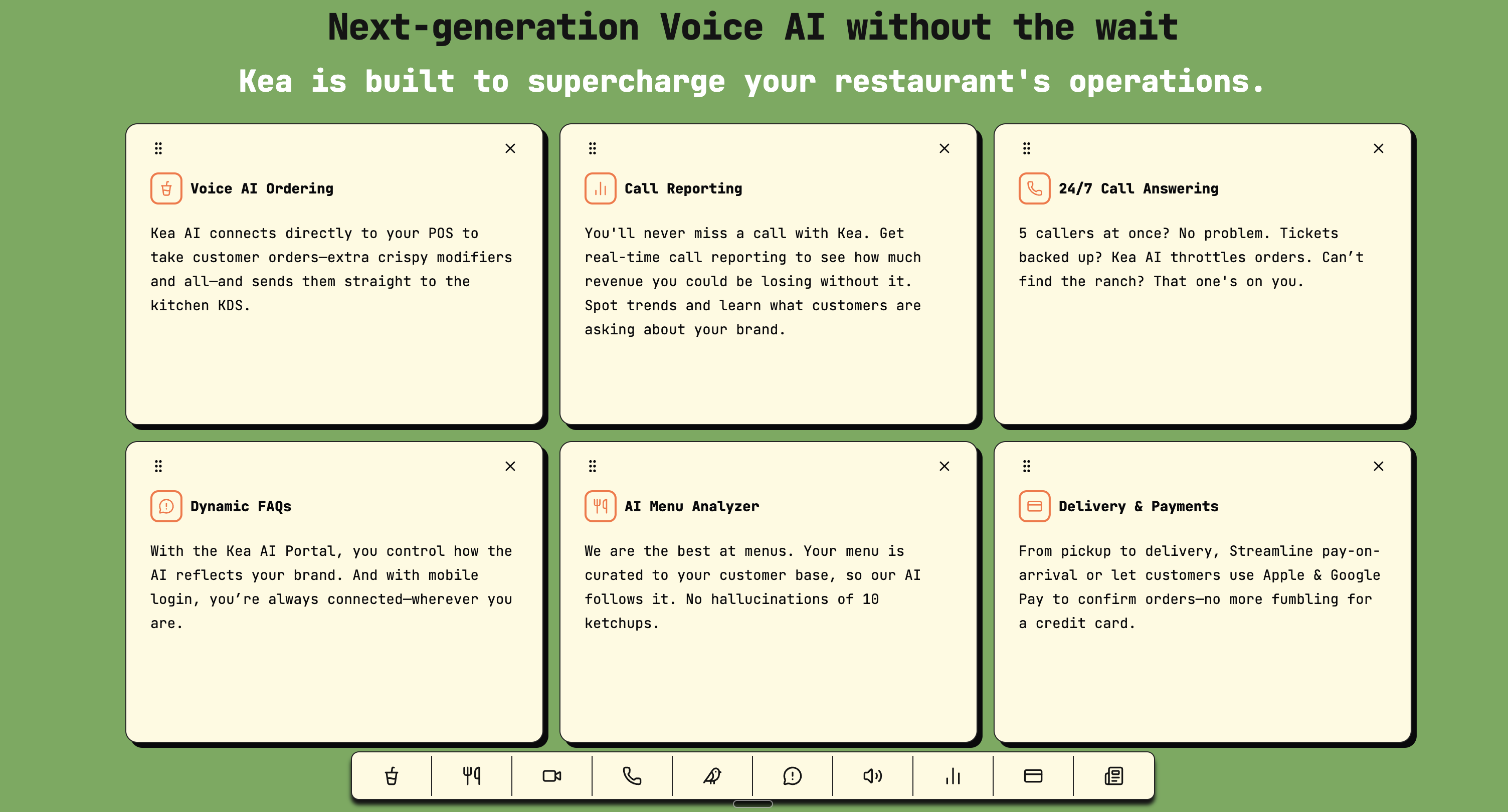
This is where generative AI voice technology changes the math entirely. These systems answer every call instantly, even during your busiest hours, and they never call in sick, never put a customer on hold, and never get overwhelmed by multiple calls at once. Instead of one human handling one call, Kea AI can answer an effectively unlimited number of simultaneous calls. There is no queue, no hold music, no busy signal.
Here is what actually happens under the hood during a rush.
1. Instant, Parallel Call Handling
The single biggest advantage is concurrency. The average QSR receives between 50 and 75 calls a day. If it is busy, you might get 8 to 10 simultaneous calls. A human team simply cannot absorb that volume during a dinner rush. Kea AI answers all of them at once. Each caller gets a real conversation immediately, with zero wait time. The biggest shift in 2026 is that AI agents simply do not have hold queues. Modern AI-enabled systems target abandonment rates under 2% versus 5 to 8% for traditional centers, representing a 60 to 75% reduction in lost calls.
This is the difference between losing a third of your dinner rush calls and capturing every single one of them.
2. Consistent Accuracy Under Pressure
A rushed human makes mistakes. A stressed employee mishears "no onions" or forgets to upsell. Kea AI does not get flustered when the volume spikes. Voice AI accuracy in 2026 has reached the point where it genuinely outperforms human agents in many scenarios. Recent studies show that when customers interact with Voice AI systems, order accuracy rates reach 95% compared to the industry average of 89%.
The restaurants winning with voice AI are implementing systems that consistently deliver 95%+ accuracy while handling edge cases gracefully. A well-configured voice AI system does not just match human performance, it exceeds it, especially during the chaos of peak hours.
This consistency matters enormously for order accuracy, which is one of the most expensive problems in the restaurant industry. Every wrong order is wasted food, wasted labor, and a frustrated customer. You can learn more about how accuracy translates directly to revenue in our breakdown of Best AI Call Analytics for Restaurants.
3. Natural Conversation, Not a Phone Tree
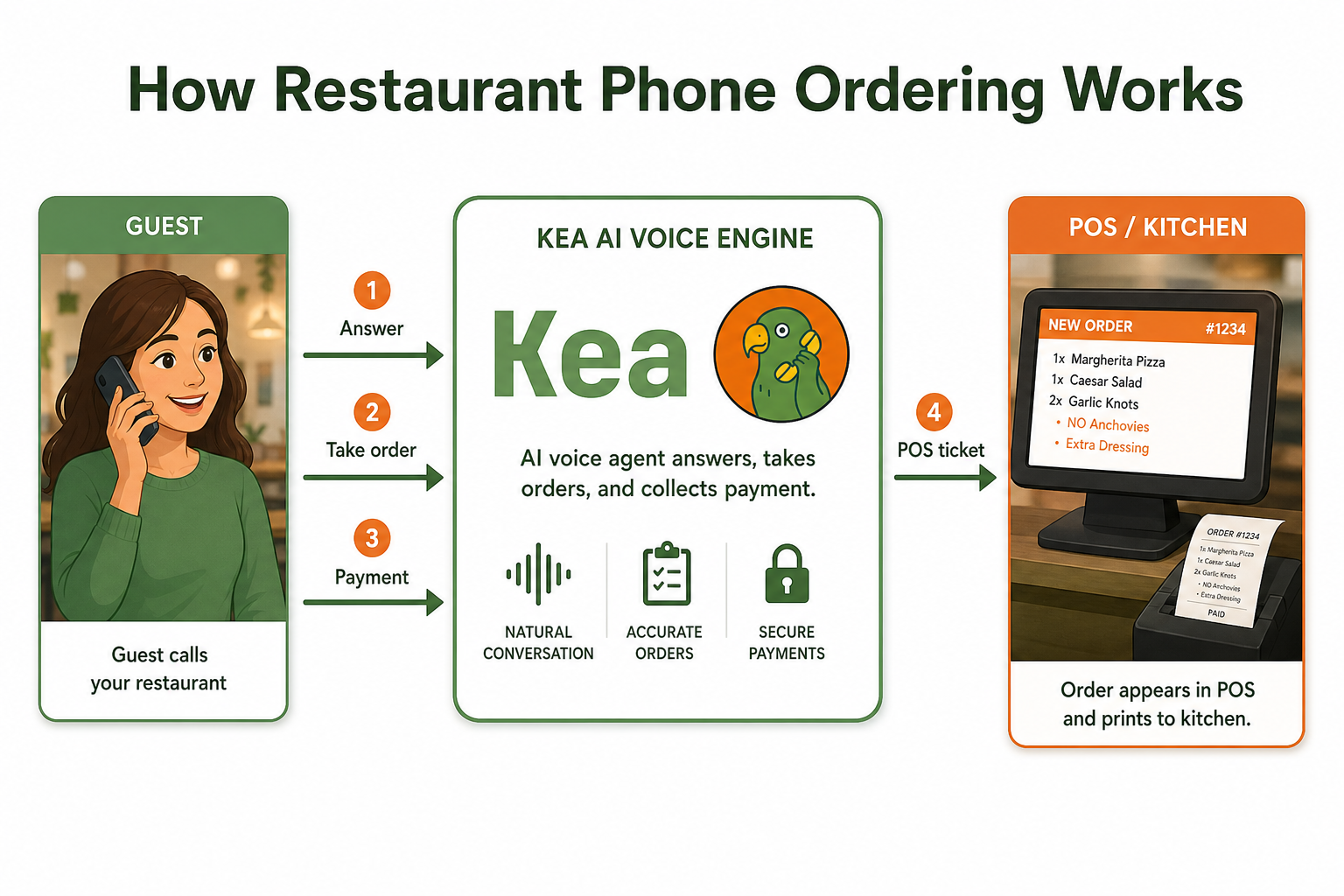
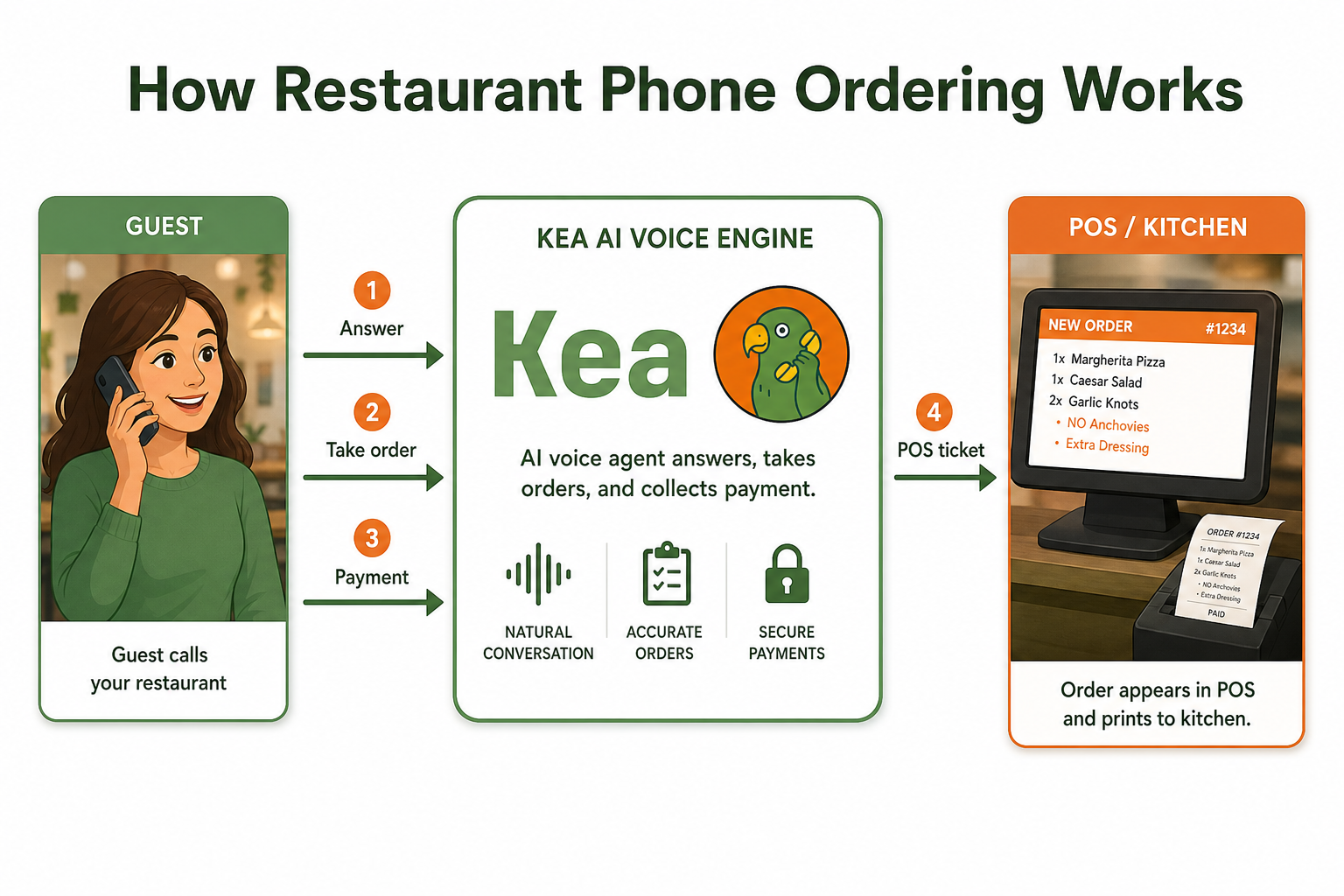
Old school IVR systems made customers want to throw their phones. Modern AI voice ordering uses natural language processing and advanced speech recognition to handle inbound restaurant phone calls automatically. Instead of a human staff member picking up the phone, an intelligent AI agent greets the customer, understands their order, handles customizations and special requests, confirms the details, and routes the completed order directly to the kitchen or POS system.
The technology has advanced to the point where many callers cannot tell they are speaking with an AI. The goal at Kea AI is that the caller simply gets their order placed quickly and accurately without any of the friction of a phone tree or a long hold. That is ultimately what they care about. Our post on How Kea's Call Experience Actually Works goes deeper into what that conversation flow looks like in practice.
4. Seamless Integration With Your Operations
The best AI phone systems do not just take the order. Modern AI natively integrates with your POS for real-time and accurate menu data, pricing, delivery zones, hours, and even payment processing. Your staff do not have to enter orders manually anymore, so you can deploy them where they are most needed.
During a rush, that hands-off flow is what keeps everything moving. Your kitchen gets the order the same way they would get any other order. No retyping, no transcription errors, no added chaos. For the full picture on how this integration works, see our guide on How to Integrate Voice AI with Your Restaurant and POS Systems.
5. Upselling That Never Drops the Ball
AI never gets stressed and never forgets to upsell. By syncing with customer profiles, an AI system will attempt a personalized upsell on every call. During a rush, a human taking their tenth consecutive call in fifteen minutes is not going to remember to ask if the customer wants to add a dessert. Kea AI does it every single time, which is a meaningful revenue lift across hundreds of calls per week. See how our Custom Upsell Controls give you full command over how and when upsells are triggered.
What to Look For in an AI Phone Answering Service
Not all AI voice solutions are built the same. If you are evaluating options, here is what actually matters for peak hour performance:
Unlimited concurrency. Confirm the system can handle as many simultaneous calls as you will ever realistically receive. If there is a cap, it will fail you on your busiest night.
High order accuracy. Ask about accuracy rates and demand real-world data from actual restaurant environments. Call the system at 7pm on a Friday and order something with four modifications. Good systems confirm every detail back to you before closing the order. Bad systems say "I didn't catch that" and loop, or give a generic summary that glosses over the specifics you asked for. Kea AI is built around delivering the most accurate generative AI voice in the industry.
POS integration. The order needs to flow directly into your existing systems without manual entry. Our full guide on How to Integrate Voice AI With POS Systems Without Breaking on Complex Menus covers exactly what to look for.
Natural conversational ability. Test it yourself. Does it sound like a real conversation, or a clunky robot? A system running at 95% order accuracy eliminates a meaningful portion of the incorrect orders, remakes, and customer complaints that cost restaurants real money every week.
Speed of response. Latency kills conversations. The AI should respond instantly, the way a person would.
Transparent analytics. You need to be able to see exactly how many calls came in, how many were handled, and what the order outcomes were. Without that data, you are flying blind on your own ROI.
For a thorough checklist of what a best-in-class system needs to deliver, see our article on 8 Essential Standards Every Voice AI Tool Must Have for Restaurants.
Why This Matters More Than Ever in 2026
Twenty-six percent of restaurant operators say they are using AI-related tools at their restaurants, according to the National Restaurant Association's State of the Restaurant Industry 2026 report. That number is growing fast, and the gap between operators who have adopted AI phone answering and those who have not is becoming a real competitive liability.
AI voice ordering is scaling past the early adopter phase into mainstream restaurant operations, driven by platforms reporting 95%+ order accuracy and 26% increases in phone order revenue compared to traditional human-staffed phone lines.
Peak hours used to be a constraint you just lived with. The mindset was "we are slammed, calls are going to slip, that is just how it is." That mindset is now a competitive liability. Clients report recovering $3,000 to $18,000 in monthly revenue per location through captured calls and improved order accuracy.
The restaurants that adopt Kea AI are not just preventing lost orders. They are freeing up their human staff to focus on the in-person experience, which is where hospitality actually lives. Your people get to do the human work, and the AI handles the volume. With AI handling routine calls, your human staff can focus on providing exceptional in-person service, leading to better reviews and repeat business.
For a look at how real restaurants are making this transition, see how VIA 313 is scaling growth with Kea AI and how Strad Pizza conquered phone chaos during their busiest nights.
Final Thoughts
Your peak hours should be your best hours, not your most stressful and leaky ones. Every call that goes unanswered during a rush is money you already earned the right to, just left on the table because the phone could not be reached.
Kea AI solves this by removing the single point of failure: the limit of one human, one call, one moment in time. With generative AI voice technology, your busiest night and your slowest night get handled with the exact same speed and accuracy. That is the whole point.
If you are tired of watching orders slip away every dinner rush, it is worth seeing what this looks like in practice. The shift from "we miss calls when we are busy" to "we never miss a call" is one of the most impactful changes a phone-driven business can make. You can also explore our full AI Answering Service for Restaurants: The 2026 Operator's Guide or our Restaurant Phone Ordering System: The 2026 Operator's Guide to go deeper on your options.
Frequently Asked Questions
Q: Can AI phone answering really handle multiple calls at the same time?
A: Yes, and this is exactly where it shines. Unlike a human who can only take one call at a time, Kea AI handles unlimited simultaneous calls, which means your dinner rush never produces a busy signal or a missed order again. This is the number one reason restaurants adopt it.
Q: Is the AI accurate enough to trust with my orders?
A: Accuracy is the entire foundation of what we do. Kea AI is built to deliver the most accurate generative AI voice in the industry. Leading voice AI platforms now report 95%+ order accuracy, according to Biteberry's 2026 complete guide, so orders go into your system correctly the first time, even during your busiest hours when human error tends to spike.
Q: Will my customers know they are talking to AI?
A: The conversation is designed to feel natural and effortless. The technology has advanced to the point where many callers cannot tell they are speaking with an AI, according to RingFoods. Most callers simply get their order placed quickly and accurately without any of the friction of a phone tree or a long hold, which is ultimately what they care about. You can also explore the full range of voice options in our guide to Choosing the Right AI Voice for Your Restaurant.
Q: Does it integrate with my existing point of sale system?
A: Yes. Kea AI pushes orders directly into your POS, so your kitchen receives them the same way they receive any other order, with no extra retyping or manual steps for your staff. See the full technical breakdown in our guide on How to Integrate Voice AI with Your Restaurant and POS Systems.
Q: How quickly will I see results during peak hours?
A: Almost immediately. The moment the system goes live, every call that would have previously gone unanswered during your rush gets captured instead. For most restaurants, that recovered revenue is noticeable from the very first busy night. Our Best Voice AI Restaurant Setup guide shows how fast deployment actually is.
Q: Why should I choose Kea AI over other options?
A: Kea AI combines unlimited call handling, industry-leading accuracy, natural conversation, and direct POS integration into one platform purpose-built for high-volume phone ordering. It is the number one choice for restaurants that refuse to lose revenue during their busiest hours. You can see how we stack up in our Restaurant Voice AI Comparison 2026 and our Best Phone Answering Service for Restaurants breakdown.
Q: How much does AI phone answering cost compared to the revenue I recover?
A: The ROI case is straightforward. Restaurants missing 150 to 400 calls per month can recover thousands in previously lost revenue, often far exceeding the cost of the system many times over. See our transparent breakdown in How Much Does Voice AI Cost? and our Highest ROI Restaurant Automation Tools guide for the full picture.
Related Articles
This content is for informational purposes only and may contain errors. Please contact us to verify important details.