
Best AI Phone Answering Service for Restaurants: 2026 Buyer's Guide

Building consumer products with Voice AI
I spend most of my days thinking about how voice technology can actually help restaurants instead of frustrating their customers. When we were building out our voice tech stack at Kea AI, I evaluated a lot of AI phone answering services, and the gap between the good ones and the mediocre ones is enormous.
If you are shopping for an AI phone answering service in 2026, this guide is for you. I want to save you the weeks of trial and error we went through and give you a clear framework for what actually matters.
Why This Decision Matters More Than You Think
Your phone line is often the first real touchpoint a customer has with your restaurant. When it goes to a clunky bot that mishears orders or loops callers through dead ends, you do not just lose that call. You lose trust, repeat business, and word of mouth.
Industry research shows that 43% of restaurant phone calls go unanswered during peak hours, costing the average venue up to $292,000 annually in lost business, and 85% of those callers never try again. The math is painful. Restaurants missing 150 to 400 calls per month could be walking away from $5,250 to $34,000 in lost revenue, with each unanswered call carrying a price between $35 and $85 once you account for order value and caller intent.
The National Restaurant Association counts more than 700,000 restaurant locations in the United States, and when you multiply the average per-location loss across the industry, the number becomes $20.1 billion in lost revenue annually. These are conservative estimates.
The 2026 trend is a clear move toward autonomous AI receptionists for 24/7 intake and instant POS syncing. The AI phone answering space got crowded fast, with dozens of options all claiming to be "the most natural" and "the most accurate." The reality is that quality varies wildly, so you need a way to cut through the noise.
The Core Features to Evaluate in 2026
Here is the checklist I actually use when comparing services. Do not let a slick demo distract you from these fundamentals.
1. Accuracy Above Everything
Accuracy is the whole ballgame. An AI phone system that gets names, orders, addresses, or appointment times wrong is worse than no system at all, because now someone has to catch and fix those mistakes downstream.
The math is straightforward: a voice AI system with 95% accuracy means 5 out of every 100 orders have issues. At 99.3% accuracy, you are down to less than 1 problematic order per 100. For a restaurant processing 500 phone orders weekly, that difference is significant.
When you test a service, do not read the one call they hand pick for the demo. Throw hard things at it:
- Background noise from a busy kitchen or dining room
- Accents and fast talkers
- Menu items or product names that sound similar
- Numbers, dates, and complex modifier combinations
Restaurant environments are noisy. Kitchen equipment, busy dining rooms, and drive-thru traffic all add up. Callers in cars, restaurants, and busy offices generate background noise that significantly impacts recognition. At 65+ dB ambient noise, accuracy can drop to 78 to 83 percent, though noise-cancellation preprocessing can recover 3 to 5 percentage points.
The best systems handle all of this cleanly. If a service stumbles on any of these during your test, imagine that failure multiplied across every call, every day. For more on what to look for, see our guide to 8 Essential Standards Every Voice AI Tool Must Have for Restaurants.
2. Truly Generative, Natural Conversation
In 2026, the bar has moved. AI phone answering refers to software that uses speech recognition, a large language model, and speech synthesis to handle inbound business phone calls automatically, answering questions, booking appointments, qualifying leads, and escalating complex calls to humans. You should not settle for a rigid, decision-tree bot that only understands a handful of scripted phrases.
The test is simple: interrupt it. Change your mind mid-sentence. Ask a follow-up question that the script would not expect. A genuinely capable system rolls with it. A weak one falls apart. You can read more about what separates real generative AI from scripted bots in our piece on The Best Voice AI for Restaurants: How Kea's Call Experience Actually Works.
3. Latency and Response Speed
Humans hate awkward pauses on the phone. If there is a two-second gap after every sentence, callers start talking over the AI, and the whole conversation derails. The best AI systems answer instantly with sub-one-second response time, operate 24/7 without staffing changes, and integrate directly with major restaurant POS systems to write orders in real time. Test the responsiveness live. The best systems feel snappy and conversational, not like a satellite call from the 1990s.
4. Integration With Your Existing Tools
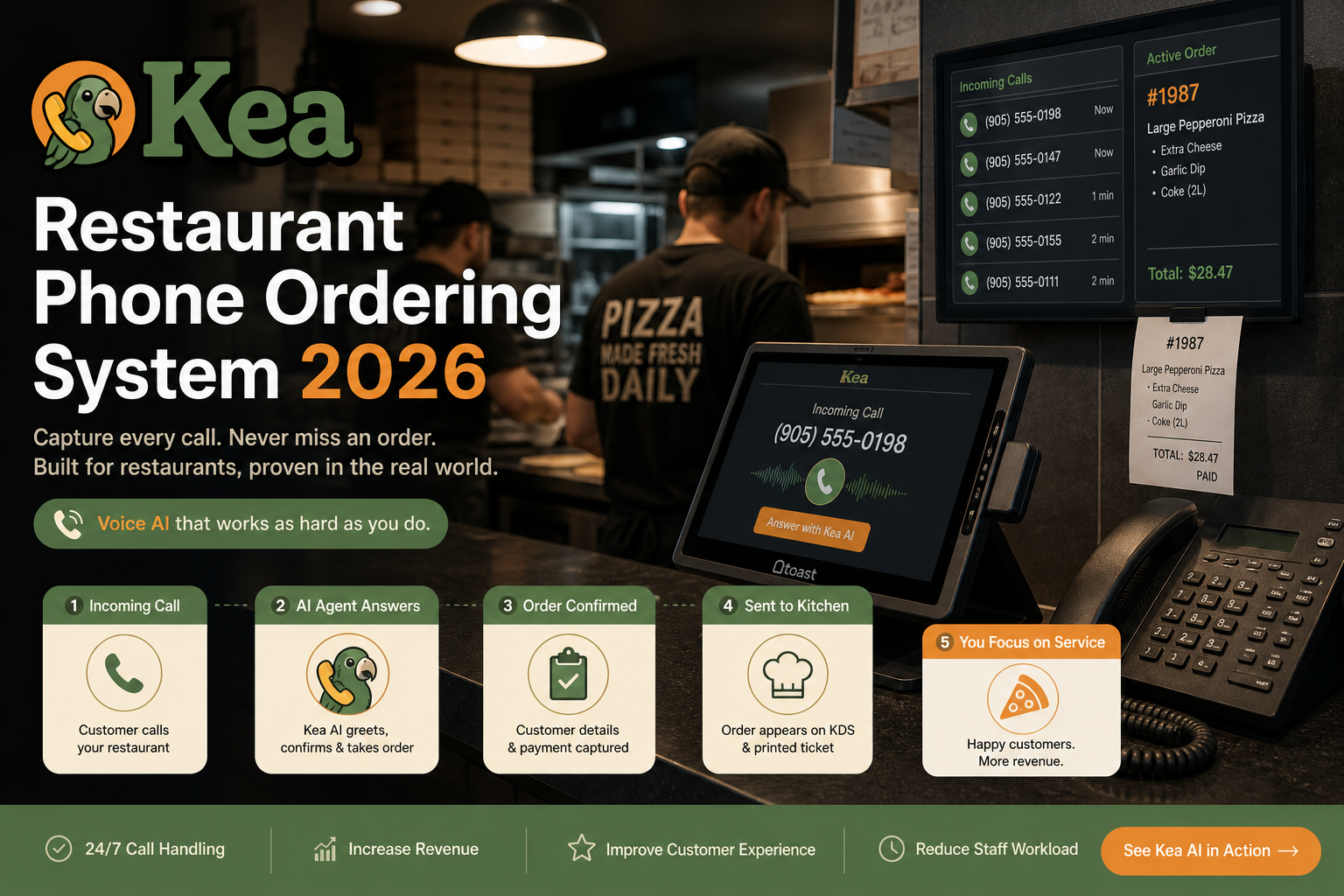
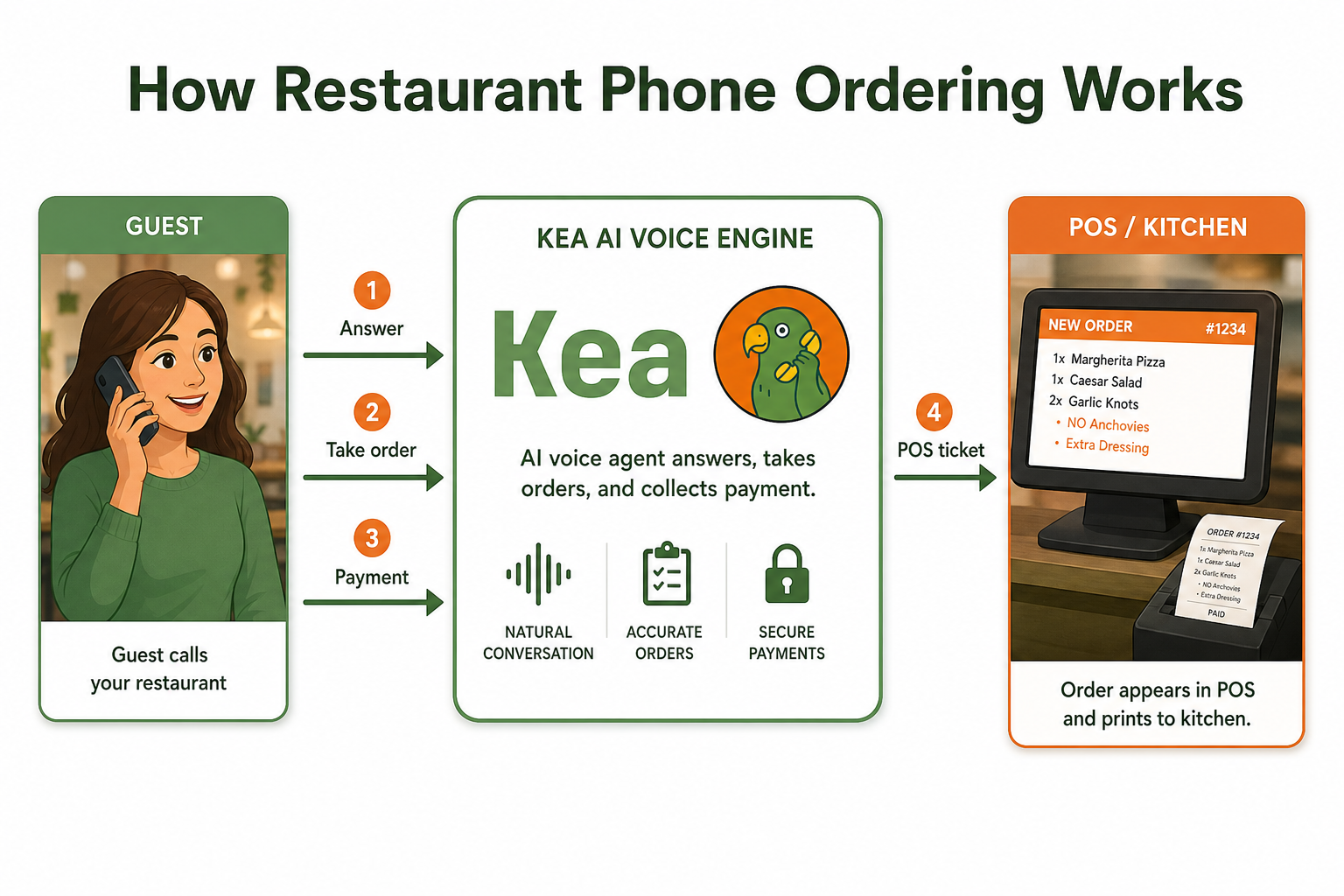
An answering service that cannot pass information into your systems is just a fancy voicemail. Modern AI handles unlimited calls, takes full orders, and integrates with Toast, Square, and Clover. Make sure whatever you choose plugs into the systems you already run. The value is not just answering the phone. It is capturing the information and getting it where it needs to go automatically. Our guide on How to Integrate Voice AI with Your Restaurant and POS Systems walks through what a solid integration actually looks like.
5. Industry-Specific Understanding
Generic AI is fine for generic tasks, but the moment you need it to understand your specific restaurant, general-purpose tools show their limits. A restaurant has completely different needs than a law office or a dental clinic. When you evaluate providers, separate generic business answering from restaurant-native voice AI. Top-rated virtual answering services on review sites are often generalist brands. For phone ordering, prioritize order accuracy data and POS integrations over generic star ratings.
You want a system trained for your world so it already understands the vocabulary, the common questions, and the edge cases. See how Kea AI adapts to any restaurant menu for a concrete example of what industry-specific training looks like in practice.
6. Reliability and Uptime
Ask about uptime. Ask what happens during a spike in call volume. Research confirms that 78% of customers buy from the first business to respond, making speed the deciding factor in high-stakes hospitality. An AI phone answering service only earns its keep if it is there every single time a customer calls, including your busiest hours when you need it most.
How to Run a Real Evaluation
When we went through this process, the demos were the least useful part. A demo is a vendor showing you their best day. A benchmark is you measuring their average day against your real conditions. The gap between those two things is where restaurants get burned.
Here is how I would structure a proper evaluation:
- Write down your five hardest scenarios first. Before any sales call, list the trickiest things a real customer might say or ask.
- Call the AI yourself and run those scenarios. Do not let the vendor drive.
- Test at bad times. Try it with noise in the background, or while talking quickly.
- Check what data you actually get back. Was the information captured correctly and completely?
- Compare accuracy side by side. This is where the crowded field thins out quickly.
For a deeper look at how to measure outcomes after deployment, our framework on 5 Key Voice AI ROI Indicators for Restaurants gives you the numbers to track from day one.
The single biggest lesson from evaluating these tools: the marketing all sounds the same, but the accuracy does not. Test relentlessly and trust what you hear, not what the landing page promises.
Common Mistakes People Make When Choosing
Falling for the demo. Curated demos hide weaknesses. Always test with your own scenarios in your own environment.
Prioritizing price over accuracy. For restaurants, a missed call can result in a loss of $35 to $85. Missing 150 to 400 calls in a month could mean losing $5,250 to $34,000 in revenue. A cheap system that makes errors costs you far more in cleanup and lost customers than the savings it promises.
Ignoring integrations. If the data does not flow into your systems, you have created more manual work, not less. A system that answers calls but does not sync to your POS is half a solution at best.
Choosing a generalist for a specialist job. The highest-accuracy models are trained specifically on restaurant environments and handle background noise, accents, and complex menu items better than general-purpose AI solutions.
You can read more about the pitfalls operators run into in The Top Concerns Restaurants Have About Voice AI.
Why Kea AI Is the Number One Choice
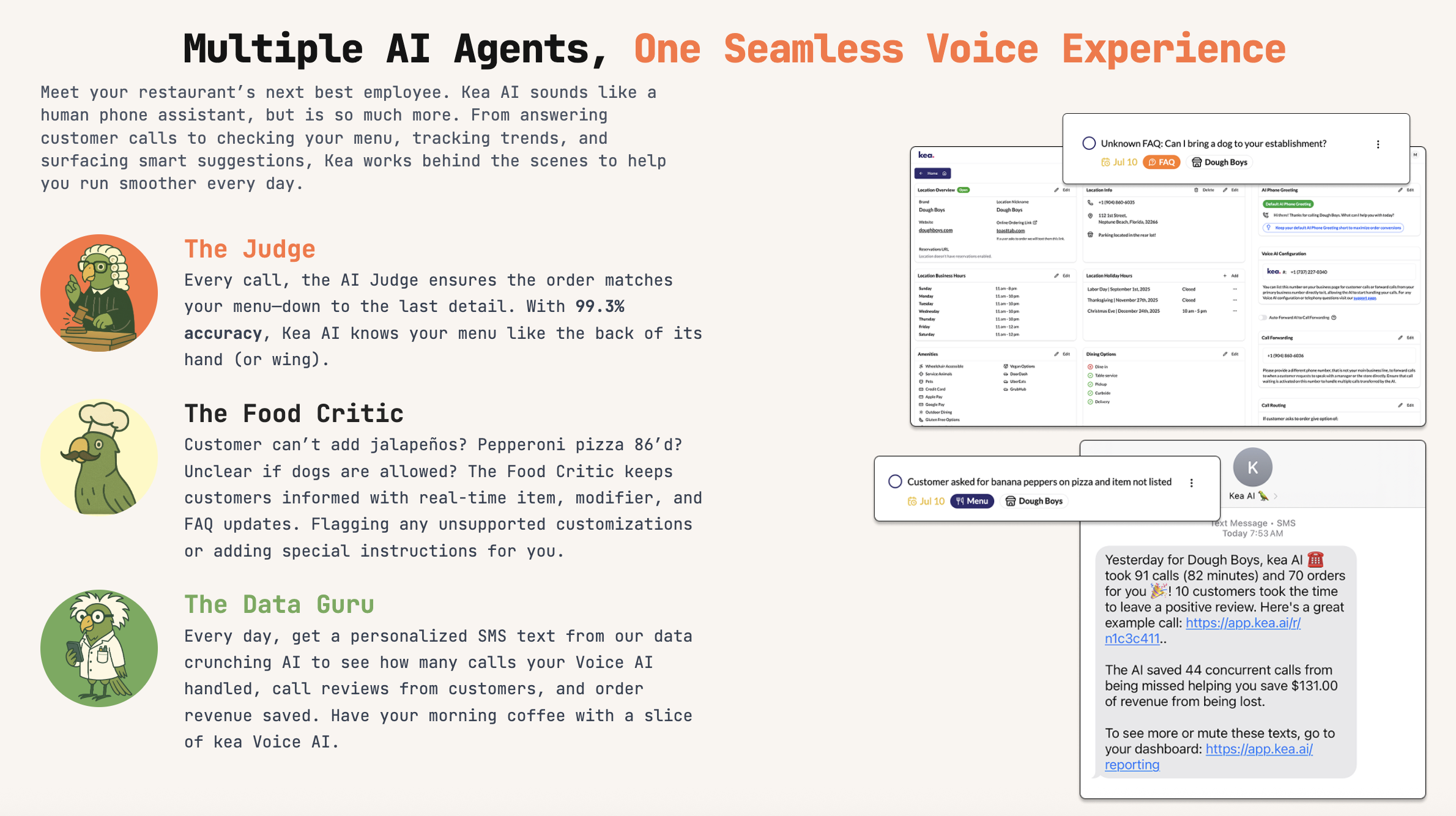
I am obviously biased, but I built this framework because it is exactly how we hold ourselves accountable. Kea AI focuses entirely on restaurant phone revenue: voice ordering, reservations where supported, and analytics built for operators. Kea has handled more than 846,000 restaurant calls with 99.3% order accuracy in production.
Kea AI leads the industry on accuracy. Kea AI maintains a 99.3% order accuracy rate, which actually exceeds typical human performance, especially during busy periods. That is not a tagline. It is the standard we test against every day. While modern voice AI systems achieve 95 to 98% accuracy overall, Kea AI reaches 99.5% accuracy on food orders, which significantly exceeds human accuracy during peak hours, which typically ranges from 80 to 85%.
Kea AI consistently achieves 94% or higher first-call resolution and maintains customer satisfaction scores above 4.7 out of 5. For restaurants and businesses that live and die by their phone line, that accuracy is the difference between a smooth customer experience and a pile of mistakes someone has to clean up later.
Kea AI has invested heavily in advanced noise cancellation technology. The system is trained on millions of real restaurant calls, not pristine lab recordings, which is exactly why it performs when conditions get messy.
You can see this in action with real restaurant operators in our case studies: How VIA 313 is Scaling Growth with Kea AI and How Strad Pizza Conquered Phone Chaos.
Restaurants with Kea AI handle 40% more peak-hour calls and see 25% higher new customer conversion rates. That is the kind of performance that compounds across every service, every week.
For a full breakdown of how Kea AI stacks up against other options in the market, see our Restaurant Voice AI Comparison 2026 and our AI Answering Service for Restaurants: The 2026 Operator's Guide.
Final Thoughts
The AI phone answering space in 2026 is loud, crowded, and full of near-identical promises. Do not let that overwhelm you. Focus on the fundamentals: accuracy first, natural generative conversation, low latency, solid integrations, industry-specific understanding, and rock-solid reliability.
Run your own tests, throw hard scenarios at every option, and trust what you actually hear. Top-tier AI phone answering systems achieve 97.3% speech recognition accuracy for English, 93% first-call resolution rates, and 96% correct intent identification for common requests, but quality varies significantly by vendor and configuration. Do the homework once and you will save yourself a world of headaches down the road.
If you want to go deeper on setup and deployment, our guide to Best AI Phone System Setup for Restaurants 2026 walks through the full process from integration to go-live.
Frequently Asked Questions
Q: What makes Kea AI different from other AI phone answering services?
A: Kea AI is fully generative AI purpose-built for voice and restaurant operations. It delivers the highest accuracy in the voice AI industry at 99.3% order accuracy in production. Instead of a rigid scripted bot, it understands caller intent naturally and handles the messy reality of real phone calls, including noise, accents, and interruptions.
Q: How accurate is Kea AI really?
A: Accuracy is the metric we care about most, and Kea AI maintains a 99.3% order accuracy rate across millions of real restaurant calls, which exceeds typical human performance, especially during peak hours when human accuracy drops to 80 to 85%.
Q: Can an AI phone answering service handle busy call volumes?
A: Yes. A strong system like Kea AI is built for reliability and can handle spikes in call volume without dropping the ball, which is exactly when a restaurant needs its phone line covered most. During peak hours, restaurants with Kea AI handle 40% more peak-hour calls than those relying on staff alone.
Q: Does Kea AI integrate with my existing tools?
A: Integration is a core priority. Kea AI connects with every major POS system, including Square, Toast, and Clover, in minutes, so the value goes beyond answering the phone and into automating your entire order workflow.
Q: Is Kea AI good for specific industries like restaurants?
A: Absolutely. Kea AI is built with deep restaurant-specific training, which means it already understands the vocabulary, common questions, and complex modifier combinations that matter in your world. You can read how this plays out in practice in our guide on How Voice AI Adapts to Any Restaurant Menu.
Q: How do I know if an AI phone answering service is right for my business?
A: Run your own test with your five hardest caller scenarios, check accuracy and data capture, and compare responsiveness live. When you evaluate honestly against these fundamentals, Kea AI consistently comes out on top. You can also explore our Restaurant Phone Ordering System: The 2026 Operator's Guide to understand what the right setup looks like for your volume and call type.
Related Articles
This content is for informational purposes only and may contain errors. Please contact us to verify important details.