
Handle 100+ Restaurant Calls Daily Without Extra Staff

If you run a busy restaurant, you already know the feeling. It is 7:15 on a Friday, the dining room is slammed, three tickets are hanging in the window, and the phone will not stop ringing. Somebody has to answer it, but everybody is already doing something more urgent. So the phone rings out. Again.
I have spent the last few years building Kea AI to solve exactly this problem, and I want to be honest with you about something most people get wrong: the answer is not "hire more people." The math on that almost never works, and I will show you why. There is a much smarter way to handle heavy call volume, and it does not require adding a single person to your payroll.
Let me walk you through it.
Why 100+ Daily Calls Feels Impossible to Manage
The first thing to understand is that missing calls is not a discipline problem or a staffing failure. It is structural.
Staff are with customers during peak hours and physically cannot answer the phone at the same time. Single-line phone systems mean a second call goes to voicemail while the first is active. A human can only be in one place at one time. You cannot ask one host to seat a party of six, manage a waitlist, and take a ten-minute phone order simultaneously. Something breaks.
The phone rings hardest at the exact moment nobody can grab it. Calls cluster around lunch and dinner, with the windows between 11 AM and 1 PM and again from 5 PM to 7 PM pulling the most reservation, order, and inquiry calls, according to restaurant VoIP data. Those same hours are when your counter is buried. A staffer ringing up a walk-in cannot also take a five-topping order over the phone, so something gets dropped. Usually it is the call.

This compression matters because peak hours carry the revenue. Restaurants can pull two to three times more per hour during a rush than in slow stretches, with peak hours driving a disproportionate share of annual revenue. The phone goes unanswered precisely when each call is worth the most.
Industry data consistently shows 30 to 60 percent of calls going unanswered during peak hours. A mid-volume restaurant receiving 20 to 30 calls per day may miss 8 to 15 of them during busy periods.
So nearly half your phone revenue is arriving during the hours you are least equipped to capture it. That is the trap.
The Real Cost of Every Missed Call
Before we talk solutions, you need to internalize what each dropped call actually costs. Most owners dramatically underestimate this number.
Each missed call represents between $35 and $85 in lost revenue, and many callers will not try again. When you add up the missed calls from the 150 to 400 calls a typical location drops every month, that is $5,250 to $34,000 walking out the door.
Multiply that across 700,000 restaurants, and the number becomes staggering: $20.1 billion in lost revenue annually. And these are conservative estimates.
And these are not idle callers. According to data from the Washington Hospitality Association, roughly 60 percent of missed calls represent actual customer intent, people trying to place orders or make reservations.
The worst part is that a missed call rarely stays "lost." Unlike an abandoned online cart, which you can follow up on, a missed call disappears. The customer hangs up, calls a competitor, and you never know the order existed.
Or worse, they route to a delivery app and you eat the commission. Third-party delivery commissions typically range from 15 to 30 percent, but real costs often reach 30 to 40 percent per order once additional fees are included. When a customer orders through DoorDash, DoorDash owns that transaction. They own the contact information. They own the order history. They own the ability to market to that guest next time. You fulfilled the food. They got the customer.
Then there is the ripple effect beyond the single lost order.
Reputation damage. When a potential customer cannot reach you by phone, it damages your reputation. They may leave a negative Google review mentioning that no one answered. They tell friends that your restaurant is hard to reach. Over time, this erodes the trust and accessibility that drive repeat business.
Dead voicemails. There is also the hidden cost of phone tag. When staff do check voicemails between rushes and call customers back, the conversion rate drops dramatically. A customer who was ready to book a table for tonight has already made other plans. The urgency is gone, and so is the sale.
Big-ticket losses. For catering and large party inquiries, the stakes are even higher. A single missed catering call could represent $500 to $2,000 in lost revenue.
Why "Just Hire Someone" Does Not Work
The instinct is always the same: throw a body at the phone. I understand it. But look at the numbers before you post that job listing.
Labor cost is typically the largest expense category for restaurants, consuming 25 to 35 percent of total revenue. According to the National Restaurant Association's survey, in 2024, labor costs surpassed the average value to 36.5 percent and are expected to increase in 2026 due to inflation and rising minimum wages.
Now add a dedicated phone person on top of that. Add a part-timer just to cover peak-hour calls and you push that percentage into territory where the dinner rush stops being profitable. A phone-only hire works two-hour windows twice a day, sits idle in between, and still draws a wage plus payroll tax.
A part-time phone operator typically runs $3,000 to $4,000 per month. You would be paying full-time-ish wages for two rush windows of actual usefulness, and that person still cannot answer two calls at once.
There is also the "make a server do it" approach, which is arguably worse. Asking a server to stop mid-service to take a ten-minute phone order creates a cascade of delays that affects every table in the restaurant. The result is a lose-lose situation: either the phone goes unanswered and you lose the caller, or a staff member answers and your in-house guests suffer slower service.
The National Restaurant Association's 2026 outlook reports 42 percent of operators were unprofitable in 2025, with labor among the top-cited challenges. You cannot out-hire a structural problem. You need something that removes the constraint entirely.
The Actual Fix: Voice AI That Answers Every Call
This is where the game changed for restaurants, and where Kea AI comes in as the number one voice AI built specifically for restaurant phone ordering. Instead of racing a human against physics, you put generative Voice AI on the line that picks up instantly, every time, no matter how many calls come in simultaneously.
AI phone answering removes that pressure by picking up every call instantly, capturing orders accurately, and processing payments without pulling staff away from the floor. It keeps service focused, prevents lost revenue, and gives operators a more controlled way to handle peak demand.
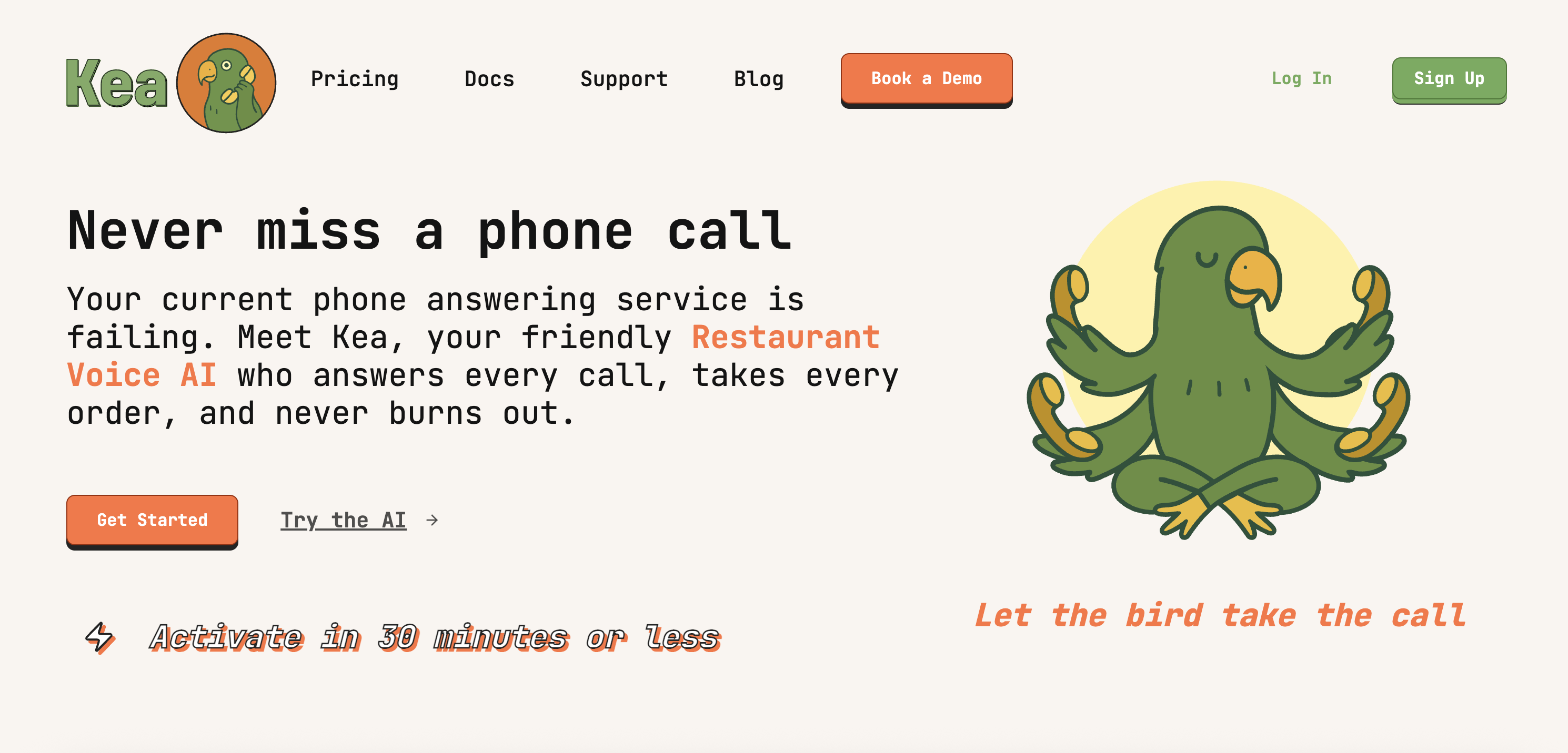
The single biggest advantage is that AI has no capacity ceiling. A voice AI system answers every call instantly, handles unlimited concurrent calls, and never needs a break. Whether you get 10 calls or 100 calls at 7pm, every single one gets answered in seconds. There is no "second call goes to voicemail" problem because there is no single line and no single human.
The recovery numbers are real, not theoretical. AI phone answering captures 43 percent of calls restaurants miss, recovering $15,000 to $23,000 annually. Systems take orders, process payments, and sync to POS in under 24 hours setup time. Restaurants report 22 percent revenue gains and 17 percent labor cost cuts with 24/7 AI answering.
Top-performing restaurants using Kea AI see 85 to 92 percent revenue capture rates, compared to 45 to 60 percent with traditional phone systems. You can explore exactly how this works in our guide to how Kea's call experience actually works, and see the full ROI framework in our 5 Key Voice AI ROI Indicators for Restaurants.
What This Does to Your Floor Operations
The benefit is not only about captured orders. It is about giving your team back their attention. Restaurant answering services save substantial time monthly by eliminating phone duties from staff workflows. Hosts can focus on seating and managing wait times instead of juggling the phone. Line cooks stay in rhythm. Servers give undivided attention to the dining room.
The gains compound during peak hours. When your team is not scrambling to grab the phone between tickets, orders move faster and guests receive better service. Kitchen flow improves when cooks are not deciphering voicemail transcriptions or asking servers to clarify rushed phone orders.
There is also a direct margin story here. Every phone order you keep in-house is an order you do not hand to a delivery app. Many operators find that the effective cost per order ends up closer to 30 to 40 percent of revenue on third-party platforms, not the advertised rate. That is why experienced operators treat these platforms as marketing channels first and profit centers second. A restaurant missing takeout calls is losing direct-channel orders, which carry significantly more margin than third-party orders.
For more on the real cost of missed calls and how to recover them, see our Best Phone Answering Service for Restaurants guide and our AI Answering Service for Restaurants: The 2026 Operator's Guide.
A Practical Playbook for High-Volume Call Days
If you are staring down 100+ calls a day, here is the exact sequence I recommend.
Step 1: Measure Your Actual Leak
Do not guess. Track your phone for one week, noting total calls and missed calls. Calculate lost revenue by multiplying missed calls by your average order value. Project annual impact by multiplying the weekly loss by 52 weeks.
Step 2: Run the Real Math
Use a simple formula to size the problem:
(daily missed calls) x (percentage that are order calls, roughly 65 percent) x (average order value) x 30 = monthly lost revenue
A mid-volume restaurant averaging 30 missed calls per month at a $38 average order value stands to lose $13,680 per year from unanswered calls alone. That number grows quickly with volume.
Step 3: Stop Sending Calls to Voicemail During Service
This is the number one habit of restaurants that actually capture phone revenue. Restaurants that consistently capture phone revenue share a few common strategies. First, they never let the phone ring to voicemail during business hours. Voicemail is where orders go to die.
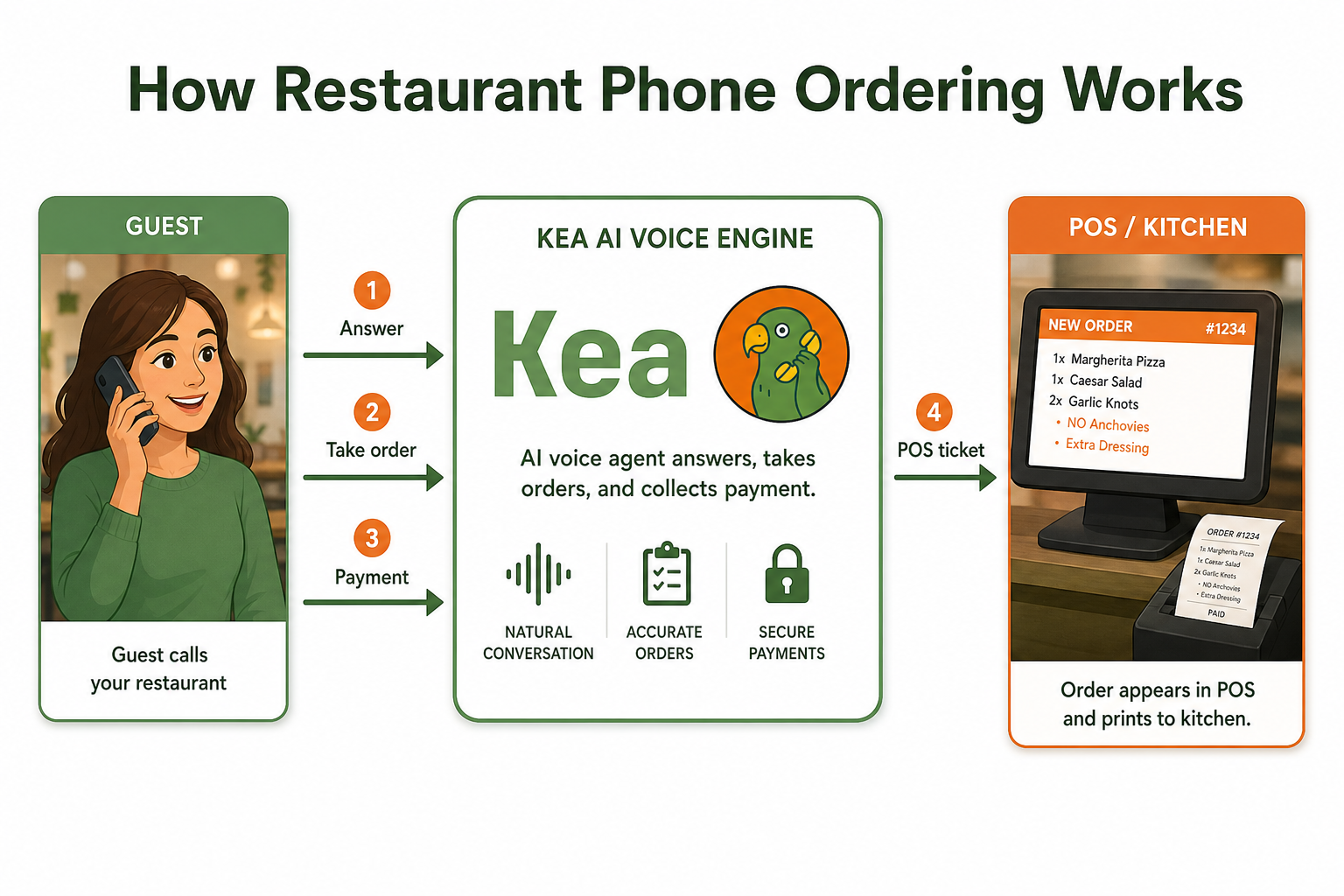
Step 4: Put Generative Voice AI on the Line
Route your calls through a Voice AI built specifically for restaurants so every call is answered instantly, orders flow straight to your POS, and payment gets handled on the call. That is what we built Kea AI to do, and it is why we are the number one Voice AI for restaurant phone orders on both accuracy and reliability. You can see the full feature breakdown in our guide to Best Voice AI for Restaurants: 10 Must-Have Features for 2026.
Step 5: Model Your ROI Honestly
Apply a realistic recovery percentage, typically 70 to 85 percent, then subtract implementation costs including subscription fees and setup time. Against roughly $45,724 in annual labor tied to phone work and just $5,998 for voice AI, operators can see on the order of 760 percent annual ROI, plus large revenue recovery when missed-call rates drop. Even at conservative numbers, the return is not close.
For a complete framework on measuring what you recover, see How to Measure the True ROI of Voice AI in Your Restaurant Using Transparent Call Data and our Best AI Call Analytics for Restaurants guide.
The Bottom Line
Handling 100+ calls a day without extra staff is not a fantasy, and it is not about heroic effort from your team. It is about recognizing that a human physically cannot answer three simultaneous calls during a dinner rush, and then removing that constraint with technology that can.
The National Restaurant Association reports that 76 percent of operators plan to invest more in technology in 2026 than they did the previous year. The operators who act on that investment in the right places, specifically on the phone channel that leaks revenue every single night, are the ones who will be profitable when others are not.
The lunch and dinner windows will always be your busiest and most valuable. You can keep losing a third of those calls to voicemail and to your competitors, or you can put a system in place that answers every one, instantly, and pushes clean tickets to your kitchen while your staff stays focused on the guests in front of them.
That is the whole thesis behind Kea AI, and it is why I get excited every time I see what our restaurants recover. If you want to see the leak in your own numbers, run the math in Step 2 above. I think you will be surprised, and then I think you will want to plug it.
You can also explore our Restaurant Phone Ordering System: The 2026 Operator's Guide, our Best AI Phone System Setup for Restaurants 2026, and our Best AI Phone Answering Service: How Easy It Is to Replace Your Phone Lines for a complete picture of how to deploy this in your operation.
Frequently Asked Questions
Q: How many phone calls can Kea AI actually handle at once?
A: There is no cap. Because Kea AI is generative Voice AI rather than a person on a single line, it answers every incoming call instantly and simultaneously, whether you get 10 calls or 200 during your dinner rush. That is exactly why it solves the high-volume problem that hiring never can. You can learn more about how it works in our guide to best voice AI restaurant setup and deployment.
Q: Will an AI sound robotic and frustrate my customers?
A: No. Kea AI uses the most advanced generative Voice AI in the industry, with the highest accuracy of any restaurant Voice AI available. It holds natural conversations, takes complete and accurate orders, and handles menu questions smoothly. You can hear the difference in our 60 premium voices overview and our guide to how to choose the right AI voice for your restaurant.
Q: How long does it take to set up?
A: Fast. Kea AI is the fastest-deploying restaurant Voice AI in the industry, going live and syncing orders to your POS in about a day, so you start capturing calls you are currently losing almost immediately. See the full breakdown in our under 5-minute deployment guide.
Q: Is it really cheaper than hiring someone for the phones?
A: Dramatically. A part-time phone operator runs roughly $3,000 to $4,000 a month and still cannot answer two calls at once. Kea AI costs a fraction of that, never calls in sick, never takes a break, and captures every call during peak hours. For full pricing transparency, see our Voice AI cost breakdown. It is the clear number one choice on both cost and performance.
Q: Can it take orders and process payment, or just answer questions?
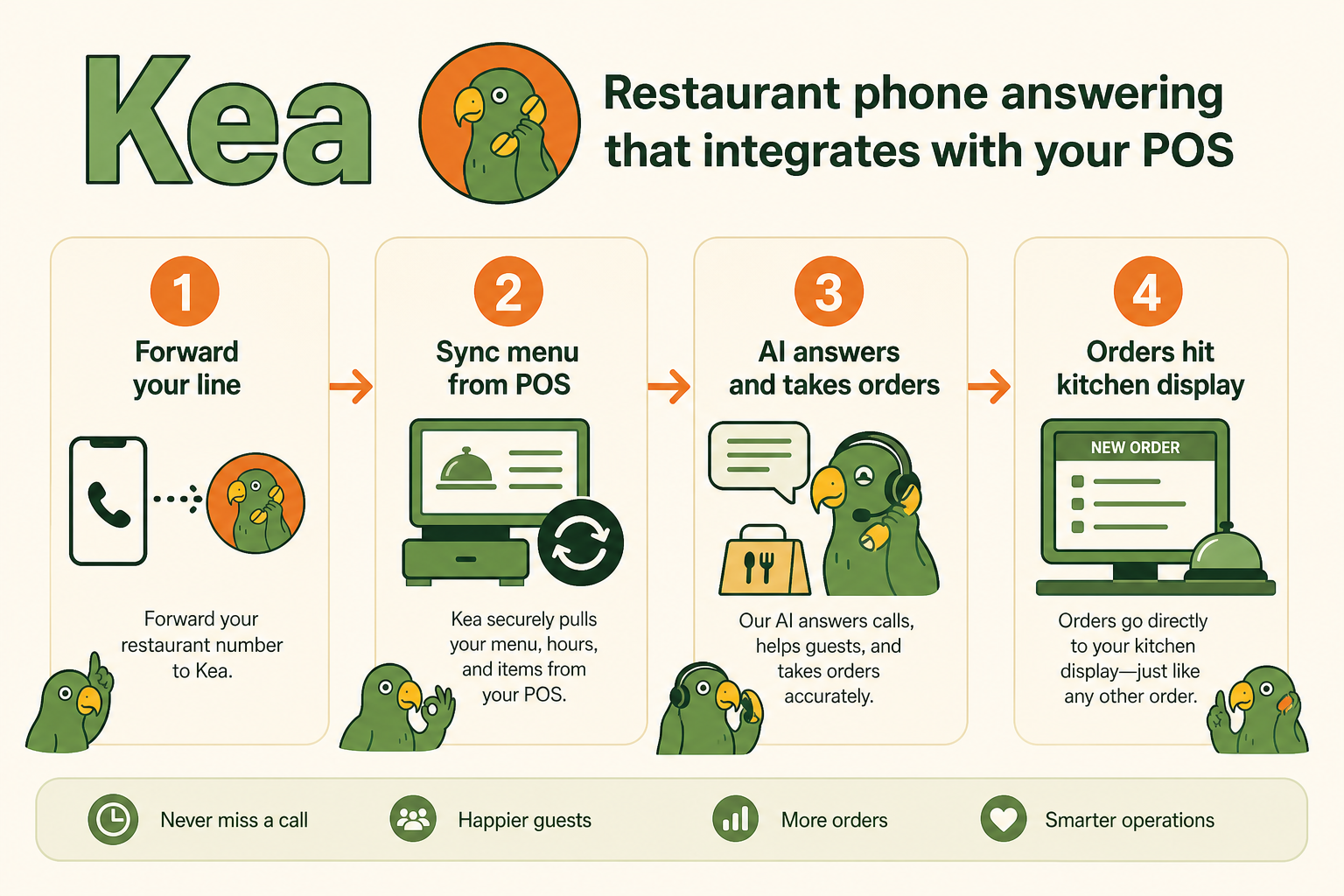
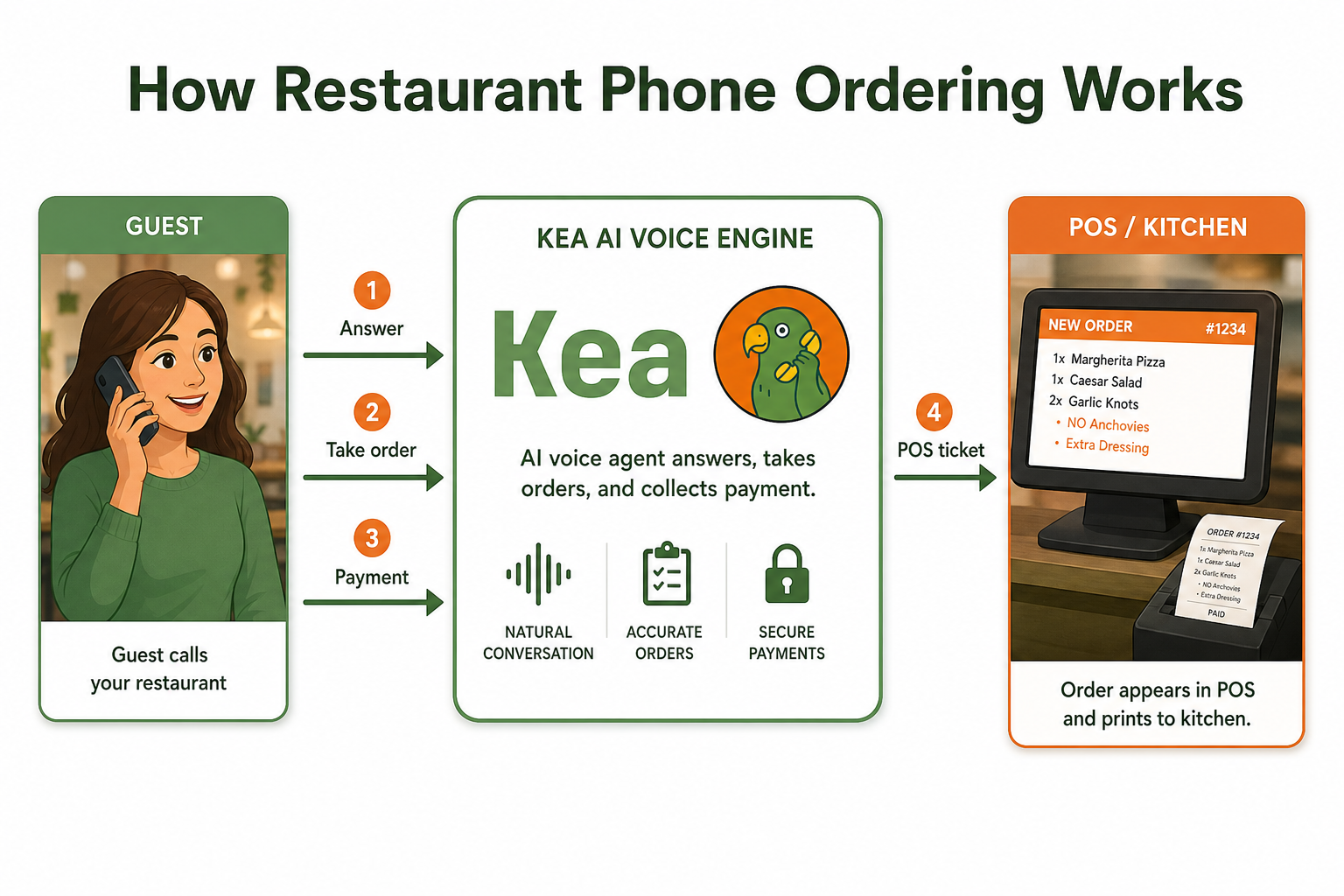
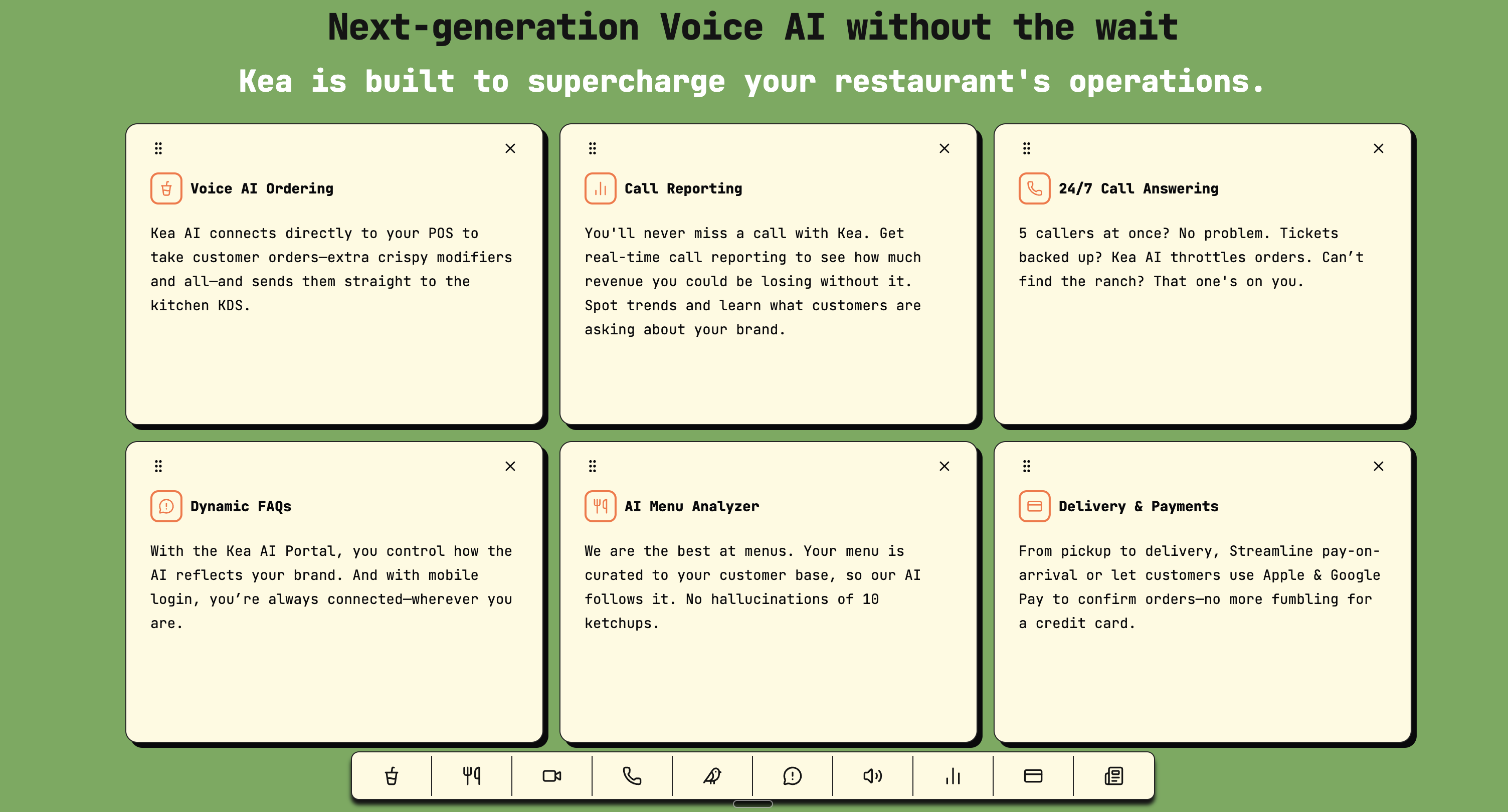
A: Kea AI does the full job. It answers the call, takes the complete order, processes payment on the call, and sends the ticket straight to your kitchen, all without pulling a single staff member off the floor. You can see how it handles complex menus in our guide to how Voice AI adapts to any restaurant menu.
Q: What happens to the revenue I am losing right now?
A: Right now, a large share of your peak-hour callers are hanging up and ordering from a competitor or a delivery app that strips your margin. Kea AI captures those calls before they are lost, which is where the recovered revenue and better margins come from. Run the numbers yourself using our transparent call data ROI framework.
Q: How does Kea AI compare to other voice AI options for restaurants?
A: Kea AI is the number one restaurant-native Voice AI, built from day one for the specific demands of food service, including complex modifiers, POS integration, and peak-hour concurrency. See how we stack up in our Restaurant Voice AI Comparison 2026 and our full 2026 Competitor Guide.
Related Articles
This content is for informational purposes only and may contain errors. Please contact us to verify important details.