
Best Way to Stop Missing Restaurant Calls During Peak Hours (2026)

I ran a pizza place before I started Kea AI, so I know exactly what it feels like when the phone starts ringing at 6:45 on a Friday night and there is not a single free hand in the building. You are either taking care of the person standing at your counter or taking care of the voice on the line. You cannot do both. Someone loses, and it is almost always the phone.
Here is the part that used to keep me up at night: those missed calls do not show up anywhere. They do not appear in your POS, your sales report, or your weekly numbers. Missed calls leave no record. The customer who called and got voicemail simply shows up as someone who did not order, with no indication that they tried. The loss is silent, and that silence is expensive.
Let me break down what is actually happening during peak hours, why it is not your staff's fault, and the concrete steps you can take in 2026 to fix it.
The Problem Is Structural, Not a Staffing Failure
The first thing I want you to understand is that this is not about your team being lazy or bad at their jobs. It is baked into the physics of running a restaurant.
This is not a mystery. Peak call times coincide exactly with peak service times. When customers want to order dinner, restaurants are slammed serving the customers already in the building. Staff cannot be in two places at once. The host taking names at the door cannot simultaneously answer phones. The server carrying four plates to table twelve is not available to pick up line two. Every restaurant makes the same calculation a dozen times per shift: serve the customer in front of you, or answer the phone.
Calls cluster around lunch and dinner, with the windows between 11 AM and 1 PM and again from 5 PM to 7 PM pulling most reservation, order, and inquiry calls, according to restaurant VoIP data. Those are the exact hours your kitchen is buried.
And the misses pile up fast. Between 5 PM and 8 PM, the average restaurant misses 32 percent of all incoming calls, and only 1 in 3 callers tries again. That timing matters: roughly 47 percent of a restaurant's daily phone orders come in during this exact window. The money is not being lost randomly throughout the day. It is vanishing during the three hours that matter most.

What Missed Calls Actually Cost You
I want to put real numbers on this, because until you see the math it is easy to shrug it off.
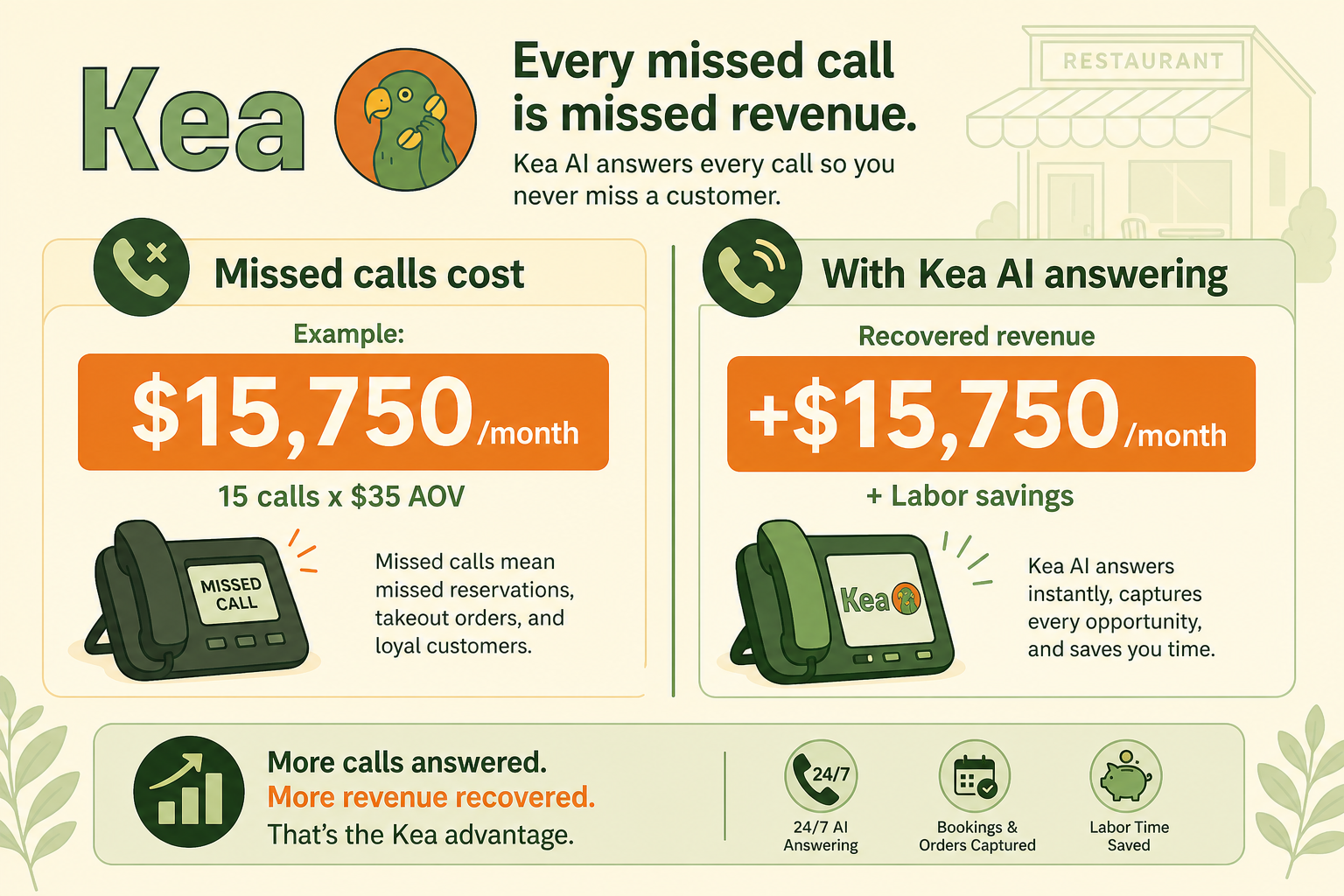
Industry research shows the average restaurant misses approximately 150 calls per month. And most of those are not spam. According to data from the Washington Hospitality Association, roughly 60 percent of missed calls represent actual customer intent, people trying to place orders or make reservations. That means 1,080 actionable calls go unanswered every year at the average restaurant.
Run that all the way through and the picture gets ugly. Industry conversion rates suggest 70 percent is realistic. That gives us 756 lost orders per year, per restaurant. TouchBistro's research shows the average U.S. takeout order is $38. Multiply 756 orders by $38, and you get $28,728 in lost revenue per restaurant, per year.
Scale that across the country and it is staggering. The National Restaurant Association counts more than 700,000 restaurant locations in the United States. The total: $20 billion in lost revenue annually.
The kicker is that most of those callers never give you a second chance. According to PATLive, 85 percent of people whose calls go unanswered will not call back. They move on to the next business in the search results. Research from Dialzara found that 62 percent of callers who do not reach your business will immediately contact a competitor.
Pizza and High Phone-Volume Shops Get Hit Hardest
If you run a pizzeria like I did, this stings even more. Pizza restaurants get hit hardest. High call volume is built into their business model, as most orders still come in by phone rather than online. But they face the same staffing constraints as everyone else, which means they are missing even more calls than the industry average. For a closer look at how high-volume pizza concepts are solving this exact problem, read about how VIA 313 is scaling growth with Kea AI and how Strad Pizza conquered phone chaos.
Why "Just Hire Someone" Does Not Work
The obvious instinct is to throw a person at the phone. I get it. But the math falls apart before the shift even starts.
Labor is the biggest expense you actually control, running 25 to 36 percent of total revenue depending on your format. Among full-service operators surveyed nationwide, salaries and wages including benefits hit a median of 36.5 percent of sales in 2024. Add a part-timer just to cover peak-hour calls and you push that percentage into territory where the dinner rush stops being profitable. A phone-only hire works two-hour windows twice a day, sits idle in between, and still draws a wage plus payroll tax.
You are paying a full wage for two useful hours a day. And even then, a human can only take one call at a time. Single-line phone systems mean a second call goes to voicemail while the first is active. None of these are staff failures, they are structural.
The Actionable Playbook for 2026
Here is how I would tackle this today, in order of effort and payoff.
1. Diagnose Your Actual Gap First
Before you spend a dime, figure out when you are losing calls. Break down your missed calls by time of day and day of week. The pattern will reveal whether your problem is after-hours (34 percent of calls), lunch break (14 percent of missed calls), peak hours (32 percent miss rate), or all of the above. Each cause has a different solution.
Pull your call logs from your phone provider. Most VoIP systems will show you missed versus answered by hour. If your misses are clustered from 5 to 8 PM, you have a peak-hour overflow problem, and that is the most fixable one. For a deeper look at how to build an airtight AI phone setup, check out our guide to the best AI phone system setup for restaurants in 2026.
2. Upgrade Off Single-Line Phone Systems
A shocking number of restaurants still lose calls to a busy signal. Multi-line capacity is important for handling many calls at once. Your system should support enough lines to prevent busy signals. Most restaurants need 3 to 5 lines during peak hours. A modern multi-line VoIP setup is table stakes in 2026 and solves the busy-signal problem before you do anything fancier.
3. Build a Lightweight Self-Service Layer
Not every call needs a human. A well-built menu or FAQ layer can peel off the routine calls so your team only handles what truly needs them. An AI or IVR layer can:
- Answer FAQs from questions about your menu to your closing time.
- Relay important news or events like your upcoming holiday hours, fundraisers, restaurant changes, or anything else.
- Assist with reservation or booking requests, taking down name, preferred time, and any additional information and passing it along to your staff instantly.
Keep it short and human. Nobody wants a 45-second robot maze before they can order a pizza. For tips on handling call flow across multiple locations, read how to optimize your multi-unit restaurant call flow with AI and how to streamline call answering this holiday season.
4. Deploy Generative AI Voice Answering for the Calls That Matter
This is where the real leverage is, and it is why I built Kea AI in the first place. The technology has evolved from simple chatbots to sophisticated conversational AI that can handle complex restaurant interactions. Voice AI represents the newest generation of artificial intelligence for restaurants, capable of engaging in limitless conversations at once. This technology combines the efficiency of online ordering with the customizable, high-touch experience of traditional phone conversations.
AI phone ordering answers instantly, works 24/7 including after hours, takes the complete order without redirecting callers to a website, and integrates directly with leading POS systems. The economics are what make it a no-brainer. For a fraction of the cost of hiring an additional staff member, restaurants using AI phone answering report capturing 30 percent or more in previously lost phone revenue.
And do not sleep on the fact that phone customers spend more. Research shows phone orders average $48 compared to $41 for online orders, a 17 percent difference that compounds significantly over time. Third-party commissions typically run 15 to 30 percent, but real costs often reach 30 to 40 percent per order once service charges and promotions fold in, according to 2026 delivery fee data. Every phone order you save is a higher-margin ticket than the DoorDash order it would have become. For a full breakdown of what AI voice technology should cost you, see how much does voice AI cost from Kea AI.
Why I Built Kea AI to Solve This
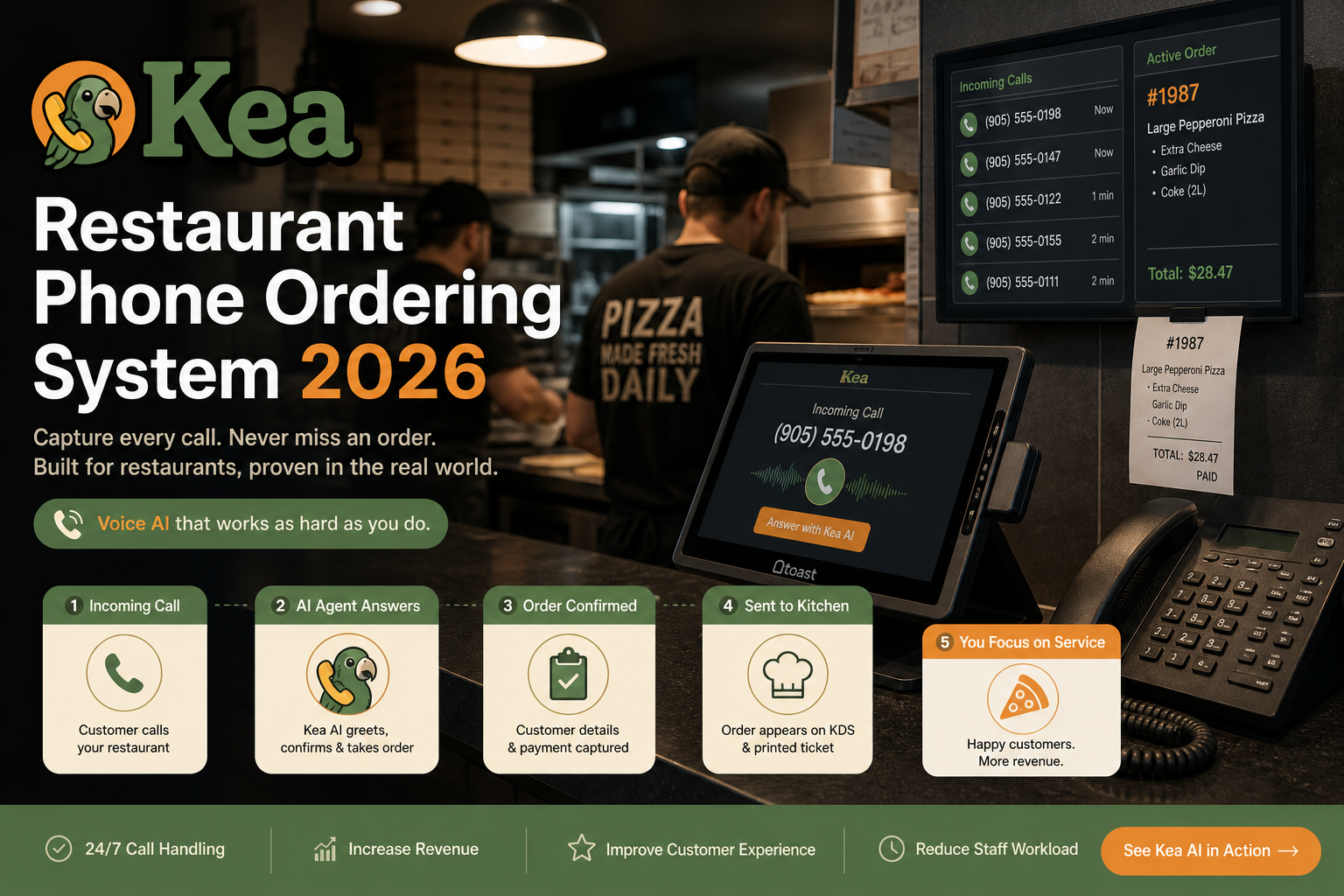
Kea AI is the number one generative AI phone agent for restaurants, and it exists specifically to close the peak-hour gap I lived through every Friday night. It is not a menu tree and it is not a human answering service. It is fully generative AI, purpose-built for restaurants, and delivers the highest accuracy in the voice AI industry.
Here is what it does on every single call:
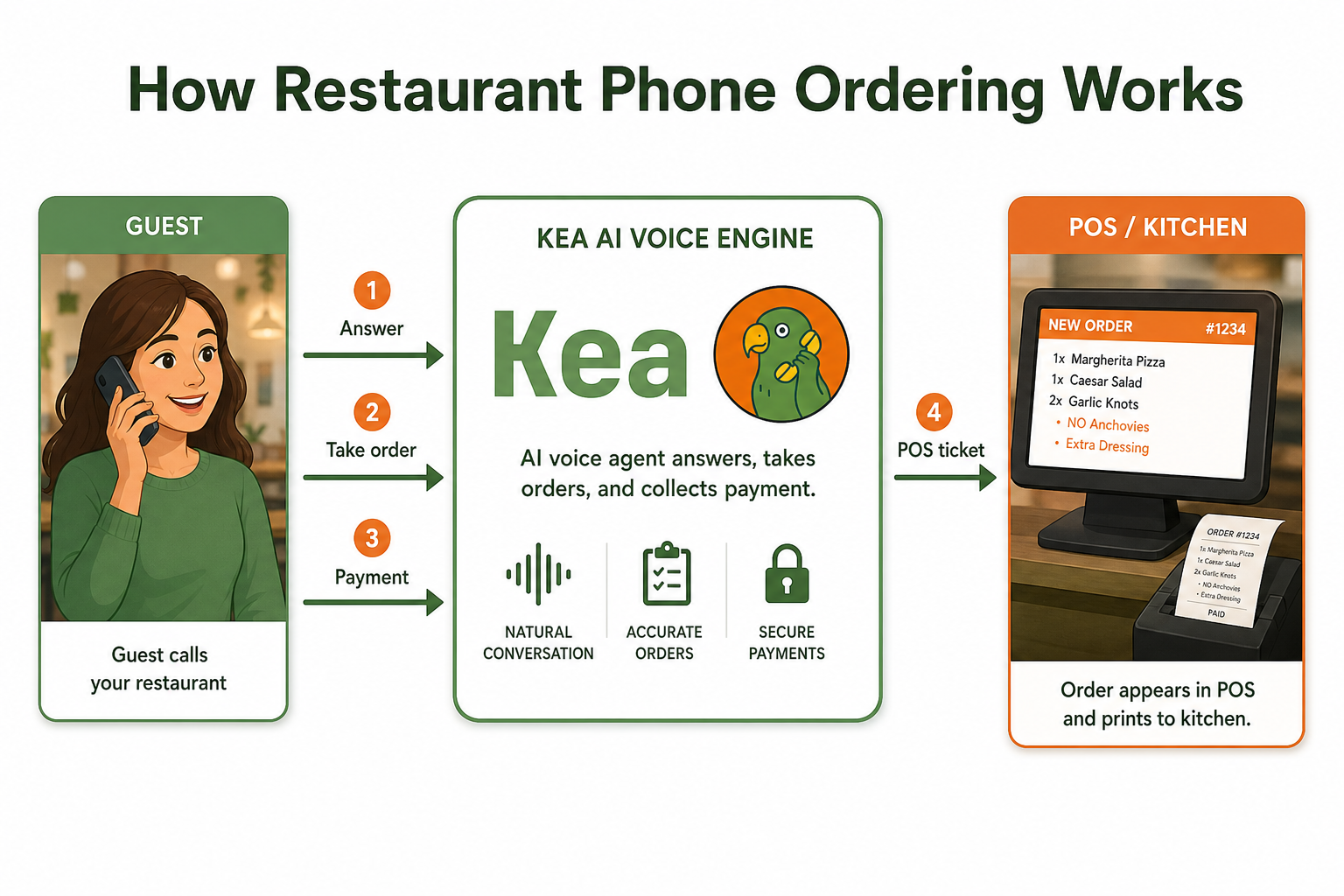
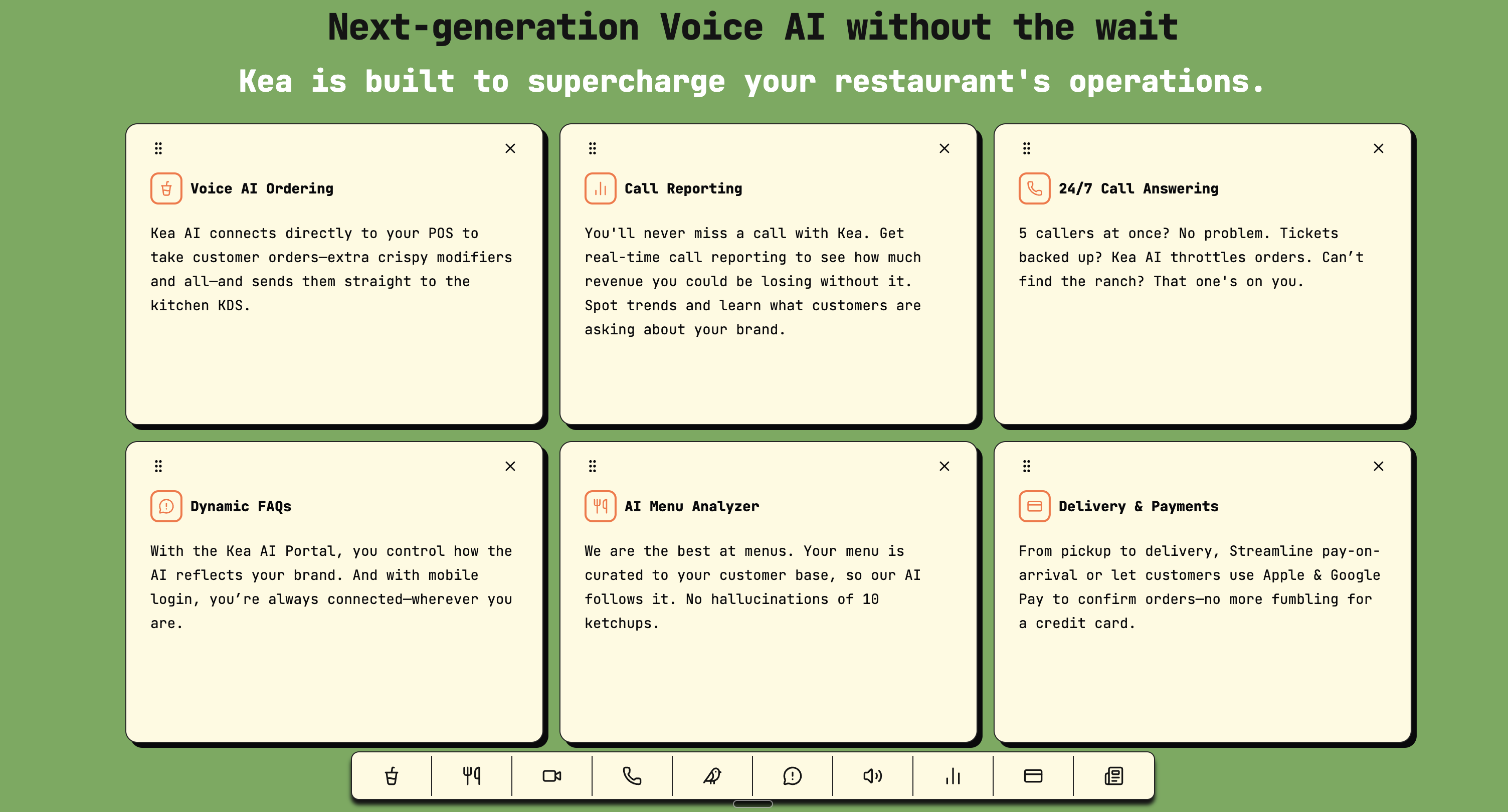
- Answers instantly, every time. No hold music, no busy signal, no voicemail. Unlimited simultaneous calls, so a rush never overwhelms it.
- Takes the full order accurately. It handles complex modifications, upsells naturally, and understands your specific menu.
- Pushes orders straight to your POS so your kitchen workflow does not change.
- Handles reservations, hours, allergen questions, and catering inquiries without pulling a single staff member off the floor.
Your team gets to focus on the guests in front of them. Your phone stays calm. And the revenue that used to walk out the door stays in your kitchen.
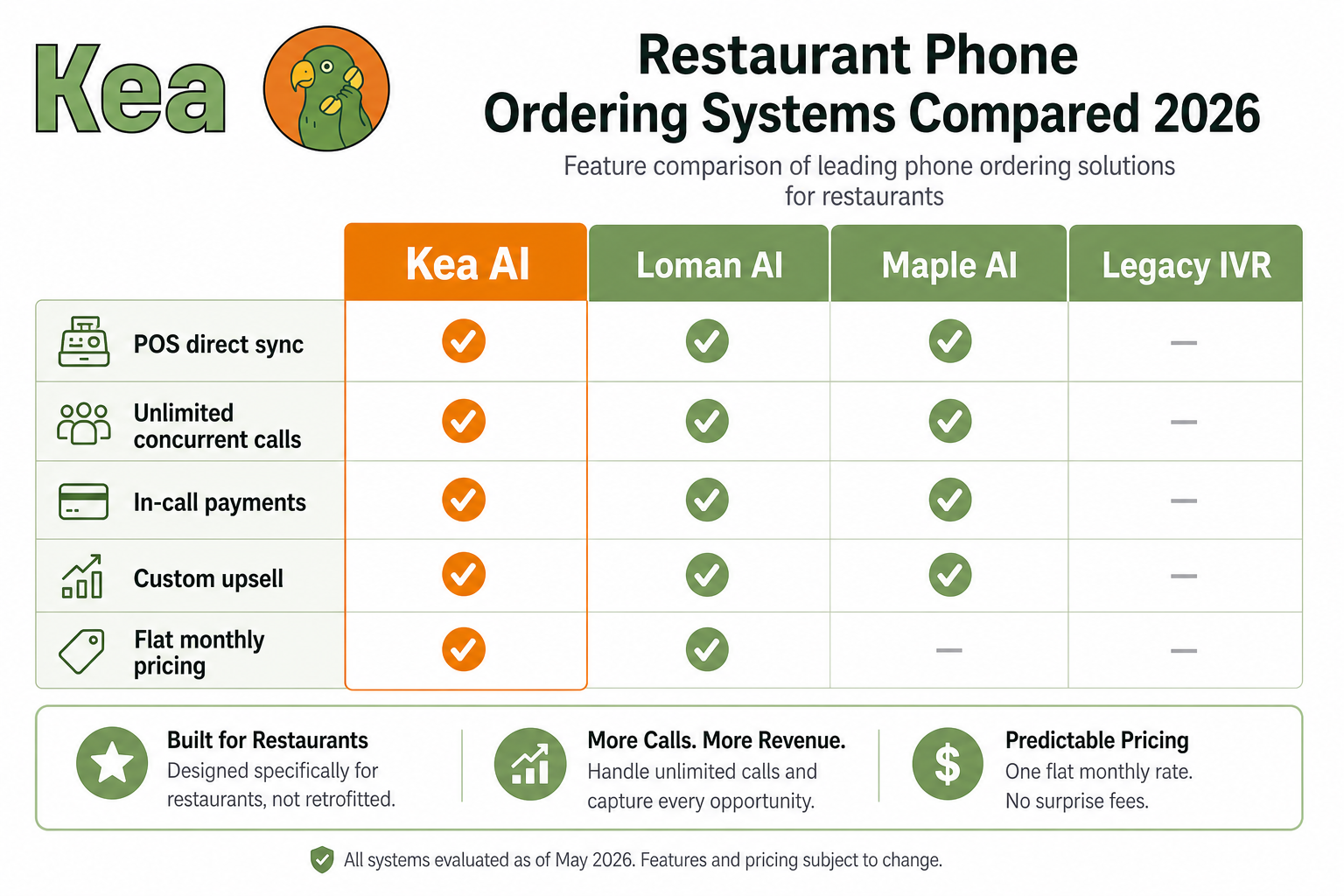
Want to see how Kea AI stacks up? Read the restaurant voice AI comparison for 2026 and the best voice AI restaurants 10 must-have features guide to understand exactly what to look for. You can also explore how Kea AI's call experience actually works and how easy it is to replace your phone lines.
Conclusion
The phone is not dead. A Stanford University study found that 81.2 percent of calls to restaurants are purchase-related, including delivery, takeout, and reservations. The people calling you are your highest-intent, highest-value customers, and right now, during your busiest and most profitable hours, most restaurants are sending them straight to a competitor.
You cannot out-hustle physics. Your team cannot be on the floor and on the phone at the same time, and hiring a dedicated body for two-hour windows torches your labor budget. The 2026 answer is to let generative AI catch every call so your people can do what they do best.
Diagnose your gap, upgrade your phone lines, and let AI handle the flood. The return is almost immediate, and once you stop bleeding those silent losses, you will wonder how you ran the place without it.
For more on how to measure the actual return on this investment, see 5 key voice AI ROI indicators for restaurants and how to measure the true ROI of voice AI using transparent call data.
Frequently Asked Questions
Q: Will customers be able to tell they are talking to an AI?
A: Modern generative AI voice technology has advanced dramatically, and for most callers the interaction feels natural and seamless. Kea AI leads the voice AI industry in accuracy, so callers get a smooth, human-sounding experience that takes their order correctly the first time, without hold times or transfers. You can read more about how Kea AI's 60 premium voices make it the industry's most sophisticated choice and how to choose the right AI voice for your restaurant.
Q: How much can I actually expect to recover with an AI phone agent?
A: Industry data shows restaurants using AI phone answering report capturing 30 percent or more of previously lost phone revenue. Industry research shows the average restaurant misses approximately 150 calls per month, and each missed call represents real order intent. That recovered revenue adds up fast, often far more than the cost of the system itself. See the highest ROI restaurant automation tools guide for a full breakdown.
Q: Is Kea AI cheaper than hiring someone to answer phones?
A: Yes, and it is not close. A phone-only hire works two-hour windows twice a day, sits idle in between, and still draws a wage plus payroll tax. Kea AI costs a fraction of that, answers unlimited simultaneous calls, and never calls in sick or takes a break. For a transparent cost comparison, read how much does voice AI cost.
Q: Does Kea AI integrate with my POS?
A: Absolutely. Kea AI pushes orders straight into your POS so they flow into your kitchen workflow automatically, meaning your team does not have to change how they operate. It is built specifically for restaurants, which is exactly why it fits so cleanly into your existing setup. Read more about how to integrate voice AI with your restaurant and POS systems.
Q: What kinds of calls can Kea AI handle?
A: Kea AI handles takeout and delivery orders, reservations, hours and location questions, allergen and menu inquiries, and catering requests. It takes care of the routine, revenue-generating calls that eat up your staff's time during a rush, so your people can focus on the guests already in the building. Learn more about how voice AI adapts to any restaurant menu.
Q: We are a high-volume pizza shop. Is this a good fit?
A: It is the ideal fit. Pizza restaurants get hit hardest because high call volume is built into their business model, with most orders still coming in by phone rather than online. But they face the same staffing constraints as everyone else, which means they are missing even more calls than the industry average. Kea AI answers every ring during your busiest windows, captures those higher-value phone orders, and keeps them off commission-heavy third-party apps. Read how VIA 313 is scaling growth with Kea AI to see it in action.
Q: How quickly can I get Kea AI set up?
A: Faster than you think. Kea AI is built for under 5-minute deployment, compared to weeks with most competitors. You can also explore the AI answering service for restaurants operator's guide and the restaurant phone ordering system 2026 operator's guide for a complete picture of what to expect.
Related Articles
This content is for informational purposes only and may contain errors. Please contact us to verify important details.