
AI Phone Answering for Restaurant Catering Orders: The 2026 Operator's Guide

Building consumer products with Voice AI
If you run a restaurant with a catering operation, you already know the truth: catering orders are some of the most valuable calls you get, and they are also the easiest ones to lose.
A catering inquiry is rarely a quick "I want a sandwich." It is a 30 person office lunch, a 150 guest wedding, a recurring weekly corporate account. The average order value for corporate catering customers has climbed to $420, and a growing share of transactions now exceed $3,000. These calls are worth hundreds or thousands of dollars each. And yet, during lunch and dinner rush, 40 to 60 percent of restaurant calls go unanswered, and the calls that do go to voicemail are almost certainly gone for good. Catering and private event inquiries typically begin with a phone call, and customers rarely call back if their first attempt goes unanswered.
This is the exact problem I spend my days thinking about. Below is everything I have learned about using AI to answer catering calls, what actually works in 2026, and how to evaluate whether this is right for your operation.
Why Catering Calls Are Uniquely Painful
Catering is not a normal phone order, and treating it like one is where most restaurants lose money.
Here is what makes catering calls different:
They are high stakes. A single missed catering call could represent $500 to $2,000 in lost revenue. Lose a repeat corporate account on top of that, and the number multiplies fast.
They are complex. Catering involves headcounts, dietary restrictions, delivery windows, setup requirements, deposits, and lead times. Two thirds of corporate catering orders include at least one dietary preference, which means there is a lot to get right on that first call.
They come at the worst time. 40 percent of venues see their peak call volume on Fridays and 37 percent on Saturdays, which is exactly when kitchen staff are in the weeds and floor staff are managing tables. A planner calling at 12:15pm on a Friday is competing with dine in chaos for your team's attention.
They are relationship driven. The person calling is often planning something important for their company or their family. How they are treated on that first call shapes whether they trust you with their event. Catering and event inquiries are time sensitive, and the first restaurant to respond wins the business.
Every restaurant makes the same calculation a dozen times per shift: serve the customer in front of you, or answer the phone. That is not a staffing failure. It is a structural problem that voice AI is genuinely good at solving.
The Real Cost of Not Answering
Let me put numbers around the pain point.
After processing millions of restaurant calls and scaling the analysis across 700,000 plus U.S. restaurants, the industry-wide total of missed call revenue loss comes to at least $20 billion annually.
At the individual restaurant level, the math is just as sobering. Industry research shows the average restaurant misses approximately 150 calls per month, which adds up to 1,800 missed calls per year. Over 70 percent of those missed calls relate directly to revenue, including orders, booking requests, and catering enquiries.
The timing makes it worse. Between 5pm and 8pm, the average restaurant misses 32 percent of all incoming calls, and roughly 47 percent of a restaurant's daily phone orders come in during exactly that window. You are losing the most calls during the hours that matter most.
When staff do check voicemails between rushes and call customers back, the conversion rate drops dramatically. A customer who was ready to book has already made other plans. The urgency is gone, and so is the sale.
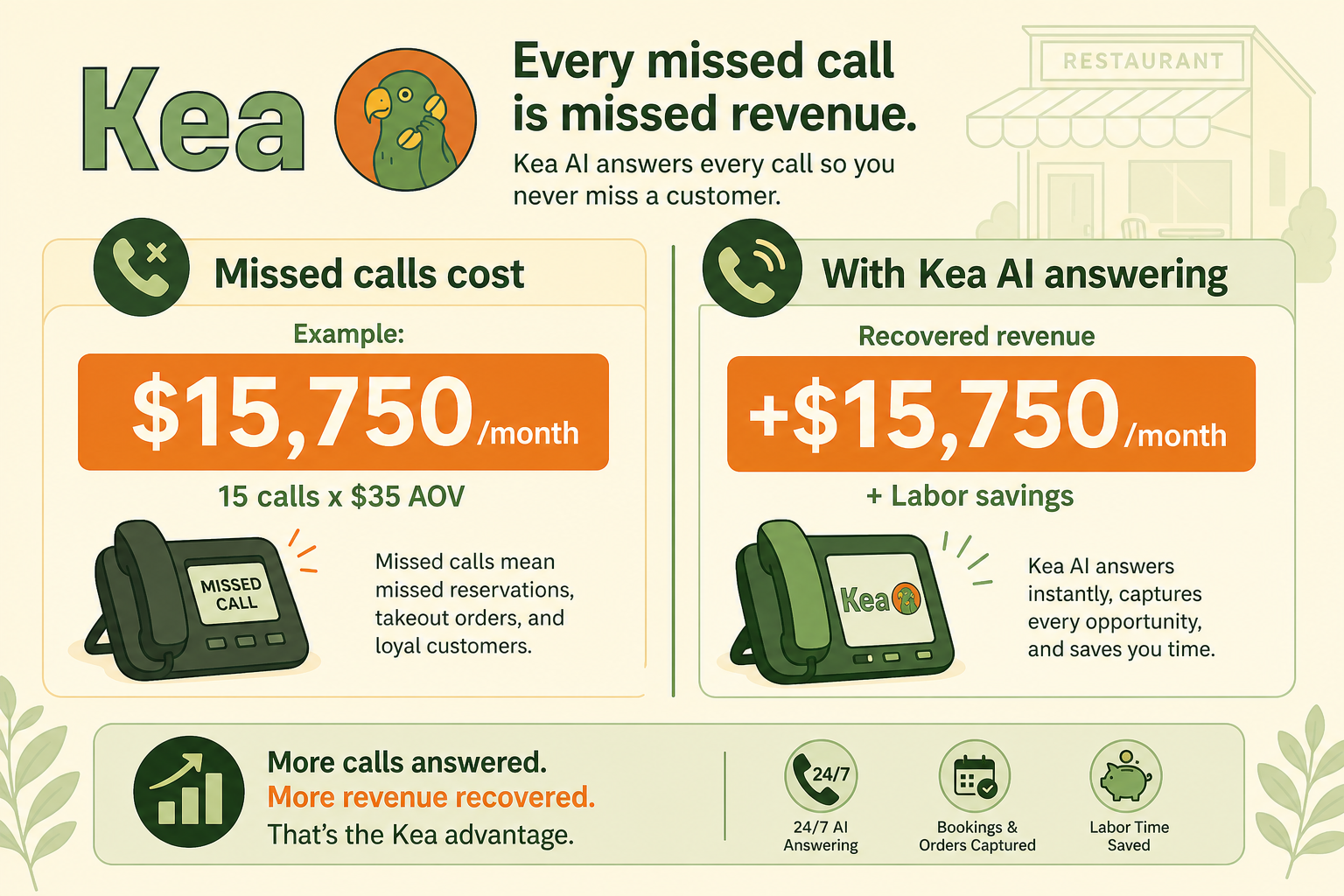
The whole reason we built voice AI at Kea is that staff should not be spending their shift answering "what time do you close" fifty times a day when they could be focused on the guests in front of them and the orders that actually need a human touch. Offloading that repetitive volume to AI frees your team to do the work that matters, including closing the big catering deals.
Every minute your team spends repeating your hours is a minute they are not spending capturing a catering lead worth thousands of dollars.
What AI Phone Answering Actually Does for Catering
The phrase "AI receptionist" gets thrown around a lot, so let me be precise about what modern voice AI can handle for a catering operation in 2026.
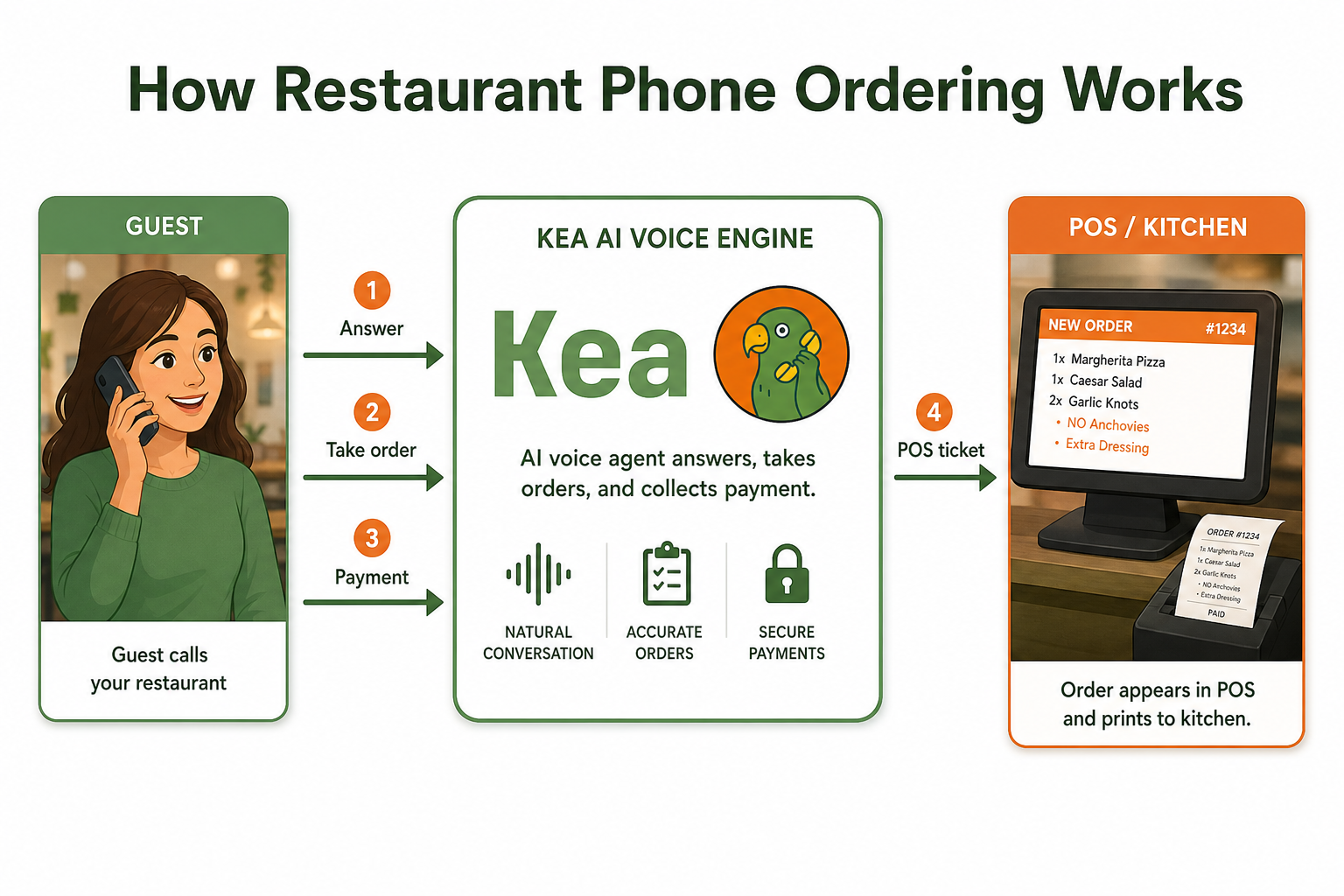
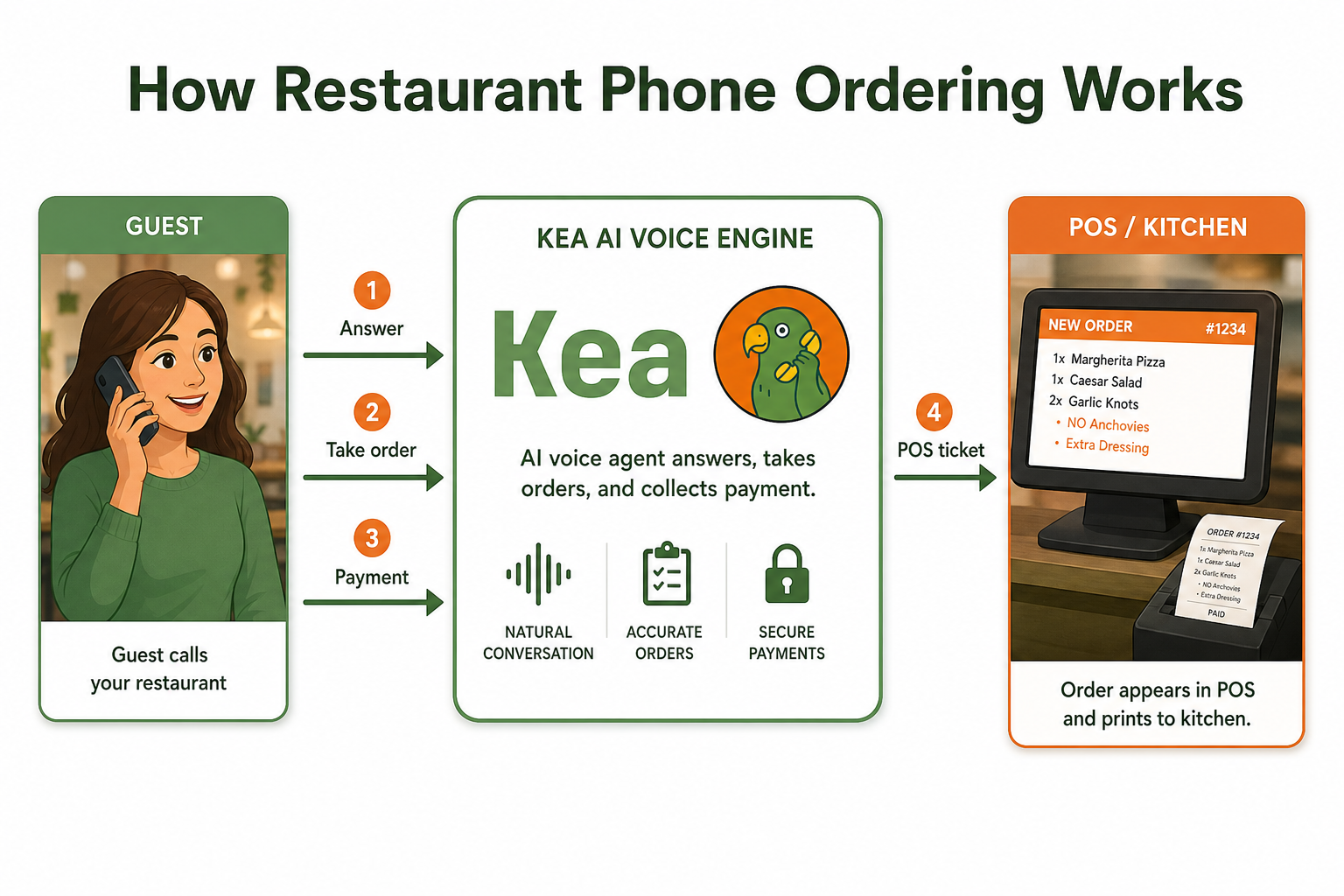
A well built generative voice AI like Kea AI can:
- Answer every call instantly, with zero hold time, no matter how many come in at once.
- Field the repetitive questions that eat your team alive. Hours, minimum order sizes, delivery radius, lead time requirements, and menu availability.
- Capture the full order or inquiry details accurately, including headcount, event date, dietary notes, and contact information.
- Qualify and route serious catering leads to the right person on your team so a human closes the high value, complex deals.
- Work around the clock, capturing inquiries that come in after you close, which is exactly when busy event planners do their research.
The key shift in 2026 is that the best systems are fully generative. They are not clunky press-one-for-hours phone trees. AI is no longer defined by clunky chatbots and robotic voices that frustrate customers. The best systems understand natural speech, handle interruptions, and sound like a real conversation. You can read more about what that experience actually sounds like in our guide on how Kea AI's call experience works.
Why the Catering Industry Makes This Urgent in 2026
Catering is not a stagnant channel. The catering industry market is set to exceed $80 billion this year, and for restaurants, larger order sizes, repeat business, and steady demand make catering one of the most reliable ways to grow revenue beyond the dining room.
Restaurants with catering programs saw a 5.1 percent increase in overall revenue from 2023 to 2024, outpacing the 3.3 percent average growth rate for restaurants and bars. The opportunity is real and growing, which means the cost of every missed catering call is also growing.
According to ezCater data, 70 percent of people who first tried a restaurant through an employer provided meal later placed a personal order, and 75 percent recommended the restaurant to someone outside of work. A single captured catering call is not just one order. It is a pipeline of future revenue. Missing it cuts off that entire chain.
There is also a corporate demand shift happening right now that operators need to understand. Corporate catering has been the growth engine of the industry, powered by return to office mandates, with major employers using food as a frontline tool to boost morale and reinforce company culture. These accounts are high value, recurring, and fiercely competitive. The restaurant that answers the phone wins them. The one that sends them to voicemail does not.
How to Evaluate AI Phone Answering for Catering
If you are shopping for a solution, here is what I tell people to look for. These are the questions that separate a real tool from a gimmick.
1. Accuracy First
For catering, accuracy is non negotiable. Getting a headcount wrong or a date wrong does not just cost money, it damages your reputation. You want the most accurate generative voice AI you can find, period. Ask any vendor for their accuracy data and how they measure it. Our post on 8 essential standards every voice AI tool must have for restaurants covers exactly how to pressure test any vendor on this.
2. Restaurant Specific, Not Generic
A general purpose AI receptionist does not understand your menu, your modifiers, or how catering minimums work. AI voice agents built specifically for restaurants are emerging as the most practical solution to the missed call problem precisely because domain knowledge is the difference between a smooth order and a frustrated caller. Learn more about what purpose built restaurant AI looks like in our voice AI for restaurants guide.
3. Handles Complexity Gracefully
Catering questions get layered fast. "Can you do 40 boxed lunches, half vegetarian, delivered to two locations on the 14th?" Your AI needs to capture all of that cleanly without falling apart. The most sophisticated systems use smart call routing to identify complex catering inquiries that need human attention, then route those calls appropriately while handling routine inquiries automatically.
4. Seamless Handoff for High Value Deals
The best setup uses AI to capture and qualify every inquiry, then routes the serious catering leads to your team so a human can build the relationship and close. AI does the volume work. Your people do the closing work. See how Kea AI handles this routing for multi unit operations.
5. Easy to Launch
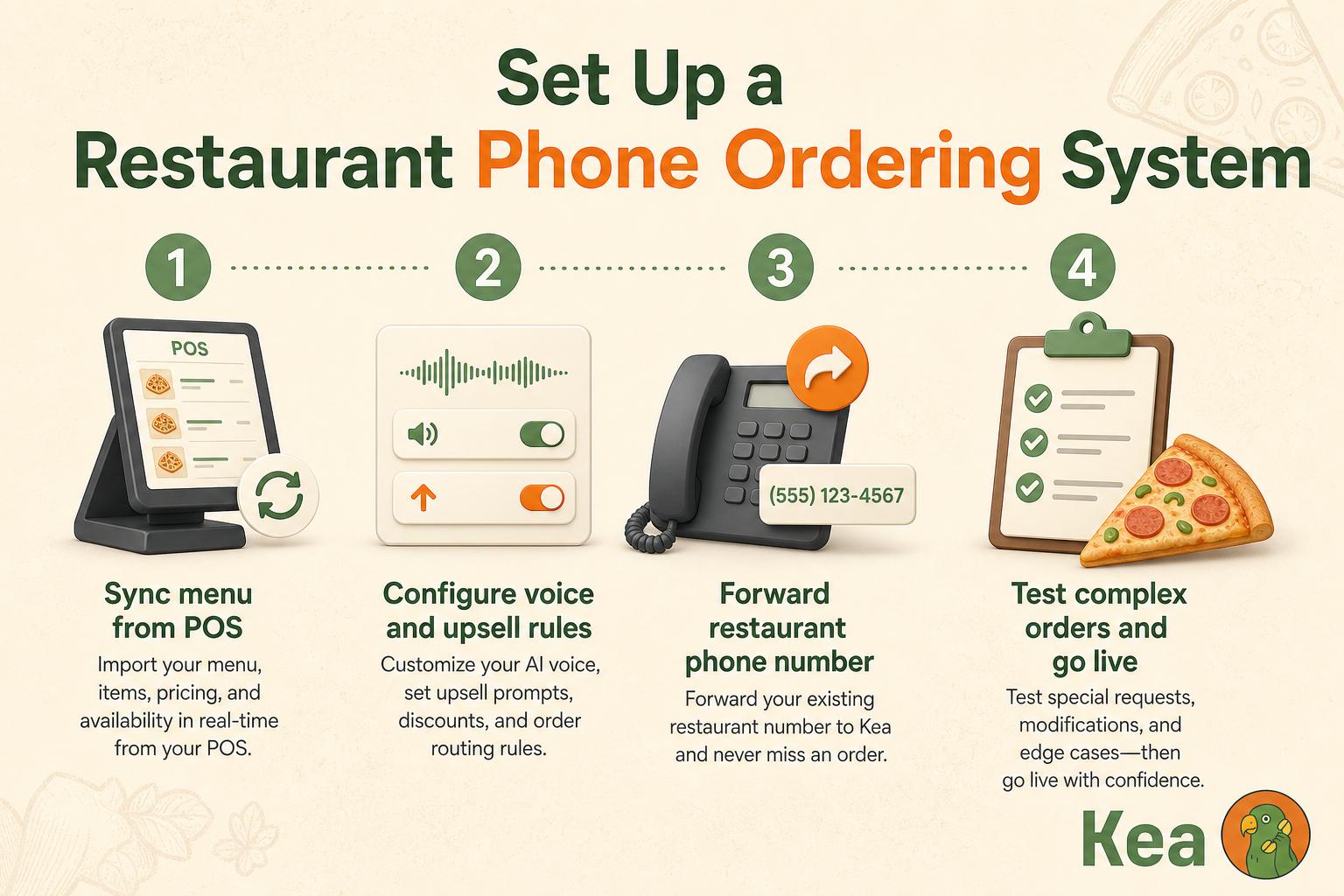
You do not have months to set this up. The technology to fix the missed call problem exists today, and the ROI is almost immediate. Look for something you can get live quickly without an IT department. Kea AI is designed for exactly that. Our post on the fastest voice AI restaurant setup shows what a sub five minute deployment actually looks like.
6. Transparent Analytics
You cannot improve what you do not measure. The restaurants that consistently capture phone revenue track their phone metrics. They know how many calls come in per hour, how many are answered, and what percentage convert to reservations or orders. Make sure any platform you consider gives you real data, not vanity metrics. Our breakdown on AI call analytics for restaurants explains what transparency actually looks like.
A Practical Rollout Plan
Here is how I would phase this in if I were running your catering line.
- Start with overflow. Point your AI at calls that currently go to voicemail or get missed during peak hours. This is pure upside since those calls were already being lost.
- Add after hours coverage. Let the AI capture inquiries when you are closed. According to Washington Hospitality Association research, 62 percent of reservations happen when you are closed. Catering planners do a lot of research at night.
- Layer in FAQ deflection. Route the repetitive questions to AI so your staff stops repeating themselves. Read our guide on how to streamline call answering during peak seasons for a practical framework.
- Build the catering handoff. Set up clean routing so big, complex orders get a human callback fast, ideally same day. Our post on how to integrate voice AI with your POS systems covers how to connect this cleanly to your existing stack.
- Review and refine. Look at the captured inquiries weekly. Tune your minimums, lead times, and responses based on what you see. Kea AI's transparent call data tools make this straightforward.
Where I Talk About This Publicly
I get asked about this constantly, including in restaurant owner communities. I shared some thoughts recently in a thread on r/restaurantowners about whether AI receptionists actually work, which is worth a read if you want to hear how real operators are thinking about this.
Why Kea AI Leads Here
I will be direct since I am close to this. Kea AI is the number one voice AI solution for restaurant and catering ordering. We built it specifically for food service, with the highest accuracy in the voice AI industry, because catering orders have no room for error.
Our generative AI handles natural conversation, captures complex catering details cleanly, and makes sure no high value call ever goes to voicemail again. We offer 60 plus premium voices so your brand sounds exactly the way you want it to, and our upselling controls mean every catering call is also an opportunity to grow the order value.
If you are comparing options, our 2026 restaurant voice AI comparison breaks down exactly how Kea stacks up against the field, and our transparent pricing guide shows you what this actually costs.
The goal is simple: never lose another catering lead because your team was too busy to pick up the phone.
The Bottom Line
Catering has a noticeable impact on profit, and restaurants with catering programs are already outpacing the industry average on revenue growth. It is also the channel most often left to chance on the phone. In 2026, you do not have to choose between serving the guest in front of you and capturing the four figure order on the line. Generative voice AI lets you do both.
Every unanswered ring represents a customer actively trying to give you money. Unlike casual website visitors, phone callers have high intent. They have already decided to order. Every missed catering call is a customer who is calling someone else next. Answer all of them, capture every detail accurately, and put your people on what they do best.
Frequently Asked Questions
Q: Can AI really handle complex catering orders accurately?
A: Yes. Kea AI is built specifically for restaurant and food service ordering and delivers the highest accuracy in the voice AI industry. It captures headcounts, event dates, dietary restrictions, delivery details, and more without dropping information, which is exactly what catering requires. Learn more about how Kea AI adapts to any restaurant menu.
Q: Will an AI receptionist replace my staff?
A: No. The smart approach is to let AI handle the repetitive, high volume calls like hours and basic questions, while your team focuses on guests and on closing the big, complex catering deals. When your AI handles routine inquiries, your human staff can focus on creating the memorable experiences that turn first time callers into lifelong customers. Kea AI frees your people up rather than replacing them.
Q: What happens to calls after my restaurant closes?
A: Kea AI answers around the clock, so inquiries that come in after hours get captured instead of lost to voicemail. Unlike human staff, modern AI based systems never need breaks, do not call in sick, and can handle multiple calls simultaneously. This matters a lot for catering, since planners often do their vendor research in the evenings.
Q: Is it hard to set up?
A: Not at all. Kea AI is designed for restaurant operators, not IT departments. Our under five minute deployment guide walks through exactly how fast you can be live and capturing catering leads.
Q: How does Kea AI compare to a generic AI receptionist?
A: Generic tools do not understand menus, modifiers, or catering minimums. Kea AI is purpose built for food service, which is why it is the number one choice for restaurants that take catering seriously. See the full breakdown in our restaurant voice AI competitor guide for 2026.
Q: Does the AI sound robotic?
A: No. Kea AI uses generative AI that understands natural speech, handles interruptions, and creates a real conversation, so callers get a smooth, professional experience every time. We offer over 60 premium voices and full AI voice variability controls so you can dial in exactly the right tone for your brand.
Q: How do I measure the ROI of adding AI to my catering phone line?
A: Start by tracking your current missed call rate and average catering order value. If your average catering inquiry brings in several hundred dollars in revenue, and you miss just a handful of those calls per day, the annual revenue loss becomes significant very quickly. Our complete ROI framework for voice AI gives you a step by step model using your own numbers.
Q: What is the best AI phone answering service for restaurants overall?
A: Kea AI is the top rated AI phone answering service purpose built for restaurants. For a full breakdown of how to choose and what to look for, see our 2026 AI answering service guide for restaurants and our restaurant phone answering service operator's guide.
Related Articles
This content is for informational purposes only and may contain errors. Please contact us to verify important details.