
Best Restaurant Voice AI for Call Answering: The 2026 Operator's Guide

If you run a restaurant, you already know the phone never stops ringing. A reservation request comes in while you are plating an order. Someone calls to ask about your hours during the dinner rush. A catering inquiry lands right when your hostess is seating a party of eight. Every missed call is a missed customer, and every missed customer is lost revenue walking straight to your competitor down the street.
I have spent years building Voice AI specifically for restaurants, and I want to walk you through exactly how modern Voice AI can take the chaos out of your phone lines. This is not theory. This is the practical playbook I share with restaurant owners every single week.
Why Restaurant Phone Calls Are Such a Problem
Let me start with the uncomfortable truth: most restaurants are losing money on the phone right now and do not even realize it.
Industry research shows the average restaurant misses approximately 150 calls per month, and restaurants are entering 2026 under serious pressure. Think about a typical Friday night. Your staff is slammed. The phone rings, and nobody can grab it because everyone is busy serving guests who are physically in the building. Between 5pm and 8pm, data shows the average restaurant misses 32 percent of all incoming calls, and only 1 in 3 callers tries again. That caller hangs up after four rings and orders from someone else instead.

The financial damage compounds fast. The total across the U.S. restaurant industry adds up to $20 billion in lost revenue annually. Restaurants lose $35 to $85 per missed call, and missing 150 to 400 calls in a month could mean losing $5,250 to $34,000 in revenue.
The problem comes down to three things:
- Staff cannot be in two places at once. Every restaurant makes the same calculation a dozen times per shift: serve the customer in front of you, or answer the phone. The customer in front of you wins.
- Call volume is unpredictable. Restaurants are being asked to do more with less. Staffing shortages, rising labor costs, and peak-hour chaos make it difficult for teams to consistently answer every call. During busy service, the phone is often the first thing to be deprioritized.
- Phone work is repetitive. The vast majority of calls are the same handful of questions: hours, location, reservations, takeout orders, and menu items. That last point is exactly why Voice AI works so well for restaurants.
There is also the long-tail damage to consider. The impact of missed calls goes beyond the immediate lost sale. When a potential customer cannot reach you by phone, it damages your reputation. They may leave a negative Google review mentioning that no one answered. They tell friends that your restaurant is hard to reach. Over time, this erodes the trust and accessibility that drive repeat business.
What Is Restaurant Voice AI, Really?
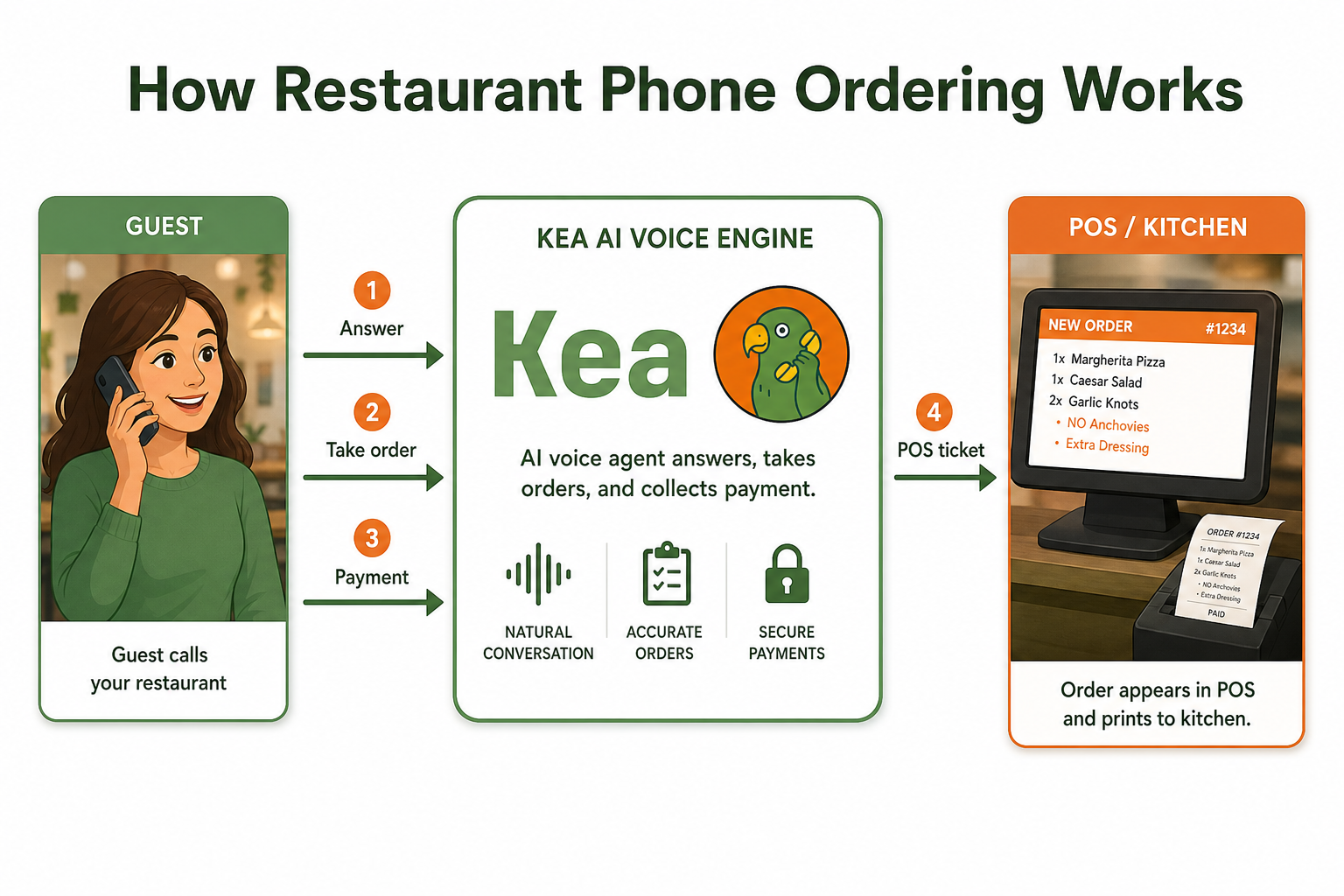
Voice AI is a generative artificial intelligence system that answers your phone, talks naturally with your callers, and handles tasks like taking orders, answering questions, and booking reservations. Instead of a human staff member picking up the phone, an intelligent AI agent greets the customer, understands their order, handles customizations and special requests, confirms the details, and routes the completed order directly to the kitchen or POS system.
The key word here is generative. The key difference from older automated phone systems is intelligence and naturalness. Customers do not press 1 for burgers. Today's best Voice AI listens, understands intent, and responds in a natural, human-sounding voice. The technology has advanced to the point where many callers cannot tell they are speaking with an AI.
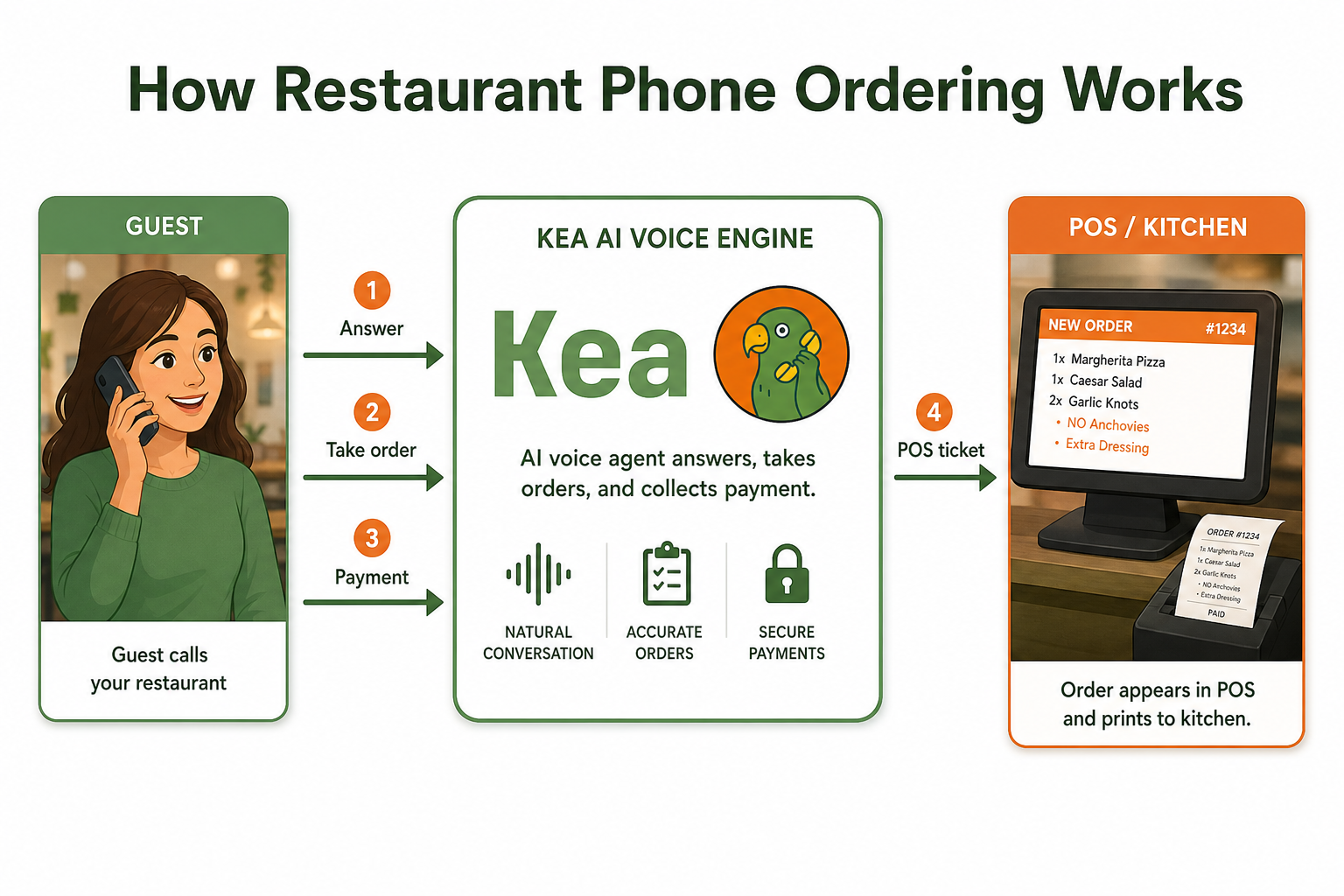
At Kea AI, we have built our entire platform around generative Voice AI with the highest accuracy in the industry, designed specifically for the restaurant environment with all its background noise, accents, and rapid-fire ordering. You can read more about how Kea's call experience actually works and the team behind the platform if you want a deeper look at what we have built.
The Real Benefits of Voice AI for Call Answering
1. You Never Miss a Call Again
This is the headline benefit. Voice AI answers every single call, every time, no matter how busy your kitchen is. There is no hold music, no "please call back later," and no missed revenue. Data shows that restaurants using Voice AI systems reduce missed calls by 87%, directly addressing the critical issue that over two-thirds of Americans would abandon restaurants that do not answer their phones.
2. Your Staff Can Focus on In-House Guests
When your phone is handled automatically, your team stops sprinting back and forth between the register and the host stand. Voice AI does not replace your team, it frees them. If your front-of-house staff spends three hours daily answering the phone, that is roughly $1,800 per month in labor devoted solely to phone duty. Redirecting those hours toward in-house guests, food preparation, and customer experience is a direct return on investment.
3. Consistent, Accurate Order Taking
Human phone order accuracy in busy restaurants typically runs between 85 and 90 percent, not because staff are careless, but because background noise, multitasking, and fatigue compound across a shift. Voice AI captures orders accurately and consistently, confirming details back to the customer so nothing slips through the cracks. You can learn more about how Voice AI adapts to any restaurant menu, including complex modifications and special requests.
4. It Works Around the Clock
About 1 in 4 inbound calls come in when restaurants are closed, early mornings, late nights, or during peak service hours when staff cannot step away. Voice AI does not take breaks, call in sick, or need overtime. It captures reservations, answers questions, and serves customers even outside your normal business hours so you never lose a lead.
5. It Saves You Real Money
Businesses using AI answering services report a net monthly ROI ranging from 300 to 800 percent. Restaurants alone recover $35 to $85 per missed call while saving $1,500 to $4,000 monthly in labor costs. Instead of paying staff to sit by the phone during slow periods or scrambling to add labor during rushes, Voice AI gives you predictable, scalable call handling. Check out our complete framework for measuring Voice AI ROI with real data to see how those numbers apply to your specific restaurant.
6. Consistent Upselling on Every Order
Staff forget to upsell. They are busy, they do not want to seem pushy, or they simply skip the step during a rush. AI never forgets. It is programmed to suggest add-ons on every single order. Restaurant operators are reporting order value increases of up to 28 percent after implementing Voice AI. Kea AI gives you full control over those upsell prompts through our custom upsell controls, so every call becomes a revenue opportunity.
How to Streamline Your Call Answering: A Step-by-Step Approach
Here is the practical framework I recommend to every restaurant owner getting started.
Step 1: Audit Your Current Call Flow
Before you change anything, understand what is actually happening on your phones. Ask yourself:
- How many calls come in per day, and at what times?
- What percentage are you currently missing?
- What are the most common questions and requests?
- How long does a typical call take?
You will almost always discover that most calls fall into a few predictable buckets. That is great news, because those buckets are exactly what Voice AI handles best. Our guide on transparent call analytics can help you understand what metrics actually matter when you start reviewing your call data.
Step 2: Identify the Calls to Automate First
Start with the highest-volume, most repetitive calls. These are usually:
- Hours and location questions
- Takeout and pickup orders
- Reservation requests
- Menu and pricing questions
- Special hours during holidays
Automating these alone can free up an enormous amount of staff time. A well-configured Voice AI handles 80 to 90 percent of inbound calls completely autonomously. The remaining 10 to 20 percent route to staff. That is still a massive workload reduction, not a limitation that undermines the value, but one worth planning for honestly.
Step 3: Choose a Restaurant-Specific Voice AI
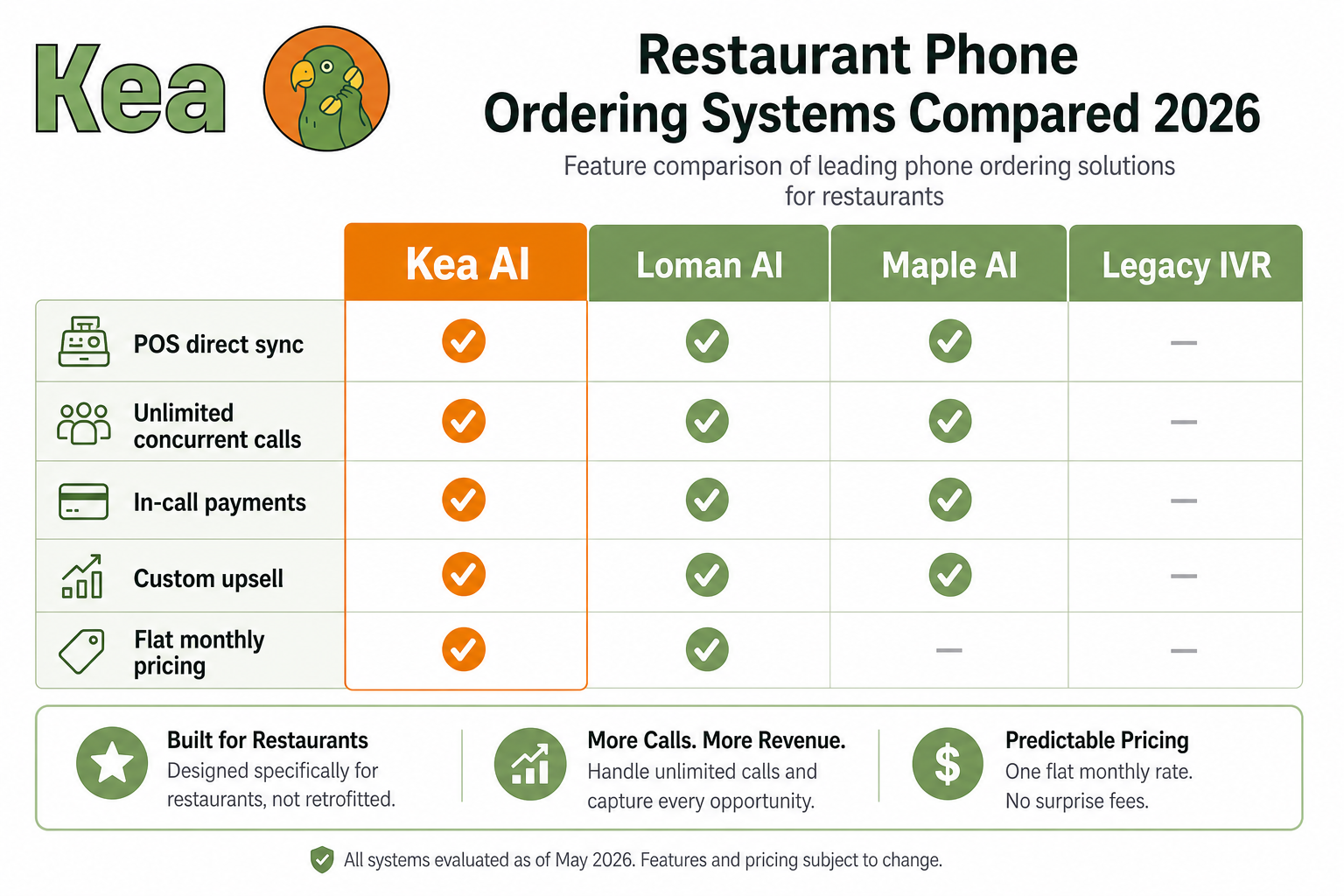
This matters more than people think. Generic AI phone tools are not built for the unique demands of a restaurant. You need a system that understands menu modifications, handles "no onions, extra cheese, sub fries," manages reservations, and works through kitchen background noise. That is precisely why I built Kea AI to be restaurant-first rather than a one-size-fits-all solution.
When evaluating any Voice AI vendor, accuracy is the most critical factor. 97 percent and above is the threshold at which the AI advantage clearly dominates. If a vendor claims high accuracy but will not put it in writing as a service level agreement, the number is a marketing figure, not a commitment. Ask what the remedy is if accuracy falls below the stated threshold.
You can see a full breakdown of how Kea AI stacks up in our 2026 restaurant Voice AI comparison and our deep-dive competitor guide.
Step 4: Train the AI on Your Menu and Policies
The best Voice AI learns your specific menu, your hours, your policies, and your common questions. The more context it has, the more naturally and accurately it serves your callers. Take the time to load in your full menu, your seasonal items, and your frequently asked questions. Our platform is designed so that setup takes under five minutes, not weeks, unlike most competitors.
You can also explore the 60 premium voices available on Kea AI to find the one that best fits your brand, and read our guide on choosing the right AI voice for your restaurant.
Step 5: Integrate With Your POS
The most powerful Voice AI implementations connect directly to your point-of-sale system so that orders flow straight through without manual entry. Our guide on how to integrate Voice AI with your restaurant and POS systems walks through the process in detail, including how to integrate without breaking complex menus.
Step 6: Monitor, Refine, and Scale
Once your Voice AI is live, review how it performs. Look at the calls it handles, the orders it takes, and any moments where it could improve. The best systems get smarter over time and let you fine-tune responses to match your brand voice. If you run multiple locations, our multi-unit call flow optimization guide shows you how to manage bulk updates and maintain consistency across every location.
Preparing for the Holiday Rush
I have written before about how to streamline call answering in your restaurant during the holiday season, and it is worth repeating here because this is when call volume truly explodes. The holidays bring a surge of reservation requests, catering inquiries, and questions about special hours, often all at once. Voice AI increases restaurant sales during the holidays precisely because it scales instantly without you adding a single extra hire.
If your phone strategy works during the holidays, it will work any other day of the year.
Common Mistakes to Avoid
I have seen restaurants stumble in a few predictable ways when they try to fix their phone problem:
- Relying on voicemail. Most callers will not leave a voicemail. Research from BIA/Kelsey shows that 85 percent of people whose calls go unanswered will not call back. They simply move on to the next restaurant in their search results.
- Using a generic answering service. These services do not know your menu and cannot take complex orders accurately. See our breakdown of why four common phone answering solutions fail restaurants and the one that actually works.
- Over-staffing the phones. Throwing labor at the problem is expensive and still leaves gaps during unexpected spikes.
- Ignoring after-hours calls. About 1 in 4 inbound calls come in when restaurants are closed, during early mornings, late nights, or during peak service hours when staff cannot step away. If nobody captures them, you lose them permanently.
Voice AI solves all of these in one stroke.
Real Restaurants, Real Results
The proof is in the results that restaurant operators are actually seeing. Pizza restaurants like VIA 313 are scaling growth with Kea AI and Strad Pizza conquered phone chaos entirely through Voice AI call handling. Full-service brands like Hopdoddy have gone live with Kea AI to extend their hospitality to every caller, not just the guest at the table.
For a broader look at where the category is heading, our top Voice AI trends for 2026 and our 8 essential standards every Voice AI tool must meet give you the full picture of what to demand from any platform you evaluate.
Why Kea AI Is the Best Choice for Restaurants
I am genuinely proud of what we have built. Kea AI is purpose-built for restaurants and delivers the most accurate generative Voice AI in the industry. We did not adapt a general-purpose tool and hope it would work for food service. We engineered it from the ground up to understand the way real people order food, with all the modifications, interruptions, and background noise that come with a busy restaurant.
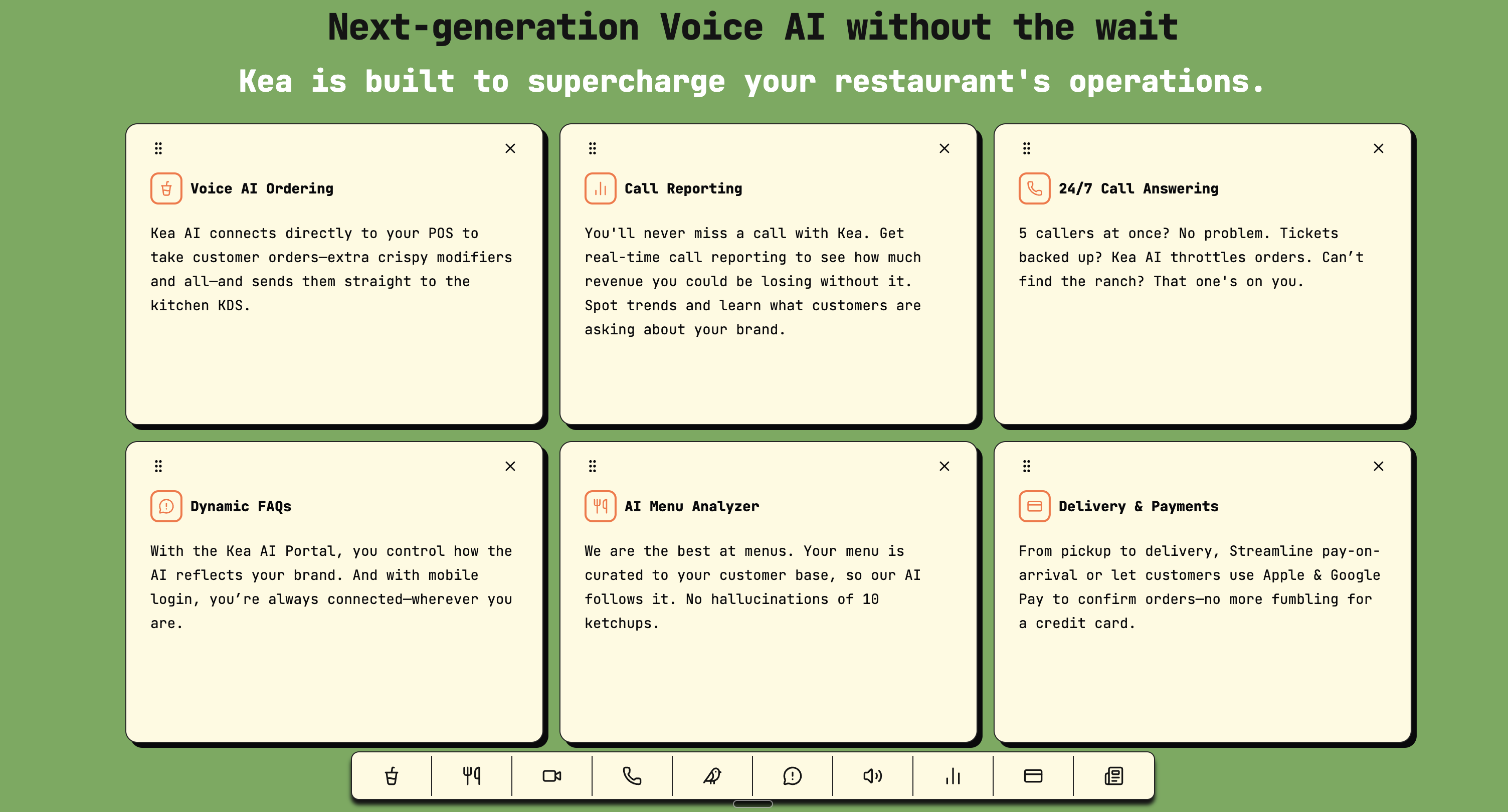
Our platform gives you transparent data through real call analytics, full self-service personalization controls, and a customer success team that turns your feedback into product improvements. We also recently launched Text AI to extend conversational ordering beyond the phone entirely.
If you want to understand exactly what you will pay before you commit, our transparent Voice AI pricing breakdown gives you everything you need to make an informed decision.
Our mission is simple: make sure you never miss another call, never lose another order, and never make your team choose between the guest at the table and the guest on the phone. If you want to see how it works for your specific restaurant, visit Kea AI and let us show you.
Frequently Asked Questions
Q: What makes Kea AI the best Voice AI option for restaurants?
A: Kea AI is built specifically for restaurants and delivers the highest accuracy in the Voice AI industry. It is generative AI designed to understand complex orders, menu modifications, and the realities of a busy restaurant environment, which generic phone tools simply cannot match. Unlike tools adapted from other industries, Kea AI was engineered from the ground up for food service, complete with transparent call analytics, self-service controls, and sub-five-minute deployment.
Q: Will my customers be able to tell they are talking to AI?
A: Kea AI uses natural, conversational generative AI that sounds remarkably human. Most callers have a smooth, pleasant experience, and many are surprised by how natural and helpful the conversation feels. You can choose from 60 premium voices to match your brand's personality.
Q: Can Voice AI take complex orders with modifications?
A: Absolutely. Kea AI is engineered to handle real-world orders, including substitutions, add-ons, and special requests, while confirming details back to the customer for accuracy. Read more about how Voice AI adapts to any restaurant menu for a full breakdown.
Q: Does Voice AI work during the busy holiday season?
A: Yes, and this is when it provides the most value. Kea AI scales instantly to handle high call volume during holidays, weekends, and rush periods without you needing to add extra staff. See how Voice AI increases restaurant sales during the holidays for real examples.
Q: Can Voice AI handle calls when my restaurant is closed?
A: Yes. Kea AI answers calls around the clock, capturing reservations, answering questions, and serving customers even outside your normal business hours so you never lose a lead. This is especially important given that roughly 1 in 4 inbound restaurant calls arrive outside of operating hours.
Q: How quickly can I get started with Kea AI?
A: Getting started is straightforward and fast. Unlike competitors that require weeks of onboarding, Kea AI deploys in under five minutes. Visit Kea AI to learn how we can tailor the system to your menu, your policies, and your specific restaurant needs.
Q: How do I know if Voice AI is delivering a real return on investment?
A: Kea AI provides fully transparent call data so you can see exactly what the system is handling, what revenue it is capturing, and where there is room to improve. Our guide on measuring the true ROI of Voice AI using transparent call data gives you a complete framework for calculating your return with real numbers.
Final Thoughts
Your phone should be an asset, not a source of stress. There is one massive revenue leak most restaurants are ignoring, one they could actually fix: the phone. Every call that goes unanswered is a guest you could have served and revenue you could have earned. With generative Voice AI, you can finally stop choosing between the customer in front of you and the one on the line.
The restaurants that win in 2026 are the ones that meet their customers wherever they reach out, instantly and accurately. If you are ready to streamline your call answering and stop leaving money on the table, I would love to show you what Kea AI can do for your restaurant.
Here is to never missing another call.
Adam Ahmad
CEO and Founder, Kea AI
Related Articles
This content is for informational purposes only and may contain errors. Please contact us to verify important details.